
耐世特

Search documents
Robotaxi 已落地 7 城,20 城在路上!一文讲透全球自动驾驶投资机会
Zhi Tong Cai Jing· 2025-07-03 11:15
Core Insights - The autonomous vehicle (AV) market is projected to reach a potential size of $1.2 trillion by 2040, covering various sectors including automotive, trucking, logistics, agriculture, and mining [1][7] - Currently, commercial AV deployment is scaling, with 7 cities globally offering commercial robotaxi services and an additional 20 cities set to launch soon [1][7] - The report encompasses companies with a combined market capitalization of approximately $10 trillion, highlighting their strategies in AV technology development and market share competition [1][3] Market Overview - The AV market is expected to grow from $137 billion in 2024 to $1.2 trillion by 2040, with significant compound annual growth rates (CAGR) across various sectors [7] - The automotive sector alone is anticipated to reach $686.89 billion by 2040, with a CAGR of 14.6% from $78.08 billion in 2024 [10] - The trucking sector is projected to grow to $353.52 billion by 2040, with a CAGR of 14.5% [10] Key Companies and Their Roles - Major players in the OEM sector include companies like Caterpillar, Deere, Daimler Truck, and Toyota, all of which are investing in AV technologies and partnerships [4][9] - Chinese companies such as Xiaomi and XPeng are also significant, with Xiaomi focusing on LiDAR technology and XPeng developing the XNGP system for nationwide deployment [8][10] - In the software domain, companies like Google (Waymo) and Baidu (Apollo Go) are leading in AV commercialization, with Waymo planning to provide 250,000 paid rides weekly by 2025 [8][10] Technology and Innovation - The semiconductor sector plays a crucial role in AV development, providing essential capabilities such as AI training and sensor processing [11] - Key semiconductor companies include Nvidia, Qualcomm, and Mobileye, with Nvidia expected to generate $1.7 billion in automotive revenue by 2025 [11] - LiDAR technology is dominated by companies like Hesai and RoboSense, with significant revenue growth projected in the coming years [8][11] Future Projections - By 2030, it is estimated that 10% of Deere's revenue will come from recurring sources related to AV solutions in agriculture and construction [9] - Daimler Truck's Torc system is expected to contribute $1.5 billion in profit by 2035, representing 30% of its adjusted EBIT in 2024 [9] - Horizon Robotics anticipates that 97% of its revenue will come from AV-related solutions by 2024, with significant market share growth expected by 2030 [9][10]





美银证券:汽车供应链首选激光雷达、自动驾驶芯片、线控底盘 看好地平线(09660)等
智通财经网· 2025-06-28 11:05
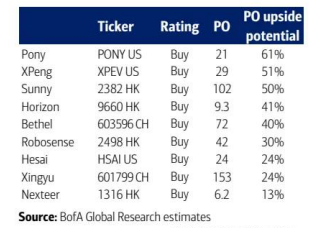
Core Insights - The report from Bank of America Securities highlights the rapid transformation in China's smart automotive industry driven by intense competition and the accelerated application of autonomous driving technologies by companies like BYD [1][2] Industry Overview - The penetration rate of L2+/L3 autonomous driving in China is projected to rise from 27% in 2025 to 80% by 2030, with sales of vehicles equipped with these features expected to grow from 6.1 million units in 2025 to 18.4 million units by 2030, reflecting a CAGR of 25% [2] - The Robotaxi market is anticipated to see explosive growth, with sales expected to increase from 2,500 units in 2025 to 400,000 units by 2030, representing a CAGR of 176% [3] Key Companies and Technologies - Companies such as Hesai (HSAI.US), Horizon (09660), and NIO (01316) are identified as key players in the smart automotive supply chain, particularly in laser radar, autonomous driving chips, and drive-by-wire chassis [1][4] - The report emphasizes that the integration of sensing, processing, and control systems is crucial for autonomous driving capabilities, while smart cockpit systems include components like cockpit domain controllers and heads-up displays [3] Component Market Insights - The estimated value of smart automotive components is $2,400 for entry-level vehicles and $6,000 for high-end models [4] - The penetration rate of laser radar in Chinese passenger vehicles is expected to increase from 6% in 2024 to 40% by 2030, driven by safety considerations and decreasing costs [4] - The market for autonomous driving and advanced driver-assistance system chips is projected to grow at a CAGR of 25% from 2024 to 2030 [4] Ratings and Price Targets - Bank of America Securities has provided ratings and price targets for several companies, indicating strong upside potential for stocks like PONY US, XPEV US, and HSAI US, with potential increases ranging from 24% to 61% [5][6]
小米YU7订单火爆,供应链迎来新机遇
Haitong Securities International· 2025-06-27 09:19
Investment Rating - The report assigns an "Outperform" rating for the industry, suggesting a positive outlook for investment opportunities [2]. Core Insights - The launch of Xiaomi YU7 is expected to structurally change the prosperity of the automotive parts industry, alleviating previous market concerns regarding the domestic passenger car market in late 2025 to 2026 [4][10]. - The YU7 has received a strong initial response, with over 289,000 orders within the first hour of its launch, indicating significant market demand [9]. - The report highlights potential investment opportunities in the supply chain of YU7, specifically mentioning companies such as Wuxi Zhenhua, Desay SV, Huayang Group, and Nexteer Automotive, which are expected to benefit from increased revenue as YU7 production ramps up [10]. Summary by Sections Investment Advice - Following the launch of Xiaomi YU7, there is a surge in orders, indicating a new opportunity in the supply chain. The report suggests focusing on the supply chain companies associated with YU7 [7][10]. Product Details - Xiaomi YU7 is priced starting at RMB 253,500, featuring advanced specifications such as the Xiaomi Super Motor V6s Plus, a 0-100 km/h acceleration time of 3.23 seconds, and a maximum range of 835 km [8][9]. - The YU7 is available in three configurations: YU7 at RMB 253,500, YU7 Pro at RMB 279,900, and YU7 Max at RMB 329,900, which are considered competitive in the market [8]. Market Potential - The report estimates that YU7's annual sales could reach between 300,000 to 400,000 units, with the potential to drive additional market growth in the RMB 200,000 to 300,000 electric vehicle segment, which is substantial [9][10]. - The total SUV market in the RMB 200,000 to 300,000 price range is estimated to exceed 1 million units, indicating a significant opportunity for YU7 to capture market share [9].

异动盘点0624|宜明昂科涨超 7%;汽车股集体回暖,小米集团涨超 3%;特斯拉涨逾 8%;Circle涨逾 9%
贝塔投资智库· 2025-06-24 03:59
点击蓝字,关注我们 今日上午港股 1.汽车股集体回暖, 理想汽车 - W (02015) 涨 4.46%;零跑汽车 (09863) 涨 4.24%;小鹏汽车 - W (09868) 涨 3.36%;比亚迪股份 (01211) 涨 3.33%。 2.越疆 (02432) 涨超 8%, 消息面上,京东 618 全周期战报数据显示,5 月 13 日 20 点到 6 月 18 日 24 点,智能机器人自营销售额同比增长 3 倍,具身智能机器人销售额同比增长 17 倍。 3.金山云 (03896) 涨超 3%, 消息面上,金山云发布公告,认购事项的条件已达成且认购事项已于 2025 年 6 月 17 日完成。 4.荣昌生物 (09995) 再涨超 6%, 消息面上,近日,荣昌生物公告称,其核心产品泰它西普获得国家知识 产权局授予的专利权期限补偿,补偿天数为 1827 天,使得该药的专利权期满终止日从 2027 年 6 月 15 日延长到 2032 年 6 月 15 日。 5.博彩股早盘普涨, 美高梅中国 (02282) 涨 4.7%,新濠国际发展 (00200) 涨 4.09%,金沙中国 (01928) 涨 2.48% ...

光大证券:L4纯视觉或再掀技术变革 持续关注智驾主题
Zhi Tong Cai Jing· 2025-06-24 03:15
Group 1 - The report from Everbright Securities indicates a positive outlook for the domestic urban intelligent driving penetration rate, expecting a turning point in 2025E and rapid growth thereafter in 2026E and beyond [1] - The focus for the L2+ market is on promoting affordable intelligent vehicles priced between 100,000 to 200,000 yuan, while the L4 market is centered on the breakthrough of commercial scale for Robotaxi [1] - Recommendations include Tesla and the steering supplier Nextracker for L4 pure vision Robotaxi commercialization, as well as Xpeng Motors, with a suggestion to pay attention to Li Auto, NIO, and Pony.ai [1] Group 2 - The acceleration of Robotaxi commercialization is nearing a scale-up inflection point, with significant breakthroughs in order volumes and external collaborations among leading global Robotaxi companies since the second half of 2024 [1] - The report suggests that the core methodology for achieving L4 may involve reinforcement learning combined with world models, contrasting with L2+ which primarily relies on imitation learning [2] - The complexity of L4 implementation is expected to increase due to challenges in data construction, algorithm development, and the need for substantial computational resources [2] Group 3 - The report highlights that the dual paths of lidar and pure vision technology will continue from L2+ to L4, despite the drawbacks of lidar technology such as delays and conflicts in multi-sensor fusion [3] - The key to achieving commercial scalability for L4 lies in technological upgrades and cost reductions, as hardware costs are expected to rise [3] - The VLA (Vision-Language-Action) model combined with world models is anticipated to be a mainstream trend in the intelligent driving industry, although it has not yet been fully realized [4]

光大证券晨会速递-20250624
EBSCN· 2025-06-24 01:45
Core Insights - The report indicates that the short-term liquidity in the Hong Kong stock market may face tightening, influenced by geopolitical tensions and uncertainties in US-China relations, leading to a potential volatile market [2] - Long-term prospects for the Hong Kong stock market remain positive due to strong overall profitability and the scarcity of assets in sectors like internet, new consumption, and innovative pharmaceuticals, suggesting a favorable long-term investment value [2] Market Data Summary - The domestic new fund market is experiencing a surge with 50 new funds launched, primarily equity mixed funds, while the net value of equity funds has collectively declined [3] - Notably, the net inflow into stock ETFs reached 14.669 billion yuan, with a focus on small-cap and sci-tech boards, while large-cap ETFs saw net outflows [3] Industry Research Summary Automotive Industry - The commercialization of Robotaxi is accelerating, with a significant growth inflection point expected in 2025, driven by advancements in reinforcement learning and large models [4] - Recommended companies include Tesla for L4 pure vision Robotaxi and suppliers like Nidec for steer-by-wire systems, along with Xpeng Motors and a focus on Li Auto and NIO [4] High-end Manufacturing - Optimus robots are set for major improvements, with a positive outlook on humanoid robotics and specific attention to high-complexity dexterous hands and rolling screw technology [5] - The engineering machinery sector is facing short-term domestic pressure but maintains a growth trend in exports, with recommended companies including Zoomlion and SANY Heavy Industry [5] Non-ferrous Metals - Domestic air conditioning sales increased by 2.3% in May, while production fell by 1.8%, indicating potential demand weakness [6] - The report suggests that copper prices may stabilize in the short term but are expected to rise gradually with domestic stimulus policies and potential US interest rate cuts [6] Basic Chemicals - The report highlights the long-term value of leading companies in the chemical industry, with recommendations for major players in oil and gas, low-valuation chemical leaders, and new materials sectors [8] - Specific companies to watch include Wanhua Chemical and China Petroleum [8] Pharmaceutical Industry - The acceleration of innovative drug reviews is expected to enhance the value of quality pipelines and improve market sentiment towards the innovative drug sector [9] - Key companies to focus on include Hansoh Pharmaceutical and BeiGene, which are positioned for rapid development and internationalization [9] Steel Industry - The report notes a decline in the domestic alumina capacity utilization rate to a new low for 2023, with expectations for steel sector profitability to recover to historical averages [10] - The revised steel industry standards are anticipated to support this recovery [10]
澳人首套房买新房还是二手?最新数据公布
Sou Hu Cai Jing· 2025-06-19 13:15
在澳洲,购买首套房仍是人们的强烈愿望,但进入房地产市场的途径在不断演变。 一些首次购房者更倾向于建造新房,而另一些人则偏爱现房。 据RealEstate网站报道,有些人选择购买首套房用于投资而非自住。 许多人依 靠"父母银行"来帮助支付首付,另一些人则利用"首套房保障计划"(First Home Guarantee)等 政府援助项目来踏上购房阶梯。 NAB最新住宅物业调查了今年第一季度首次购房者活动。 调查显示,新房市场的首 次购房者活动(占总销量的34.2%)略高于现房市场(占总销量的32.8%)。 新房可能更受青睐,因为首套房业主补贴仅适用于新房。此外,"房屋与土地套 餐"对首次购房者具有 吸引力,因为它们通常位于城市边缘更实惠区。 在各州中,新房在西澳最受欢迎。今年第一季度,近一半(47.6%)的新房销售对 象是首次购房者,而 现房销售的这一比例为32.2%, 在新州、昆州和南澳,新房也比现房更受欢迎,但差距比西澳小得多。 维州的情况 则相反,首次购房者对现房更感兴趣。 今年第一季度,维州约37.6%的现房销售对 象是首次购房者,而新房市场的这一比例为23.8%。 (图片来源:RealEstate) ( ...

全球主要Robotaxi运营商情况梳理
2025-06-12 15:07
Summary of Robotaxi Industry and Key Players Industry Overview - Robotaxi represents the ultimate model for commercializing Level 4 (L4) and above autonomous driving, facing safety and pricing concerns but expected to lower costs through technological maturity and economies of scale [1][2][3] - The Robotaxi operation is projected to generate an additional $260 billion in the domestic market by 2030, with a penetration rate of at least 10% [1][3] Key Players and Developments - **Waymo**: - Increased sensor configurations and partnered with Zeekr, capturing a significant market share in the San Francisco ride-hailing market with a 20% order market share, fleet size of 1,500 vehicles, and over 10 million paid rides [1][3] - **Xiaoma Zhixing (Pony.ai)**: - Collaborated with GAC Aion to reduce new model costs by 70%, with an operational area exceeding 2,000 square kilometers and a 200% year-on-year revenue increase in Q1 [1][3][6] - Plans to have 1,000 vehicles operational by the end of the year and has initiated RoboTaxi road tests in Seoul, South Korea [4][6] - **Tesla**: - Announced the official launch of Robotaxi on June 22, 2025, focusing on the feasibility of pure vision technology and significant cost reduction potential [2][8] Market Dynamics - Robotaxi is expected to create new demand in the transportation market, similar to how ride-hailing services expanded the market through differentiated services [2][3] - The current market concerns about Robotaxi affecting traditional taxi and ride-hailing services are countered by the expectation that it will expand the overall market [2][3] Regulatory Environment - Both China and the U.S. are leading in autonomous driving regulations, with multiple cities allowing paid autonomous driving operations [5][7] - Recent regulations in China, such as the promotion of intelligent connected vehicles and the release of technical guidelines, support the deployment of L3 and above autonomous driving [7] Future Trends - The automotive sector is expected to continue focusing on smart technology, with the launch of Tesla's Robotaxi likely to further stimulate the smart vehicle theme [9] - The penetration rate of intelligent driving in domestic cities is anticipated to rise rapidly, driven by the focus on vehicles priced between 100,000 to 200,000 yuan [9] Investment Recommendations - Recommended stocks include Xiaopeng Motors, Tesla, Li Auto, and Xiaoma Zhixing, with a focus on parts supplier, Aptiv [10]

耐世特20250609
2025-06-09 15:30
Summary of the Conference Call for NEXTEER Company Overview - NEXTEER is a product-driven cyclical stock focusing on steering and braking systems for the automotive industry [4] Key Industry Insights - The company has successfully developed a new generation of steer-by-wire (SBW) products, which have been adopted by leading industry clients, indicating the onset of a new product cycle [2][4] - The North American business is largely insulated from tariffs, with 60% of revenue coming from the U.S. and 40% from Mexico, most of which complies with the USMCA [5][6] Financial Performance - The EBITDA margin for the first half of the year is expected to remain in double digits, a significant increase from less than 5% last year [2][4] - Revenue projections are optimistic, with expected revenues of $4.6 billion in 2025, $5.1 billion in 2026, and $5.6 billion in 2027, maintaining double-digit growth annually [3][9] - Profit forecasts indicate an increase from $150 million this year to $240 million by 2027, reflecting substantial growth compared to the previous year [3][9] Product Development and Market Position - The launch of the EMB braking product, which overlaps with existing electric power steering and steer-by-wire capabilities, could further expand the product line and create long-term growth opportunities [2][4] - The SBW project has gained traction, with models like NIO ET9 and Cybertruck adopting this technology, which is expected to penetrate both high-end and mid-range markets [2][8] - The company has secured new orders in the Asia-Pacific region, achieving $800 million in order volume in Q1, an 80% year-over-year increase [7] Competitive Landscape - NEXTEER is currently in a mature phase for hydraulic steering products, facing increased domestic competition, but the new product cycle and technological advancements are expected to enhance profitability [4] - The company is leveraging design optimization and supply chain management to maintain stable profitability despite intense price competition among domestic automakers [7] Conclusion - NEXTEER is positioned for significant growth driven by new product developments, improved operational performance, and a favorable market environment, particularly in North America and the Asia-Pacific region [2][3][4][9]
政策持续优化,Robotaxi商业化落地加速
2025-06-06 02:37
Summary of Robotaxi Industry and Company Developments Industry Overview - The Robotaxi industry is experiencing rapid commercialization in the United States, with San Francisco approving all-weather commercial operations and states actively advancing autonomous driving legislation to support testing and commercialization [1][2] - China has defined 2025 as the year for Robotaxi commercialization, with ongoing improvements in high-level autonomous driving legislation and pilot projects for integrated vehicle-road-cloud systems [1][4] Key Companies and Developments Tesla - Tesla is leveraging its large fleet to accumulate data, optimize models, and innovate its Robotaxi business model, planning to deploy unmanned test vehicles in Austin, Texas, with an expected operational fleet of 110,000 vehicles by 2026 [1][5][6] - The company aims to enhance its Full Self-Driving (FSD) software monetization and has changed the landscape of partnerships in the autonomous driving sector, allowing better cost control [5][6] Baidu - Baidu's Robotaxi service, "Luobo Kuaipao," has launched in 11 cities, providing over 11.4 million global rides in Q1 2025, a 75% year-on-year increase, and has penetrated 36 cities in total [1][7] Pony.ai and WeRide - Pony.ai is entering its production year, planning to deploy around 1,000 vehicles by the end of 2025 and has formed a strategic partnership with Uber for testing in the Middle East [1][8] - WeRide has also received a commercial license for all-weather operations in San Francisco, marking a significant milestone for Robotaxi commercialization in the U.S. [2] Other Companies - Companies like Zhongyuan Zhixin, Yunnei Power, and Baixingniu are advancing L3-level autonomous driving in the unmanned logistics sector, creating investment opportunities in the upstream supply chain [3][11] - GAC Group, BAIC Blue Valley, and Dongfeng Technology are also making strides in the Robotaxi space, with GAC's ride-hailing service and BAIC's collaboration with Pony.ai for vehicle production [9] Legislative and Technological Support - The U.S. National Highway Traffic Safety Administration is set to release a regulatory framework for Robotaxi operations, addressing key issues such as operational qualifications and accident liability [2] - In China, the government is enhancing regulations and infrastructure to support high-level autonomous driving, with significant investments in technology development and cost reduction for L2+ level driving assistance [4][6] Investment Opportunities - The commercialization of Robotaxi is expected to create investment opportunities in upstream industries, particularly in areas like line control braking, line control steering, and domain controllers [3][12][13][14] - Companies such as Boteli, Nissin, Desay SV, and Jingwei Hengrun are positioned to benefit from the growing demand for advanced driving technologies [12][14] Conclusion - The Robotaxi industry is on the brink of significant growth, driven by technological advancements, regulatory support, and strategic partnerships among key players. The developments in both the U.S. and China indicate a robust future for autonomous driving services and related investments [1][17]
