沐曦

Search documents
国产GPU爆发,但仍未迈过那道天堑
Hu Xiu· 2025-07-04 03:25
Core Viewpoint - The article discusses the recent IPO applications of two domestic GPU companies, Moore Threads and Muxi, highlighting their potential and challenges in the competitive landscape of the GPU industry in China [1][2]. Group 1: Company Overview - Moore Threads and Muxi submitted their IPO applications on June 30, marking a significant step towards their public listing [1]. - Both companies are led by experienced founders with backgrounds in major global tech firms, enhancing their credibility in the GPU market [1]. - Pre-IPO valuations for Moore Threads and Muxi are reported at 24.62 billion yuan and over 21 billion yuan, respectively [1]. Group 2: Financial Performance - Moore Threads' revenue projections from 2022 to 2024 are 46.08 million yuan, 124 million yuan, and 438 million yuan, with net losses of 1.84 billion yuan, 1.67 billion yuan, and 1.49 billion yuan [2]. - Muxi's revenue for the same period is projected at 426,400 yuan, 5.3 million yuan, 74.3 million yuan, and 32 million yuan, with net losses of 777 million yuan, 871 million yuan, 1.41 billion yuan, and 233 million yuan [2]. - Combined, both companies have incurred total losses of 8.2 billion yuan over the past three years [3]. Group 3: Market Context - The GPU industry is characterized by high R&D costs, with Moore Threads investing 3.81 billion yuan in R&D from 2022 to 2024, which is over six times its projected revenue [2]. - The current market environment presents a critical window for GPU companies to seek public listings, especially with recent reforms allowing unprofitable companies to go public [6]. Group 4: Product Development - Moore Threads has developed a comprehensive product line, including four generations of GPU architectures and various applications in AI computing, graphics rendering, and personal entertainment [8]. - Muxi focuses on training and inference integrated GPUs, with products based on self-developed GPU IP and instruction sets, enhancing efficiency and reducing dependency on external IP [11]. - Moore Threads' desktop GPU, MTT S80, is reported to perform comparably to NVIDIA's RTX 3060, although it still lags in driver support [10]. Group 5: Competitive Landscape - Both companies are positioned in the first tier of the domestic GPU market, but they face challenges in customer retention and dependency on key distributors [13][15]. - The ability to secure production capacity is a significant concern, as both companies rely on foundries for manufacturing, and recent regulations have limited their options [17].

摩尔线程IPO:三年亏损50亿,能否成为未来国产GPU幸存者?
阿尔法工场研究院· 2025-07-03 11:16
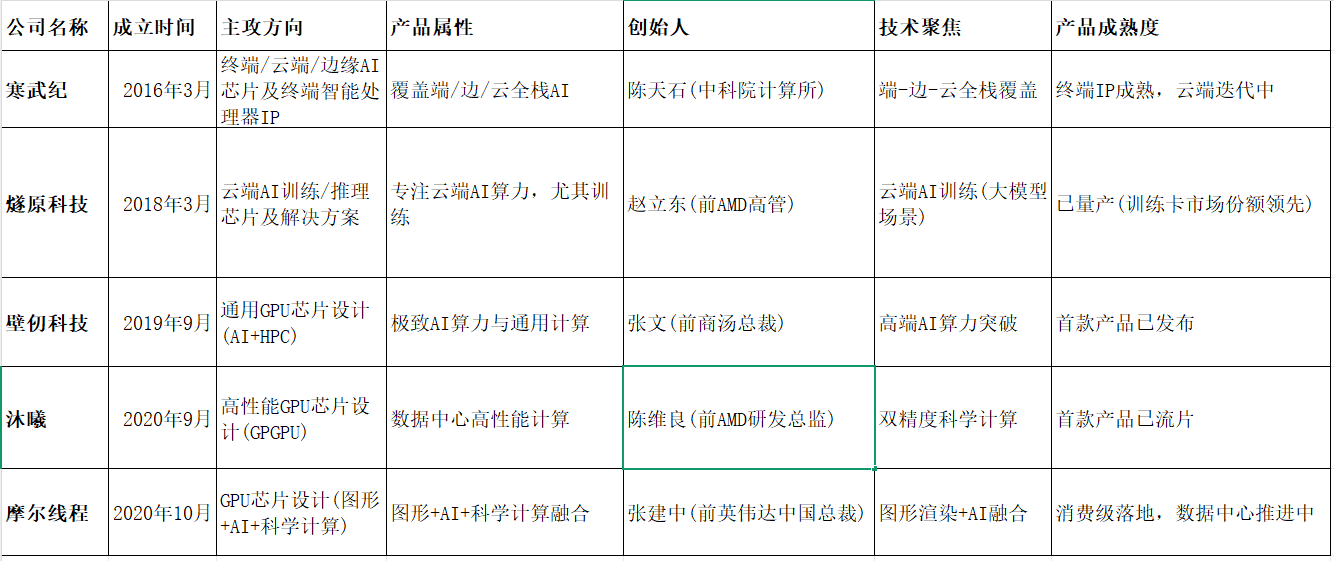
Core Viewpoint - The article highlights the inevitable industry consolidation in the domestic GPU market, predicting that only 2-3 out of several current domestic GPU companies will survive. It emphasizes the strategic importance of GPUs as the core computing engine of the digital economy and notes that the IPO application of Moore Threads marks a capital acceleration phase for domestic GPU companies [1][2]. Industry Status and Market Landscape - By 2024, the penetration rate of domestic AI chip brands in China has increased to 30%, but the high-end market is still dominated by NVIDIA. Export restrictions on high-end GPUs to China from a Western country starting in Q4 2024 create a window for domestic alternatives. The demand for AI computing in China is driving rapid expansion in the GPU market, with the market size expected to reach 322.8 billion yuan by 2027 [3]. - The current landscape of the domestic GPU industry is characterized by four main players: Moore Threads, which adopts a full-function GPU approach; Muxi, focusing on high-performance GPUs; Birran Technology, excelling in GPGPU; and Suyuan Technology, specializing in cloud AI training and inference [3]. Advantages and Risks - Moore Threads plans to raise 8 billion yuan for the development of next-generation chips. From 2022 to 2024, the company's revenue grew from 46.0883 million yuan to 438 million yuan, with a compound annual growth rate exceeding 200%. The revenue share of its AI intelligent computing products increased from zero to 77.63% in 2024, reaching 336 million yuan [5]. - Technologically, Moore Threads' MUSA architecture supports various capabilities, including AI computing acceleration and graphics rendering. As of February 2025, the company has obtained 470 authorized patents. Its product matrix spans from cloud to edge, with MTT S4000/S5000 intelligent computing cards supporting large language models, and MTT S80/S70 graphics cards showing a performance improvement of five times over two years [5]. - However, the company faces significant challenges, including a cumulative net loss of 5 billion yuan from 2022 to 2024, and the FP32 computing power of its flagship product S5000 is only half that of NVIDIA's H100. Being listed on the U.S. Entity List poses a threat to its supply chain [6]. Peer Comparison Analysis - Moore Threads has advantages in product comprehensiveness and market share, but all companies face common challenges: competing with international giants like NVIDIA in technology and ecosystem while also contending with domestic rivals. Despite policy support for domestic alternatives, customers still have concerns about the performance and stability of domestic GPUs [7]. - Revenue data for major domestic GPU companies from 2022 to 2024 shows significant growth, with Moore Threads increasing from 0.46 billion yuan to 4.38 billion yuan (compound growth rate of 208.44%), Muxi from 0.004 billion yuan to 7.43 billion yuan (4309%), and Cambrian from 7.29 billion yuan to 11.74 billion yuan (26.9%) [7]. - The future outlook suggests that industry consolidation is unavoidable, with predictions that only 2-3 domestic GPU companies will survive. Moore Threads is in a favorable position due to its full-function approach and capital advantages, but it must balance technological breakthroughs with commercial implementation to transition from "domestic substitution" to "international competition" [7].

银河证券每日晨报-20250703
Yin He Zheng Quan· 2025-07-03 09:03
Key Insights - The report indicates that the A-share market is expected to experience a seasonal rebound in July, driven by policy and performance factors, with a stable upward trend anticipated [3][2][1] - The focus for July is on three main lines: consumption, technology, and dividends, with growth sectors like technology expected to have good development prospects and investment opportunities [3][2][1] - The construction industry is seeing a recovery in activity, with a business activity index of 52.8% in June, indicating expansion, while fixed asset investment growth is slowing [5][6] - Infrastructure investment remains high, with broad infrastructure investment growth at 10.44% year-on-year for the first five months of the year, although narrow infrastructure investment growth is at 5.6% [6][9] - The real estate sector is under pressure, with a 10.7% year-on-year decline in development investment for the first five months, but policy measures are expected to improve market confidence [7][9] - The floating rate bond market is developing, with a current market size of approximately 495.9 billion yuan, accounting for about 0.3% of the total bond market [13][12] - The banking sector is benefiting from a supportive monetary policy environment, with expectations of continued easing and structural policy tools to support key areas like technology and consumption [20][21][23]
自主可控:看好国产制造链投资机会
2025-07-02 01:24
Summary of Conference Call Records Industry Overview - The conference call primarily discusses the **semiconductor industry** and the **domestic manufacturing chain** in China, focusing on investment opportunities and challenges related to self-sufficiency and technological advancements in semiconductor equipment and materials [1][2][20]. Key Points and Arguments 1. **Impact of Semiconductor Equipment Ban**: The semiconductor equipment ban's impact is expected to be limited due to prior sanctions on SMIC, and WFE (Wafer Fab Equipment) growth may not meet expectations [1][2]. 2. **Material Export Controls**: While there are risks associated with material export controls, alternative sourcing options are available, with domestic companies like Dinglong and Anji making progress in polishing pads and liquids [1][2]. 3. **AI Market Demand**: The AI market demand in Q1 did not meet expectations, with no significant transfer of orders for computing cards despite the H20 ban [6][11]. 4. **Growth in Chip Design**: Q2 saw high growth in chip design companies, particularly in the automotive sector, while SMIC faced challenges affecting its guidance [1][11]. 5. **New Product Launches**: Upcoming new product launches from terminal manufacturers in H2 are expected to boost sales, particularly in the analog and power platforms [14]. 6. **Domestic Foundry Profitability**: Domestic foundries are expected to improve profitability and return on equity (ROE) as they adapt to market conditions [1][14]. 7. **Technological Advancements**: TSMC and Samsung are advancing to 2nm production, while SMIC lags by about four years in technology nodes [1][15]. 8. **Investment Opportunities**: The self-sufficiency theme is driving investment opportunities in companies like SMIC, Huahong, and Northern Huachuang, which are well-positioned to benefit from domestic demand [32]. Additional Important Content 1. **Challenges in Domestic Semiconductor Equipment**: Domestic semiconductor equipment faces challenges in achieving high localization rates, particularly in critical areas like photolithography [23][30]. 2. **Future of AI Edge Devices**: AI edge devices, such as AI glasses, are expected to be launched in Q4 2026, potentially creating a market beta effect [10]. 3. **Market Size and Growth**: The global semiconductor equipment market was approximately $110 billion, with China accounting for nearly $50 billion, but the localization rate remains low [21]. 4. **Long-term Outlook**: The long-term outlook for the semiconductor equipment sector remains positive, with expectations of steady performance despite potential slowdowns in growth rates [26]. 5. **Material Localization Progress**: The localization rate for materials like polishing pads and liquids is improving, with companies like Anji and Dinglong making significant strides [28][29]. This summary encapsulates the key insights and developments discussed in the conference call, highlighting the semiconductor industry's current state and future prospects.

8点1氪|12306回应充电宝上高铁规定;韦东奕晋升北大长聘副教授;腾讯客服回应“共同好友点赞不提醒”
3 6 Ke· 2025-07-02 00:08
Listing Updates - Zhejiang Yifei Intelligent Technology Co., Ltd. has submitted a listing application to the Hong Kong Stock Exchange, with Agricultural Bank of China International as the sole sponsor [1] - Moer Thread Intelligent Technology (Beijing) Co., Ltd. has received approval for its initial public offering on the Sci-Tech Innovation Board, aiming to raise 8 billion yuan [2] - Youyan Composite Materials (Beijing) Co., Ltd. has also received approval for its IPO on the Sci-Tech Innovation Board, with a fundraising target of 900 million yuan [3] - Muxi Integrated Circuit (Shanghai) Co., Ltd. has received approval for its IPO on the Sci-Tech Innovation Board, planning to raise 3.904 billion yuan [4] - Anjii Food has set the final price for its H-share issuance at 60 HKD per share, with trading expected to begin on July 4 on the Hong Kong Stock Exchange [5] Corporate Developments - Gree Group has appointed a new chairman, with Zou Hui taking over from Kang Hong [8] - Xiaomi has launched youth apartments in Beijing and Nanjing, with a monthly rent of 1999 yuan, prioritizing recent graduates [9] - CATL has officially commenced production of high-end battery packs at the AITO Super Factory, marking its first base in Chongqing [10] Financing Activities - Anhui Yixi Decoration Design Co., Ltd. has completed a 10 million yuan angel round financing led by Zhongjing Investment, aimed at smart home system development [18] - Lingchuan Technology has completed a multi-hundred million yuan Series A financing led by Beijing AI Industry Investment Fund and Kuaishou Group, focusing on next-generation chip development [19] - Beijing Jianyun Technology Co., Ltd. has completed a multi-million yuan Series A financing, with funds allocated for business expansion and agricultural technology development [20] - Remark, an AI-driven e-commerce tool developer, has raised 16 million USD in Series A financing, bringing its total funding to 27 million USD [21]
募资80亿,科创板最大IPO来了
3 6 Ke· 2025-07-01 11:15
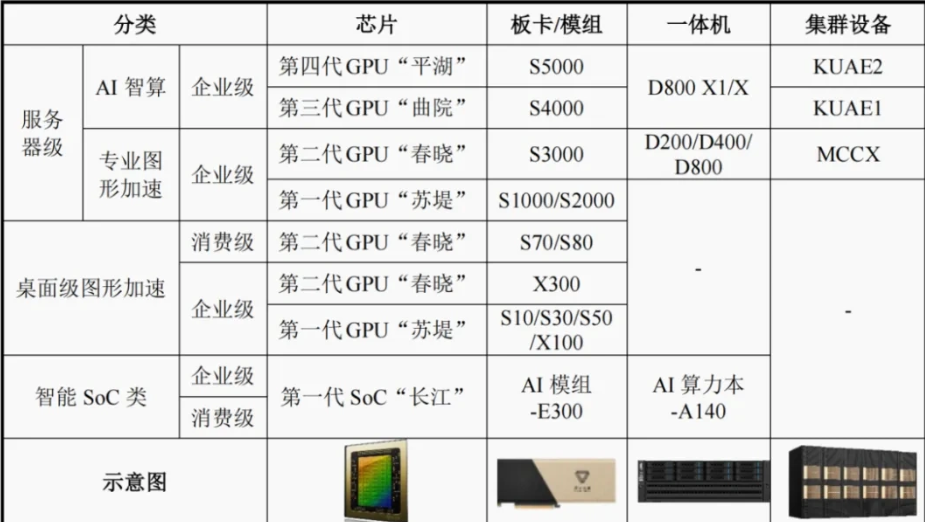
Core Viewpoint - The Chinese GPU market is experiencing significant developments, with companies like Moer Thread and Muxi competing for the title of "China's first GPU stock" as they prepare for IPOs on the Sci-Tech Innovation Board [1][3][8]. Company Overview - Moer Thread, founded in 2020, has rapidly progressed towards its IPO, completing its listing guidance in June 2023 and receiving acceptance for its IPO application [3][4]. - The company has launched four generations of GPU architectures, including "Sudi," "Chunxiao," "Quyuan," and "Pinghu," covering various applications such as AI computing, high-performance computing, and graphics rendering [6][15]. Market Dynamics - The global GPU market is dominated by NVIDIA, which holds over 80% market share, while Chinese manufacturers are striving to capture the domestic market amid increasing competition [17]. - Moer Thread's founder, Zhang Jianzhong, previously increased NVIDIA's market share in China and aims to challenge NVIDIA's dominance with a focus on self-developed GPUs [4][17]. Financial Performance - Moer Thread has shown a growth trend in revenue, with figures of 46.08 million, 124 million, and 438 million yuan for 2022, 2023, and 2024 respectively, despite significant net losses [13][14]. - The company has raised substantial capital through multiple funding rounds, with the latest round in 2024 raising 5.225 billion yuan, leading to a post-money valuation of approximately 30 billion yuan [10][12]. Product Strategy - Moer Thread's product line includes AI computing cards, professional graphics acceleration products, and desktop graphics acceleration products, with a strategic focus on high-margin segments [15][16]. - The company has developed its MUSA architecture, which allows for easy migration of CUDA code, enhancing compatibility with existing GPU applications and reducing transition costs for developers [17].
上交所同日受理摩尔线程和沐曦IPO申请,均未盈利
Nan Fang Du Shi Bao· 2025-07-01 04:53
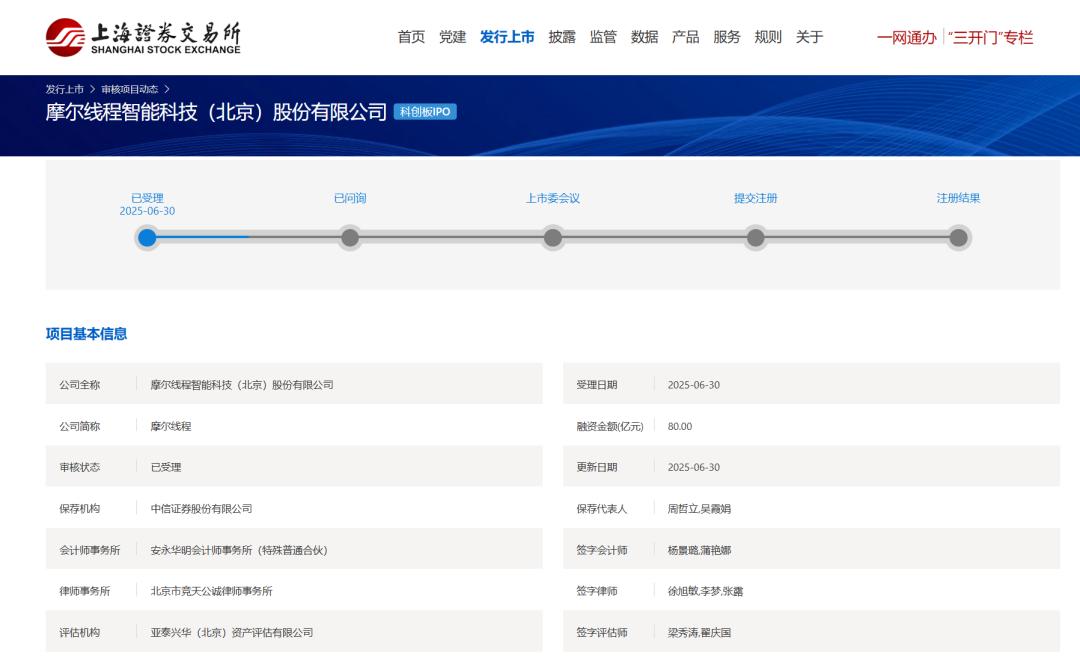
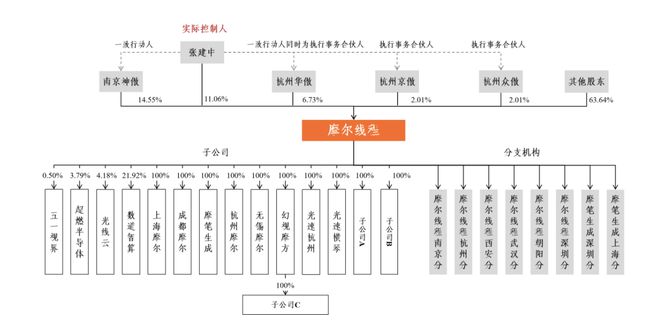
Core Viewpoint - The IPO applications of domestic GPU chip companies Moore Threads and Muxi have been accepted by the Shanghai Stock Exchange, aiming to raise 80 billion yuan and 39.04 billion yuan respectively, indicating progress in their IPO processes amidst competition in the AI chip sector [1] Company Overview: Moore Threads - Moore Threads was established in October 2020 and has a workforce of 1,126 as of the end of 2024 [2] - The actual controller, Zhang Jianzhong, holds 11.06% of the shares directly and controls 36.36% through holding platforms [2] - The company plans to use the IPO funds for R&D of AI training and inference chips, graphics chips, and AI SoC chips, as well as to supplement working capital [4] - Moore Threads has chosen the second set of listing standards on the Sci-Tech Innovation Board, with an expected market value of no less than 1.5 billion yuan [4] - The company’s revenue is projected to grow from 0.46 billion yuan in 2022 to 4.38 billion yuan in 2024, with a compound annual growth rate (CAGR) of 208.44% [5] - Despite rapid revenue growth, the company reported net losses of approximately 1.84 billion yuan, 1.67 billion yuan, and 1.49 billion yuan from 2022 to 2024 [5][6] - Moore Threads anticipates achieving profitability by 2027 based on future product sales and cost forecasts [6] - The company has established four product lines, with AI computing products contributing 77.63% of revenue in 2024 [6] - The gross margin for its products in 2024 is 70.71%, with AI computing and professional graphics acceleration products having higher margins [7] - The company faces risks related to high customer concentration, with the top five customers contributing over 80% of revenue from 2022 to 2024 [7] Company Overview: Muxi - Muxi was founded in September 2020 and has a workforce of 870 as of March 2023 [8] - The founder, Chen Weiliang, has nearly 20 years of experience in GPU chip design and controls 22.94% of the voting rights [8][9] - Muxi aims to raise funds for the R&D of high-performance general-purpose GPU chips and AI inference GPU chips [9] - The company has chosen the fourth set of listing standards on the Sci-Tech Innovation Board, with an expected market value of no less than 3 billion yuan [9] - Muxi's revenue is projected to grow from 0.424 million yuan in 2022 to 7.43 billion yuan in 2024, with a staggering CAGR of 4,074.52% [9] - The revenue heavily relies on the C500 series training and inference chip, which accounted for 97.28% of revenue in 2024 [9][10] - Muxi's gross margin for 2024 is 53.43%, with the training and inference GPU board having a margin of 56.21% [13] - The company reported net losses of approximately 0.777 billion yuan, 0.871 billion yuan, and 1.409 billion yuan from 2022 to 2025 [13][14] - Muxi also faces high customer concentration risks, with the top five customers contributing 71.09% and 88.35% of revenue in 2024 and the first three months of 2025, respectively [11]
摩尔线程完成上市辅导 国产GPU厂商冲刺IPO绕不开的话题:跨越制程,实现盈利
Mei Ri Jing Ji Xin Wen· 2025-06-20 11:54
近日,中国证监会网上办事服务平台信息显示,摩尔线程智能科技(北京)股份有限公司(以下简称"摩尔线程")IPO辅导状态已变更为"辅导验收",其上 市之路迎来新进展。 每经记者|杨卉 每经编辑|董兴生 去年以来,包括摩尔线程在内的国产GPU"四小龙"(摩尔线程、壁仞科技、燧原科技、沐曦)先后开启了IPO(首次公开募股)之路,截至目前进展各不相 同。 国产芯片厂商一直没能绕开两个痛点:能不能自己制造、能不能实现盈利。在业内看来,国产算力芯片起步虽晚,但发展势头很猛。"四小龙"企业创始团队 有的出身于高校,专做科研;有的自带AMD(超威半导体)、英伟达等大厂履历。各家企业也得到了资本支持,每个项目都有几轮融资,降低了芯片"强烧 钱"属性的后顾之忧。 不过,在"打怪升级"以及未来实现自主生产的路上,国产芯片厂商也需要直面盈利问题,备好叩开二级市场大门的"敲门砖"。 GPU"四小龙"更新上市动态 时隔大半年,国产芯片企业上市进程陆续有了最新进展。 中国证监会网上办事服务平台信息显示,摩尔线程IPO辅导状态已变更为"辅导验收"。辅导机构中信证券认为,经辅导,摩尔线程具备成为上市公司应有的 公司治理结构、财务会计工作、内部控 ...
AI算力需求涌向模型推理,国产芯片站上竞技台了
Di Yi Cai Jing· 2025-05-28 07:22
Core Insights - The Chinese data center accelerator card market is experiencing a significant shift, with domestic computing power expected to exceed 40% in the first half of 2024, up from approximately 30% last year [1][2] - NVIDIA's CEO highlighted the ongoing AI investment trend, indicating that the demand for AI computing power is evolving, particularly with the rise of inference chips [1][8] - The introduction of DeepSeek has led to a notable increase in the demand for inference chips, which are expected to constitute over 57.6% of the market by 2024 [8][11] Market Dynamics - The construction of data centers is accelerating, with a projected 97.3% year-on-year growth in China's accelerated computing server market in 2024 [4] - The number of successful bids for intelligent computing centers in China has increased significantly, indicating a robust demand for computing resources [4] - Universities and enterprises are increasingly seeking computing power, with many opting for cloud solutions or purchasing their own computing cards [5][6] Technological Shifts - The demand for inference capabilities is reshaping the chip composition in the market, allowing domestic chips to gain traction as they are suitable for inference tasks [11][12] - The performance requirements for inference chips are lower, enabling a broader range of domestic chips to compete effectively against NVIDIA [10][11] - Companies like Tencent are adapting to the changing landscape by increasing their focus on inference needs, indicating a shift in AI application strategies [9][13] Competitive Landscape - NVIDIA's market share in China's data center accelerator card market has decreased from 95% to around 65.2%, while domestic chip manufacturers are gaining ground [11][13] - The introduction of export controls on NVIDIA's chips has prompted the company to consider launching a new AI chip tailored for the Chinese market [13] - Domestic AI chip manufacturers, such as Cambricon, are beginning to report profitability, reflecting a positive trend in the domestic chip market [12]


2024年中国人工智能产业研究报告
艾瑞咨询· 2025-05-23 09:42
Core Viewpoint - The artificial intelligence (AI) industry is recognized as a key development direction by the government, with significant policies aimed at promoting innovation and enhancing regional economic competitiveness. The rise of open-source models like DeepSeek is accelerating the domestic AI ecosystem's openness and competitiveness, marking a significant event in China's AI industry development [1][4][25]. Summary by Sections Research Background - The AI industry is positioned as a core engine for the new technological revolution and industrial transformation, with the government emphasizing its strategic importance [1]. Macro Environment - In 2024, the national focus on AI development is evident, with local governments promoting research innovation and infrastructure. Despite a slowdown in GDP growth, AI technology shows vast potential for efficiency improvement and industrial upgrading, supported by government initiatives [4]. Industry Dynamics - The AI market size in China is projected to reach 269.7 billion yuan in 2024, with a growth rate of 26.2%, slightly below expectations due to high costs and unmet client needs in real business scenarios [6]. - The demand for computing power is shifting structurally, with increased utilization expected as open-source models drive application growth [6]. - The ecosystem of AI tools is improving, with advancements in distributed AI frameworks and LLMOps platforms facilitating model training and deployment [6]. - Commercialization is primarily project-based for enterprises, while consumer products often adopt a "free + subscription" model [6]. - Many companies are actively pursuing overseas markets to mitigate domestic competition [6]. Development Trends - AI Agents are evolving product applications from simple Q&A to complex task completion, with embodied intelligence becoming a strategic focus for future AI competition [8]. - The open-source movement led by DeepSeek is promoting equitable access to AI technology, enhancing its application in both industrial and consumer sectors [8]. Policy Environment - The government has integrated AI into national development strategies, with various cities launching initiatives to foster local AI industries [9]. Capital Environment - Investment in the AI sector is increasing, particularly in language and multimodal applications, with a notable rise in equity investment [12]. Technology Environment - The Transformer architecture is the foundation for current large model developments, with ongoing exploration in efficiency optimization and new attention mechanisms [16][18]. Market Size - The AI industry in China is expected to exceed 1 trillion yuan by 2029, with a compound annual growth rate of 32.1% from 2025 to 2029 [24][25]. Application Layer Insights - The application layer is seeing a competitive landscape where pricing and user engagement strategies are critical, with many companies adopting aggressive pricing tactics [34]. - B-end applications are primarily driven by state-owned enterprises, focusing on sectors like government, education, and energy [37]. C-end Product Ecosystem - C-end AI products are rapidly developing, but many still face challenges in user retention and monetization [39]. AI Agent Development - AI Agents are bridging the gap between model capabilities and application needs, with a growing ecosystem of diverse vendors driving innovation [45][76]. AI Hardware - AI capabilities are increasingly integrated into consumer hardware, with significant advancements in mobile devices and educational tools [47]. Voice Modality - Voice recognition and generation capabilities are improving, with a focus on end-to-end model architectures enhancing user interaction [50]. Visual Modality - The Transformer architecture continues to dominate visual model development, with ongoing advancements in generative models [56]. Language Modality - Language models are primarily driven by large enterprises, with a focus on enhancing user experience and functionality [66]. AI Product Commercialization - Current AI product monetization strategies are primarily project-based and subscription-based, with potential for new models emerging [69]. International Expansion - Many companies are looking to expand into international markets, with a focus on AI image/video and social applications [71][73].