百威亚太

Search documents
54岁华润老将接班侯孝海,延续 “啤白双线”,白酒业务亏损成首要挑战
Tai Mei Ti A P P· 2025-09-04 13:15
Core Viewpoint - The appointment of Zhao Chunwu as the Chairman of China Resources Beer marks a significant leadership transition following the resignation of Hou Xiaohai, with Zhao facing challenges in a competitive beer market and a loss-making liquor business [5][6][10]. Leadership Transition - Zhao Chunwu has officially transitioned from acting Chairman to Chairman and Chairman of the Finance Committee, effective September 3, 2025 [2][6]. - Zhao has over 20 years of experience within the China Resources system, having held various key positions since joining in 2003 [5][8]. - The board has expressed high confidence in Zhao's management and leadership abilities, considering him the best candidate to drive further development for the company [8]. Business Performance - In the first half of the year, China Resources Beer reported a beer sales volume of approximately 6.487 million kiloliters, a year-on-year increase of 2.2%, with revenue reaching 23.161 billion yuan, up 2.6% [10]. - The company's gross profit margin for beer increased by 2.5 percentage points to 48.3%, driven by high-end product sales, which grew over 10% [10]. - The liquor business, however, reported a loss of 150 million yuan, with revenues dropping to 780 million yuan from 1.18 billion yuan year-on-year [10][11]. Strategic Direction - Zhao has committed to continuing the high-quality and high-end development strategy initiated by his predecessor, with no major changes expected [11]. - The company aims to enhance its product offerings to cater to diverse consumer preferences, focusing on personalized and niche products [11]. - Zhao acknowledged that the integration of beer and liquor sales has not met expectations, but efforts are underway to deepen collaboration between beer distributors and liquor projects [12][13].



百威亚太(01876) - 截至2025年8月31日止月份之股份发行人的证券变动月报表
2025-09-04 08:38
股份發行人及根據《上市規則》第十九B章上市的香港預託證券發行人的證券變動月報表 截至月份: 2025年8月31日 狀態: 新提交 致:香港交易及結算所有限公司 公司名稱: 百威亞太控股有限公司 呈交日期: 2025年9月4日 I. 法定/註冊股本變動 III.已發行股份及/或庫存股份變動詳情 | 1. 股份分類 | 普通股 | 股份類別 | 不適用 | | 於香港聯交所上市 (註1) | | 是 | | | --- | --- | --- | --- | --- | --- | --- | --- | --- | | 證券代號 (如上市) | 01876 | 說明 | | | | | | | | | | 法定/註冊股份數目 | | | 面值 | | 法定/註冊股本 | | | 上月底結存 | | | 18,000,000,000 | USD | | 0.00001 USD | | 180,000 | | 增加 / 減少 (-) | | | | | | USD | | | | 本月底結存 | | | 18,000,000,000 | USD | | 0.00001 USD | | 180,000 | 本月底法定 ...

恒指短线整固,料2万5千点见支持
Guodu Securities Hongkong· 2025-09-04 01:21
Group 1: Market Overview - The Hong Kong stock market continues to experience fluctuations, with the Hang Seng Index closing at 25,343.43, down 153 points or 0.6%, after a day of volatility [3] - The trading volume decreased to below 30 billion HKD, indicating reduced market activity [3] Group 2: Macro & Industry Dynamics - The sustainable debt market in Hong Kong is projected to grow steadily, with an estimated issuance of 34.3 billion USD in the first half of 2025, representing a 15% year-on-year increase [6] - The total issuance of green and sustainable debt in Hong Kong is expected to reach 84.4 billion USD in 2024, a significant 61% increase from the previous year [6] - Goldman Sachs forecasts a substantial increase in global merger and acquisition (M&A) activity, predicting a total deal volume of approximately 3.1 trillion USD in 2025, rising to 3.9 trillion USD in 2026 [8] Group 3: Company News - WuXi AppTec plans to raise 2.731 billion HKD through a share placement at a price of 58.85 HKD per share, with approximately 90% of the proceeds allocated to expanding service capacity and production capabilities [10] - Zijin Mining International is expected to raise at least 3 billion USD (approximately 23.4 billion HKD) in its Hong Kong listing, which is 50% higher than the initial estimate [11] - Henderson Land Development's CFO indicated that residential property prices in Hong Kong are nearing a bottom, with expectations of increased demand due to immigration [12]

外资重仓中国市场,战略升级投资加码彰显强大磁力
Sou Hu Cai Jing· 2025-09-04 00:28
Group 1 - The Chinese government emphasizes its strong potential to attract foreign investment despite global economic challenges such as insufficient momentum and increasing trade barriers [1] - China's high-tech industry saw a significant increase in foreign investment, reaching 137.36 billion RMB in the first seven months of the year, with notable growth in e-commerce (146.8%), aerospace (42.2%), chemical pharmaceuticals (37.4%), and medical equipment (25.5%) [3] - The Chinese market is recognized for its unique appeal, supported by a complete industrial supply chain and a commitment to opening up, which creates a favorable environment for foreign investment [3][4] Group 2 - Budweiser Asia's CEO highlighted China as the largest consumer market for the company, with plans for continued investment, particularly in green and low-carbon sectors [3] - The Swedish company Alfa Laval has seen rapid growth in China, which has become its largest single market, surpassing the U.S. for the first time in 2024 [4] - The number of newly established foreign-funded enterprises in China increased by 14.1% year-on-year in the first seven months, reflecting the effectiveness of policies aimed at attracting foreign investment [4]

茅台完成回购启动增持;五粮液舍得低度酒上市热销|观酒周报
2 1 Shi Ji Jing Ji Bao Dao· 2025-09-01 07:24
Core Insights - The overall performance of the liquor industry has declined in the first half of the year, with over two-thirds of listed liquor companies experiencing a year-on-year decrease in performance, while only a few managed to maintain single-digit growth [2][10] Company Dynamics - Guizhou Moutai announced a share repurchase of 60 billion yuan and a new plan for the controlling shareholder to increase its stake by 30 to 33 billion yuan within six months, signaling confidence in the company's long-term value [3][4] - Li Du Liquor Company has suspended the supply of certain high-quality products due to resource scarcity, ensuring product quality and customer rights [5] - Shede Liquor launched a new low-alcohol product "Shede·Zizai" priced at 329 yuan, with a strategic partnership with JD.com for marketing and distribution [6] - Wuliangye's new product "Wuliangye·Yijianqingxin" was launched and sold out quickly during a live broadcast event, indicating strong market interest [7][8] - Moutai's new "Moutai 1935" product was launched with a controlled pricing model, aiming to solidify its position in the premium market segment [9] Industry Performance - Among 21 listed liquor companies, only six reported positive growth, with Moutai showing the highest increase of approximately 9% in revenue and net profit [10] - The beer industry showed mixed results, with Budweiser experiencing the largest decline, while Yanjing and Zhujiang breweries reported significant profit increases [12][13] - The yellow wine sector saw only one company, Kuaijishan, achieve double-digit revenue growth, while others like Guyue Longshan and Jinfeng reported declines [14] Industry Trends - The first half of 2025 saw a slight decrease in the production of liquor, with a total output of 191.59 million hectoliters, down 5.8%, while sales revenue increased marginally by 0.19% [16] - In Jiangsu Province, liquor production fell by 17% and beer production decreased by 3.9% in the first seven months of the year [17] Industry Events - The 114th National Sugar and Wine Fair is scheduled for March 26-28, 2026, in Chengdu, continuing to be a significant event for the industry [15] Personnel Changes - Zhu Xianghong has been appointed as the chairman of Huanghelou Liquor Company, while still serving as the general manager [18]


2025港交所上市公司多元包容指数DIIndex研究报告与100强榜单
Sou Hu Cai Jing· 2025-09-01 00:35
Group 1 - The report by Zhong Chengxin Certification Research provides a comprehensive quantitative assessment of the diversity and inclusion (D&I) performance of 760 companies listed on the Hong Kong Stock Exchange with a market capitalization exceeding HKD 5 billion, using a framework that integrates ISO 30415:2021 standards and HKEX ESG guidelines [1][12][14] - The overall D&I performance of Hong Kong listed companies shows a pattern of "initial development with significant differentiation," with an average score of 48.52 out of 100 and a median score of 47.11, indicating that most companies are still in the early stages of D&I practices [1][13][41] - 28% of companies scored below 40, while 51% scored between 40 and 60, and only 7% exceeded a score of 70, highlighting the need for improvement in D&I practices across the market [1][41][44] Group 2 - Leading companies in D&I performance are primarily in the financial sector, with HSBC Holdings scoring 85.3 and AIA Group scoring 83.7, attributed to their strong governance, high levels of internationalization, and significant investment in human capital [1][13][52] - The report identifies common issues across the market, such as the lack of substantial equity indicators like "gender pay ratio" and low disclosure rates for data on employees with disabilities, indicating a gap in transparency and accountability [1][2][13] - The financial industry leads with an average score of 65.8, followed by non-bank financial services at 62.5, while sectors like real estate and electronics lag behind with scores of 45.6 and 43.2, respectively, reflecting significant industry disparities in D&I performance [2][13][56] Group 3 - The report suggests that companies should adopt ISO 30415 as a guideline to strengthen governance commitments, data-driven decision-making, and enhance transparency in disclosures [2][14] - Investors are encouraged to incorporate D&I assessments into their investment frameworks and conduct industry comparisons, as D&I performance is expected to become a key non-financial indicator of investment value in the Hong Kong capital market [2][14] - The findings indicate that the Hong Kong market is at a critical transition period for D&I practices, moving from mere compliance to creating strategic value, which is essential for gaining investor trust [2][14]




渠道失利 百威亚太营收被华润啤酒反超
Jing Ji Guan Cha Wang· 2025-08-30 12:38
Group 1 - The core viewpoint of the article highlights that Budweiser APAC experienced the largest decline in revenue and net profit among the top six beer companies in China, with decreases of 8.06% and 24.4% respectively [2] - The Chinese beer market is dominated by a few major players, with the top six companies holding over 90% market share for the past three years [2] - Budweiser APAC lost its position as the top revenue earner in the industry to China Resources Beer, with revenues of 22.275 billion and 23.942 billion respectively [2] Group 2 - The Chinese market is crucial for Budweiser APAC, contributing over 70% of its revenue in 2024, but sales volume and net income in the first half of 2025 saw declines of 8.2% and 10.2% year-on-year [2] - The CEO of Budweiser APAC noted that the company's sales in China did not meet industry averages due to weak performance in key markets and channels [2][3] - Budweiser APAC plans to accelerate the expansion of non-drinking channels, which currently account for about 50% of its business in China, compared to the industry average of 60% [4] Group 3 - China Resources Beer has been proactive in adapting to the rise of new retail channels, including e-commerce and instant retail, which are growing rapidly at rates of 30% or higher [5] - The company has established strategic partnerships with major platforms such as Alibaba and Meituan, resulting in significant growth in online and instant retail business, with GMV increasing by nearly 40% and 50% respectively in the first half of 2025 [5]

连续4日获资金净流入,港股消费ETF(159735)盘中翻红,海尔智家涨超6%
2 1 Shi Ji Jing Ji Bao Dao· 2025-08-29 02:00
Group 1 - The Hong Kong stock market opened higher on August 29, with the consumer sector showing mixed performance, particularly strong gains in food and beverage stocks while daily retail and durable goods consumption declined [1] - The Hong Kong Consumer ETF (159735) opened up 0.24% and fluctuated before rising 0.12% with a trading volume exceeding 13 million, showing a premium trading rate of 0.46% [1] - Notable stocks in the Consumer ETF included Haier Smart Home, which rose over 6%, along with other companies like Shenzhou International, Smoore International, Bosideng, Li Ning, Budweiser APAC, Li Auto-W, and Uni-President China [1] Group 2 - According to a press conference by the State Council Information Office on August 27, China's consumption pattern is shifting towards a balance between goods and service consumption, with upcoming policies aimed at boosting service consumption [2] - Dongguan Securities noted that the increase in broad fiscal spending in China could support consumption and infrastructure policies, which are expected to play a crucial role in stabilizing domestic demand and boosting confidence [2] - GF Securities highlighted that service consumption is likely to become a fundamental direction for China's macro economy, with a shift in consumer preferences towards emotional and quality-driven spending as the Z generation matures [2]

青岛啤酒中报“双增”下的隐忧:现金流下滑,华南增长受阻
Nan Fang Du Shi Bao· 2025-08-28 13:01
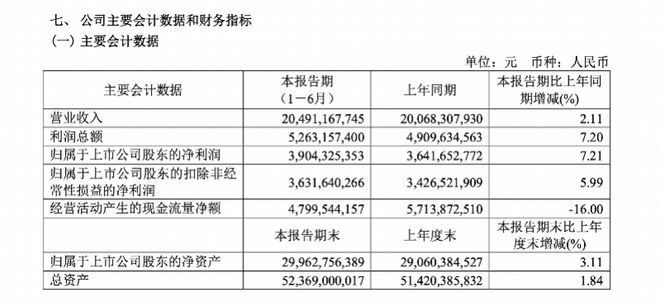
Core Viewpoint - Qingdao Beer reported a "double increase" in its semi-annual performance, with revenue and net profit showing growth amidst expanding beer market demand [1][2]. Financial Performance - Revenue for the first half of the year reached approximately 20.49 billion yuan, a year-on-year increase of 2.11% [2]. - Net profit attributable to shareholders was about 3.90 billion yuan, reflecting a year-on-year growth of 7.21% [2]. - The company's cash flow from operating activities decreased by 16% to approximately 4.80 billion yuan, indicating a divergence from revenue growth [4][2]. Product and Market Dynamics - The sales volume of mid-to-high-end products reached 1.99 million kiloliters, up 5.1% year-on-year, accounting for about 42% of total sales [3]. - New product launches included several mid-to-high-end specialty beers, contributing to sales growth [3]. - Despite overall growth, sales in the South China market showed a slight decline, with revenue of 1.46 billion yuan, down 0.4% year-on-year [6][7]. Challenges and Industry Context - The decline in cash flow and slower dealer payment collection may indicate potential risks, such as inventory pressure and operational efficiency issues [4][6]. - The South China market's sluggish growth is a common challenge faced by multiple beer companies, with local competitors like Zhujiang Beer gaining market share [7]. - The high-end beer market appears to be at a "crossroads," with external factors such as price sensitivity and adverse weather impacting growth [7].

中国必选消费品8月成本报告:现货成本小幅回升
Haitong Securities International· 2025-08-28 11:15
Investment Rating - The report assigns an "Outperform" rating to several companies including China Feihe, Huazhu, and others, while Budweiser APAC is rated as "Neutral" [1]. Core Insights - The report indicates a slight rebound in spot costs for essential consumer goods, with most indices showing an increase, while futures indices generally declined [35]. - The overall trend in the consumer goods sector reflects a mixed performance, with some categories experiencing cost increases while others face declines [8][35]. Summary by Category Beer - The spot cost index for beer increased by 0.39% month-on-month, while the futures index decreased by 6.06%. Year-to-date changes show a decline of 4.17% for spot and 6.16% for futures [36][13]. - Glass prices initially rose but later fell, with month-on-month changes of +0.3% for spot and -13.9% for futures [12]. Seasonings - The spot cost index for seasonings decreased by 0.16% month-on-month, while the futures index fell by 5.93%. Year-to-date changes are -1.76% for spot and -6.01% for futures [37]. - Domestic soybean prices have increased due to supply contraction, while imported soybeans remain weak [16]. Dairy - The spot cost index for dairy products increased by 0.7% month-on-month, while the futures index decreased by 1.44%. Year-to-date changes are -3.2% for spot and -2.11% for futures [38]. - Fresh milk prices have declined to 3.02 yuan/kg, with various factors contributing to price pressures [19]. Instant Noodles - The spot cost index for instant noodles increased by 1.3% month-on-month, while the futures index decreased by 2%. Year-to-date changes are -3.01% for spot and -4.21% for futures [39]. - Palm oil prices have risen, impacting overall costs [23]. Frozen Foods - The spot cost index for frozen foods increased by 1.15% month-on-month, while the futures index rose by 0.97%. Year-to-date changes are -1.83% for spot and -2.74% for futures [40]. - Vegetable prices have shown significant fluctuations due to seasonal demand [27]. Soft Drinks - The spot cost index for soft drinks increased by 0.78% month-on-month, while the futures index decreased by 5.63%. Year-to-date changes are -4.99% for spot and -8.6% for futures [41]. - PET prices are stable to weak, reflecting changes in demand and inventory levels [31].