
华夏基金

Search documents
A500ETF基金(512050)上涨1%,成分股星宇股份、福斯特涨停,多家A股公司业绩预喜
Xin Lang Cai Jing· 2026-02-03 05:12
Group 1 - The A500 Index (000510) increased by 0.65% as of February 3, 2026, with notable gains from stocks such as Robotech (up 17.37%), Jing Sheng (up 17.17%), and Maiwei (up 11.77%) [1] - The A500 ETF Fund (512050) rose by 1.00%, with a latest price of 1.22 yuan, and showed active trading with a turnover rate of 27.7% and a transaction volume of 10.922 billion yuan [1] - Over the past three months, the A500 ETF Fund's scale increased by 202.30 billion yuan, indicating significant growth [1] Group 2 - As of January 31, 2026, 2,956 A-share listed companies had disclosed their 2025 annual performance forecasts, with a disclosure rate of 54% and 1,092 companies expecting positive results, resulting in a positive forecast rate of 37% [1] - China Galaxy Securities highlighted structural clues from the performance forecasts, noting a high positive forecast rate in the technology manufacturing sector, benefiting from price increases and product structure improvements in certain cyclical industries [1] - The A500 Index consists of 500 securities selected from various industries based on market capitalization and liquidity, reflecting the overall performance of representative listed companies [2]

ETF午评 | 光伏板块强势反弹,科创新能源ETF、光伏ETF国泰涨5%
Ge Long Hui· 2026-02-03 05:07
Market Performance - The three major A-share indices collectively rose in the morning session, with the Shanghai Composite Index up by 0.38%, the Shenzhen Component Index up by 0.93%, and the ChiNext Index up by 0.76% [1] - The North Star 50 Index saw a significant increase of 2.16% [1] - The total trading volume in the Shanghai and Shenzhen markets reached 161.69 billion yuan, a decrease of 40 billion yuan compared to the previous day [1] - Over 4,400 stocks in the market experienced gains [1] Sector Performance - Leading sectors included photovoltaic equipment, commercial aerospace, CPO, military equipment, cultivated diamonds, chemicals, rare earth permanent magnets, and storage chips, all showing notable increases [1] - Conversely, sectors such as precious metals, oil and gas extraction and services, banking, insurance, agricultural product processing, and beverage manufacturing faced declines [1] ETF Performance - The photovoltaic sector saw a strong rebound, with notable ETFs such as Penghua Fund's Science and Technology New Energy ETF, Guotai's Photovoltaic ETF, and E Fund's Science and Technology New Energy ETF rising by 5.25%, 5.24%, and 4.96% respectively [1] - The China Merchants Fund's Emerging Asia ETF increased by 5.12% [1] - The commercial aerospace sector also performed well, with Huaxia Fund's Aerospace ETF and Hua'an Fund's Aerospace ETF rising by 4.55% and 4.49% respectively [1] - The metals sector rebounded, with the Dachen Metals ETF increasing by 4.12% [1] Declining ETFs - The New Economy ETF from Yinhua fell by 5.9% [2] - Gold stocks continued to weaken, with the Gold Stock ETF and Gold Stocks ETF declining by 3.64% and 2.5% respectively [2] - The Hong Kong stock market showed weakness, with the Hong Kong Stock Connect Technology ETF from Ping An dropping by 2% [2]
低空经济产业链发展会成功举办,赛道规模最大的通用航空ETF华夏(159230) 强势涨超2%
Sou Hu Cai Jing· 2026-02-03 03:00
Group 1 - The three major indices opened high but closed lower, with photovoltaic and silicon energy sectors leading gains, while gold jewelry and nickel mining sectors faced declines [1] - The aerospace ETF (159227) rose by 3.55%, and the general aviation ETF Huaxia (159230) increased by 2.6%, with significant movements in stocks such as Aviation Industry Corporation of China [1] - The general aviation ETF Huaxia (159230) has seen net inflows for 15 out of the last 20 days, accumulating over 700 million, making it the largest ETF by scale in its index [1] Group 2 - The general aviation ETF Huaxia (159230) tracks the National General Aviation Industry Index, focusing on low-altitude economy, covering sectors such as aviation materials, infrastructure, aircraft manufacturing, operational services, and application scenarios [2] - The low-altitude economy comprises 88.26% of the ETF, while the commercial aerospace sector accounts for 65.32% [2] Group 3 - The "Investment Promotion Low-altitude Economy Industry Chain Development Matching Conference" was successfully held in Zhengzhou, aiming to connect quality projects with capital to inject innovation and capital momentum into the low-altitude economy in Henan [1] - Analyst Wang Jiahao from CITIC Securities emphasized that China's low-altitude economy is at a critical development window, requiring a policy-driven system, infrastructure foundation, aircraft technology engine, and industry application scenario to create a virtuous cycle [1]



CPO反复活跃,天孚通信再创新高,低费率创业板人工智能ETF华夏(159381)盘中一度涨4%
Xin Lang Cai Jing· 2026-02-03 02:54
Group 1 - The CPO concept sector is active, with notable gains in stocks such as Zhishang Technology (up over 13%) and Tianfu Communication (up over 7%) [1] - Major players in the optical module sector, including Zhongji Xuchuang, Xinyi Sheng, and Tianfu Communication, have released earnings forecasts indicating significant profit growth, reflecting the acceleration of the AI industry and global data center construction [1] - Zhongji Xuchuang expects a net profit of 9.8 billion to 11.8 billion yuan for 2025, representing a year-on-year increase of 89.50% to 128.17% [1] - Xinyi Sheng anticipates a net profit of 9.4 billion to 9.9 billion yuan for 2025, with a year-on-year growth of 231.24% to 248.86% [1] - Tianfu Communication projects a net profit of 1.881 billion to 2.150 billion yuan for 2025, reflecting a year-on-year increase of 40.00% to 60.00% [1] - Changcheng Securities expresses optimism about the communication industry, highlighting the ongoing positive news across various sectors and the potential for investment in new directions such as commercial aerospace and quantum computing by 2026 [1] Group 2 - The Huaxia AI ETF (159381) tracks an index with nearly 50% weight in CPO and covers domestic software and AI application companies, providing high elasticity [2] - The top three weighted stocks in the Huaxia AI ETF are Zhongji Xuchuang (15.64%), Xinyi Sheng (15.57%), and Tianfu Communication (6.85%) [2] - The on-market comprehensive fee rate for the Huaxia AI ETF is only 0.20%, the lowest among similar products [2] - The Huaxia Communication ETF (515050) focuses on electronic components and communication hardware, with major holdings including Zhongji Xuchuang and Xinyi Sheng [2] - The Huaxia Cloud Computing ETF (516630) emphasizes domestic AI software and hardware, with a combined weight of 83.7% in computer software, cloud services, and computer equipment [2]

航材股份股价涨5.26%,华夏基金旗下1只基金位居十大流通股东,持有475.58万股浮盈赚取1726.36万元
Xin Lang Cai Jing· 2026-02-03 02:53
2月3日,航材股份涨5.26%,截至发稿,报72.63元/股,成交2.55亿元,换手率3.05%,总市值326.83亿 元。 华夏上证科创板50成份ETF(588000)成立日期2020年9月28日,最新规模760.22亿。今年以来收益 7.93%,同类排名670/5562;近一年收益51.52%,同类排名926/4285;成立以来收益6.09%。 华夏上证科创板50成份ETF(588000)基金经理为荣膺。 截至发稿,荣膺累计任职时间10年93天,现任基金资产总规模1432.79亿元,任职期间最佳基金回报 188.24%, 任职期间最差基金回报-7.58%。 资料显示,北京航空材料研究院股份有限公司位于北京市海淀区永翔北路5号,成立日期2000年4月10 日,上市日期2023年7月19日,公司主营业务涉及主要从事航空、航天用部件及材料研发、生产和销 售。主营业务收入构成为:航空成品件46.54%,基础材料44.60%,非航空成品件4.18%,加工服务 3.96%,其他0.72%。 从航材股份十大流通股东角度 数据显示,华夏基金旗下1只基金位居航材股份十大流通股东。华夏上证科创板50成份ETF(588000) ...
1月公募打新获配超10亿元
Guo Ji Jin Rong Bao· 2026-02-03 00:47
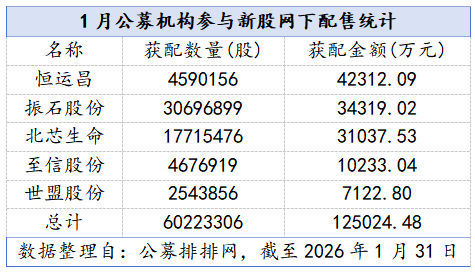
Group 1 - In January 2026, the A-share IPO market saw increased activity, with public funds becoming the dominant force in offline allocations due to their capital scale, research capabilities, and pricing advantages [1][4] - Public funds participated in the offline allocation of 5 new stocks, acquiring a total of 60.22 million shares worth 1.25 billion yuan, covering high-growth sectors such as semiconductors, wind power, medical devices, and automotive manufacturing [1][3] - Among the new stocks, semiconductor equipment and wind power materials were particularly favored, with Hengyun Chang and Zhenstone Co. receiving significant allocations, reflecting public funds' strong recognition of domestic semiconductor substitution and long-term optimism for high-end manufacturing in the renewable energy sector [1][2] Group 2 - In the medical innovation sector, Beixin Life, the first domestic company with a combination of vascular functional FFR and imaging IVUS products, attracted public fund allocations of 17.72 million shares worth 310 million yuan, highlighting the investment appeal in this field [2] - Public funds also participated in the offline allocations of Zhixin Co. (automotive welding components) and Shimon Co. (supply chain logistics solutions), with allocations of 102.33 million yuan and 71.22 million yuan respectively, further diversifying the coverage of public fund IPO activities [2] Group 3 - A total of 107 public fund institutions participated in the offline allocations in January, with a clear differentiation in allocation amounts; 31 institutions received less than 1 million yuan, while the top twenty institutions received no less than 10 million yuan, dominating the market [3] - Leading public funds such as E Fund, Southern Fund, and ICBC Credit Suisse Fund excelled in offline allocations, with E Fund acquiring 7.19 million shares worth 148 million yuan, leading among public institutions [4] - The active participation of public funds in IPOs is driven by the low-risk and quick-return characteristics of offline allocations, which have become an important stabilizer for fund returns, especially during market fluctuations [4][5] Group 4 - Public funds view IPO participation as a key strategy for accessing high-growth sectors, allowing them to lock in quality assets early and optimize their portfolio structure [5] - Looking ahead, the focus on hard technology, renewable energy, and medical innovation is expected to continue, with a stable supply of quality new stocks, although competition for allocations may intensify [5] - Top public funds with strong research capabilities and precise pricing will likely continue to dominate the IPO market, while smaller funds may need to seek differentiation through niche strategies and optimized pricing [5]

千亿级ETF 跌停
Shang Hai Zheng Quan Bao· 2026-02-02 23:16
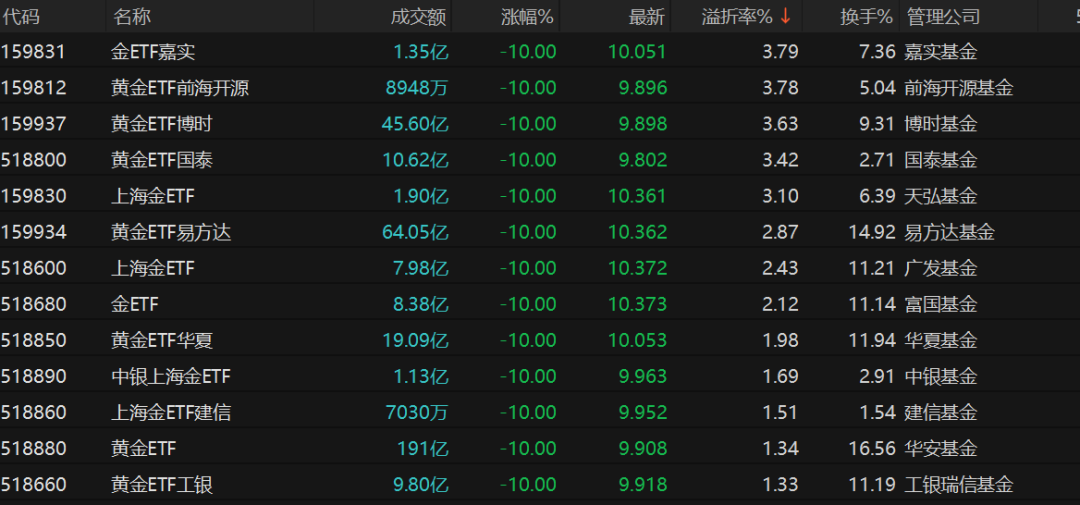
Group 1: Market Overview - Gold-related ETFs experienced significant declines, with multiple ETFs hitting the daily limit down [2][5] - The Huashan Gold ETF recorded a trading volume of 19.1 billion yuan, marking the third-highest trading day since its inception in 2013 [2][4] - The total scale of gold-related commodity ETFs reached 333.3 billion yuan as of January 30, up from 70.4 billion yuan at the beginning of 2025 [4] Group 2: Trading Performance - Several gold ETFs, including E Fund Gold ETF and Bosera Gold ETF, also saw high trading volumes, with E Fund Gold ETF at 6.4 billion yuan and Bosera Gold ETF exceeding 4.5 billion yuan [2][3] - The performance of various gold-related ETFs showed a uniform decline of 10% on the trading day [3][6] Group 3: Investor Sentiment and Recommendations - Analysts suggest that the recent drop in gold prices is a short-term technical adjustment and emotional release, emphasizing the importance of avoiding irrational trading behaviors [8] - Investment firms recommend that investors focus on long-term strategies and be cautious of leverage risks, especially in a high-volatility environment [8]
今年首月公募“打新”获配超12亿元
Xin Lang Cai Jing· 2026-02-02 23:02
本报记者 方凌晨 公募排排网统计数据显示,今年1月份,公募机构共参与了5只新股的网下配售,获配金额超12亿元。在 业内人士看来,公募机构参与"打新",主要出于收益增厚、优化组合配置、战略布局等多方面考量。未 来公募"打新"热情有望延续,综合实力强劲的公募机构有望主导"打新"市场。 新股各具行业代表性 上述数据显示,1月份公募机构参与新股网下配售合计获配6022.33万股,获配金额达12.50亿元。 深圳市融智私募证券投资基金管理有限公司FOF(基金中的基金)基金经理李春瑜对《证券日报》记者 分析,一方面,新股网下配售具有风险相对较低、收益兑现较快的特点,能够有效增厚基金收益,尤其 在市场震荡期间,"打新"收益可以成为基金重要的收益稳定器;另一方面,"打新"也是公募机构布局高 成长赛道的重要方式,通过参与新股配售,公募机构可以提前锁定优质资产,与现有权益组合形成互 补,进一步优化配置结构。 具体来看,公募机构参与网下配售的5只新股分别是恒运昌、振石股份、北芯生命、至信股份和世盟股 份,从申万行业分类来看,这些新股各具行业代表性,分别隶属于半导体、玻璃玻纤、医疗器械、汽车 零部件和物流五大行业。 在南开大学金融学 ...
公募1月份调研近4000次 脑机接口技术突破受关注
Zheng Quan Ri Bao· 2026-02-02 16:41
Core Insights - Public fund institutions have significantly increased their research activities in January, focusing on AI computing power, high-end medical technology, and new energy as the three core investment themes [1][3][5] Group 1: Research Activity - A total of 156 public fund institutions participated in A-share research in January, covering 486 stocks across 17 industries, with a total of 3,992 research instances [1] - Leading institutions such as Bosera Fund, Huaxia Fund, and Penghua Fund conducted the most research, with Bosera Fund leading at 116 instances [2] - The most researched stocks included Zhongji Xuchuang in the communications sector with 61 instances, followed by Aipeng Medical and Xiangyu Medical in the medical sector with 57 and 47 instances respectively [2] Group 2: Industry Focus - The electronics industry was the most researched, with 603 instances covering 71 stocks, followed by the machinery equipment industry with 591 instances covering 67 stocks [2][3] - Other industries such as medical biology, electric equipment, and basic chemicals also saw significant research activity, each exceeding 276 instances [3] Group 3: Emerging Trends - Brain-computer interfaces have emerged as a key focus within the high-end medical sector, driven by technological breakthroughs and commercial progress [4] - Companies like Aipeng Medical and Meihai Medical are actively engaging in brain-computer interface developments, with Aipeng Medical discussing advancements in brainwave technology [4] - The year 2026 is anticipated to be pivotal for the commercialization of invasive brain-computer interfaces, with several companies already in clinical stages [4]



ETF周报2026年1月第3期:宽基流出边际趋缓,个人投资者积极-20260202
East Money Securities· 2026-02-02 13:11
Overall ETF Fund Flow Overview - During the period from January 26 to 30, 2026, the overall market stock ETFs (excluding cross-border) experienced a net outflow of 314.93 billion, with a notable decrease in outflow scale towards the end of the week as the market weakened [11][14] - A-share industry and thematic ETFs saw a net inflow of 71.75 billion, an increase of 12.88 billion compared to the previous period, indicating strong market entry willingness from individual investors who view market pullbacks as opportunities for allocation [14][16] - Hong Kong stock ETFs recorded a net inflow of nearly 10 billion, continuing the inflow trend, while cross-border industry and thematic ETFs had a net inflow of 1.16 billion, a decrease of 6.35 billion from the previous week [16] Sector Analysis - The inflow into sectors such as non-ferrous metals, semiconductors, chemicals, and gold stocks showed strong sustainability, while the oil and petrochemical sector saw a significant increase in net inflow, although recent market volatility may affect price direction [20][22] - In the cross-border sector, emerging markets, Hong Kong's Hang Seng Technology, and major industry categories like technology and financial real estate saw relatively high inflows [25] Representative ETF Fund Flow - For stock ETFs, the top five by net inflow from January 26 to 30 were: - Huaxia CSI Non-ferrous Metals Industry Thematic ETF (6.46 billion) - Southern CSI Shenwan Non-ferrous Metals ETF (5.63 billion) - Penghua CSI Chemical Industry ETF (4.01 billion) - Huaxia CSI Shanghai-Hong Kong Gold Industry Stock ETF (3.82 billion) - Fortune CSI Chemical Industry Thematic ETF (2.78 billion) - The top five by net outflow were: - E Fund CSI 300 ETF (-74.73 billion) - Huatai-PB CSI 300 ETF (-74.20 billion) - Huaxia CSI 300 ETF (-54.71 billion) - Huaxia SSE 50 ETF (-41.73 billion) - Jiashi CSI 300 ETF (-40.63 billion) [28] Cross-Border ETF Representative Products - The top five cross-border ETFs by net inflow were: - GF CSI Hong Kong Stock Connect Non-bank ETF - Tianhong Hang Seng Technology ETF - Southern Fund Southern Dongying FTSE Asia Pacific Low Carbon Selected ETF (QDII) - GF CSI Hong Kong Innovative Medicine (QDII-ETF) - E Fund CSI Hong Kong Stock Connect Consumer Thematic ETF [3]