步步高

Search documents
商贸零售行业11月6日资金流向日报
Zheng Quan Shi Bao Wang· 2025-11-06 09:52
Market Overview - The Shanghai Composite Index rose by 0.97% on November 6, with 19 sectors experiencing gains, led by non-ferrous metals and electronics, which increased by 3.05% and 3.00% respectively [1] - The trading day saw a net inflow of 6.174 billion yuan in the main funds across both markets, with 12 sectors receiving net inflows [1] Sector Performance - The electronic sector had the highest net inflow of funds, totaling 12.224 billion yuan, while the non-ferrous metals sector followed with a net inflow of 3.647 billion yuan [1] - Conversely, 19 sectors experienced net outflows, with the media sector leading at a net outflow of 4.261 billion yuan, followed by the pharmaceutical and biological sector with 3.299 billion yuan [1] Retail Sector Analysis - The retail sector declined by 1.04%, with a net outflow of 1.161 billion yuan, and out of 97 stocks in this sector, 16 rose while 78 fell [2] - The top three stocks with the highest net inflow in the retail sector were CITIC Metal (601061) with 51.99 million yuan, followed by Wenkong Development (600058) and Yiyaton (002183) with 46.92 million yuan and 41.15 million yuan respectively [2] Notable Stocks in Retail Sector - The stocks with the largest net outflows included China Duty Free (601888) with 310 million yuan, followed by Supply and Marketing Group (000564) and Bubugao (002251) with 160 million yuan and 123 million yuan respectively [2] - The retail sector's performance was characterized by significant declines in several stocks, with notable drops including Zhejiang Dongri (600113) at -3.35% and Yonghui Supermarket (601933) at -1.07% [2][3]



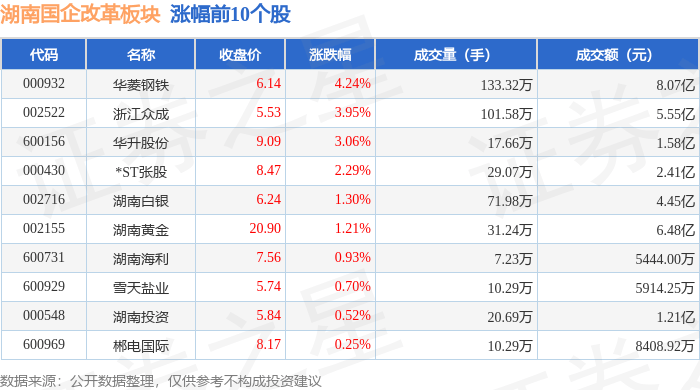
湖南国企改革板块11月6日跌0.3%,芒果超媒领跌,主力资金净流出6.09亿元
Sou Hu Cai Jing· 2025-11-06 09:00
Core Viewpoint - The Hunan state-owned enterprise reform sector experienced a decline of 0.3% on November 6, with Mango Super Media leading the losses, while the Shanghai Composite Index rose by 0.97% and the Shenzhen Component Index increased by 1.73% [1][2]. Group 1: Market Performance - The closing price of the Shanghai Composite Index was 4007.76, marking an increase of 0.97% [1]. - The Shenzhen Component Index closed at 13452.42, reflecting a rise of 1.73% [1]. - The Hunan state-owned enterprise reform sector saw a mixed performance among individual stocks, with notable gainers such as Hualing Steel, which rose by 4.24% to a closing price of 6.14 [1]. Group 2: Individual Stock Performance - Mango Super Media (300413) led the decline with a drop of 5.29%, closing at 27.24 [2]. - Other significant decliners included Xiangdian Co. (600416) down 4.18% and Bubugao (002251) down 2.07% [2]. - Hualing Steel (000932) and Zhejiang Zhongcheng (002522) were among the top gainers, with increases of 4.24% and 3.95%, respectively [1][2]. Group 3: Capital Flow - The Hunan state-owned enterprise reform sector experienced a net outflow of 609 million yuan from institutional investors, while retail investors saw a net inflow of 562 million yuan [2][3]. - The capital flow data indicates that Zhejiang Zhongcheng had a net inflow of 48.55 million yuan from institutional investors, while Hualing Steel experienced a net outflow of 15.06 million yuan [3].


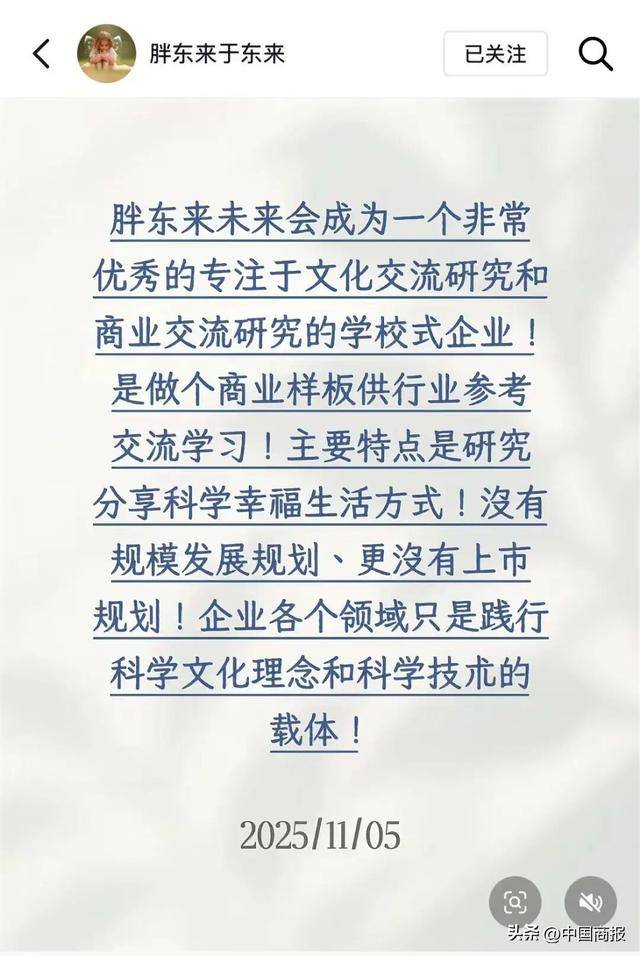
手握41亿元现金,胖东来“不上市”!于东来最新发声→
Sou Hu Cai Jing· 2025-11-06 07:44
Core Viewpoint - The founder of Pang Donglai, Yu Donglai, stated that the company has no plans for scale development or an IPO, aiming instead to be a model enterprise focused on cultural and business exchange research, promoting a scientific approach to a happy lifestyle [1] Group 1: Open Day and Learning Initiatives - Pang Donglai has established an "Open Day" to allow external parties to learn about the company, with visits starting from November 1, 2025, and occurring on the 10th and 20th of each month [3][4] - The participation fee for the Open Day is set at 20,000 yuan per person, with a limit of 15 participants per batch and a maximum of 5 from the same company [4] - Yu Donglai announced personal sharing sessions at a cost of 500,000 yuan for three hours, alongside a two-day entrepreneur study activity organized by Lian Shang College costing 1 million yuan [4] Group 2: Financial Performance and Industry Impact - Pang Donglai reported a cash reserve of 4.1 billion yuan and no loans, with sales reaching 18.4 billion yuan from January to October 2025, and a single-month sales record of 1.1 billion yuan in October [6] - The company has been recognized as a benchmark in the retail industry, inspiring competitors like Yonghui Supermarket and Bubugao to adopt its operational model, leading to improved performance metrics [6][7][8] Group 3: Focus on Quality Over Scale - Pang Donglai currently operates 14 stores primarily in Xuchang and Xinxiang, with no plans to expand outside Henan, emphasizing a strategy of steady and sustainable growth rather than blind expansion [9][10] - The company has closed several profitable stores to maintain quality and customer experience, reflecting its commitment to operational excellence over mere growth [10] - Yu Donglai expressed the desire for Pang Donglai to serve as a model for the industry, focusing on quality and long-term sustainability rather than becoming a nationwide chain or multinational giant [10]
步步高涨2.11%,成交额2.75亿元,主力资金净流入2841.57万元
Xin Lang Cai Jing· 2025-11-05 02:09
Core Viewpoint - The stock of Bubugao has shown a significant increase of 34.94% year-to-date, despite recent fluctuations in the short term, indicating potential investor interest and market volatility [1][2]. Group 1: Stock Performance - As of November 5, Bubugao's stock price rose by 2.11% to 5.33 CNY per share, with a trading volume of 2.75 billion CNY and a market capitalization of 143.31 billion CNY [1]. - Year-to-date, the stock has experienced a 34.94% increase, with a slight decline of 0.56% over the last five trading days and a 6.82% drop over the last 20 days [1]. - The stock has appeared on the "龙虎榜" (top trading list) 10 times this year, with the most recent appearance on September 9, where it recorded a net buy of -51.15 million CNY [1]. Group 2: Financial Performance - For the period from January to September 2025, Bubugao reported a revenue of 3.201 billion CNY, reflecting a year-on-year growth of 26.45%, while the net profit attributable to shareholders decreased by 88.83% to 226 million CNY [2]. - The company has cumulatively distributed 1.677 billion CNY in dividends since its A-share listing, with no dividends paid in the last three years [3]. Group 3: Shareholder Information - As of September 30, 2025, the number of shareholders increased to 172,500, marking a 95% rise, while the average circulating shares per person decreased by 27.06% to 12,476 shares [2]. - The top ten circulating shareholders saw a change, with Hong Kong Central Clearing Limited exiting the list [3].
身家猛涨50亿,“中国巴菲特”豪捐1500万元股票
Sou Hu Cai Jing· 2025-11-04 14:10
Core Insights - Duan Yongping, known as "China's Buffett," donated 10,000 shares of Kweichow Moutai stock valued at 15 million yuan to Jiangxi Water Conservancy and Electric Power University [2][3] - The donation is part of Duan's long-standing commitment to educational philanthropy, having donated over 1 billion yuan to various universities over the past 20 years [2][5] - Kweichow Moutai has a history of consistent dividends, with an estimated dividend of 515,600 yuan from the donated shares based on last year's payout [2][5] Company and Industry Overview - Kweichow Moutai has distributed a total of 336.11 billion yuan in dividends to date, with a cash dividend of 64.67 billion yuan planned for 2024 and a payout ratio of 75% [4][5] - Despite a slight revenue growth of 6.32% to 130.90 billion yuan and a net profit increase of 6.25% to 64.63 billion yuan in the first three quarters, the company faces challenges in maintaining growth amid a declining market for high-end liquor [10] - The price of Moutai's flagship product has dropped significantly, from 2,220 yuan per bottle at the beginning of the year to 1,640 yuan, reflecting market pressures [10] - Moutai's management is actively seeking diversification strategies to alleviate performance pressures, including exploring new product lines in wine and health beverages [10][11]


服务产业迎政策利好,新消费景气持续
Haitong Securities International· 2025-11-04 10:31
Group 1 - The service industry is expected to benefit from favorable policies, with a significant increase in service consumption anticipated in 2026 due to continuous policy support and demand dividends [3][7][11] - The report highlights the structural growth in emotional value and symbolic consumption, particularly in the IP toy industry, which is rapidly realizing commercial value [3][7][9] - The retail industry is undergoing a transformation towards a decentralized model, with traditional retail facing intense competition and new channels like discount stores and community supermarkets emerging [3][7][9] Group 2 - The report emphasizes the importance of optimizing holiday arrangements and integrating cultural tourism to stimulate demand, particularly for families with children [12][15] - The service consumption structure in China shows significant room for growth, with the current per capita service consumption being much lower than that of developed countries [29][30][32] - The tea and coffee beverage market in China is experiencing rapid growth, with the market size expected to increase significantly, driven by consumer demand in lower-tier cities [56][58][59] Group 3 - The online travel agency (OTA) market is projected to maintain stable profit margins, with companies like Trip.com leading in growth despite slight slowdowns in overseas markets [48][54] - The hotel industry is seeing a gradual improvement in operating data, with a narrowing decline in revenue per available room (RevPAR) expected to continue [37][40][43] - The report indicates that the demand for travel and tourism services is stable, with business travel being a significant source of fluctuations in demand [40][41]




超市“调改”步入深水区
Bei Jing Shang Bao· 2025-11-03 16:24
Core Insights - The supermarket industry is experiencing revenue growth pressure and a divergence in profitability among listed companies, with a need for refined operations and differentiated competition to find breakthroughs [1][3] Revenue Performance - Supermarkets are entering a "stock competition" phase, facing stagnant or declining revenue growth, with significant divergence in net profit performance among companies [3] - Yonghui Supermarket reported a cumulative revenue of 42.434 billion yuan for the first three quarters, a year-on-year decline of 22.21%, with Q3 revenue at 12.486 billion yuan, down 25.55%, and a net loss of 469 million yuan [3] - Zhongbai Group also saw revenue decline, with 6.552 billion yuan for the first three quarters, down 19.41%, and a net loss of 580 million yuan [3] - Hongqi Lianchained reported revenue of 7.108 billion yuan, down 8.48%, but achieved a net profit of 383 million yuan, with a net profit margin increase of 7.21% [3] - Bubu Gao's revenue was 3.194 billion yuan, ranking fifth in the industry with a net profit of 238 million yuan [3] - Sanjiang Shopping reported revenue of 2.988 billion yuan and a net profit of 114 million yuan [3] Industry Transformation - The industry is undergoing a collective transformation with various new models emerging, such as "Fat Donglai model adjustment" and "24-hour cloud service" by Hongqi Lianchained, indicating a shift towards differentiated products and innovative business formats [4][5] - Yonghui Supermarket has completed adjustments in 222 stores, resulting in an average customer flow increase of 80% and over 60% of stores surpassing their highest profitability in the past five years [4] - Bubu Gao's store adjustments have led to increased sales and improved employee benefits, achieving a 90% alignment with the Fat Donglai model [4] E-commerce and Digitalization - Walmart China reported a significant 96% increase in e-commerce net sales in Q3, with Sam's Club membership exceeding 4 million [5] - The transformation in the supermarket industry is systemic, with major players like Wumart also advancing deep transformations [5] - The focus on self-owned brand development, fresh direct sourcing, and regional specialty products is emphasized as a strategy for profit growth [6] Market Demand Response - The core of the transformation lies in enhancing product strength and optimizing supply chains, with companies increasingly relying on operational efficiency and innovative business models [6] - The emergence of membership stores, hard discount stores, and community stores reflects a response to market demand for segmentation [6] - Digital channels such as e-commerce, live streaming, and instant delivery are becoming standard configurations for supermarket operations, with examples from Walmart China and Hongqi Lianchained [6]


六个核桃越来越难卖,前衡水首富弃转身又押中风口,市值冲上430亿!
Sou Hu Cai Jing· 2025-11-03 14:40
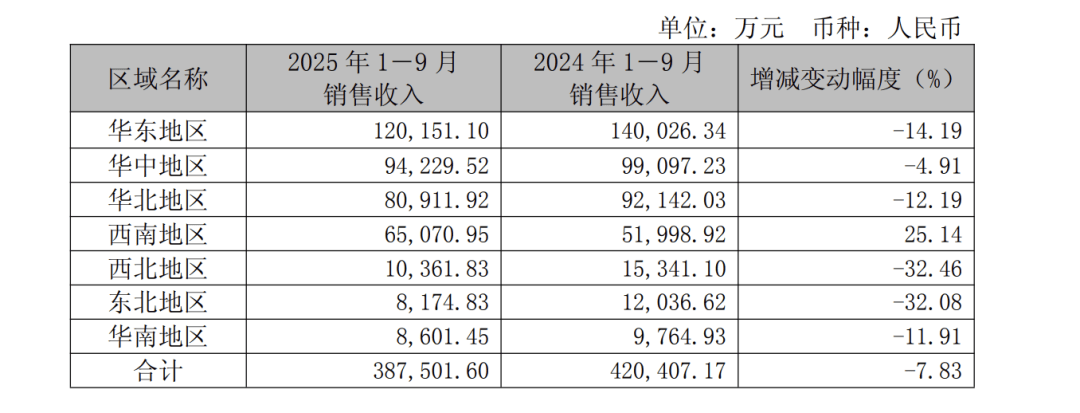
Core Viewpoint - Yangyuan Beverage has reported a decline in sales across all major regions, with significant drops in the Northeast and Northwest regions, indicating challenges in maintaining revenue growth for its flagship product, "Six Walnuts" [1][4]. Sales Performance - The company's revenue for Q3 2025 was 3.91 billion yuan, a year-on-year decrease of 7.64% [4]. - The net profit attributable to shareholders was 1.12 billion yuan, down 8.95% year-on-year [4]. - The operating cash flow showed a negative net amount of 165 million yuan [4]. Product Performance - "Six Walnuts" has historically contributed 88% to 98% of Yangyuan's total revenue, highlighting its critical role in the company's financial health [1][3]. - Sales of "Six Walnuts" have been on a downward trend since 2016, and new product launches like oat milk and coconut milk have not gained significant traction in the market [6]. Investment Strategy - Yangyuan has shifted focus towards diversification through investments, with significant allocations to financial products and equity stakes in various companies [6][12]. - The company has invested 1 billion yuan in AI firm Chongqing Ziguang Huashan Zhian Technology and 8 billion yuan in lithium-ion battery company Ruipu Lanjun [6]. - Recent investments include 1.6 billion yuan in Yangtze Memory Technologies, which has led to a notable increase in stock price, with a 62% rise over a short period [8]. Market Activity - Yangyuan's stock has seen substantial gains, with a market capitalization reaching 43.4 billion yuan following the investment in Yangtze Memory Technologies [8]. - The company has also been active in the secondary market, benefiting from holdings in stocks like Jiamei Packaging, yielding profits in the millions [11]. Fund Management - Yangyuan has increased its investment in the private equity fund Qianhong Investment by 1 billion yuan, raising its total commitment to 3.997 billion yuan, which now represents a 99.925% stake [12]. - This move is aligned with the company's strategy to enhance its investment capabilities and protect shareholder interests [12].

超市三季报:行业步入转型深水区 注重细分与差异化运营
Bei Jing Shang Bao· 2025-11-03 10:45
Core Insights - The supermarket industry is experiencing revenue growth pressure and a divergence in profitability among companies as they navigate a phase of deep adjustment and transformation [1][3] - Companies are focusing on refined operations and differentiated competition to find breakthroughs in a challenging market environment [1] Revenue Performance - The supermarket sector has entered a "stock competition" phase, with many companies facing stagnant or declining revenue [3] - Yonghui Supermarket reported a cumulative revenue of 42.434 billion yuan for the first three quarters, a year-on-year decline of 22.21%, with a net loss of 469 million yuan [3] - Zhongbai Group's revenue also decreased, with a total of 6.552 billion yuan, down 19.41%, and a net loss of 580 million yuan [3] - Hongqi Chain's revenue was 7.108 billion yuan, down 8.48%, but it achieved a net profit of 383 million yuan, with a net profit margin increase of 7.21% [3] - Bubu Gao's revenue was 3.194 billion yuan, ranking fifth in the industry, with a net profit of 238 million yuan [3] - Sanjiang Shopping reported revenue of 2.988 billion yuan and a net profit of 114 million yuan [3] Industry Transformation - Various new operational models are emerging, indicating a collective transformation within the industry, focusing on differentiated products, experiential scenarios, and innovative business formats [4][5] - Yonghui Supermarket has completed the transformation of 222 stores under the "Fat Donglai model," resulting in an average customer flow increase of 80% and over 60% of stores exceeding their highest profitability in the past five years [4] - Bubu Gao has completed its "Store Transformation 1.0," improving sales and employee benefits, with a product structure alignment of 90% with the Fat Donglai model [4] - Hongqi Chain is expanding its 24-hour cloud service stores to 300 by the end of the year, enhancing product offerings through live broadcasts and joint product development [4] Strategic Focus - Companies are emphasizing the development of private labels, direct sourcing of fresh products, and regional specialty items to enhance profitability [6] - The emergence of membership stores, hard discount stores, cloud warehouses, and community stores reflects a trend towards smaller, specialized formats [6] - Digital channels such as e-commerce, live streaming, and community operations are becoming standard in supermarket operations, with Walmart China reporting a 96% increase in e-commerce net sales [6] - The future of the retail market is expected to be diverse and differentiated, requiring supermarkets to continuously explore new business models and technological applications to adapt to changing consumer demands [6]
消费者服务行业周报(20251027-20251031):关注十五五提振消费相关政策-20251103
Huachuang Securities· 2025-11-03 05:24
Investment Rating - The report maintains a "Buy" rating for the consumer services industry, emphasizing the potential for growth driven by government policies aimed at boosting consumption [1]. Core Insights - The report highlights the importance of the "14th Five-Year Plan" which aims to significantly enhance consumer spending through various measures, including increasing public service expenditure and improving consumer rights protection [4]. - It suggests that the current transformation in China's service consumption sector presents a prime investment opportunity, particularly in service consumption platforms, hotel groups with improving margins, and the tourism sector [4]. Industry Overview - The consumer services sector consists of 55 listed companies with a total market capitalization of approximately 498.8 billion yuan and a circulating market value of about 457.1 billion yuan [1]. - The sector's performance over the past month shows a decline of 7.7%, while the 12-month performance indicates a growth of 9.2% [2]. Market Performance - The consumer services industry experienced a weekly increase of 0.45%, outperforming the overall A-share market which rose by 0.39% [7]. - Notable stocks in the sector include Dalian Shengya, Chuangye Heima, and Fangzhi Technology, which showed significant gains [4]. Key Announcements - Major announcements include Meituan's issuance of $2 billion in senior bonds with a subscription rate exceeding 5.7 times, and Guangzhou Restaurant's third-quarter revenue of 2.293 billion yuan, reflecting a year-on-year growth of 4.66% [31][32]. Upcoming Events - Several companies in the sector are scheduled to hold shareholder meetings in November, including Guangzhou Restaurant and Yunnan Tourism, which may provide further insights into their operational strategies and financial performance [35][36]. Industry News - Recent developments include the collaboration between Mixue Ice City and Hainan Airlines to launch a co-branded flight, and the introduction of pet-friendly travel products by Zhongxin Tourism, indicating innovation in service offerings [37][38].