五粮液

Search documents
马年新春启新程:线上非遗直播燃消费 线下文旅盛宴润巴蜀
Sou Hu Cai Jing· 2026-02-07 19:35
当一场非遗年货直播在七小时内创下亮眼交易纪录时,另一场规模更大的非遗盛宴正在线下悄然铺展——近3000场文旅活动在巴蜀大地同步启幕,从川西 雪场的飞扬滑板到川南古镇的袅袅炊烟,从直播间秒杀的年货礼盒到非遗市集的手作体验,马年新春的"年味"正以线上线下交融的方式,打破传统与现代 的壁垒,让千年文脉在烟火气中焕发新生。 线上直播带货 新春消费浪潮涌 近日,抖音电商发布的《2026年货礼盒消费报告》显示,抖音电商年货节期间,品牌年货礼盒销量较日常提升3倍,其中超70%的礼盒通过直播间售出。 这一数据清晰表明,直播电商已成为推动年货礼盒销售增长的核心渠道,也成为新春消费的重要载体。 抖音电商《2026年货礼盒消费报告》 直播让非遗不再是遥不可及的展品,而是飞入寻常百姓家的新春好物。这场云端非遗大集最终实现曝光近900万,观看人次近20万,最高1.77万人在线, 成交金额达23.2万元,封面新闻首次跻身抖音冲饮带货榜排名第38位,印证了媒体非遗直播带货的传播力与消费力。 今年消费者对年货的选择呈现出多元化、品质化趋势。其中,100元-200元价格带的品牌礼盒最受青睐,销量占比达到25%;坚果、乳制品、肉干肉脯、 糕点和 ...


一年消失32万家!曾年入百万的烟酒店铁饭碗,被年轻人砸得稀碎
Sou Hu Cai Jing· 2026-02-07 14:55
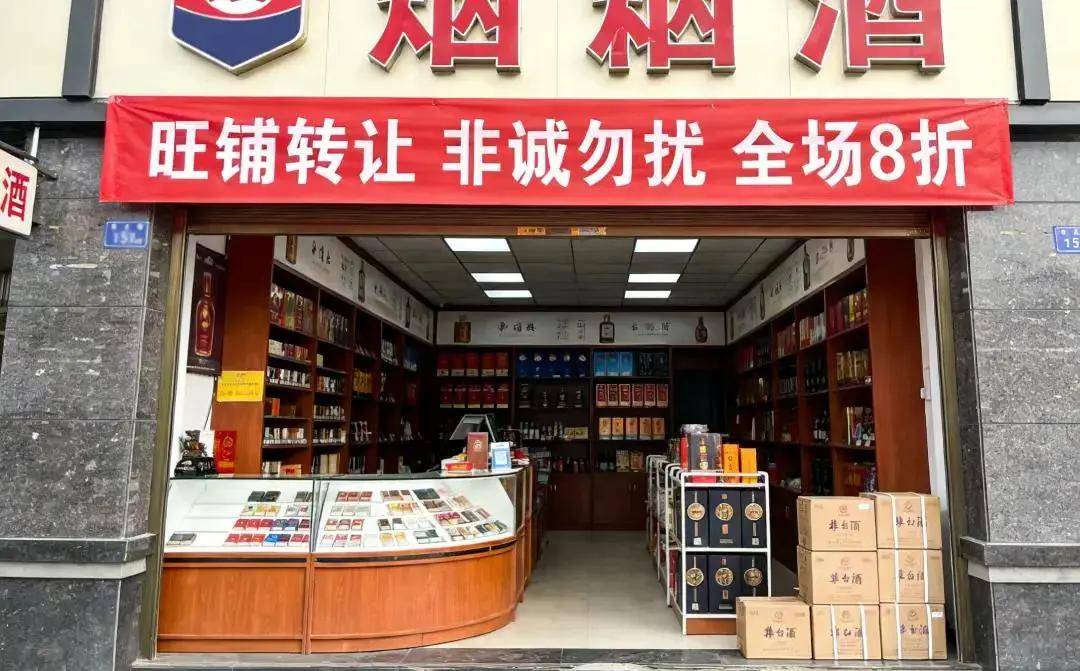
Core Viewpoint - The traditional tobacco and alcohol retail industry in China is facing a significant decline, with a projected 19% reduction in the number of tobacco shops by 2025, equating to the closure of approximately 320,000 stores annually, and over 1.3 million closures in the past five years [2][12]. Industry Overview - Tobacco shops were once considered a stable business, with high demand for tobacco licenses and substantial profits, often exceeding 50,000 yuan per month even with low foot traffic [4][9]. - The industry thrived on B2B sales, primarily through corporate orders, which accounted for over 60% of sales in many shops [7][9]. Market Changes - The decline in tobacco shops is attributed to changing consumer preferences, particularly among younger generations who are moving away from traditional drinking and smoking cultures [16][34]. - The introduction of strict regulations, such as the 2025 alcohol ban, has severely impacted business, leading to a drastic reduction in corporate orders [10][11]. Competitive Landscape - The rise of large chain liquor stores and direct sales from alcohol manufacturers has further squeezed the profit margins of traditional tobacco shops, with many owners reporting profit margins below 10% [17][19]. - Consumers are increasingly using tobacco shops as showrooms before purchasing online, diminishing the traditional retail model [21]. Adaptation Strategies - Some tobacco shop owners are pivoting to meet the demands of younger consumers by offering lower-priced, everyday alcohol options and diversifying their product offerings to include snacks and beverages [26][30]. - Innovative strategies include leveraging social media for marketing, creating community engagement through services like package delivery, and transforming shops into lifestyle venues [28][30]. Industry Trends - The decline of tobacco shops reflects broader trends in various industries, with significant closures in pharmacies, eyewear stores, and beauty brands, indicating a shift in consumer behavior and market dynamics [31][32]. - The survival of tobacco shops will depend on their ability to adapt to changing consumer preferences and embrace new business models [34].
重庆努力推动知识产权行政执法工作迭代升级
Xin Lang Cai Jing· 2026-02-07 14:37
Core Viewpoint - The Chongqing Market Supervision Administration is enhancing intellectual property enforcement to support high-quality development and create a favorable business environment in Chongqing [1]. Group 1: Key Initiatives - Focus on key sectors for systematic governance, strengthening the protection of the entire industrial chain for advantageous industries such as automotive and motorcycle manufacturing, with 75 cases of automotive parts infringement investigated and 910 sets of infringing motorcycle parts intercepted [4] - Emphasis on consumer safety by conducting extensive enforcement actions in sectors like food, home appliances, and children's toys, resulting in 745 related cases being handled [4] - Addressing the rampant sale of infringing goods in the internet sector by establishing a joint anti-counterfeiting mechanism with major logistics companies, leading to the seizure of over 60,000 infringing items valued at over 20 million yuan [4] Group 2: Collaborative Efforts - Strengthening multi-dimensional collaboration and full-chain crackdown by establishing over 20 grassroots cooperation mechanisms with market supervision departments in neighboring regions, protecting renowned brands like Wuliangye and Fuling Pickles [4] - Enhancing coordination with law enforcement and judicial bodies, successfully investigating a cross-border counterfeit luxury goods case involving over 300 million yuan, and dismantling 23 illegal operations [4] - Collaborating with intellectual property courts to implement a dual approach of "enforcement + mediation," helping companies recover over one million yuan in damages and significantly reducing the cost of rights protection [4] Group 3: Proactive Enforcement - Promoting a shift in enforcement philosophy from "post-event investigation" to "prevention, regulation during the process, and improvement afterward," by establishing a directory of 477 well-known brands and geographical indication products [5] - Creating a government-enterprise cooperation platform and conducting tailored research for companies like "Yongchuan Douzhi" and "Youfu Food" to identify risks of infringement [5] - Innovating a "penalty + service" model that incorporates post-case follow-ups into mandatory procedures, guiding industries like shoemaking back to a brand cultivation-focused development path [5]

白酒产能结构第二轮调整来了?这次名酒也未必安全
Sou Hu Cai Jing· 2026-02-07 12:59
Core Viewpoint - The Chinese liquor industry is undergoing a structural adjustment rather than a simple capacity shrinkage, with a significant decline in overall production while premium brands are expanding their market share [1][3]. Group 1: Industry Overview - The overall production of liquor in China has decreased for nine consecutive years, with a cumulative production of 3.549 million kiloliters in 2025, down 12.1% from previous years, and a nearly 74% decline from the historical peak of 13.584 million kiloliters in 2016 [1]. - The first round of capacity reduction is characterized by a shift towards premium brands, where high-end liquor production has not contracted but rather expanded, indicating a trend of "total decline with structural upgrade" [1][3]. Group 2: Factors Influencing Change - Two main forces are driving this change: consumer upgrading, where preferences shift from quantity to quality and brand value, and brand concentration, where resources are increasingly directed towards better-selling and safer products [2][3]. - Since 2016, while overall industry capacity has declined, premium liquor companies have been expanding their production capabilities, with notable projects launched by brands like Moutai and Wuliangye [3]. Group 3: Second Round of Capacity Adjustment - The second round of capacity adjustment may target even the previously expanding premium brands due to slowing demand, particularly in high-end social settings, compounded by stricter regulations on official dining [4][6]. - The generational shift in consumption patterns shows younger consumers are less reliant on traditional high-end liquor, favoring lower-alcohol beverages and casual drinking scenarios, which poses a challenge for premium brands [6]. Group 4: Future Industry Dynamics - The upcoming adjustments in the industry will not only affect weaker brands but will also require strong brands to recalibrate their strategies, including slowing down production and managing inventory more effectively [7]. - The competition in the liquor industry is expected to shift from "who is bigger" to "who is more aligned" with market demands, emphasizing the importance of matching products to diverse consumer needs and scenarios [8]. Group 5: Opportunities in Diversity - Future opportunities may lie in three areas of diversity: diverse consumer needs, where different segments seek various experiences; diverse product categories, moving beyond traditional flavors; and diverse consumption scenarios, adapting to everyday emotional consumption [9][11]. - The industry's capacity management will evolve from rigid long-term planning to a more dynamic approach, allowing for adjustments based on market signals, thus reflecting a structural transformation in the liquor industry [11].

飞天茅台价格腰斩,十大名酒降价,白酒消费真的回归理性了吗?
Sou Hu Cai Jing· 2026-02-07 09:21
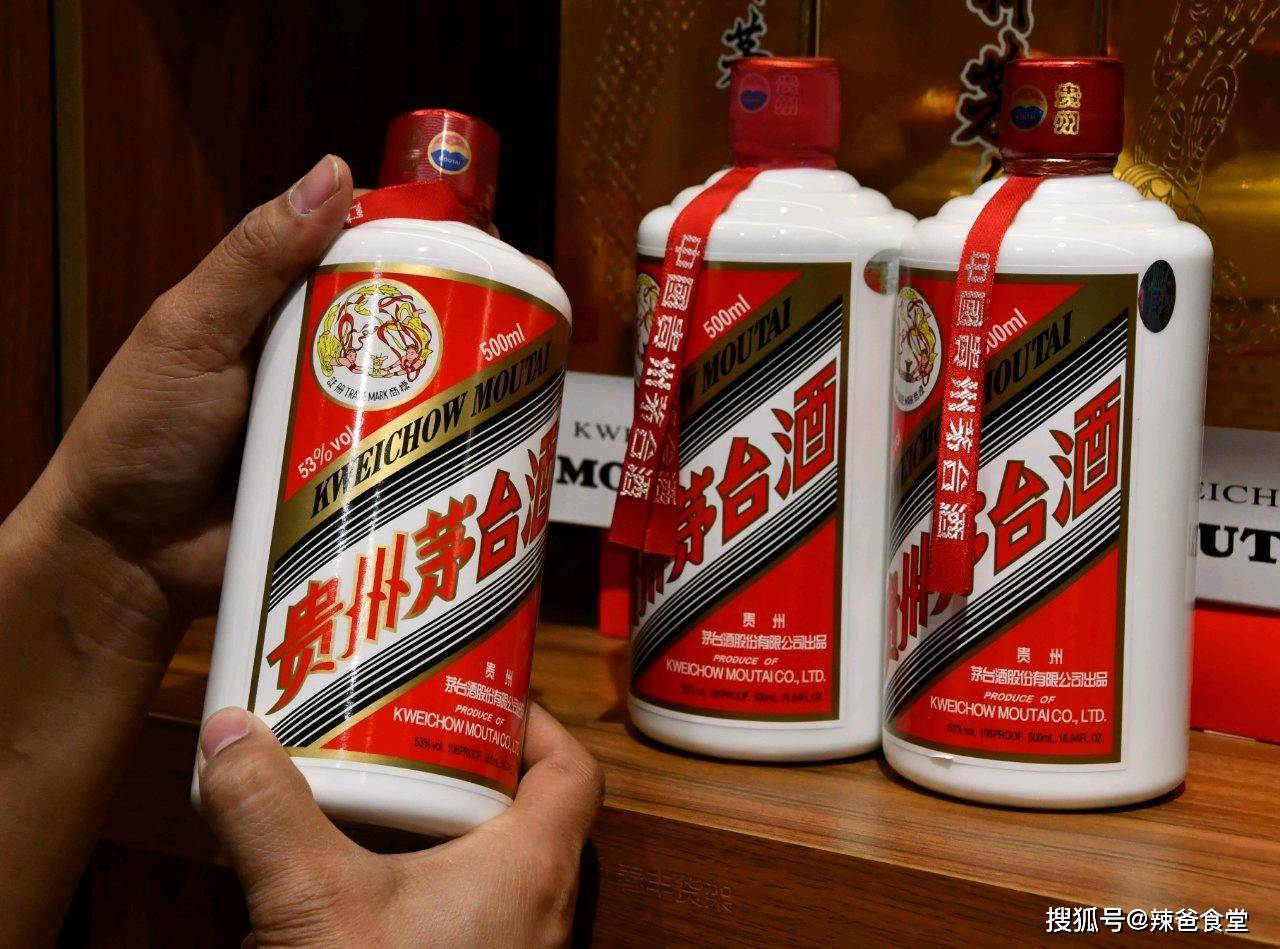
Core Viewpoint - The high-end liquor market, particularly the Moutai brand, is undergoing a significant price correction, moving from a speculative bubble to a more rational consumption phase, driven by changing consumer preferences and market dynamics [1][3][18]. Group 1: Market Changes - The price of Moutai has dropped significantly, with current wholesale prices stabilizing around 1700 yuan, down from a peak of 3500 yuan [3][5]. - Other top liquor brands are also experiencing price declines, with Wuliangye's actual transaction price falling to around 800 yuan and Moutai 1935 dropping from 2000 yuan to 700 yuan [5][7]. - The entire high-end liquor market is in a period of price adjustment, reflecting a systemic clearing of the bubble that has built up over the past two decades [7][12]. Group 2: Demand Dynamics - There has been a substantial contraction in business demand for high-end liquor, particularly due to reduced spending in the real estate and infrastructure sectors, leading to a sharp decline in large-scale consumption [7][10]. - The financial speculation surrounding high-end liquor has collapsed, as Moutai's increased supply through its iMoutai platform has diminished its scarcity, resulting in oversupply and falling prices [8][12]. - Younger consumers are shifting away from high-priced liquor, with only 11% expressing a preference for spirits over 30 degrees, favoring lower-alcohol, smaller-packaged, and diverse-flavored beverages instead [10][14]. Group 3: Industry Adjustments - Leading brands are proactively adjusting to market changes, with Moutai using its iMoutai platform to offer products at lower prices, effectively removing financial speculation and focusing on consumer needs [12][16]. - Wuliangye is also lowering its invoice prices for distributors to adapt to the changing market landscape [12]. - The overall production of liquor is expected to decline by 12% in 2025, marking the ninth consecutive year of decrease, indicating a challenging environment for second-tier brands [12][16]. Group 4: Future Outlook - The trend towards rational consumption in the liquor market is expected to continue, with high-end brands focusing on volume and affordability while smaller brands must differentiate themselves through high cost-performance [16][18]. - Consumer preferences are likely to become more diverse, with an increase in demand for low-alcohol and health-oriented products, as well as a shift towards personal consumption settings [16][18]. - The market is moving towards a more reasonable pricing structure as speculation fades, which is beneficial for consumers and essential for the industry's healthy development [18].

估值周报:最新A股、港股、美股估值怎么看?-20260207
HUAXI Securities· 2026-02-07 06:31
Group 1: A-share Market Valuation - The current PE (TTM) of the A-share market is 17.99, with a historical average of 27.52, indicating a significant undervaluation[7] - The Shanghai Composite Index has a current PE of 16.89, while the Shenzhen Component Index stands at 32.20, reflecting a divergence in valuation across indices[14] - The risk premium for the A-share market is currently at 2.96%, which is above the historical average, suggesting potential for future gains[16] Group 2: Hong Kong Market Valuation - The Hang Seng Index has a current PE of 12.11, with a historical maximum of 22.67, indicating a relatively low valuation compared to historical levels[58] - The Hang Seng Technology Index shows a current PE of 22.13, which is significantly lower than its historical maximum of 65.18, suggesting potential for recovery[60] - The median PE for key Hong Kong sectors, such as Financials and Consumer Staples, is 10.06 and 22.07 respectively, indicating sector-specific valuation opportunities[67] Group 3: U.S. Market Valuation - The S&P 500 Index has a current PE of 28.69, which is above its historical average, indicating a potentially overvalued market[81] - The NASDAQ Index shows a current PE of 40.55, significantly higher than its historical minimum of 16.46, suggesting high investor expectations[89] - The Dow Jones Industrial Average has a current PE of 28.81, reflecting a similar trend of elevated valuations compared to historical norms[94] Group 4: Sector-Specific Insights - Non-bank financials and food & beverage sectors in A-shares are currently at historically low PE levels, while technology sectors like computers and electronics are at high PE levels[24] - In Hong Kong, the healthcare sector has a median PE of 45.27, indicating strong growth expectations compared to other sectors[67] - Key U.S. bank stocks have a median PB of 1.34, which is lower than the historical average, suggesting potential value in the banking sector[102]
五粮液3月1日起终止二代五粮春酒盖回收
Cai Jing Wang· 2026-02-07 04:44
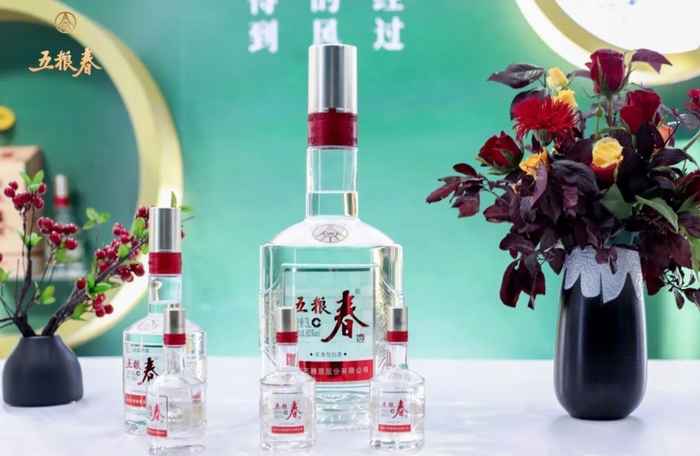
#五粮液将终止二代五粮春系列酒瓶盖回收#【3月1日起将终止二代五粮春系列酒瓶盖回收业务?五粮 液:政策信息属实】2月6日,记者从五粮液浓香经销商、终端店处获悉,接四川五粮液浓香酒有限公司 通知,自2026年3月1日起,将终止二代五粮春系列酒(瓶盖+盒盖)的回收业务,2026年3月1日(含) 之后扫码的瓶盖,不再回收。同时,还提醒经销商、终端店、消费者,于2026年3月25日前,将符合回 收条件且已完成扫码的(瓶盖+盒盖)进行兑换,逾期将无法办理兑换。记者第一时间向五粮液公司求 证,五粮液公司相关工作人员回应称,"该通知非浓香酒公司官方发布,但政策信息属实,该变化为品 牌市场政策正常切换过渡"。(每经) ...

3月1日起将终止二代五粮春系列酒瓶盖回收业务?五粮液:政策信息属实 为品牌市场政策正常切换过渡
Sou Hu Cai Jing· 2026-02-07 02:46
同时,还提醒经销商、终端店、消费者,于2026年3月25日前,将符合回收条件且已完成扫码的(瓶盖 +盒盖)进行兑换,逾期将无法办理兑换。 《每日经济新闻·将进酒》记者第一时间向五粮液公司求证,五粮液公司相关工作人员回应称,"该通知 非浓香酒公司官方发布,但政策信息属实,该变化为品牌市场政策正常切换过渡"。 来源:每日经济新闻 2月6日,《每日经济新闻·将进酒》记者从五粮液浓香经销商、终端店处获悉,接四川五粮液浓香酒有 限公司通知,自2026年3月1日起,将终止二代五粮春系列酒(瓶盖+盒盖)的回收业务,2026年3月1日 (含)之后扫码的瓶盖,不再回收。 ...
白酒行业更新报告:高端白酒引领,提振市场信心
GUOTAI HAITONG SECURITIES· 2026-02-07 01:56
Investment Rating - The report assigns an "Accumulate" rating for the liquor industry [5] Core Insights - The liquor industry is currently at the bottom of its cycle, with the "opening red" sales expected to remain under pressure year-on-year, while brand differentiation is evident. Positive feedback from high-end liquor is significantly boosting market confidence, and a shift in style and improved expectations may catalyze liquor stock prices [2][6] Summary by Sections Market Overview - The liquor market is experiencing a deep adjustment, with sales and revenue expected to decline throughout the year. However, there are signs of marginal improvement starting from Q4 2025, with high-end brands like Moutai and Wuliangye leading the market [6] High-End Liquor Performance - High-end liquor brands are showing resilience, with Moutai and Wuliangye implementing strategies to stabilize prices and enhance channel profits. Moutai's sales performance has improved, with significant user engagement and order volume [6][7] Stock Recommendations - The report recommends stocks with price elasticity, including Guizhou Moutai, Wuliangye, and Luzhou Laojiao, as well as other brands like Shanxi Fenjiu and Yingjia Gongjiu, which are expected to clear inventory [6][7] Future Outlook - The liquor industry is believed to be at the bottom of its current cycle, with potential catalysts for stock prices including improvements in sales, price increases, and inventory reduction. Positive signals from policy changes could further enhance market sentiment [6][7]


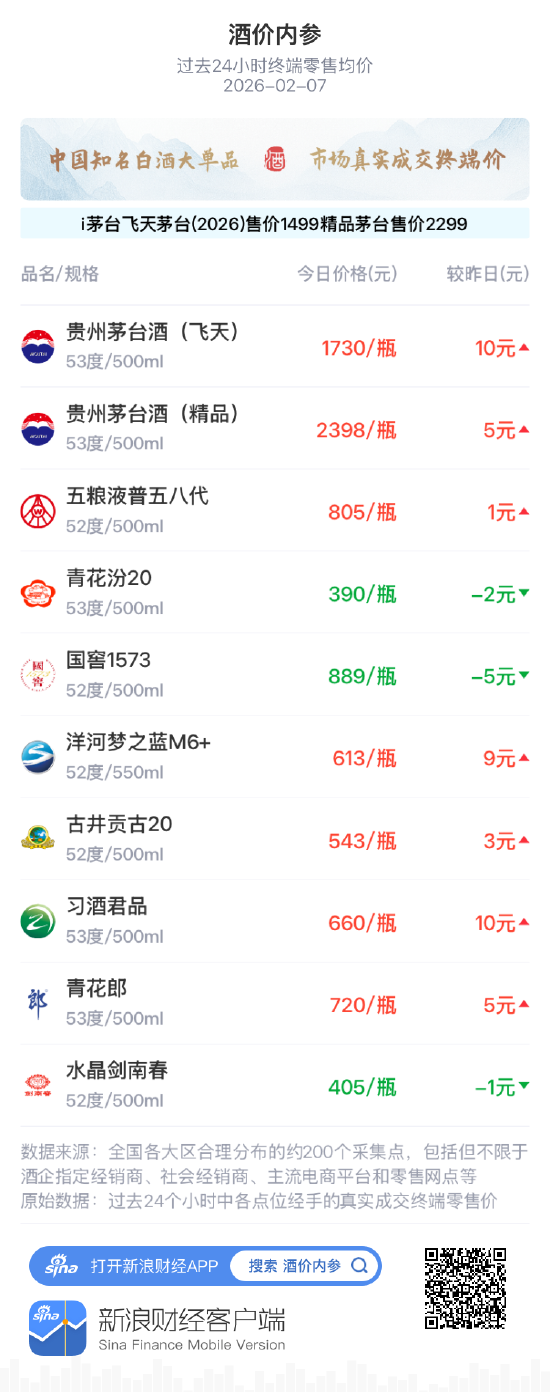
酒价内参2月7日价格发布 总价续创新高价格中枢进一步抬升
Xin Lang Cai Jing· 2026-02-07 01:27
Core Viewpoint - The Chinese liquor market is experiencing a price rebound, with the average retail price of the top ten liquor products reaching a new high since the beginning of 2026, driven by strong performance from leading brands [1]. Price Trends - The total price for a package of the top ten liquor products is 9153 yuan, an increase of 35 yuan from the previous day [1]. - Among the top products, the price of Feitian Moutai has risen by 10 yuan per bottle, while Xijiu Junpin has also increased by 10 yuan, marking a five-day consecutive rise [4]. - The overall price movement shows seven products increasing and three decreasing, indicating a strong market trend [4]. Specific Product Prices - Feitian Moutai (53 degrees, 500ml) is priced at 1730 yuan, up 10 yuan from yesterday [2]. - The price of the premium Moutai (53 degrees, 500ml) is 2398 yuan, up 5 yuan [2]. - Other notable price changes include Wuliangye (805 yuan, up 1 yuan), and Guojiao 1573 (889 yuan, down 5 yuan) [2][4]. Market Dynamics - The price increase is attributed to strong demand during the pre-Spring Festival period and tight supply channels [6]. - The market sentiment is cautious, with brands like Wuliangye and Guojiao 1573 showing stable prices, contrasting with the volatility seen in Moutai [6]. - The introduction of new sales channels for Moutai has had a significant impact on retail prices, with the official platform pricing Feitian Moutai at 1499 yuan per bottle [5].