
国窖

Search documents
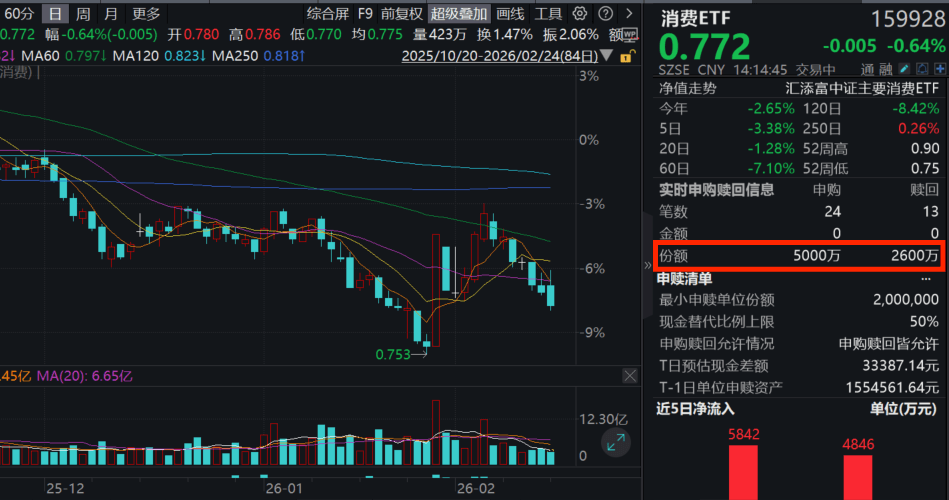
春节消费开门红!消费ETF(159928)冲高回落,盘中获2400万份净申购!机构:春节白酒反馈略好于预期
Xin Lang Cai Jing· 2026-02-24 06:57
Core Viewpoint - The consumer sector experienced a strong start during the Spring Festival, with significant growth in consumption demand, particularly in services and travel, despite some weaknesses in the film box office [3][6][9]. Group 1: Market Performance - The leading consumer ETF (159928) initially rose over 1% but later fell by 0.64%, with a trading volume exceeding 360 million yuan and a net subscription of 24 million shares during the day [1]. - The consumer ETF's latest scale surpassed 22.3 billion yuan, maintaining a leading position among its peers [1]. Group 2: Consumption Trends - The Spring Festival saw a notable increase in travel and service consumption, with a record number of cross-regional movements expected to reach 9.5 billion people, marking a historical high [6][7]. - Restaurant bookings for the New Year's Eve dinner increased by 105% year-on-year, with significant growth in demand from lower-tier cities [7]. - The demand for pre-packaged food is accelerating, driven by new national standards and retail channel transformations [8]. Group 3: Alcohol Consumption Insights - High-end liquor brands, particularly Moutai, showed better-than-expected performance, with sales expected to increase by 10-20% year-on-year during January and February [9][10]. - The overall liquor market is experiencing a recovery, with high-end brands gaining market share while lower-tier brands face challenges [10]. Group 4: Policy and Economic Environment - The government is implementing zero-tariff measures for 53 African countries and enhancing support for rural enterprises to access multi-level capital markets [3]. - The market is expected to see a positive start post-Spring Festival, with historical trends indicating a strong "Spring Festival effect" in A-shares [3].







白酒春节渠道跟踪报告:信心逐步企稳
CMS· 2026-02-24 03:06
Investment Rating - The report maintains a "Recommended" rating for the industry, indicating a positive outlook for the sector's fundamentals and expectations for the industry index to outperform the benchmark index [21]. Core Insights - The overall sales performance during the 2026 Spring Festival met pre-holiday expectations, with a double-digit decline observed. High-end and mass-market price segments showed resilience, while the sub-premium segment faced some pressure. The demand for family consumption and personal gatherings significantly increased, leading to a continuous rise in their market share [1][2]. - Inventory levels post-holiday were lower than the previous year, and channel burdens continued to ease. The supply side is tightening, and the industry is expected to stabilize price levels, particularly for leading brands like Moutai and Wuliangye, which are projected to maintain their price support [2][3]. - The report suggests a selective investment strategy focusing on strong leading brands and those with better-than-expected sales performance, particularly recommending Moutai, Wuliangye, and Yingjia Gongjiu [7]. Summary by Sections Industry Sales Performance - The overall sales during the Spring Festival were in line with expectations, with high-end and mass-market segments showing strong resilience while the sub-premium segment faced challenges. The demand from family and personal gatherings has notably increased [1][2]. - Moutai's sales performance was particularly strong, with a 15% increase during the festival, and inventory levels are currently very low, supporting a stable price around 1700 RMB [2][3]. Brand Performance - Wuliangye also performed better than expected, with sales growth attributed to brand strength and Moutai's price stabilization. Current inventory levels are manageable, with prices holding steady around 790-800 RMB [3]. - Shanxi Fenjiu showed stable performance, with some regions reporting growth, while Luzhou Laojiao's sales met expectations, although high-end products saw a decline [3][4]. Price and Inventory Outlook - The report anticipates that the industry will see a stabilization in prices, with Moutai's price expected to maintain above 1600 RMB due to improved channel confidence and reduced supply-side pressure [2][3]. - Many brands have reached a price floor, limiting further downward adjustments, and the upcoming festival periods are expected to provide additional sales opportunities [8][9].
招商证券:白酒行业动销符合预期 贵州茅台景气领先
智通财经网· 2026-02-12 03:13
Core Viewpoint - The report from China Merchants Securities indicates that the sales performance of key brands is expected to accelerate in the week before the Spring Festival, with tight supply and rising prices supporting market sentiment. Despite a potential decline in financial reports for 2026, leading brands like Moutai and Wuliangye have safe margins in valuation and dividends, suggesting a potential dual upgrade in performance and valuation as negative factors gradually dissipate [1] Industry Overview - Sales performance before the Spring Festival is expected to decline but aligns with forecasts, with Moutai showing leading market conditions. The overall industry is experiencing a double-digit decline in sales, but confidence is gradually recovering as companies ease pressure on sales targets [2] - The overall collection and delivery progress in the industry is slower than the same period last year, with Moutai and Wuliangye showing faster delivery rates. The inventory levels of distributors are lower than last year, but the days of inventory have not decreased significantly due to slower sales [2] Product Analysis - Moutai's sales volume and price have exceeded expectations, with a projected net increase of over 2,000 tons in January. Wuliangye's sales are expected to remain stable, while other brands like Laojiao and Fenjiu are experiencing varying degrees of decline [3] - The demand for low-end products remains, but brands like Jiannanchun and Yanghe are seeing significant declines in sales, with some brands experiencing double-digit drops [3] Consumption Scenarios - Business dining consumption remains suppressed, with mid-to-high-end dining showing poor performance. However, there is a rebound in gift-giving consumption, and the demand for affordable genuine products is increasing, with the proportion of mass consumption rising to 20% [4] Future Outlook - There is potential for further sales growth during the Spring Festival, with Moutai's supply-demand imbalance expected to continue into Q1, supporting prices. The overall industry volume and price have not yet bottomed out, and close attention is needed on the recovery of Wuliangye and Fenjiu's sales and distributor confidence [5] Institutional Holdings - Institutional holdings in the liquor sector are at historical lows, with the proportion of actively managed funds in the liquor sector dropping to 3.5% in Q4 2025. The overweight ratio has also decreased, indicating a stabilization in holdings among major liquor companies [6]
白酒行业更新报告:高端白酒引领,提振市场信心
GUOTAI HAITONG SECURITIES· 2026-02-07 01:56
Investment Rating - The report assigns an "Accumulate" rating for the liquor industry [5] Core Insights - The liquor industry is currently at the bottom of its cycle, with the "opening red" sales expected to remain under pressure year-on-year, while brand differentiation is evident. Positive feedback from high-end liquor is significantly boosting market confidence, and a shift in style and improved expectations may catalyze liquor stock prices [2][6] Summary by Sections Market Overview - The liquor market is experiencing a deep adjustment, with sales and revenue expected to decline throughout the year. However, there are signs of marginal improvement starting from Q4 2025, with high-end brands like Moutai and Wuliangye leading the market [6] High-End Liquor Performance - High-end liquor brands are showing resilience, with Moutai and Wuliangye implementing strategies to stabilize prices and enhance channel profits. Moutai's sales performance has improved, with significant user engagement and order volume [6][7] Stock Recommendations - The report recommends stocks with price elasticity, including Guizhou Moutai, Wuliangye, and Luzhou Laojiao, as well as other brands like Shanxi Fenjiu and Yingjia Gongjiu, which are expected to clear inventory [6][7] Future Outlook - The liquor industry is believed to be at the bottom of its current cycle, with potential catalysts for stock prices including improvements in sales, price increases, and inventory reduction. Positive signals from policy changes could further enhance market sentiment [6][7]


食品饮料行业周报:茅台定调投放量总体稳定,食品加大顺周期布局-20251229
CMS· 2025-12-29 02:33
Investment Rating - The report maintains a positive outlook on the food and beverage industry, particularly highlighting the stability in the production volume of Moutai and the cyclical layout of food products [1][15]. Core Insights - Moutai's production volume for 2026 is set to remain stable, with a focus on balancing supply and demand, and a shift from production-driven to sales-driven strategies [2][11]. - The report anticipates a significant improvement in supply-demand dynamics compared to 2025, driven by emerging channels stimulating consumer demand for alcoholic beverages [1][15]. - The dairy sector is expected to see a turning point in milk prices, with leading dairy companies projected to experience performance recovery and increased valuation support in 2026 [1][15]. - The report emphasizes the importance of strategic planning and product innovation among key companies to navigate market challenges and capitalize on growth opportunities [12][14]. Summary by Sections Core Company Tracking - Moutai aims to enhance the market share of its 500ml Flying Moutai while reducing the production of high-value products and focusing on a diversified sales network [2][11]. - Luzhou Laojiao maintains a restrained pricing strategy for its Guojiao product, anticipating Q1 2026 as a critical adjustment period for the industry [12]. - Shouxiangu is projected to achieve a compound annual growth rate of over 20% from 2026 to 2030, with a focus on major products and channels [12]. Investment Recommendations - The report suggests a focus on Moutai and other key brands for the upcoming Spring Festival, with recommendations for stocks like Wuliangye and Luzhou Laojiao due to their potential for rebound [15][16]. - Attention is drawn to consumer goods companies such as Weidong and Angel Yeast, which are expected to benefit from cost advantages and cyclical performance improvements [16]. - The report highlights three main investment themes: improving sales volume, cyclical opportunities, and cost benefits across various companies in the sector [16]. Industry Valuation Table - The report includes a valuation table for key companies, indicating market capitalizations and projected earnings for 2025 to 2027, showcasing the financial health and growth potential of major players in the industry [17][19].
过去十年中国白酒销量大幅下滑,所以?
集思录· 2025-12-05 12:06
Core Viewpoint - The article discusses the significant decline in Chinese liquor sales over the past decade, highlighting a trend of "decreasing volume and increasing price" in the market, particularly for high-end baijiu [2][3]. Sales Changes - In 2016, baijiu sales peaked at approximately 1305 million tons, but are projected to drop to around 414 million tons by 2024 [2][4]. - The sales figures for baijiu from 2017 to 2025 are as follows: - 2017: 1200 million tons - 2018: 860 million tons - 2019: 755 million tons - 2020: 740 million tons - 2022: 670 million tons - 2023: 629 million tons - 2024 (forecast): 414 million tons - 2025 (forecast): 350 million tons [4][5]. Market Dynamics - The decline in baijiu consumption is attributed to reduced business banquets and a subsequent drop in high-end baijiu prices, which compresses the premium space for all baijiu [5]. - The high prices of brands like Moutai are linked to scarcity and marketing strategies, but as production increases, the perceived value diminishes [3][5]. - The article suggests that the high prices of Chinese liquor are not justified compared to international spirits, which are often of higher quality and lower price [4]. Consumer Behavior - The changing drinking culture, influenced by regulations and generational shifts, is leading to a decline in traditional drinking occasions, particularly among younger consumers [11]. - The article notes that while overall baijiu sales are declining, mid to high-end products are experiencing growth, indicating a shift in consumer preferences [12].

江苏省徐州市市场监管局发布2025“守护消费”铁拳行动典型案例(第六批)
Zhong Guo Zhi Liang Xin Wen Wang· 2025-11-21 08:35
Core Points - The Xuzhou market supervision department aims to enhance consumer protection by focusing on issues that significantly impact public welfare and safety, emphasizing strict enforcement against various illegal activities in the consumer sector [2] Group 1: Case Summaries - Case 1: A dental clinic in Xuzhou was fined 30,000 yuan for false advertising, including misleading qualifications of doctors not practicing at the clinic [3] - Case 2: A seller in Suining was penalized for selling 531 bottles of counterfeit liquor, with a total illegal revenue of 83,724.04 yuan and illegal gains of 30,807.36 yuan, resulting in a fine of 10,000 yuan [4] - Case 3: A cosmetics store in Jiawang was fined 20,000 yuan for selling prohibited food products, specifically capsules containing banned substances, with a total sales amount of 400 yuan [5] - Case 4: A trading company in Gulou was fined 40,000 yuan for misleading consumers by using the Li Ning brand logo without authorization, creating confusion about its relationship with the brand [6] - Case 5: A food store in Yunlong was fined 30,000 yuan for false advertising targeting elderly consumers, lacking scientific evidence for its claims about the benefits of its products [7]
东吴证券:白酒板块周期筑底 高端、次高端需求要实现爬坑修复
智通财经网· 2025-11-07 01:41
Core Viewpoint - The current state of the liquor industry indicates that companies are entering a phase of pressure relief and clearing, with future expectations centered on performance recovery [1] Group 1: Industry Performance - The liquor sector's total revenue for Q1-Q3 2025 decreased by 5.5% year-on-year, with net profit attributable to shareholders down by 6.7% [2] - In Q3 2025, the liquor sector's total revenue fell by 18.3% year-on-year, and net profit attributable to shareholders dropped by 21.9% [2] - The macroeconomic environment is affecting demand recovery, particularly in high-end and mid-high-end liquor segments, which rely on a recovery from deflation [1][2] Group 2: Sales and Revenue Trends - The sales performance of liquor companies is under pressure, with many experiencing a decline in revenue and net profit in Q3 2025 compared to Q2 2025 [2] - The pre-receipt balance for liquor companies is at a near two-year low, indicating potential challenges in future revenue realization [2] - High-end liquor companies are adjusting their product structures, while mid-high-end liquor sales are facing temporary pressure [2] Group 3: Profitability and Cost Structure - The gross profit margin for the liquor sector in Q1-Q3 2025 was 82.3%, a decrease of 0.1 percentage points year-on-year, while Q3 2025 saw a margin of 81.7%, down 0.7 percentage points [3] - Sales expense ratios for most liquor companies increased year-on-year in Q3 2025, although some companies improved their ratios due to better cost control [3] - The profit growth rates for high-end liquor (-0.5%) outperformed those of mid-high-end (-7.6%) and real estate liquor (-34.7%), indicating a trend of increasing cost control among leading companies [3]

白酒2025年三季报总结:加速纾压,底部渐明
Soochow Securities· 2025-11-06 11:05
Investment Rating - The report maintains an "Accumulate" rating for the liquor industry [1] Core Viewpoints - The liquor industry is currently in a phase of pressure relief and clearing, with expectations for performance recovery in the future. The focus should be on companies that show early signs of a turning point and have leading growth elasticity [3] - The overall revenue of the liquor sector has declined, with a 5.5% year-on-year drop in total revenue for the first three quarters of 2025, and an 18.3% decline in Q3 alone. Net profit also saw a significant decrease of 21.9% in Q3 [12][24] - The high-end liquor segment is under pressure, with a need for macroeconomic recovery to achieve a balance in volume and price. Companies with strong brand positioning and national expansion potential are recommended for investment [3][12] Summary by Sections 1. Q3 Performance and Market Conditions - The Q3 performance of the liquor sector shows a slow recovery in consumption scenarios, with overall sales continuing to face pressure. The high-end and next-high-end liquor demand remains under pressure, particularly in business and personal dining scenarios [12][13] - The overall revenue for the liquor sector in Q3 dropped by 18.3% year-on-year, with net profit down by 21.9%, indicating a significant acceleration in the decline compared to previous quarters [12][24] 2. Revenue Trends - The liquor sector's revenue has been on a downward trend, with a 5.5% year-on-year decline in the first three quarters of 2025. The Q3 revenue decline is particularly sharp at 18.3% [12][24] - High-end liquor companies are experiencing a shift in their financial reports, with revenue declines driven by pressure on major brands like Moutai and Wuliangye [30][41] 3. Profitability Analysis - The gross profit margin for the liquor sector has decreased, with Q3 margins at 81.7%, down 0.7 percentage points year-on-year. The decline in profitability is attributed to structural issues and increased costs [2][3] - The report highlights that the majority of liquor companies have seen an increase in sales expenses, while management expenses have also risen slightly due to weaker revenue realization [2][3] 4. Investment Recommendations - The report suggests prioritizing investments in companies that are likely to recover first, such as Luzhou Laojiao and Shanxi Fenjiu, which have strong governance and dividend yields. Other companies to watch include Zhenjiu Lidu and Shede Liquor [3][12] - The focus should be on companies that can maintain channel stability and show early signs of marginal recovery, as the market is expected to support valuations for these firms [12][13]


食品饮料2025年三季报总结:白酒主动释放压力,速冻迎来行业拐点,软饮、零食量贩高景气维持
China Post Securities· 2025-11-06 05:06
Industry Investment Rating - The investment rating for the food and beverage industry is "Outperform" [1] Core Insights - The report highlights that the liquor sector is actively releasing pressure on financial statements, with the industry gradually bottoming out. The frozen food sector is witnessing a turning point, while the soft drink and snack sectors maintain high levels of prosperity [3][4][30] Summary by Sections 1. Liquor - The liquor sector's total revenue for the first three quarters of 2025 was CNY 319.23 billion, a year-on-year decrease of 5.76%, with net profit down 6.85% to CNY 122.67 billion. In Q3 alone, revenue fell 18.38% to CNY 78.48 billion, and net profit dropped 22.00% to CNY 28.09 billion [14][28] - High-end liquor brands like Moutai showed stable growth, while others like Wuliangye and Luzhou Laojiao faced significant declines. Moutai's revenue grew by 9.28% year-on-year, while Wuliangye's fell by 10.26% [17][19] - The second-tier liquor brands, such as Fenjiu, showed resilience with a revenue increase of 5.00%, while others like Shui Jing Fang and Shede experienced declines [26][22] 2. Soft Drinks - The soft drink sector saw significant growth, with companies like Dongpeng Beverage reporting a 34.13% increase in revenue year-on-year. The energy drink segment, particularly, showed robust growth [30][31] - The introduction of new flavors and products, such as Dongpeng's summer limited edition, contributed to the sustained high growth rates in this sector [30] 3. Dairy Products - The dairy sector, led by Yili, maintained stable performance despite high base effects, with significant growth in milk powder and cold drink products. New Dairy's low-temperature products continued to show double-digit growth [4][31] 4. Frozen Foods - The frozen food industry is experiencing a turning point, with companies noting that the price war has peaked. The focus is shifting towards rational competition and value [7][30] 5. Snacks - The snack sector is undergoing strategic adjustments, with member stores and instant retail becoming key growth channels. The overall consumption environment remains weak, but the snack sector is adapting with targeted strategies [7][30]