
华夏基金

Search documents
黄金崩盘!美联储换帅引发市场恐慌,你的黄金资产还安全吗?
Sou Hu Cai Jing· 2026-02-02 07:35
周一开盘,金银价格继续大幅下挫,市场陷入一片恐慌。美国总统特朗普提名凯文·沃什出任美联储主席的消息如同重磅炸弹,瞬间引爆 市场对鹰派政策的强烈预期,贵金属市场因此遭到恐慌性抛售。受此影响,商品黄金相关ETF甚至以跌停开盘,这一罕见景象让投资者 措手不及。 沃什的提名意味着什么?他向来以鹰派立场著称,主张紧缩货币政策。市场普遍预期,一旦他正式执掌美联储,加息步伐可能会加快, 这对黄金这一不生息资产来说无疑是重大利空。黄金价格应声暴跌,创下了近期的新低。 对于许多黄金投资者而言,这个周一无疑是"黑色星期一"。黄金ETF的跌停开盘让无数投资者措手不及,尤其是那些刚刚在高位买入的投 资者,面临着巨大的账面亏损。市场情绪极度恐慌,抛售潮此起彼伏。 黄金ETF的跌停开盘在历史上都较为罕见,这充分反映了市场对美联储政策转向的担忧。投资者们纷纷抛售黄金,转而寻求更为安全的 资产,或者干脆暂时离场观望。这种恐慌情绪的蔓延,进一步加剧了黄金价格的下跌。 凯文·沃什的提名之所以引发如此大的市场震动,主要是因为他长期以来一直被视为鹰派人物。他在担任美联储理事期间曾多次投票支持 加息,对通胀保持高度警惕。他的政策理念与现任主席鲍威尔有 ...


恒生科技ETF,2026年1月复盘及2026年2月展望
Soochow Securities· 2026-02-02 07:14
Market Performance - The Hang Seng Tech Index increased by 3.67% from December 31, 2025, to January 31, 2026, with a total trading volume of approximately 16,088 billion CNY[10] - The index's price pattern showed two upward movements followed by a pullback, indicating a higher price center compared to the end of December[10] Valuation Analysis - As of January 31, 2026, the price-to-earnings ratio (PE-TTM) of the Hang Seng Tech Index was 24.38, positioned at the 39.10% historical percentile since its inception on July 27, 2020, indicating relatively low historical valuation[15] - The PE-TTM fluctuated between 23.38 and 24.56 during January, reflecting a restrained valuation center[15] Technical Analysis - The risk degree (TR) of the Hang Seng Tech Index was 35.69 as of January 30, 2026, indicating a sufficient release of market risk and an attractive risk-reward ratio[19] - The index is in a local bottom phase, with a potential for upward movement if trading volume supports a breakout above the main chip peak[19] Macro Factors - External interest rates dominated the macro landscape in January, with geopolitical and policy uncertainties increasing risk premiums and affecting tech valuations[23] - The macro narrative indicated a balance between expectations of domestic easing and external rate pressures, impacting the Hang Seng Tech Index's performance[35] Policy Environment - The main policy theme in January was the expectation of easing measures from the mainland, which supported the Hang Seng Tech Index's valuation and reduced risk premiums[35] - The People's Bank of China signaled potential adjustments to reserve requirements and interest rates, enhancing market confidence in growth support[36] Industry Dynamics - The AI sector saw marginal easing of computational constraints, improving risk preferences and mid-term growth narratives for tech companies[39] - Regulatory clarity regarding platform compliance, particularly for TikTok, helped alleviate uncertainties in overseas markets, positively impacting tech valuations[39] Future Outlook - The Hang Seng Tech Index is expected to experience a sideways trading pattern in February 2026, with potential for recovery contingent on trading volume and capital inflows[44] - Key macroeconomic data, policy decisions, and earnings reports will drive the index's performance, with a focus on U.S. inflation and employment data influencing market sentiment[46]
超80亿资金被困跌停板!黄金、白银基金从赶套利到忙出逃
Sou Hu Cai Jing· 2026-02-02 07:06
Core Viewpoint - The recent sharp decline in gold and silver funds, triggered by the nomination of hawkish Kevin Warsh as the next Federal Reserve Chairman, has led to significant market panic and liquidity traps for investors [2][6][11]. Group 1: Market Reaction - On February 2, the Guotai Silver LOF fund resumed trading and immediately hit the daily limit down, with sell orders exceeding 8 billion yuan, while the trading volume was only around 50 million yuan by midday [3][5]. - Major gold and silver funds, including E Fund and Harvest, experienced daily declines of over 7%, with some ETFs hitting the limit down, reflecting a nearly 30% maximum drawdown over the past three trading days [5][6]. Group 2: Causes of Decline - The direct catalyst for the decline was President Trump's nomination of Kevin Warsh, known for his hawkish monetary policy stance, which raised fears of a shift in monetary policy [6][11]. - Following this announcement, international precious metal futures prices plummeted, with silver futures experiencing a single-day drop of over 30%, the largest since 1980, and gold futures dropping over 10% [6]. Group 3: Investment Risks - The investment frenzy in gold and silver funds, particularly the Guotai Silver LOF, revealed multiple risks, including liquidity traps and a lack of understanding of the fund's arbitrage mechanisms among investors [8][10]. - The Guotai Silver LOF saw its price premium soar to over 60%, attracting speculative investments, but the subsequent market downturn has left many investors facing significant losses due to the rapid decline in both the fund's net asset value and the premium [10][11]. Group 4: Future Outlook - Analysts suggest a "long-term bullish, short-term bearish" outlook for precious metals, indicating that while short-term volatility is expected, the long-term demand from global central banks will continue to support gold prices [7]. - The current market conditions highlight the importance of value investing and caution against speculative behavior, as many investors may become trapped in high-premium situations [11].


净流出超7900亿元!
Zhong Guo Ji Jin Bao· 2026-02-02 06:24
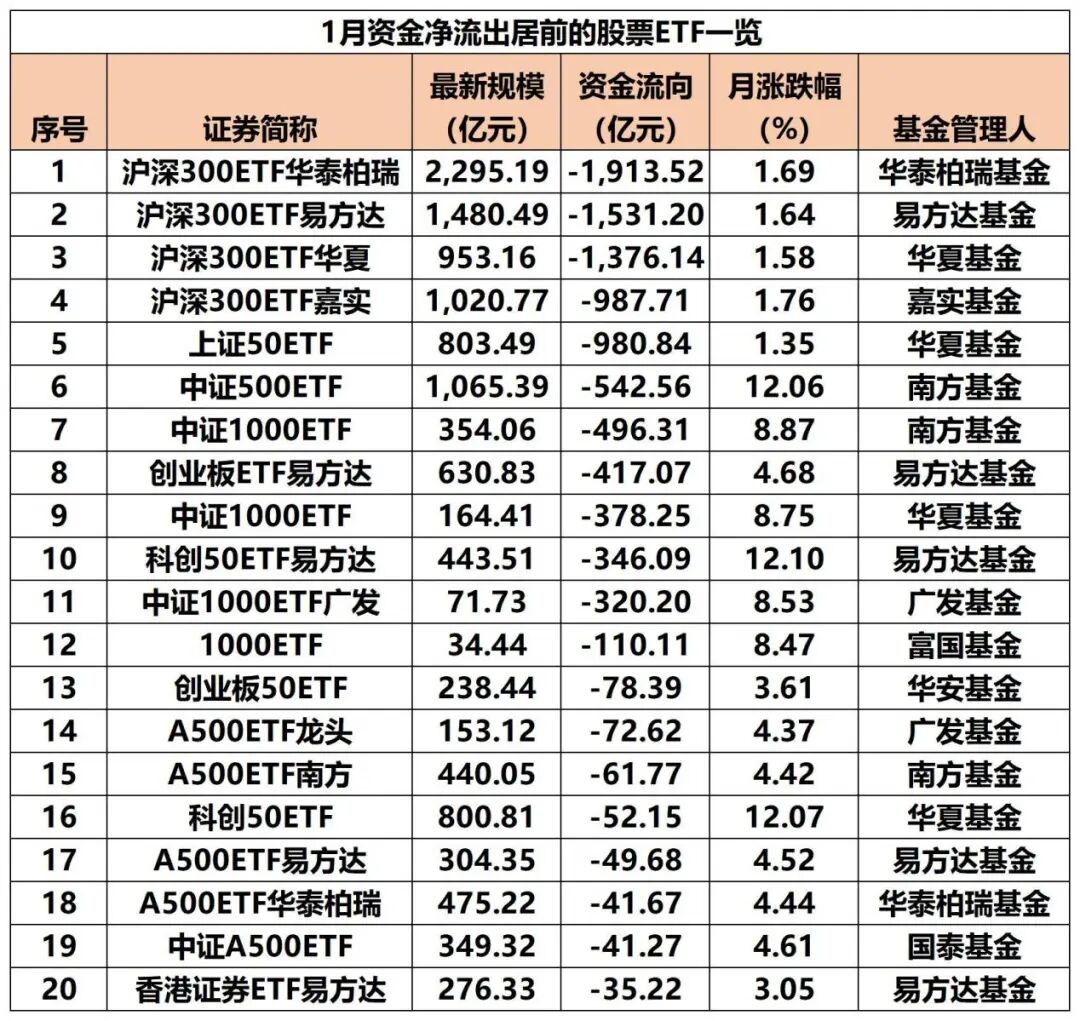
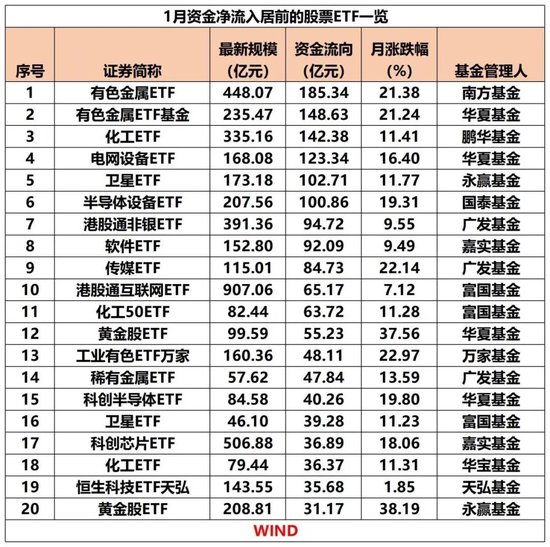
Core Viewpoint - In January, the stock ETF market experienced significant outflows, totaling over 790 billion yuan, with a notable net outflow of 37.20 billion yuan on January 30 alone [1][5][3]. Group 1: ETF Market Performance - On January 30, the Shanghai Composite Index fell over 2%, closing down 0.96% at 4117 points, with most industry sectors declining, while communication, electronics, and agriculture sectors showed gains [2][3]. - The total net outflow for all stock ETFs (including cross-border ETFs) in January reached 795.67 billion yuan [5]. - The largest inflows were seen in thematic ETFs such as non-ferrous metals, chemicals, electric grid equipment, and satellite ETFs, while broad-based ETFs like the CSI 300 ETF and SSE 50 ETF faced significant outflows [6][7]. Group 2: Specific ETF Data - On January 30, the SGE Gold 9999 index had the highest net inflow of 16.24 billion yuan, while the CSI 300 index saw the largest outflow of 73.23 billion yuan [3]. - Over the past five days, the SGE Gold 9999 index attracted over 20.2 billion yuan, and the chemical sector saw inflows exceeding 9.9 billion yuan [3]. - Leading fund companies like Huaxia Fund reported significant inflows in their non-ferrous metals ETF and chip ETF, with net inflows of 1.134 billion yuan and 430 million yuan, respectively [3]. Group 3: Sector Insights - The chemical industry ETF from E Fund saw a net inflow of 390 million yuan, while the chip ETF from E Fund had a net inflow of 170 million yuan [4]. - Analysts suggest that geopolitical uncertainties and rising nationalism may drive resource commodities into a super cycle, with metals like gold, silver, copper, aluminum, tungsten, and cobalt being particularly noteworthy [9]. - Investment opportunities are identified in sectors such as steel, building materials, chemicals, and silicon materials, which are expected to benefit from demand recovery [9].
20cm速递|午后拉升近1%!创业板新能源ETF华夏(159368)跌幅收窄,同类费率最低
Mei Ri Jing Ji Xin Wen· 2026-02-02 06:22
Core Viewpoint - The article highlights a significant shift in the photovoltaic industry towards healthy competition, driven by a meeting led by the Ministry of Industry and Information Technology, which aims to address irrational competition and promote a more sustainable development model [1]. Group 1: Market Performance - The ChiNext New Energy ETF (Hua Xia, 159368) experienced a rapid increase of nearly 1%, with a narrowed decline to 0.53%, while key holdings such as Jing Sheng Electromechanical rose over 7%, Yingjie Electric increased over 4%, and Penghui Energy gained over 3% [1]. - Over the past five days, the ChiNext New Energy ETF (Hua Xia, 159368) saw a net inflow of over 22 million yuan [1]. Group 2: Industry Developments - The meeting focused on "anti-involution" governance, signaling a clear policy shift aimed at breaking the cycle of irrational competition in the photovoltaic sector [1]. - The proposed measures include capacity regulation, standard guidance, and price enforcement, which are intended to transition the industry from disorderly expansion to a model driven by technology and healthy competition [1]. - This shift is expected to benefit leading companies by consolidating their advantages and improving the overall quality of industry development [1]. Group 3: ETF Characteristics - The ChiNext New Energy Index encompasses various segments of the new energy and electric vehicle industries, including batteries and photovoltaics, and is the only new energy index on the ChiNext with a 20% daily price fluctuation limit [1]. - The ChiNext New Energy ETF (Hua Xia, 159368) has high elasticity, with a potential price increase of up to 20%, and features the lowest fees, with a total management and custody fee of only 0.2% [1]. - The ETF has a nearly 90% allocation to energy storage and solid-state batteries, aligning with current market trends [1].

1月股票ETF资金累计净流出超7900亿元
Xin Lang Cai Jing· 2026-02-02 06:22
Core Viewpoint - In January, the stock ETF market in China experienced a significant net outflow of over 790 billion yuan, indicating a turbulent market environment with specific sectors showing varied performance [1][5][11]. Summary by Category Market Performance - On January 30, the Shanghai Composite Index fell by over 2%, closing down 0.96% at 4117 points, with most sectors declining, while communication, electronics, and agriculture sectors showed gains [2][12]. - The total net outflow for stock ETFs (including cross-border ETFs) on January 30 was 37.20 billion yuan, with industry theme ETFs and commodity ETFs seeing inflows of 112.63 billion yuan and 21.66 billion yuan, respectively [3][13]. ETF Inflows and Outflows - In January, the cumulative net outflow for all stock ETFs reached 795.67 billion yuan, with popular theme ETFs like non-ferrous metals, chemicals, electric grid equipment, and satellite ETFs attracting significant inflows [5][15]. - The largest net outflows were observed in broad-based ETFs such as the CSI 300 ETF, which saw a net outflow of 1,913.52 million yuan, followed by other major ETFs [7][17]. Sector-Specific Insights - The SGE Gold 9999 index recorded a net inflow of 16.24 billion yuan on January 30, while the CSI 300 index had a net outflow of 73.23 billion yuan [3][13]. - Notable inflows were seen in specific ETFs managed by major fund companies, with the non-ferrous metals ETF and chip ETF from Huaxia Fund seeing inflows of 11.34 billion yuan and 4.3 billion yuan, respectively [3][13][14]. Investment Opportunities - Analysts suggest that geopolitical uncertainties and rising national consciousness may drive resource commodities into a super cycle, highlighting metals like gold, silver, copper, and aluminum as having long-term investment value [8][18]. - The focus is also on sectors benefiting from domestic demand and self-sufficiency trends, such as engineering machinery, new energy vehicles, and AI computing, which are expected to provide structural investment opportunities [8][18].
ETF 周报:上周科创芯片 ETF 规模突破 680 亿元,沪深 300 净赎回超 2400 亿元-20260202
Guoxin Securities· 2026-02-02 06:19
- The report does not contain any quantitative models or factors for analysis[1][2][3]
20cm速递|钠电池产业化有望加速落地!创业板新能源ETF华夏(159368)近五日净流入超2200万元,同类费率最低
Mei Ri Jing Ji Xin Wen· 2026-02-02 06:00
Core Viewpoint - The article discusses the performance of the ChiNext New Energy ETF (159368) and highlights the growth potential of sodium batteries in the energy storage market, emphasizing their cost advantages and safety features compared to lithium batteries [1]. Group 1: ETF Performance - On February 2, the ChiNext New Energy ETF (159368) experienced a decline of 1.19%, while its holdings, including Jing Sheng Electric and Ying Jie Electric, saw gains of over 6% and 4% respectively [1]. - Over the past five days, the ChiNext New Energy ETF (159368) has seen a net inflow of over 22 million yuan [1]. Group 2: Sodium Battery Market - By 2025, sodium batteries are expected to achieve large-scale applications, with energy storage being the largest market, accounting for over 50% of the total [1]. - The annual shipment volume of sodium batteries is projected to nearly double year-on-year, with further significant growth anticipated in 2026 according to Xinluo Sodium Battery forecasts [1]. - Dongguan Securities predicts that by 2026, the cost of sodium batteries may drop below 0.40 yuan/Wh, approaching the current price level of lithium iron phosphate cells, with potential for further reduction to below 0.3 yuan/Wh due to technological advancements and economies of scale [1]. - Sodium batteries offer differentiated advantages over lithium batteries, including high safety, wide temperature range, and high discharge rates [1]. Group 3: ChiNext New Energy Index - The ChiNext New Energy Index primarily covers the new energy and electric vehicle industries, encompassing various sub-sectors such as batteries and photovoltaics [1]. - The ChiNext New Energy ETF (159368) is characterized by high elasticity, with a maximum fluctuation limit of 20%, and has the lowest fee structure, with a total management and custody fee of only 0.2% [1]. - The ETF has a nearly 90% allocation to energy storage and solid-state batteries, aligning with current market trends [1].
YiwealthSMI|万家基金7分钟作品上榜!抖音财经内容向深度价值转型?
Di Yi Cai Jing· 2026-02-02 05:12
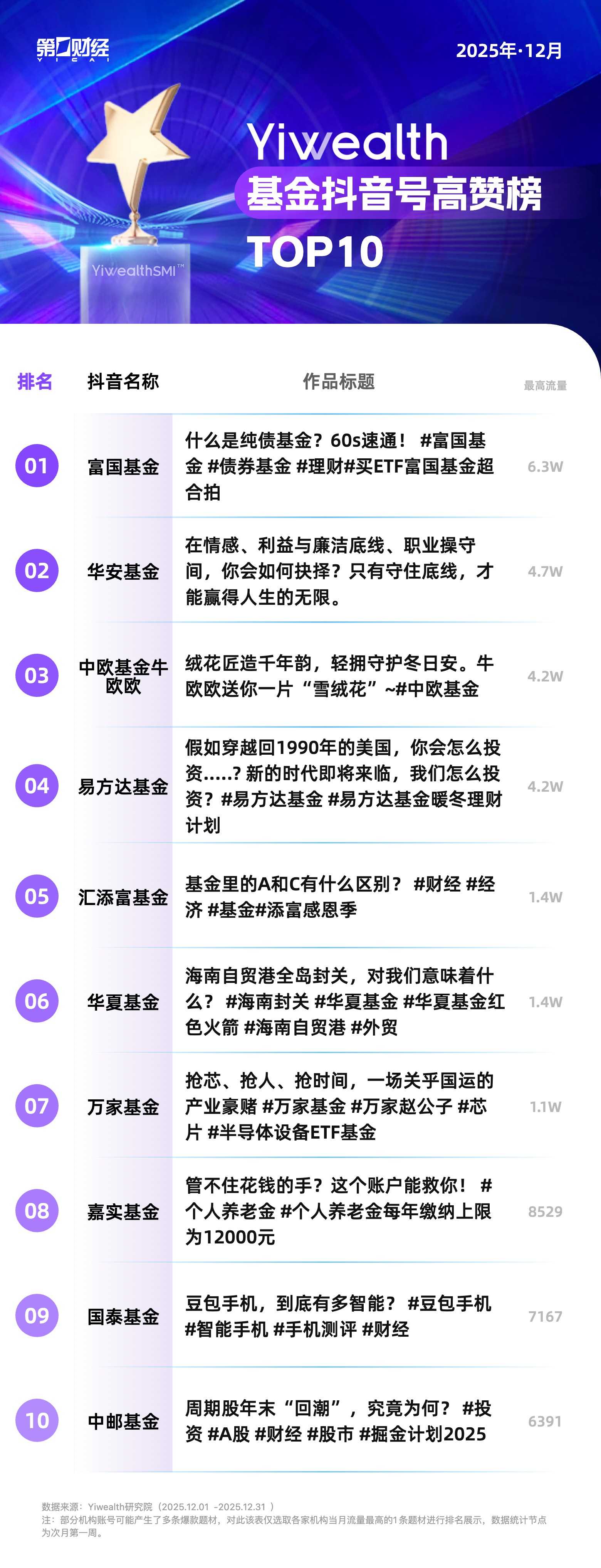
Group 1 - The core viewpoint of the article highlights the transformation of Douyin's financial content towards deeper value, as evidenced by the popularity of educational content and the shift in user preferences from fragmented information to high-value learning [2][6][7] - The top three funds in the December fund social media index are China Europe Fund, Huaxia Fund, and Huaan Fund, with several funds replacing others in the top rankings [1][2] - E Fund's video on the historical failure of investing in automotive and aviation stocks during the 1990s tech revolution received over 60,000 likes, indicating a strong user engagement with high-information content [2][6] Group 2 - Wanji Fund's seven-minute deep dive into the chip industry, analyzing its ten-year development and transition from blind expansion to precise investment, also garnered over 10,000 likes, showcasing the acceptance of in-depth analysis on Douyin [2][6] - Other funds like Fuguo Fund and Huitianfu Fund focused on basic investment knowledge, with Fuguo explaining pure bond funds and Huitianfu discussing the differences between A and C share classes, reflecting the educational trend in financial content [2][5] - The article notes that Douyin's financial content is increasingly characterized by its focus on hot topics, as seen in the analyses of current events like the Hainan Free Trade Port and the "Doubao" smartphone by Huaxia Fund and Guotai Fund [2][6]
增强版”指数基金马力全开“圈粉
Zheng Quan Ri Bao Zhi Sheng· 2026-02-02 04:26
Core Insights - The demand for precise and efficient investment tools is increasing among investors, driven by the high-quality development of public funds and profound market changes [1][2] - Enhanced index funds (指增基金) are rapidly growing, with fundraising expected to exceed 100 billion yuan by 2025, surpassing the total of the previous three years [1][3] Group 1: Growth and Popularity - Enhanced index funds are shedding their "niche" label and becoming mainstream investment options for investors [2] - By the end of 2025, the number of enhanced index funds reached 476, with total fundraising of 100.45 billion yuan, including 186 newly established funds in 2025 [3] - As of January 31, 2026, 10 new enhanced index funds have been launched, exceeding the same period in 2025 [3] Group 2: Competitive Advantages - Enhanced index funds combine passive and active investment strategies, aiming for stable excess returns while closely following market trends [3][4] - Over 80% of enhanced index funds achieved annual excess returns, with an average net value growth rate of 32.44% and an average excess return rate of 5.39% by the end of 2025 [4] - The flexibility in product development and operation of enhanced index funds allows smaller institutions to fill significant gaps in index product lines [4] Group 3: Challenges and Solutions - Despite rapid growth, enhanced index funds face challenges in maintaining stable excess returns, which is a common concern in the industry [6][7] - The complexity of quantitative strategies and performance attribution makes it difficult for ordinary investors to understand enhanced index funds quickly [7] - High management costs compared to ETFs may hinder competitive advantages in fee structures [7] Group 4: Future Prospects - Enhanced index funds are continuously upgrading through product innovation, model iteration, team collaboration, and ecosystem building [8] - The recent release of guidelines for performance benchmarks aligns with the systematic enhancement strategies of enhanced index funds, highlighting their value [9] - Future developments will focus on product innovation, strategy optimization, and expanding scenarios to cater to institutional investors and retail education [10]