南钢股份

Search documents
钢铁价格磨底蓄势,重申看多板块配置
Xinda Securities· 2025-11-16 06:03
Investment Rating - The report maintains a "Positive" investment rating for the steel industry, consistent with the previous rating [3]. Core Viewpoints - The steel sector is showing signs of recovery with a slight increase in prices and production, despite facing supply-demand imbalances and overall profit declines. The report suggests that the implementation of "stability growth" policies will support demand in real estate and infrastructure, leading to a potential marginal improvement in steel demand [4][6]. - The report highlights that the steel industry is expected to maintain a stable supply-demand situation, with a tightening supply due to policy expectations and increasing industry concentration. This is anticipated to create structural investment opportunities, particularly for high-margin special steel companies and leading enterprises with strong cost control [4][6]. Supply Situation - As of November 14, the capacity utilization rate for blast furnaces in sample steel companies is 88.8%, an increase of 0.99 percentage points week-on-week. Electric furnace utilization stands at 53.2%, up by 2.31 percentage points [26]. - The total production of five major steel products is 7.261 million tons, a week-on-week decrease of 229,800 tons, or 3.07% [26]. Demand Situation - The consumption of five major steel products is 8.606 million tons, reflecting a week-on-week decline of 63,300 tons, or 0.73% [34]. - The transaction volume of construction steel by mainstream traders is 100,000 tons, which is an increase of 370 tons, or 3.87% week-on-week [34]. Inventory Situation - Social inventory of five major steel products is 10.614 million tons, a week-on-week decrease of 136,100 tons, or 1.27%, but an increase of 30.61% year-on-year [42]. - Factory inventory of five major steel products is 4.160 million tons, down by 126,100 tons, or 2.94% week-on-week, and up by 6.35% year-on-year [42]. Price & Profit Situation - The comprehensive index for ordinary steel is 3,422.3 yuan/ton, with a week-on-week increase of 2.47 yuan/ton, but a year-on-year decrease of 6.85% [48]. - The profit for rebar produced in blast furnaces is -29 yuan/ton, an increase of 10 yuan/ton week-on-week, while the profit for electric arc furnace-produced construction steel is -155 yuan/ton, up by 7 yuan/ton week-on-week [54]. Raw Material Situation - The spot price index for Australian iron ore (62% Fe) is 786 yuan/ton, with a week-on-week increase of 10 yuan/ton [71]. - The price of primary metallurgical coke is 1,935 yuan/ton, reflecting a week-on-week increase of 55 yuan/ton [71]. Investment Recommendations - The report suggests focusing on regional leading enterprises with advanced equipment and environmental standards, such as Shandong Steel and Hualing Steel, as well as companies with excellent growth potential like Baosteel and Nanjing Steel [4].
钢铁周报20251116:西芒杜铁矿正式投产,新增产能逐步释放-20251116
Minsheng Securities· 2025-11-16 02:53
Investment Rating - The report maintains a "Buy" recommendation for several steel companies, including Hualing Steel, Baosteel, Nanjing Steel, and others, based on their projected earnings and valuations [3][4]. Core Insights - The Ximangdu Iron Mine has officially commenced production, with a total designed capacity of 120 million tons per year, expected to gradually ramp up over the next 2-3 years. This high-quality iron ore resource is anticipated to lower iron ore prices, alleviating pressure on steel mill profits [3][4]. - Steel prices have decreased, with notable declines in rebar and medium plates, while hot-rolled and cold-rolled prices remained stable [1][9]. - Steel production has decreased, with a total output of 8.34 million tons for major steel products, down by 223,600 tons week-on-week. Total social inventory also fell by 136,300 tons [2][6]. Summary by Sections Price Trends - As of November 14, 2025, the price of 20mm HRB400 rebar in Shanghai is 3,170 CNY/ton, down 30 CNY/ton from the previous week. Other steel products also saw price changes, with hot-rolled at 3,280 CNY/ton and cold-rolled at 3,770 CNY/ton remaining stable [1][9]. Production and Inventory - The total production of major steel products was 8.34 million tons, with rebar production specifically reduced to 2 million tons, a decrease of 85,400 tons week-on-week. Total social inventory decreased to 10.602 million tons [2][6]. Profitability - Steel margins have declined, with rebar, hot-rolled, and cold-rolled margins decreasing by 29 CNY/ton, 37 CNY/ton, and 39 CNY/ton respectively. Electric arc furnace steel margins also saw a slight decrease of 2 CNY/ton [1][3]. Investment Recommendations - The report recommends several companies based on their market positioning and expected performance, including Hualing Steel, Baosteel, Nanjing Steel, and others in various segments such as special steel and pipe materials [3][4].


普钢板块11月14日跌0.35%,杭钢股份领跌,主力资金净流出1.87亿元
Zheng Xing Xing Ye Ri Bao· 2025-11-14 08:49
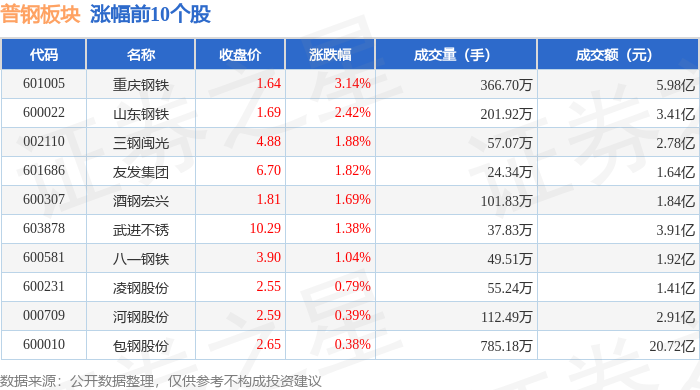
Market Overview - On November 14, the steel sector declined by 0.35% compared to the previous trading day, with Hangzhou Steel leading the decline [1] - The Shanghai Composite Index closed at 3990.49, down 0.97%, while the Shenzhen Component Index closed at 13216.03, down 1.93% [1] Individual Stock Performance - Chongqing Steel (601005) saw a closing price of 1.64, up 3.14% with a trading volume of 3.67 million shares and a transaction value of 598 million [1] - Shandong Steel (600022) closed at 69.1, up 2.42% with a trading volume of 2.02 million shares and a transaction value of 341 million [1] - Hangzhou Steel (600126) closed at 9.05, down 2.69% with a trading volume of 822,300 shares and a transaction value of 752 million [2] Capital Flow Analysis - The steel sector experienced a net outflow of 187 million from main funds, while retail investors saw a net inflow of 184 million [2] - Major stocks like Wujin Stainless Steel (603878) had a net outflow of 40.17 million from main funds, while retail investors had a net inflow of 41.04 million [3] - Huazhong Steel (000932) experienced a net inflow of 31.31 million from main funds but a net outflow of 23.20 million from retail investors [3]


新兴产业领跑、传统产业焕新 上市公司结构向好创新向优
Jing Ji Ri Bao· 2025-11-14 00:27
Core Insights - The A-share market is experiencing a dual growth trend with emerging industries and traditional sectors both showing positive performance amid favorable macro policies and challenges such as weak global economic growth and insufficient domestic demand [1][2][5] Emerging Industries - New generation information technology, new energy, and new materials are leading the A-share market, with companies in these sectors showing strong performance [2] - In the first three quarters, 588 companies on the Sci-Tech Innovation Board achieved a total revenue of 1.01 trillion yuan, a year-on-year increase of 6.6% [2] - Key technological breakthroughs are driving the performance of technology companies, with significant advancements in biomedicine, high-end equipment, and communication sectors [2][3] Traditional Industries - Traditional industries are also innovating and improving efficiency, with companies like Midea Group and BYD showing growth in smart home and electric vehicle sales, respectively [5][6] - The steel and cement industries are optimizing supply-demand balances, with companies like Nanjing Steel and Anhui Conch Cement reporting significant profit increases due to improved pricing and cost management [7] R&D Investment - Increased R&D investment is providing strong internal momentum for technology companies, with the R&D intensity for the ChiNext, Sci-Tech Innovation Board, and Beijing Stock Exchange reaching 4.54%, 11.22%, and 4.42% respectively [4] - Companies like Zhongrun Optical are focusing R&D efforts on new product innovation, leading to substantial growth in core technology competitiveness [4] Investor Return Awareness - Companies are enhancing their awareness of investor returns, with an increase in cash dividend announcements and share buybacks, reflecting a commitment to shareholder value [8][9] - As of October 31, 2023, 1,033 companies announced cash dividend plans totaling 734.9 billion yuan, with 89 companies planning dividends exceeding 1 billion yuan [8] Future Outlook - Despite external uncertainties, many companies maintain an optimistic outlook for future growth, supported by proactive strategies and scientific planning [10]
2025年南京市企业百强榜单发布 南钢蝉联综合百强及制造业百强榜首
Nan Jing Ri Bao· 2025-11-14 00:17
Core Insights - The 2025 Nanjing Top 100 Enterprises list was released, showcasing the growth and development of the "Top 100 family" in Nanjing over the past seven years [1] Group 1: Rankings and Revenue - Nanjing Iron and Steel Group topped the comprehensive and manufacturing sectors with a revenue of 180.793 billion yuan [1] - Jiangsu Bank and Jiangsu Fuel Group led the service and growth sectors, respectively [1] - The threshold for entry into the comprehensive top 100 increased from 4.666 billion yuan to 5.176 billion yuan, while the manufacturing threshold rose from 1.044 billion yuan to 1.165 billion yuan [1] Group 2: Industry Composition - The comprehensive top 100 includes 59 service enterprises, an increase of 6 from the previous year, while manufacturing and construction sectors have 36 and 5 enterprises, respectively [1] - The service sector's dominance is reinforced, with notable growth in financial services, business services, and software and information technology services [1] Group 3: Financial Performance - The total revenue of the comprehensive top 100 enterprises was 2,537.5 billion yuan, remaining stable compared to last year, while total assets reached 11,739.5 billion yuan, reflecting a year-on-year growth of 7.58% [2] - Research and development expenses amounted to 27.217 billion yuan, with an average increase in R&D expenses over the past three years [2] - The average R&D intensity for manufacturing top 100 enterprises was 4.17%, indicating a clear trend towards high-end and intelligent transformation [2] Group 4: Ownership Structure - Among the comprehensive top 100, there are 58 state-owned enterprises and 32 private enterprises, with their respective revenue shares being 72.34% and 21.5% [2] - In the manufacturing sector, there are 30 state-owned and 45 private enterprises, with revenue shares of 60.6% and 22.21% [2] - The service sector comprises 64 state-owned and 35 private enterprises, with revenue shares of 68.94% and 30.1% [2]

上市公司结构向好创新向优
Jing Ji Ri Bao· 2025-11-13 22:10
Core Viewpoint - The A-share market is experiencing a dual growth trend in both emerging and traditional industries, driven by favorable macro policies and technological innovation, despite facing challenges such as weak global economic growth and insufficient domestic demand [1] Emerging Industries - Emerging industries, particularly in hard technology sectors like new generation information technology, new energy, and new materials, are showing strong performance, with 588 companies on the Sci-Tech Innovation Board achieving a total revenue of 1.01 trillion yuan, a year-on-year increase of 6.6% [2] - Key technological breakthroughs are driving the performance of technology companies, with 26 new Class 1 drugs approved in the biopharmaceutical sector and significant advancements in high-end equipment and communication technologies [2] - Companies like Mingzhi Electric and Obit Zhongguang are capitalizing on opportunities in AI and robotics, with revenue growth of 11.66% and 103.5% respectively in the first three quarters [3] R&D Investment - Increased R&D investment is providing strong internal momentum for technology companies, with R&D intensity reaching 4.54% for the ChiNext, 11.22% for the Sci-Tech Innovation Board, and 4.42% for the Beijing Stock Exchange [4] - Companies are focusing on innovation and technology breakthroughs to enhance their competitive edge, as seen with Zhongrun Optical's 50.47% increase in R&D spending [4] Traditional Industries - Traditional industries are also evolving, with companies like Midea Group and Seres adapting to new technologies and applications, resulting in a 13% increase in smart home revenue and significant sales in the electric vehicle sector [5][6] - The steel and cement industries are optimizing supply-demand balances, with companies like Nanjing Steel and Anhui Conch Cement reporting improved profit margins and net profit growth due to strategic adjustments [7] Investor Return Awareness - There is a growing awareness among companies regarding investor returns, with an increase in cash dividend announcements and share buybacks, totaling 734.9 billion yuan in cash dividends announced by 1,033 companies [8] - Companies like Yili Group are actively engaging in share buybacks and dividend distributions to enhance shareholder value [8][9] Future Outlook - Despite external uncertainties, many companies maintain an optimistic outlook for future growth, supported by proactive strategies in R&D, market expansion, and operational efficiency [10]
南钢股份(600282):赛道切换,基业功成
GUOTAI HAITONG SECURITIES· 2025-11-13 12:12
Investment Rating - The report assigns a "Cautious Accumulate" investment rating with a target price of 6.56 CNY, compared to the current price of 5.56 CNY [5]. Core Insights - The company is positioned in advanced steel materials, benefiting from the trend of manufacturing upgrades in China. Its industrial layout mitigates cyclical fluctuations, leading to superior profitability within the sector. There is an expectation of reduced competition in the steel industry by 2026, and the company enjoys advantages in valuation and dividend yield [2][11]. Financial Summary - Total revenue is projected to be 72.5 billion CNY in 2023, decreasing to 61.8 billion CNY in 2024, with a gradual recovery to 67.9 billion CNY by 2027. Net profit attributable to the parent company is expected to grow from 2.1 billion CNY in 2023 to 3.2 billion CNY in 2027, reflecting a compound annual growth rate of 21.7% from 2025 to 2026 [4][45]. - Earnings per share (EPS) are forecasted to increase from 0.34 CNY in 2023 to 0.51 CNY in 2027, with a net asset return rate projected to remain around 10% [4][45]. Company Positioning and Strategy - The company has a clear strategic focus on advanced steel materials, with significant R&D investments that exceed the industry average. In 2024, R&D expenses are expected to account for 3.94% of revenue, indicating a strong commitment to innovation [15][17]. - The company has successfully transitioned its product mix, with less than 10% of its steel products used in real estate and infrastructure, focusing instead on high-end manufacturing sectors [17][18]. Market Dynamics - The company is well-positioned to benefit from growth in downstream industries, with approximately 90% of its products utilized outside real estate and infrastructure, including automotive, marine, and renewable energy sectors [28][29]. - Export volumes and proportions are increasing, with export margins significantly higher than domestic sales margins, enhancing overall profitability [34]. Financial Health - The company maintains a stable debt ratio around 60%, with a strong cash flow from operations. The dividend payout ratio has consistently exceeded 50% since 2019, with a projected dividend yield of approximately 4% based on 2025 earnings [39][40]. Profitability Outlook - The report forecasts net profits for 2025-2027 to be 2.752 billion CNY, 3.006 billion CNY, and 3.156 billion CNY respectively, with corresponding EPS of 0.45 CNY, 0.49 CNY, and 0.51 CNY. The company’s valuation is considered advantageous compared to peers, with a potential 20% increase in valuation expected [45][48].
我国煤炭运输体系实现结构性变革,国企红利ETF(159515)盘中蓄势
Xin Lang Cai Jing· 2025-11-13 03:11
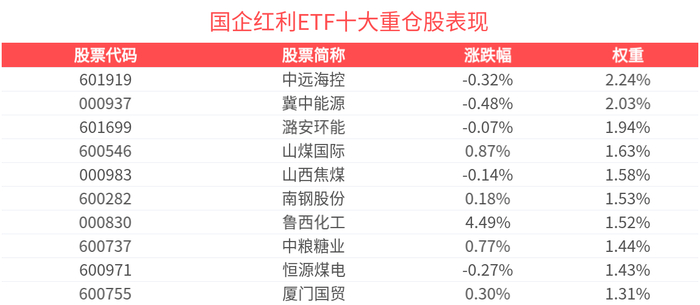
Core Viewpoint - The China Coal Economic Research Association reports significant structural changes in the coal transportation system during the "14th Five-Year Plan" period, enhancing the national allocation capacity of coal resources and promoting a smart and green transformation in coal transportation [1][2]. Group 1: Market Performance - As of November 13, 2025, the CSI State-Owned Enterprises Dividend Index (000824) decreased by 0.27%, with component stocks showing mixed performance [1]. - Leading gainers included Luxi Chemical (000830), while Sichuan Road and Bridge (600039) led the declines [1]. Group 2: Coal Transportation Developments - The National Railway Group reported that coal transportation reached 1.57 billion tons in the first nine months of the year, a year-on-year increase of 11.1%, with thermal coal accounting for 1.1 billion tons, up 17% [2]. - The successful operation of the new Shuo Railway, capable of 20,000-ton heavy-load transport, marks a significant advancement in coal transportation capabilities [1][2]. Group 3: Investment Strategies - CITIC Securities suggests that in the context of a weak macroeconomic recovery, high dividend strategies remain attractive, particularly for large-cap stocks in sectors like coal and photovoltaics [2]. - The CSI State-Owned Enterprises Dividend ETF closely tracks the CSI State-Owned Enterprises Dividend Index, which includes 100 listed companies with high and stable cash dividend yields [2].





研判2025!中国抗震支架行业发展背景、产业链、市场规模、竞争格局和未来趋势分析:建筑安全需求拉动,抗震支架行业快速增长[图]
Chan Ye Xin Xi Wang· 2025-11-13 01:17
Core Insights - The seismic support bracket market in China is experiencing rapid growth due to increased national emphasis on building safety, with the market size projected to reach 8.942 billion yuan in 2024 [1][7]. Industry Overview - Seismic support brackets are components designed to enhance the seismic performance of buildings, primarily aimed at reducing damage from earthquakes [2]. - These brackets are part of building seismic facilities and consist of anchoring bodies, reinforcements, connectors, and supports, which work together to form a complete support system [2]. Industry Development Background - China is one of the countries most affected by seismic activity, accounting for 33% of global continental earthquakes, with over 95% of casualties resulting from building collapses during such events [4]. - The introduction of new seismic design standards post-2008 Wenchuan earthquake has led to a significant increase in the adoption of seismic support brackets in construction projects [6]. Industry Chain - The seismic support bracket industry consists of upstream raw materials (steel, aluminum, plastic, rubber), midstream manufacturing, and downstream applications across various building types [5]. - Steel is the primary material used due to its high strength and ability to absorb seismic energy, with China's steel production reaching 1.104 billion tons in the first nine months of 2025, a 5.4% increase year-on-year [5][6]. Current Industry Status - The seismic support bracket market has expanded from public buildings to commercial complexes, data centers, industrial plants, and residential buildings, particularly in new infrastructure projects like 5G base stations [1][7]. Competitive Landscape - The industry is structured into three tiers: international giants (e.g., Hilti, Fischer, Walraven) dominate the high-end market, domestic leaders (e.g., Jiupeng Hengye, Shengnian Technology) are the core driving force, and small enterprises compete primarily on price [7]. Key Companies - Jiupeng Hengye Group Co., Ltd. specializes in the research, production, and sales of seismic support brackets and has established a comprehensive operational model [8]. - Shengnian Technology Co., Ltd. focuses on earthquake protection technology and offers integrated solutions for various applications, including seismic support brackets [9]. Industry Development Trends - The seismic support bracket industry is expected to see technological innovations and upgrades, with new materials and smart technologies enhancing performance and reducing costs [11]. - The industry is also moving towards more environmentally friendly and sustainable practices, presenting new growth opportunities [11].

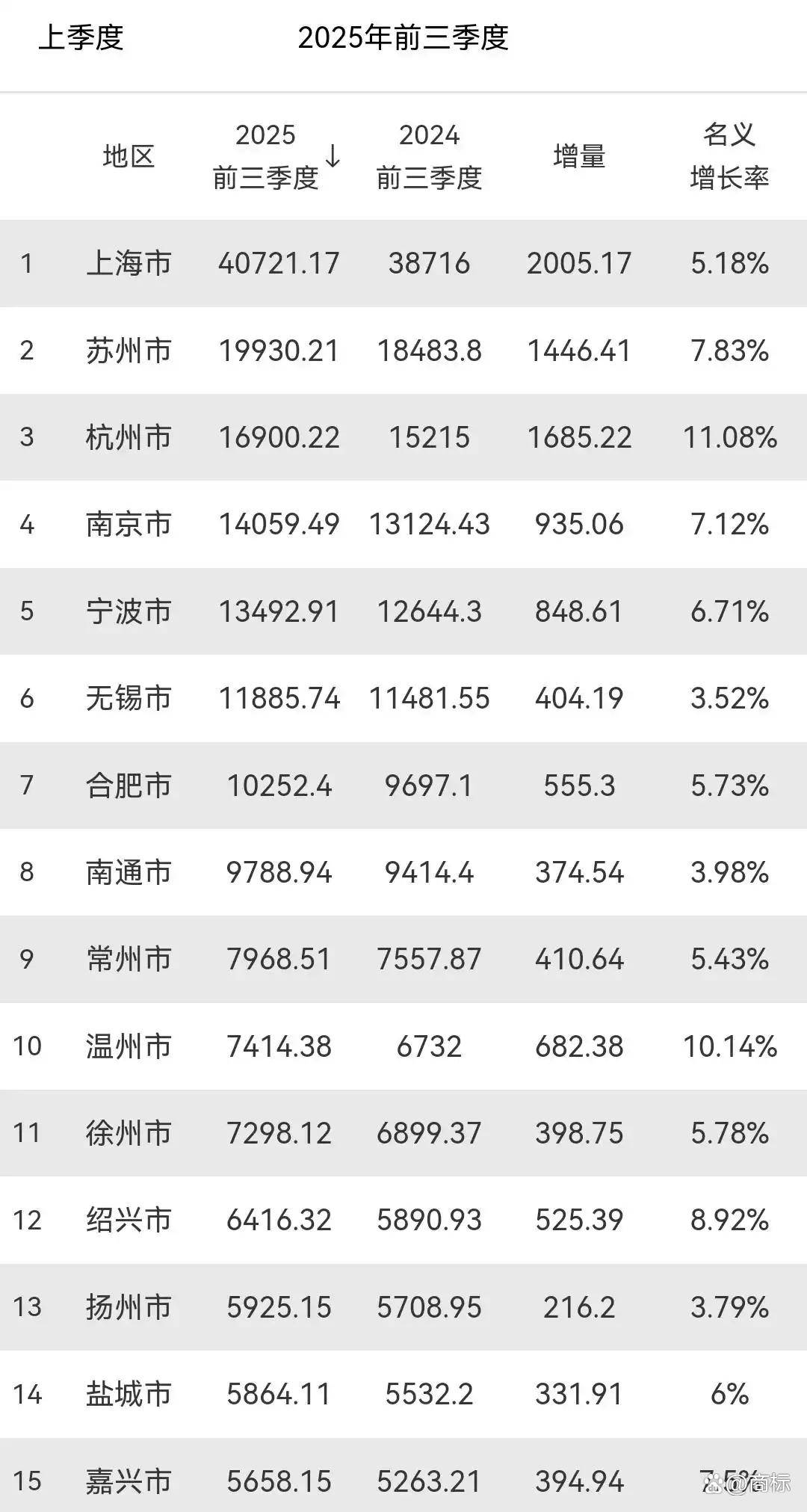
最新GDP!长三角15强城市洗牌:南京超1.4万亿,合肥突破万亿,温州逆袭徐州!
Sou Hu Cai Jing· 2025-11-12 19:05
Core Insights - The Yangtze River Delta region continues to demonstrate strong economic resilience, driven by national strategies and regional advantages, such as the deepening of integration and technological innovation [1] - The latest GDP rankings reveal intense competition among mid-tier cities, with Nanjing surpassing 1.4 trillion yuan and Hefei entering the "trillion club" for the first time [1][2] - The economic reshuffling reflects not just numerical growth but also profound changes in regional development logic [1] Economic Performance - Shanghai remains the largest city with a GDP of 40.72 billion yuan, growing by 5.18% year-on-year [2] - Suzhou and Hangzhou follow with GDPs of 19.93 billion yuan and 16.90 billion yuan, respectively, with growth rates of 7.83% and 11.08% [2] - Nanjing's GDP reached 14.06 billion yuan, marking a 7.12% increase, driven by its dual-core development strategy focusing on integrated circuits and biomedicine [3][4] - Hefei's GDP of 10.25 billion yuan signifies its entry into the trillion-yuan club, with a growth of 5.73%, supported by advancements in quantum information and new energy vehicles [6] - Wenzhou's GDP of 7.41 billion yuan, with a remarkable growth rate of 10.14%, showcases the vitality of its private economy [7] Sectoral Insights - Nanjing's economic resilience is attributed to its focus on high-tech industries, with over 500 new high-tech enterprises established and a 15% increase in patent authorizations [3][4] - Hefei benefits from policy incentives and a focus on technology transfer, achieving a 35% technology conversion rate [6] - Wenzhou's economic model has evolved, with significant growth in the low-voltage electrical appliance industry and a 40% increase in photovoltaic exports [7] - The digital economy in Wenzhou accounts for 38% of its GDP, surpassing Xu Zhou's 31%, indicating a shift towards more innovative economic activities [7] Competitive Dynamics - The competition among cities in the Yangtze River Delta has shifted from a single-pole leadership to multi-core collaboration, with Shanghai's influence and the unique characteristics of smaller cities [10] - The essence of regional competition lies in the interplay of innovation ecosystems and openness, as cities like Hefei and Nanjing vie for leadership in technology and infrastructure [10] - The GDP reshuffling serves as a reminder that urban growth is a result of coordinated efforts among policies, industries, and local initiatives [10]