
幻方

Search documents
梁文锋的幻方进入量化新“四大天王”
21世纪经济报道· 2025-07-09 15:18
Core Viewpoint - The performance of large private equity firms in the A-share market has been outstanding in the first half of 2025, with an average return of 10.93% among the top 50 firms, and 94% of them achieving positive returns [1][3]. Group 1: Overall Performance - As of June 30, 2025, the average return for 50 large private equity firms was 10.93%, with 47 firms achieving positive returns, representing over 90% [3]. - Among the 47 firms with positive returns, 20 had returns below 10%, 21 had returns between 10% and 19.99%, and 6 firms achieved returns of 20% or more [3]. Group 2: Strategy Performance - The average return for 14 large subjective private equity firms was 5.51% in the first half of 2025 [4]. - Notable firms like Shenzhen Rido Investment and Shanghai Harmony Huiyi Asset Management performed well under subjective strategies, emphasizing the importance of fundamental analysis and long-term holdings [5]. Group 3: Quantitative Private Equity - The performance of large quantitative private equity firms was particularly impressive, with an average return of 13.72% among 32 firms, all of which reported profits [7]. - The success of quantitative firms is attributed to their strategy models aligning well with the current market trends, particularly the small-cap growth style [7][8]. - The number of large quantitative private equity firms increased to 39, with over 2,300 new products registered in the first half of 2025 [8][9]. Group 4: Market Outlook - Large private equity firms are optimistic about the market in the second half of 2025, citing opportunities in Chinese assets due to global capital rebalancing [11]. - Firms like Xing Shi Investment expect A-shares to benefit from a combination of emotional and fundamental recovery, supported by ample liquidity and reasonable valuations [11]. - Emerging growth opportunities are anticipated to expand beyond new consumption and innovative pharmaceuticals into technology and cyclical industries, with a focus on AI, semiconductor equipment, and high-end manufacturing [12].


百亿私募半年“答卷”,梁文锋的幻方进入量化新“四大天王”
2 1 Shi Ji Jing Ji Bao Dao· 2025-07-09 12:36
Group 1 - The core viewpoint of the articles highlights the strong performance of billion-level private equity firms in the first half of 2025, with an average return of 10.93% among 50 firms, and 94% of them achieving positive returns [1][2] - Among the billion-level quantitative private equity firms, all 32 firms with performance data reported profits, with an average return of 13.72%, indicating a significant advantage in this sector [1][5] - The emergence of new leading quantitative firms, referred to as the "Four Kings," is noted, with management scales between 60 billion to 70 billion, while Lingjun has fallen to the second tier [1][6] Group 2 - The subjective private equity firms showed an average return of 5.51%, with some firms like Shenzhen Rido Investment and Shanghai Harmony Huiyi Asset Management performing well [3][4] - The market environment is described as resilient despite external disturbances, with a positive outlook for the second half of 2025, focusing on sectors like artificial intelligence, new consumption, innovative pharmaceuticals, and dividend assets [1][8] - The quantitative private equity sector has seen a significant increase in management scale, with 39 firms now classified as billion-level, and over 2300 new quantitative products registered in the year [7][8] Group 3 - The overall sentiment among billion-level private equity firms for the second half of 2025 is optimistic, driven by the resilience of Chinese manufacturing and trade, as well as the influx of international capital into the Hong Kong market [8][9] - Investment opportunities are expected to expand from new consumption and innovative pharmaceuticals to technology and cyclical industries, with a focus on AI, domestic semiconductor equipment, and high-end manufacturing [9]
央行、银保监会等多部门密集释放利好!地产行情能走多远 ?
摩尔投研精选· 2025-07-07 10:41
Core Viewpoint - The new quantitative regulations have led to a significant decrease in trading volume, with a total turnover of 1.21 trillion yuan, down over 200 billion yuan, indicating a serious contraction in market activity [1] Group 1: Market Reactions - The initial impact of the new quantitative regulations has caused a short-term pain in the market, but it is expected to benefit the healthy development of the market in the long run [3] - Leading institutions are shifting towards fundamental quantitative strategies and AI stock selection models, which will favor long-term investors in the future [4] Group 2: Power Sector Insights - The power sector is experiencing a resurgence, with multiple stocks hitting the daily limit up due to high temperatures and increased electricity demand during the summer peak [5][6] - National statistics show that on July 4, the maximum national power load reached 1.465 billion kilowatts, an increase of approximately 200 million kilowatts from the end of June and nearly 150 million kilowatts year-on-year, marking a historical high [7] - Analysts suggest focusing on the power sector due to the rising electricity load and the positive performance of thermal power companies, which have seen nearly 70% of listed companies report year-on-year profit growth in Q1, largely due to falling coal prices [9] Group 3: Real Estate Sector Developments - The real estate sector has become active following a series of favorable policies released since June by the central bank and other regulatory bodies, leading to a warming market atmosphere [11] - Analysts recommend focusing on high-quality residential properties, particularly in core cities with strong land acquisition capabilities and product strength, as they are likely to benefit from the current policy environment [11]

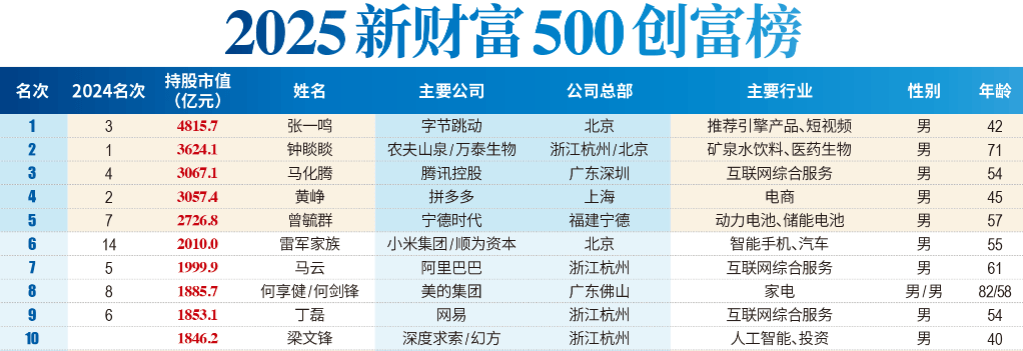
超1846亿!DeepSeek梁文锋成国内最年轻前十大富豪,张一鸣以4816亿身家问鼎首富
Sou Hu Cai Jing· 2025-06-24 01:18
Group 1 - The total market value of the 500 entrepreneurs or families on the list reached 13.7 trillion yuan, an increase of 11% year-on-year, with an average of 273.8 million yuan and a threshold of 66.2 million yuan for entry [3] - Zhang Yiming topped the list with a net worth of 481.57 billion yuan, marking a significant increase of over 141.37 billion yuan compared to last year, primarily due to his stake in ByteDance [3][4] - ByteDance's revenue reached 155 billion USD (approximately 1.13 trillion yuan) last year, growing by 29% year-on-year, surpassing Alibaba and Tencent [4] Group 2 - The AI sector has significantly influenced the wealth dynamics among tech entrepreneurs, with ByteDance's valuation being raised by various investment firms to between 400 billion and 450 billion USD [4][5] - DeepSeek, founded by Liang Wenfeng, has gained substantial attention in the AI field, with a user base exceeding 180 million, making it the leading AI application in China [7][8] - The TMT (Technology, Media, and Telecommunications) sector remains dominant, with 110 entrepreneurs listed, contributing to a total wealth of 3.34 trillion yuan, accounting for one-fourth of the total wealth of all listed individuals [14][15] Group 3 - The chip industry saw a significant presence on the list, with 36 entrepreneurs from various segments, including design and manufacturing, reflecting the growing importance of AI and semiconductor technology [15][16] - Companies like Xiaomi and Tencent have also benefited from AI advancements, with Xiaomi's stock price doubling in the past year due to its AI-driven products [12][13] - The emergence of new entrepreneurs in the AI and robotics sectors indicates a shift towards innovative technologies, with several startups making their mark on the wealth list [16]






下一个十年,AI的大方向
Hu Xiu· 2025-06-12 01:16
Core Insights - The article reflects on the evolution of artificial intelligence (AI) over the past decade, highlighting the rise and decline of major players in the industry, particularly the "AI Four Dragons" [3][4] - It suggests that the next decade (2025-2035) may shift focus from visual recognition to visual generation technologies [4][5] - The article discusses the emergence of various AI models in China, including those from major companies like Baidu, Alibaba, and Tencent, indicating a competitive landscape [4][6] Industry Developments - The AI landscape has seen significant advancements in large models, with a variety of applications emerging, such as text generation, audio generation, image generation, and video generation [4][5][6] - The article notes that these advancements are being monetized, with many companies starting to charge for their services, except for code generation in China [6] Historical Milestones - Key milestones in AI development include the introduction of the Transformer model in 2017, which revolutionized the field by consolidating various specialized models into a more unified approach [7] - The launch of ChatGPT in 2023 marked a significant turning point, prompting major companies like Google to accelerate their AI initiatives [8] - The article also references the release of OpenAI's Sora visual model in 2024, which highlighted the industry's challenges and led to renewed focus on text and context generation [8] Philosophical Considerations - The article raises questions about the future direction of AI, debating whether the next decade will be dominated by Artificial General Intelligence (AGI) or AI-Generated Content (AIGC) [11] - It draws parallels with the skepticism surrounding reusable rocket technology, suggesting that innovation often faces initial resistance before its value is recognized [13][14][15]
私募备案数量井喷!77%增速!黑翼、宽德领衔,市场信心回来了?
私募排排网· 2025-06-09 08:07
Core Viewpoint - The private equity securities industry in China is experiencing a significant growth trend, with a 45.03% increase in the number of registered products compared to the same period last year, driven by multiple factors including market recovery and regulatory improvements [2][3]. Group 1: Industry Growth - As of May 31, 2025, a total of 4,361 private equity securities products have been registered, marking a monthly increase of 870 products in May alone, which represents a year-on-year growth of 77.19% [2][3]. - The recovery of the A-share market, supported by favorable technology innovation policies and expectations of industrial upgrades, has led to a significant increase in market risk appetite and investor sentiment [3]. Group 2: Regulatory Environment - The continuous optimization of the regulatory environment, including improvements in compliance systems and transparency in information disclosure, has provided a more stable and predictable development environment for market participants, boosting investor confidence [3]. Group 3: Product Performance - The performance of private equity securities products has been impressive, particularly in quantitative products, which have demonstrated significant excess return capabilities, attracting more capital [3]. Group 4: Strategy Distribution - Stock strategies dominate the market, with 2,749 stock strategy products accounting for 63.04% of the total registered products, indicating their core asset allocation status [4]. - Multi-asset strategies and futures/derivatives strategies follow, with 646 and 510 products respectively, showing a growing demand for diversified asset allocation [4]. Group 5: Quantitative Products - Since the beginning of 2025, a total of 1,930 quantitative private equity products have been registered, representing 44.26% of the total market, highlighting the importance of quantitative strategies in the private equity sector [6]. - Within quantitative products, stock strategies are predominant, with 1,339 products registered, making up 69.38% of the total quantitative products [6]. Group 6: Active Institutions - A total of 1,558 private equity institutions have registered products this year, with 1,177 institutions managing between 0-10 billion, 259 managing between 10-50 billion, and 122 managing over 50 billion [9]. - Among the institutions, 190 have been particularly active, registering at least five products, with 66 institutions registering at least ten products [9]. Group 7: Leading Firms - The top quantitative private equity firms include Heiwing Asset and Kuande Private Equity, with 87 and 79 products registered respectively, leading the market in terms of product registration [9][12].

头部梯队持续洗牌,量化百亿私募增至38家
2 1 Shi Ji Jing Ji Bao Dao· 2025-05-16 13:02
Group 1 - The core viewpoint of the articles highlights significant changes in the private equity sector, particularly among the billion-yuan private equity firms, with a notable increase in the number of firms and a shift towards quantitative strategies [1][3][6] - As of May 12, the number of billion-yuan private equity managers has risen to 87, up from 84 in March, indicating a competitive environment where some firms are thriving while others are falling behind [1][3] - The proportion of quantitative firms within the billion-yuan private equity sector has increased, now accounting for over 40%, reflecting a shift in investment strategies [1][3] Group 2 - The private equity industry in China has developed a multi-layered ecosystem with 7,893 managers and a total management scale of 5.24 trillion yuan, showcasing a diverse range of investment strategies [2][6] - The trend of headquarter concentration is accelerating, with larger firms building barriers through research and technology investments, while smaller firms face increasing survival challenges [2][6] - Recent data shows that among 49 billion-yuan private equity firms with performance reports in April, the average return was -0.46%, with only 34.69% achieving positive returns, indicating a challenging market environment [4][6] Group 3 - The growth of quantitative private equity is characterized by rapid scale expansion and strategy differentiation, with dominant strategies being index-based and quantitative stock selection [4][5] - The average return for mixed strategy (subjective + quantitative) billion-yuan private equity firms was the highest at 0.04%, while subjective long-only strategies suffered a significant decline [4] - The private equity sector is transitioning from scale expansion to quality improvement, with regulatory changes pushing for more compliance and stability among firms [6][7]
百亿量化私募AI探索新动向:灵均投资试水AI应用
2 1 Shi Ji Jing Ji Bao Dao· 2025-05-13 09:06
在大模型底层创新趋近平稳之际,有百亿量化私募助力AI应用闯进了名片场景。 近日,灵均投资发起了"点点同行,乡乡同兴——AI点亮乡村振兴"公益行动,并推出"点点AI名片"的垂 类应用。以灵均投资董事长蔡枚杰作为创始人的点富科技,参与了这一应用的技术研发和平台的搭建。 "能对话、有科普"是点点名片的特色。据了解,使用者可以在点点名片中构建自己的"AI名片",也可以 通过AI技术与其他人的名片进行互动交流。 21世纪经济报道记者 黎雨辰 北京报道 当前,中国AI技术发展正处于快车道,制度与市场的双重优势为技术落地提供了良好环境。政策层 面,"新型举国体制"下的算力统筹与科技专项支持加速技术转化;市场层面,2.5 亿生成式AI用户推动 着AI与垂类领域的产业升级、造福社会。 而在其中,国内头部量化私募的资金实力、算力资源以及人才储备,使其具备了进入AI领域的潜力。 从投研的角度出发,事实上2017年以来,AI就已开始走入量化行业,并在提升数据处理分析能力、优 化模型构建与策略创新等方面大显身手。 "AI支持量化行业发展的根源在于对算力的提升。"一位头部量化人士向记者指出,"在策略的制定方 面,AI推动了数据处理分析深 ...
对话印奇:节奏比方向重要,智驾冲刺的信号已经响起
晚点Auto· 2025-05-12 14:47
Core Viewpoint - The article discusses the transformation of Qianli Technology under the leadership of CEO Yin Qi, focusing on the integration of AI and automotive technology, aiming to create a sustainable business model that emphasizes the importance of a commercial loop in the AI industry [4][22]. Group 1: Company Transformation - Yin Qi transitioned from the founder of Megvii to the chairman of Qianli Technology, which was previously known as Lifan Technology, with a strategic focus on "AI + Vehicle" [4][5]. - The restructuring aims to leverage existing partnerships with major stakeholders like Geely Group and local governments to enhance Qianli's position in the automotive intelligence supply chain [4][22]. - The company is shifting its focus from pure AI research to practical applications in robotics and automotive technology, emphasizing the need for a commercial model to support technological advancements [4][18]. Group 2: Market Dynamics - The AI industry is experiencing a shift where the focus is moving from pure technology development to creating practical applications that can generate revenue [4][14]. - Yin Qi believes that the future of AI lies in integrating large models with real-world applications, particularly in the automotive sector, where data-driven solutions will be crucial [14][38]. - The competitive landscape is expected to consolidate, with only a few key players emerging as leaders in the AI and automotive integration space [3][38]. Group 3: Strategic Insights - Yin Qi emphasizes the importance of a sustainable business model, stating that without a solid commercial loop, technological advancements cannot be maintained [18][17]. - The company aims to create a dual strategy focusing on both hardware and software integration, which is seen as essential for long-term success in the AI and automotive sectors [22][29]. - Yin Qi's experience highlights the necessity of adapting business strategies based on market conditions and the importance of maintaining a balance between innovation and practical application [4][31].

“为啥DeepSeek不可能诞生在产业园区里?”丨大北窑14F
投中网· 2025-03-30 03:39
作者丨蒲凡 来源丨东四十条资本 以下文章来源于东四十条资本 ,作者蒲凡 对于中国创投圈来说,2025年有一个不错的开头。科技端,DeepSeek、宇树科技集中涌现,更新了人们对国内科创能力的认 知;文化端,《哪吒2》历史级别的表现,具象化地阐述了人们描述已久的文化产业"爆发力"。这个不错的开头,进一步又带 来 了 近 年 来 少 有 的 " 集 体 信 心 " , Manus 在 发 布 当 天 迅 速 爆 火 就 是 一 个 很 好 的 例 子 —— 人 们 期 待 并 且 真 诚 地 相 信 下 一 个"Deepseek时刻"即将到来。 东四十条资本 . 聚焦股权投资行业人物、事件、数据、研究、政策解读,提供专业视角和深度洞见 | 创投圈有趣的灵魂 将投中网设为"星标⭐",第一时间收获最新推送 创业者们需要的帮助实际上仍然被外界所低估。 但有人高兴就有人生气。有拿"杭州六小龙"这个标签说事儿的,要求家乡城市反思一下创投氛围的;有拿可可豆、Deepseek没 拿到过任何VC投资,嘲讽风险投资行业充满慕强投机气息的。 有争议,很正常。可有一条批评让我思考了很久。这条评论出现在投中网文章《谁的运不是国运呢?》的 ...