
中信证券

Search documents
杭州天元宠物用品股份有限公司关于全资子公司开立募集资金专项账户并签署募集资金四方监管协议的公告
Shang Hai Zheng Quan Bao· 2026-02-12 18:44
Group 1 - The company, Hangzhou Tianyuan Pet Products Co., Ltd., has established a special account for the raised funds and signed a four-party supervision agreement to manage the funds effectively [3][4]. - The company raised a total of RMB 112,455.00 million from the public offering of 22.5 million shares at a price of RMB 49.98 per share, with a net amount of RMB 100,717.30 million after deducting issuance costs [2]. - The funds will be specifically allocated to the "Tianyuan Pet Vietnam Pet Cage Project," with the establishment of a special account in Vietnam for fund management [3][4]. Group 2 - The four-party supervision agreement involves the company, its wholly-owned subsidiary YUE WANG VIET NAM COMPANY LIMITED, Agricultural Bank of China Hanoi Branch, and CITIC Securities [6][8]. - The special account will only be used for the project and will not hold non-raised funds, with a total amount not exceeding RMB 26,500 million [6][8]. - The agreement stipulates that the Agricultural Bank must provide monthly account statements and that any withdrawals exceeding RMB 50 million or its equivalent must be reported to CITIC Securities within five working days [8][9].
央行今日将开展1万亿元买断式逆回购操作
Xin Lang Cai Jing· 2026-02-12 18:30
Group 1 - The People's Bank of China (PBOC) announced a 1 trillion yuan reverse repo operation with a fixed amount and interest rate, set to take place on February 13, with a term of 6 months (182 days) [1] - In February, the PBOC has conducted a total of 1.8 trillion yuan in reverse repo operations, with a net injection of 600 billion yuan after accounting for 1.2 trillion yuan in maturing operations [1] - The increase in net reverse repo operations in February is aimed at countering potential liquidity tightening, especially with the upcoming Spring Festival and government bond issuances [1] Group 2 - Citic Securities noted that the demand for cash during the Spring Festival is a major factor affecting liquidity in February, with expectations of a phase of tightening at the end of the month [2] - The PBOC is expected to use various tools, including medium-term lending facilities (MLF) and structural tools, to inject medium-term liquidity into the market [2] - Analysts predict that the PBOC will continue to utilize reverse repos and MLF to maintain liquidity and support financial institutions amid pressure on net interest margins [2]


人民币汇率升破6.90 盘中创近三年来新高
Shang Hai Zheng Quan Bao· 2026-02-12 17:42
◎记者 范子萌 春节将至,人民币强势破关。2月12日,在岸、离岸人民币对美元汇率双双升破6.90关口,盘中创下 2023年4月以来新高。 这轮自去年末悄然启动的升值行情,正引发市场广泛关注:人民币的强势,成色几何?行情是否可持 续? 从市场归因来看,结汇盘集中释放是本轮人民币走强的核心驱动力。东方金诚首席宏观分析师王青对上 海证券报记者表示,年末企业结汇需求季节性增加,叠加近期人民币持续升值,此前出口高增所累积的 结汇需求有可能加速释放。 王青提醒,汇率是出了名的"测不准",外贸企业切忌在人民币汇率波动过程中单边押注,要坚守主业, 适度利用各类外汇市场衍生品工具,控制汇率风险敞口,锁定出口收入,稳定经营预期。对居民来说, 换汇更应以实需为原则。 外部环境变化也为人民币走强提供了助力。王青分析称,近期美国司法部对美联储主席鲍威尔发起刑事 调查,令美联储独立性受到冲击,加之美联储新主席人选的"降息+缩表"主张尚未扭转美元颓势。非美 货币普遍升值,人民币顺势走升。 展望后市,多位专家提醒,人民币汇率走势仍存在较大不确定性,企业和金融机构切忌盲目跟风、赌汇 率走势。 "在当前人民币持续走强过程中,不可忽视未来人民币兑 ...
央行开展10000亿元买断式逆回购操作 传递保持流动性充裕积极信号
Shang Hai Zheng Quan Bao· 2026-02-12 17:42
Core Viewpoint - The People's Bank of China (PBOC) is set to conduct a 1 trillion yuan reverse repo operation on February 13, indicating a proactive approach to maintain liquidity and stabilize the financial market [1] Group 1: Monetary Policy Actions - The PBOC will implement a fixed quantity, interest rate tender, multi-price bidding method for a 1 trillion yuan reverse repo operation with a term of 6 months (182 days) [1] - This operation is expected to result in a net injection of 500 billion yuan, with a cumulative net injection of 600 billion yuan in February, marking a three-month high [1] Group 2: Market Conditions and Expectations - There is an increased demand for liquidity in the market due to factors such as credit issuance and cash withdrawals around the Spring Festival [1] - Analysts expect the PBOC to continue using various policy tools, including reverse repos and Medium-term Lending Facility (MLF), to inject medium-term liquidity into the market [1] Group 3: Future Outlook - The PBOC's recent monetary policy report indicates a continued support for liquidity easing [1] - With expectations of a strong credit opening in February and increased government bond supply, further liquidity support through MLF and bond trading tools is anticipated [1]
券商出海持续提速,差异化路径成中小机构关键考题
Di Yi Cai Jing· 2026-02-12 14:57
Core Viewpoint - The competition in the overseas market for Chinese securities firms is intensifying, with leading players dominating the Hong Kong IPO market, while many smaller firms struggle to establish a foothold. Group 1: Overseas Expansion Efforts - As of February 11, 2026, four securities firms have disclosed their latest progress in overseas business, including Huatai Securities and GF Securities, which are issuing zero-coupon convertible bonds to support their international operations [2][4] - Northeast Securities and Huawan Securities have received approval to establish and increase capital in their Hong Kong subsidiaries, with each committing HKD 500 million [3][4] Group 2: Competitive Landscape - The "Matthew Effect" is evident in the overseas competition, with leading firms like CITIC Securities and CICC capturing a significant share of the Hong Kong IPO market, accounting for 53.96% of the total fundraising, while smaller firms have less than 1% [5][6] - Head firms have expanded into derivatives and broader international markets, establishing a 24-hour global trading system, while smaller firms face higher barriers to entry and slower internationalization processes [6][7] Group 3: Strategic Differentiation - The industry consensus is that while the pace of overseas expansion varies, it is essential for firms to explore differentiated development paths. Leading firms should leverage their capital strength and extensive client networks, while smaller firms should focus on niche markets or specialized financial products [8][9] - Smaller firms are exploring opportunities in cross-border services, wealth management, and Southeast Asian markets, capitalizing on their understanding of domestic policies and established trust with local enterprises [9]




节前1万亿买断式逆回购即将登场 助力信贷开门红
Mei Ri Jing Ji Xin Wen· 2026-02-12 14:43
Core Viewpoint - The People's Bank of China (PBOC) is injecting liquidity into the banking system through a 10 trillion yuan reverse repurchase operation to maintain a stable liquidity environment ahead of the Spring Festival [1][2]. Group 1: Monetary Policy Actions - On February 13, the PBOC will conduct a 10 trillion yuan reverse repurchase operation with a term of 6 months, marking the sixth consecutive month of increased liquidity support [1]. - The total net injection from the two types of reverse repos in February is expected to be 600 billion yuan, a significant increase of 300 billion yuan compared to the previous month [2]. - The PBOC's actions are aimed at ensuring sufficient liquidity for government bond issuance and supporting financial institutions' credit provision [1][2]. Group 2: Economic Context and Expectations - The PBOC's liquidity measures are in response to the anticipated demand for funding in key sectors and the increased issuance of government bonds, despite the upcoming Spring Festival [2][3]. - Analysts expect that the MLF (Medium-term Lending Facility) and government bond trading tools will also provide further liquidity support in February [2][3]. - The PBOC's monetary policy remains supportive, with a focus on maintaining liquidity and promoting stable economic growth [3][4]. Group 3: Future Policy Considerations - The likelihood of a reserve requirement ratio (RRR) cut is deemed low in the short term, as the PBOC is currently utilizing various tools to meet market liquidity needs [4]. - The potential for interest rate cuts exists, but the necessity for such actions is not high at this moment due to recent structural rate adjustments and a stable stock market [4].
2026年金价震荡走高,影响黄金价格的主要因素有何玄机?
Sou Hu Cai Jing· 2026-02-12 14:31
Core Viewpoint - The international gold market experienced dramatic fluctuations at the beginning of 2026, with prices reaching nearly $5600 per ounce before quickly retreating to around $4850 per ounce, reflecting a 12% increase from the end of 2025, making gold price trends a focal point for investors [1][2]. Group 1: Market Volatility - The gold market's opening in 2026 was characterized by extreme volatility, with a single drop of over $700, leading to significant losses for many investors who bought at the peak [2]. - The rapid shift in market sentiment indicates varying interpretations of multiple influencing factors, with discussions on platforms like Douyin surging as investors shared their positions and strategies [2]. Group 2: Central Bank Purchases and Geopolitical Risks - Central bank gold purchases and geopolitical tensions form the foundational framework affecting gold prices, with a Reuters survey indicating a median price forecast of $4746.50 per ounce for 2026, the highest since the survey began in 2012 [4]. - The geopolitical situation, particularly tensions surrounding Iran, has provided ongoing safe-haven support for gold prices, while central bank demand continues to diversify foreign exchange reserves [4]. Group 3: Federal Reserve Policies and Dollar Trends - The policies of the Federal Reserve and the strength of the dollar are critical factors influencing gold prices, with concerns over the Fed's independence impacting market volatility [5]. - Despite these concerns, forecasts suggest that the U.S. will likely lower interest rates in 2026, which could support gold prices, while a weaker dollar typically boosts gold prices [5]. Group 4: Market Structure Changes and Speculative Flows - The participant structure in the gold market has shifted from being dominated by central banks to individual investors, leading to behavior changes where decisions are more influenced by market sentiment [6]. - The World Gold Council reported a significant increase in global gold ETF holdings during the peak price drop, indicating a trend of late-stage entry by investors [6]. Group 5: Institutional Price Predictions - Major institutions maintain a positive outlook for gold prices in 2026, with Deutsche Bank predicting a long-term price of $6000 per ounce, supported by stable driving factors [7]. - Citic Securities and other institutions also express optimism regarding gold prices, citing ongoing geopolitical uncertainties and U.S. policy impacts as key support elements [7]. Group 6: Supply and Demand Dynamics - Despite potential demand suppression from rising prices, the long-term trend of central bank gold purchases provides a solid foundation for the market [8]. - Strong demand from China, particularly in gold ETFs, is expected to reach historical highs in 2026, while limited growth in gold mining supply and rising extraction costs pose constraints [8].
芯片ETF领涨;多家公募机构看好持股过节丨ETF晚报
2 1 Shi Ji Jing Ji Bao Dao· 2026-02-12 14:31
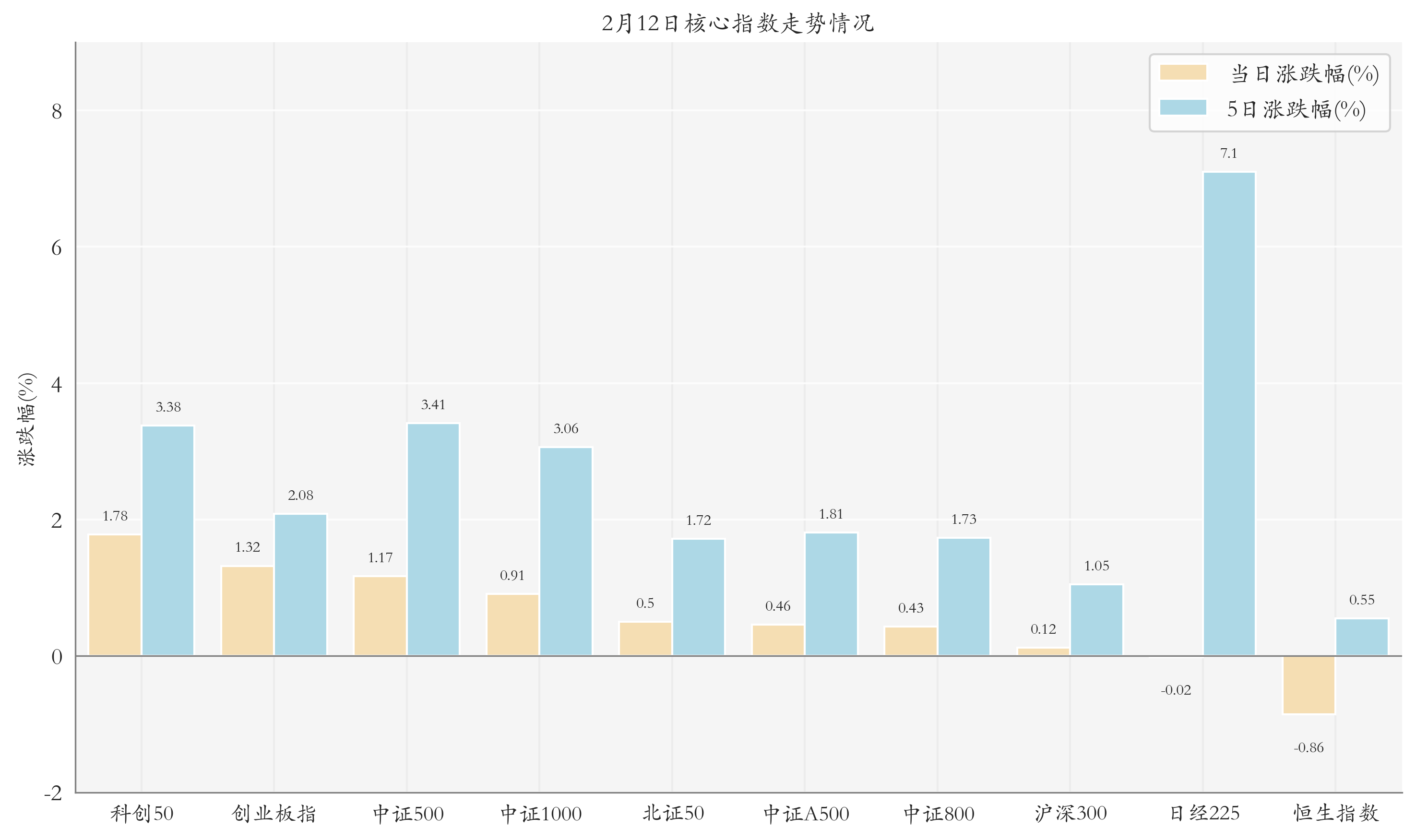
ETF Industry News - The three major indices collectively rose, with the electronic sector ETFs leading the gains. The Kweichow Moutai ETF (588780.SH) increased by 4.43%, while the E Fund AI ETF (588730.SH) and Bosera AI ETF (588790.SH) rose by 4.20% and 4.15% respectively. Conversely, several bank sector ETFs declined, with E Fund Bank ETF (516310.SH) down by 1.52% [1] - CITIC Securities reported a continuous price increase trend in the electronic components industry, with recent price hikes observed in mid-to-low voltage MOSFETs, built-in storage SOCs, and LED drivers. The report suggests that the price increase trend will continue, particularly benefiting segments like storage, CCL, BT substrates, wafer foundry, and packaging [1] Market Overview - The A-share market saw all three major indices rise today, with the Shanghai Composite Index up by 0.05% to 4134.02 points, the Shenzhen Component Index up by 0.86% to 14283.0 points, and the ChiNext Index up by 1.32% to 3328.06 points. The highest daily increases were recorded by the Sci-Tech 50 and ChiNext indices, with daily gains of 1.78% and 1.32% respectively [4] - In terms of sector performance, the comprehensive, electronic, and power equipment sectors ranked highest, with daily increases of 5.31%, 1.73%, and 1.65% respectively. Conversely, the beauty care, commercial retail, and textile sectors lagged behind with declines of -1.77%, -1.57%, and -1.49% [7] ETF Market Performance - The overall performance of ETFs showed that the stock-themed ETFs had the best average daily increase of 0.92%, while cross-border ETFs had the worst performance with an average decline of -0.76% [10] - The top-performing ETFs today included the Kweichow Moutai ETF (588780.SH), the Kweichow Moutai ETF Guangfa (589210.SH), and the E Fund AI ETF (588730.SH), with returns of 4.43%, 4.28%, and 4.20% respectively [13] - The highest trading volumes were recorded for the A500 ETF Fund (512050.SH) at 12.228 billion, followed by the A500 ETF Huatai Bairui (563360.SH) at 9.240 billion, and the A500 ETF Southern (159352.SZ) at 7.004 billion [16]

国债逆回购节前“买1躺11”,收益吸引力却大幅下降
第一财经· 2026-02-12 13:10
Core Viewpoint - The article discusses the increasing popularity of government bond reverse repos as a method for investors to manage idle funds during the upcoming Spring Festival holiday, highlighting the operational details and market conditions affecting returns [3][6]. Group 1: Government Bond Reverse Repo Operations - Investors can engage in 1-day government bond reverse repos on February 12, allowing them to earn interest for 11 days, with funds available for trading on February 13 [5][6]. - The operation is characterized as a short-term loan where investors lend money against bond collateral, offering flexibility, safety, low fees, and simplicity [6][7]. - The trading window for optimal returns is emphasized, with February 12 identified as the best day for transactions before the holiday [7]. Group 2: Market Conditions and Interest Rates - This year's pre-holiday funding rates are notably lower compared to previous years, indicating a more relaxed liquidity environment, which diminishes the potential returns from reverse repos [8][10]. - Historical trends show that funding rates typically rise before holidays due to increased cash demand, but this year, the central bank's liquidity support has kept rates low [9][10]. - As of February 12, the 1-day government bond reverse repo rates were reported at 1.27% and 1.21% for Shanghai and Shenzhen exchanges, respectively, reflecting a downward trend [10]. Group 3: Central Bank Actions - The central bank announced a significant reverse repo operation of 1 trillion yuan to maintain liquidity, indicating a continued supportive stance towards monetary policy [11]. - The expectation of further liquidity support through various tools, including medium-term lending facilities and government bond transactions, is anticipated in the coming months [11].
每日机构分析:2月12日
Zhong Guo Jin Rong Xin Xi Wang· 2026-02-12 13:01
•中信证券研报指出,预计鲍威尔任期内将不再降息,沃什担任美联储主席后,下半年基准情形降息1-2 次。沃什不会按特朗普诉求大幅降息,仍以经济基本面为主要决策依据,沃什关注通胀风险但并非绝对 鹰派。 转自:新华财经 •Monex:美联储3月降息的可能性已消除 •华泰证券:预计美联储在6月会议前将暂缓降息 •中信证券:预计鲍威尔任期内将不再降息 【机构分析】 •Monex的宏观研究负责人Nick Rees表示,对于美联储而言,1月美国就业数据表现强劲,"应当能消除 市场对3月降息的押注。"不过,Monex目前仍预计美联储将在6月恢复降息。 •华泰证券研报表示,1月非农数据持续性有待观察,但整体佐证了就业市场逐步改善的判断;维持美联 储在6月前暂停降息,待新主席就任后降息1-2次的判断。往前看,由于通胀整体较为温和,就业数据持 续性存疑,预计美联储在6月会议前仍将暂缓降息,强调观察后续数据再做决策。 •对冲基金正出现明显转向,在"买入日本"交易升温的背景下,加大对日元走强的押注。交易员表示, 即便强劲的美国就业数据削弱了市场对今年美联储降息的预期,日元多头情绪仍在升温。周三,日元相 对美元连续第三个交易日上涨,在美国 ...