新大陆

Search documents
计算机周观点第14期:GPT5发布,成本大幅下降,长期利好AI应用-20250818
Haitong Securities International· 2025-08-18 07:50
Investment Rating - The report maintains an "Outperform" rating for the computer industry, expecting a relative return exceeding the benchmark index by over 10% in the next 12-18 months [5][27]. Core Insights - The Ministry of Industry and Information Technology has issued guidelines to promote the development of the brain-computer interface industry, which is expected to enhance high-quality growth and innovation [10]. - The release of GPT-5 on August 8, 2025, has significantly reduced costs and is anticipated to benefit AI applications in the long term, accelerating the implementation of AI technologies [9][11]. - The World Robot Conference, held from August 8-12, 2025, showcases advancements in robotics and AI, featuring over 200 companies and focusing on embodied intelligence applications across various sectors [12]. Summary by Sections Industry Development - The guidelines aim for breakthroughs in key technologies by 2027, establishing a secure industry system by 2030 with 2-3 globally influential enterprises and a competitive ecosystem [10]. GPT-5 Release - GPT-5 has shown improvements in reliability, efficiency, and cost, with a 45% reduction in hallucination rates compared to GPT-4 and an 80% reduction compared to OpenAI o3, enhancing its practical applications in software development and content production [11]. - The context processing capability of GPT-5 supports 400k tokens, doubling the accuracy of long-text generation compared to previous versions [11]. Recommended Stocks - The report recommends focusing on companies such as Kingdee International, Kingsoft Office, Hand Enterprise, and others, which are expected to benefit from the positive outlook in the computer sector [5][9].




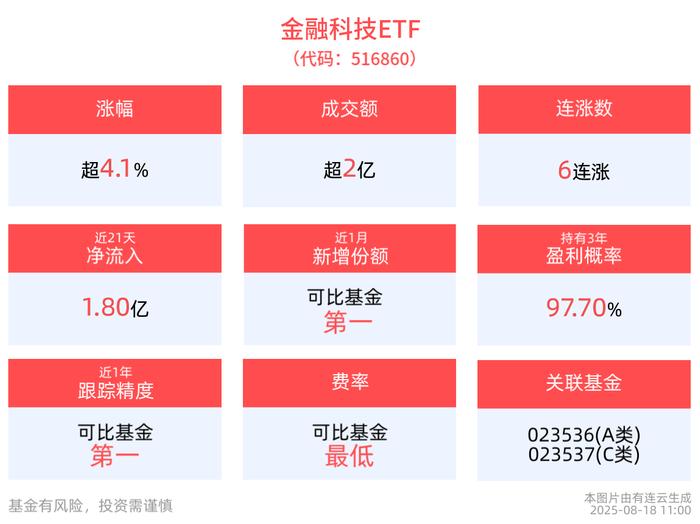
大智慧涨停,金融科技ETF(516860)上涨4.10%冲击6连涨,金融科技板块充分受益资本市场高景气
Xin Lang Cai Jing· 2025-08-18 03:25
Core Viewpoint - The financial technology sector is experiencing significant growth, as evidenced by the strong performance of the China Securities Financial Technology Theme Index and related ETFs, indicating a favorable market environment for investments in this sector [3][4][5]. Market Performance - As of August 18, 2025, the China Securities Financial Technology Theme Index rose by 4.36%, with notable increases in constituent stocks such as Guide Compass (up 18.32%) and Wealth Trend (up 12.39%) [3]. - The Financial Technology ETF (516860) has seen a 4.10% increase, marking its sixth consecutive rise, with a latest price of 1.65 yuan [3]. - Over the past week, the Financial Technology ETF has accumulated an 11.79% increase [3]. Trading Activity - The Financial Technology ETF recorded a turnover rate of 18.08% with a trading volume of 289 million yuan, indicating active market participation [3]. - The average daily trading volume for the ETF over the past week was 244 million yuan [3]. Financial Results - Dongfang Fortune reported a total revenue of 6.856 billion yuan for the first half of 2025, a year-on-year increase of 38.65%, and a net profit of 5.567 billion yuan, up 37.27% [3][4]. Capital Market Insights - The average daily trading volume for the Shanghai, Shenzhen, and Beijing stock markets reached 1.64 trillion yuan in the first half of 2025, a 65.7% increase compared to the same period last year [4]. - The Financial Technology ETF's latest scale reached 1.572 billion yuan, with a significant increase in shares by 10.3 million over the past month [4]. Fund Performance Metrics - The Financial Technology ETF has achieved a net value increase of 150.49% over the past year, ranking 4th out of 2961 index stock funds [5]. - The ETF's highest monthly return since inception was 55.92%, with an average monthly return of 10.10% [5]. - The ETF has a Sharpe ratio of 1.90 as of August 15, 2025, indicating strong risk-adjusted returns [6]. Fee Structure and Tracking Accuracy - The management fee for the Financial Technology ETF is 0.50%, and the custody fee is 0.10%, which are among the lowest in comparable funds [7]. - The ETF has a tracking error of 0.044% over the past year, demonstrating high tracking precision [7]. Index Composition - As of July 31, 2025, the top ten weighted stocks in the China Securities Financial Technology Theme Index accounted for 51.26% of the index, with companies like Dongfang Fortune and Tonghuashun being prominent constituents [7].


市场情绪监控周报(20250811-20250815):本周热度变化最大行业为非银金融、通信-20250817
Huachuang Securities· 2025-08-17 05:35
- The report introduces a "Total Heat Indicator" as a proxy variable for tracking market sentiment. This indicator is defined as the sum of browsing, watchlist additions, and clicks for individual stocks, normalized as a percentage of the total market on the same day, and then multiplied by 10,000. The value range is [0, 10,000][7] - A "Broad-based Index Heat Rotation Strategy" is constructed based on the weekly heat change rate (MA2) of major indices. The strategy involves buying the index with the highest heat change rate at the end of each week, or staying in cash if the "Others" group has the highest rate. The strategy achieved an annualized return of 8.74% since 2017, with a maximum drawdown of 23.5%, and a 2025 return of 24.5%[13][16] - A "Concept Heat Strategy" is developed by selecting the top 5 concepts with the highest weekly heat change rates. Two portfolios are constructed: 1. "TOP Portfolio" includes the top 10 stocks with the highest total heat within each concept 2. "BOTTOM Portfolio" includes the bottom 10 stocks with the lowest total heat within each concept Historical results show the BOTTOM Portfolio achieved an annualized return of 15.71% with a maximum drawdown of 28.89%, and a 2025 return of 33%[31][33]
计算机行业周报:验证物理AI加速!计算机行业周报持续看好金融科技-20250816
Shenwan Hongyuan Securities· 2025-08-16 15:23
Investment Rating - The report maintains a "Buy" rating for the financial technology sector, particularly for C-end companies benefiting from an active capital market [2][23][37]. Core Insights - The report highlights the continuous optimism for financial technology, with C-end companies directly benefiting from the active capital market [2][4]. - Key companies such as Desay SV, DaoTong Technology, and Huada Jiutian have shown significant performance improvements, with Desay SV exceeding expectations in overseas markets and DaoTong leveraging AI strategies effectively [2][19][25][34]. - The report anticipates a strong correlation between the revenue of financial technology C-end companies and the trading volume in the market, projecting over 50% year-on-year revenue growth for Q2 2025 [5][9]. Summary by Sections Financial Technology Sector - The report emphasizes the active trading environment in the market, with a total margin balance exceeding 2 trillion yuan, indicating sustained trading activity [4][5]. - The average daily trading volume for the Shanghai Composite Index in Q2 2025 was 498.8 billion yuan, a year-on-year increase of 36%, while the Shenzhen Component Index saw an average of 733.2 billion yuan, up 59% year-on-year [4][5]. Key Company Updates - **Desay SV**: Reported a revenue of 14.644 billion yuan in H1 2025, a 25.25% increase year-on-year, with a net profit of 1.223 billion yuan, up 45.82% [19][20][23]. - **DaoTong Technology**: Achieved a revenue of 2.345 billion yuan in H1 2025, a 27.3% increase, with a net profit of 480 million yuan, up 24.3% [25][26]. - **Huada Jiutian**: Generated a total revenue of 502 million yuan in H1 2025, a 13.01% increase, despite a net profit decline due to increased stock payment expenses [31][32]. Investment Opportunities - The report identifies several key investment targets within the financial technology sector, including companies like Kingsoft Office, Wanxing Technology, and DaoTong Technology, which are positioned to benefit from the ongoing market dynamics [2][39]. - The report also highlights the potential for B-end financial technology companies to benefit from the active market, including firms like New大陆 and 恒生电子 [18].






跨境支付迎来历史级发展机遇
2025-08-14 14:48
Summary of Cross-Border Payment Industry Conference Call Industry Overview - The cross-border payment market consists of B2C and B2B segments, with B2C primarily serving Chinese merchants on e-commerce platforms like Amazon and Shopee, and B2B targeting small and medium-sized foreign trade enterprises [1][2] - Major players in the B2C segment include LianLian Digital, PingPong Payments, and others, with a combined transaction volume nearing $150 billion [1][2] - XTransfer leads the B2B segment with an annual transaction volume of $30-40 billion, while other companies also report significant volumes [1][2] Market Growth and Opportunities - The cross-border payment market in China is projected to exceed 7.5 trillion RMB in transaction volume (TPV) by 2024, with an expected annual growth rate of over 25% from 2022 to 2027 [2] - The global B2B e-commerce trade is expected to grow at a CAGR of over 15%, while B2C is projected to grow at over 10% from 2022 to 2026 [4] - China's export volume is anticipated to approach 47 trillion RMB by 2027, with a growth rate exceeding 10% [4] Business Models and Fee Structures - B2C companies link payment services directly to e-commerce platforms, while B2B companies open virtual accounts for SMEs in foreign banks, earning revenue from exchange rate spreads [3] - The average fee rate in the industry is around 0.3%, which has stabilized after a decline from approximately 0.4% two to three years ago [3] Unique Value Proposition of Cross-Border Payment Providers - Cross-border payment service providers offer efficient, secure, and low-cost solutions for SMEs, addressing their challenges in obtaining bank support [5] - Traditional banks impose high costs and lengthy processes, making cross-border payment providers a more viable option for small enterprises [5] Current Trends and Future Directions - The market is rapidly evolving, with increasing demand from SMEs and cross-border e-commerce [6] - Cross-border payment providers are expected to expand their market size and opportunities as more SMEs enter international markets [6] Development of RMB Cross-Border Payment Systems - China is actively developing RMB-centric cross-border payment systems like CIPS to reduce reliance on the SWIFT system, enhancing efficiency and lowering costs [7] - Initiatives like the "Cross-Border Wealth Management Connect" in Hong Kong facilitate real-time cross-border remittances, indicating a significant opportunity for RMB internationalization [7] Impact of Stablecoins on Cross-Border Payments - Stablecoins are set to revolutionize traditional cross-border payment models by enabling real-time settlements and significantly reducing costs [8] - Payment service providers must adapt to this new environment while continuing to offer essential services [8] Adjustments Needed by Payment Service Providers - Providers need to upgrade their technology to support new RMB settlement methods and stablecoin transactions, ensuring compliance and security [9] - They must continue to offer efficient, low-cost services to meet diverse client needs [9] Merchant Preferences in Payment Solutions - Merchants prioritize the convenience and integration of payment solutions over the specifics of the settlement process [10] - The potential reduction in fees due to stablecoin adoption could provide significant cost savings for merchants [10] Leading Companies in Cross-Border Payment - Notable companies in the cross-border payment sector include LianLian Digital, Newland, and Lakala, each with distinct business strategies and market positions [12][14][17] - LianLian Digital has obtained 65 global payment licenses, with a transaction volume of 3.3 trillion RMB, while Lakala's Skyee brand serves over 120,000 clients with a transaction volume of 49.2 billion RMB [14][17] Conclusion - The cross-border payment industry is poised for significant growth driven by e-commerce expansion, technological advancements, and evolving consumer preferences, presenting ample opportunities for established and emerging players alike [1][4][6]


四年首次!重磅时刻重现!
Ge Long Hui· 2025-08-14 10:44
Group 1 - The A-share market has shown signs of a bull market, with the Shanghai Composite Index surpassing 3700 points for the first time in nearly four years, and trading volume exceeding 2 trillion yuan for two consecutive days [1][4][36] - Despite a collective decline in major indices, the market remains optimistic, as evidenced by 52 stocks hitting the daily limit up, indicating strong investor sentiment [5][4] - Recent data shows that the A-share market has experienced four consecutive months of growth, with the Shanghai Composite Index up over 11% and the ChiNext Index up over 26% [5][4] Group 2 - There has been significant capital inflow into the market, particularly in sectors like financial technology, securities, and insurance, with net inflows exceeding 20 billion yuan [5][4] - The margin trading balance has surged to 2.046251 trillion yuan, marking a return to levels not seen since the 2015 bull market, indicating increased leverage in the market [6][4] - The recent surge in non-bank deposits suggests a shift of funds from traditional savings into the stock market, driven by lower interest rates and attractive equity returns [8][9] Group 3 - The financial technology sector is highlighted as a promising investment direction, with significant growth potential as investor risk appetite increases [12][14] - Notable stocks in the financial technology sector have shown impressive gains, with the financial technology index up over 143% in the past year, outperforming other major indices [30][34] - The financial technology ETF has attracted substantial capital, with a net asset value increase of 125.8% since the "924" market rally, indicating strong investor interest [32][34] Group 4 - Analysts express optimism about the A-share market's future, suggesting it is in a "systematic slow bull" phase, supported by increased risk appetite and declining risk-free rates [36][37] - Conditions for a potential challenge of the 4000-point mark on the Shanghai Composite Index by year-end include broad profit improvements, optimized capital structure, and alignment of domestic policies with global economic cycles [37][36]

四年首次!重磅时刻重现!
格隆汇APP· 2025-08-14 10:33
Core Viewpoint - The A-share market is experiencing a slow bull market, characterized by significant trading volumes and a positive sentiment among investors, despite recent fluctuations in major indices [4][9][37]. Market Performance - The Shanghai Composite Index has surpassed the 3700-point mark for the first time since December 2021, with trading volumes exceeding 2 trillion yuan for two consecutive days [4][3]. - A total of 52 stocks reached their daily limit up, indicating strong market enthusiasm despite a general market pullback [9][4]. - The A-share market has seen a cumulative increase of over 11% in the Shanghai Composite Index and over 26% in the ChiNext Index over the past four months [9]. Fund Flows - Despite market adjustments, many sectors continue to see net inflows, particularly in financial technology, securities, and insurance, with net inflows exceeding 2 billion yuan in several sectors [9][11]. - The margin trading balance has surged to 2.046 trillion yuan, marking a significant increase reminiscent of the 2015 bull market [11]. Investor Behavior - There has been a notable shift in deposit flows, with a significant increase in non-bank deposits, suggesting a migration of funds from savings to the stock market [14][15]. - The number of new A-share accounts opened in July reached 1.9636 million, a 19.27% increase month-over-month and a 70.54% increase year-over-year, indicating heightened retail investor interest [15]. Institutional Support - Regulatory measures have encouraged long-term institutional investments, with over 504 billion yuan expected to enter the A-share market in 2025 from various institutional sources [16]. - The financial technology sector has been highlighted as a key area for investment, with significant inflows into related ETFs, such as the Financial Technology ETF (516860), which has seen a 125.8% increase in net asset value since the "924" market surge [34]. Sector Analysis - The financial technology sector has shown strong performance, with the Financial Technology Index recording a cumulative increase of over 143% in the past year, outperforming other major indices [32][36]. - Specific stocks within the AI, military, and robotics sectors have demonstrated substantial short-term gains, indicating a shift in investor preference towards high-growth sectors [19][20][22][24]. Future Outlook - Analysts predict a continued slow bull market, with potential for a transition to a faster bull market as more capital enters the market [37]. - Financial technology stocks are recommended for investment due to their high certainty and potential for significant returns, especially through ETFs that track the sector [34][36].

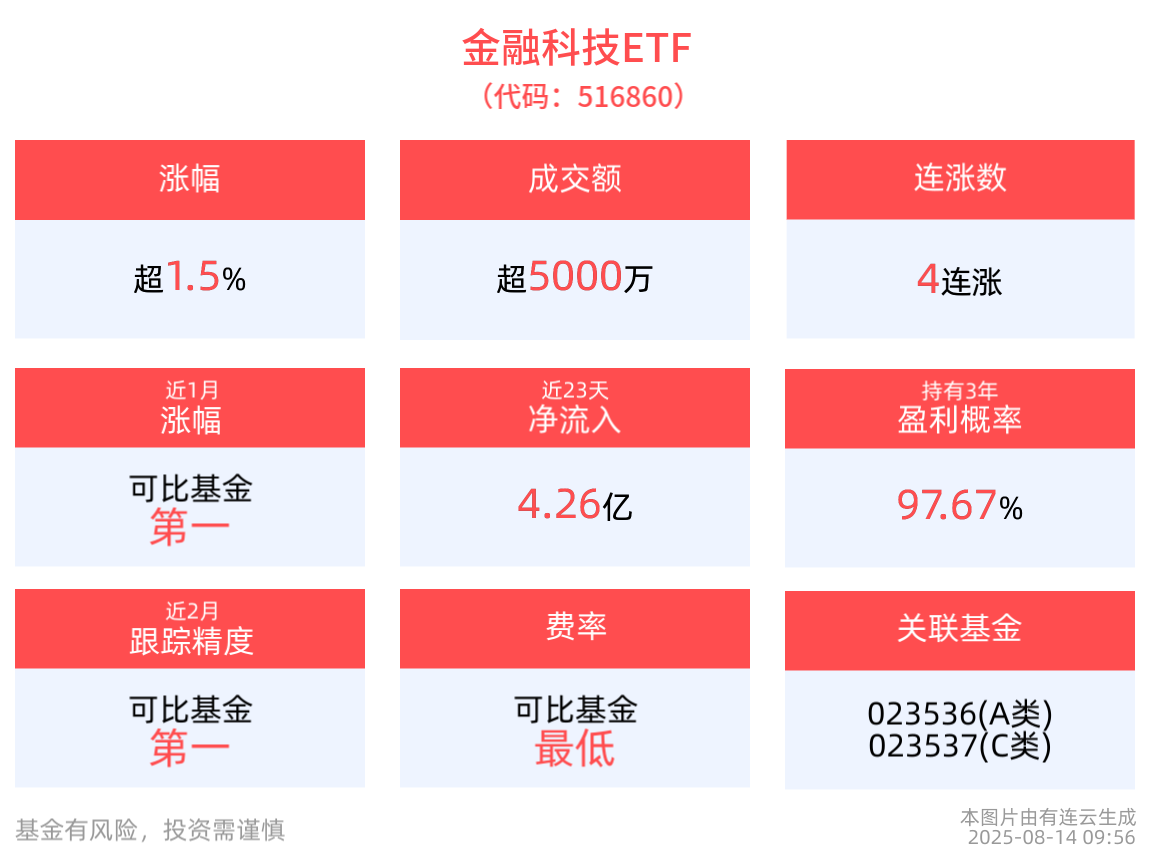
冲击4连涨!金融科技ETF(516860)盘中拉升上涨1.54%,数字基础设施获金融大力支持
Xin Lang Cai Jing· 2025-08-14 02:17
Group 1 - The core viewpoint of the news highlights the strong performance of the financial technology sector, particularly the rise of the China Securities Financial Technology Theme Index and its constituent stocks [3][4]. - The financial technology ETF has shown significant growth, with a recent increase of 1.54% and a weekly rise of 3.39%, ranking in the top third among comparable funds [3][5]. - The total scale of the financial technology ETF has reached 1.564 billion yuan, with a net inflow of 42.6 million yuan over the past 23 trading days [5][6]. Group 2 - The implementation of digital currency initiatives in Nansha, Guangzhou, aims to expand the application of digital RMB across various sectors, enhancing cross-border trade and financial transactions [4]. - The release of GPT-5 is expected to bolster AI applications in financial technology, improving efficiency and accuracy in financial services [4]. - The financial technology ETF has demonstrated impressive returns, with a one-year net value increase of 138.38% and a historical holding period profit probability of 97.67% [5][6]. Group 3 - The financial technology ETF has the lowest management and custody fees among comparable funds, at 0.50% and 0.10% respectively [6]. - The ETF closely tracks the China Securities Financial Technology Theme Index, which includes companies involved in financial technology services [7]. - The top ten weighted stocks in the index account for 51.26% of the total index weight, indicating a concentrated investment in leading financial technology firms [7].
金融科技ETF(516860)涨近1%冲击3连涨,广州发布重要《方案》,加强关键数字服务机构招商引资力度
Xin Lang Cai Jing· 2025-08-13 05:53
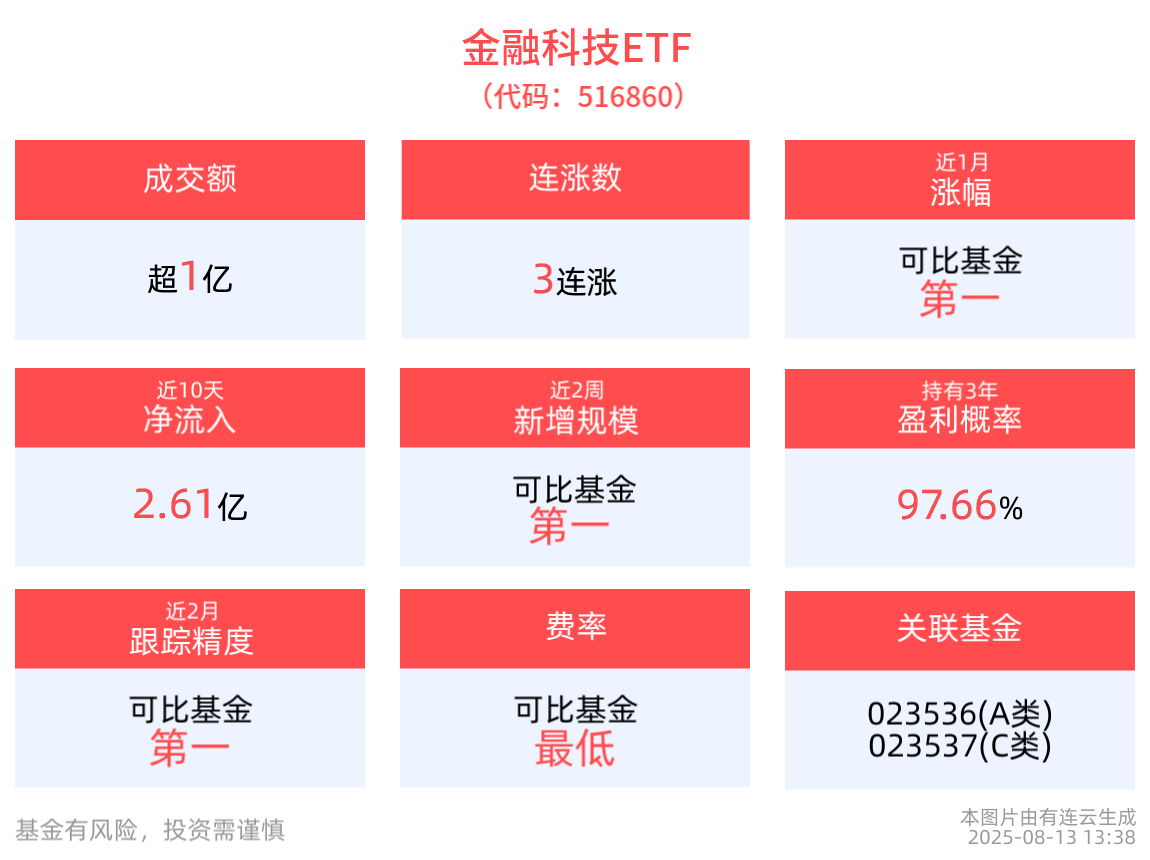
截至2025年8月13日 13:38,中证金融科技主题指数(930986)强势上涨1.09%,成分股数字认证(300579)上涨9.67%,恒宝股份(002104)上涨7.61%,安硕信息 (300380)上涨5.20%,指南针(300803),财富趋势(688318)等个股跟涨。金融科技ETF(516860)上涨0.95%, 冲击3连涨。最新价报1.49元。拉长时间看,截至 2025年8月12日,金融科技ETF近1周累计上涨3.21%,涨幅排名可比基金1/3。 流动性方面,金融科技ETF盘中换手8.86%,成交1.42亿元。拉长时间看,截至8月12日,金融科技ETF近1月日均成交1.71亿元。 消息面上,近日,广州市印发《关于贯彻落实金融支持广州南沙深化面向世界的粤港澳全面合作的意见实施方案》。其中提到,加强对区块链、人工智能等 关键数字服务机构的招商引资力度,培育本土优质数字服务机构。支持在南沙建设区块链、人工智能等关键数字技术与金融场景融合应用的数据算力中心、 研发认证中心、测评中心以及监管平台等机构。 国泰海通证券表示,AI在证券投研及投顾、银行信贷和营销渠道、保险代理人赋能、小微商户点餐及营销、消费 ...
2025万亿城市大洗牌!福州泉州双星闪耀 烟台增速领跑 谁将成下一个“黑马”?
Sou Hu Cai Jing· 2025-08-13 03:14
Group 1 - The competition among China's "trillion-yuan cities" is intensifying, with 27 cities now classified as such, and the top ten cities maintaining a stronghold in the rankings [1][2] - Shanghai and Beijing lead the first tier with GDPs exceeding 2 trillion yuan, while cities like Shenzhen, Guangzhou, and Chengdu form the second tier with GDPs between 800 billion and 2 trillion yuan [2] - The stability of the top ten cities is attributed to their industrial depth and policy advantages, with significant contributions from sectors like finance, technology, and manufacturing [2] Group 2 - The competition among mid-tier cities (ranked 11-20) is fierce, with cities like Jinan, Nantong, and Fuzhou having GDP differences of less than 500 billion yuan, indicating a volatile ranking landscape [3] - The economic performance of these mid-tier cities reveals a trend towards regional economic balance but also highlights the risks of homogenization, as many still rely heavily on traditional manufacturing and real estate [3] - Fuzhou's GDP growth rate of 5.8% outpaces the national average, driven by emerging industries, while Quanzhou faces challenges due to its reliance on traditional sectors [3] Group 3 - Economic growth rates among the trillion-yuan cities show significant divergence, with Yantai leading at 6.4% and Foshan lagging at 2.3%, reflecting the challenges faced by traditional manufacturing hubs [4] - Yantai's growth is fueled by strategic investments in emerging industries, while Foshan struggles with the pressures of rising labor costs and declining export demand [4] - The need for structural adjustments in traditional manufacturing cities is emphasized, as they face the dual challenge of transformation and maintaining competitiveness [4] Group 4 - Potential growth cities such as Hefei, Xi'an, and Fuzhou are highlighted for their strong industrial foundations and innovative capabilities [5] - Hefei's venture capital model has led to significant growth in sectors like new energy vehicles and integrated circuits, positioning it for future advancement [5] - Xi'an's focus on "hard technology" and its strong educational resources contribute to its economic resilience, while Fuzhou's digital economy is rapidly expanding [5] Group 5 - The fluctuations in the rankings of the trillion-yuan cities reflect broader trends in China's economic structural transformation, showcasing various paths to high-quality development [6] - The competition among these cities will increasingly focus on innovation and industrial strength, with the ability to overcome key technological challenges being crucial for future success [6] - The diverse growth strategies of these cities illustrate the dynamic nature of China's economic landscape, with potential for more cities to emerge as leaders in the future [6]