
问界

Search documents
上半年两江新区社零超790亿元!新型消费成主力
Sou Hu Cai Jing· 2025-08-05 09:31
体验城市空中跳伞、 到离境退税商店"扫货"、 打卡影视剧取景地同款照片...... 近年来,新消费热度攀升,催生出更多跨领域、跨场景的新消费业态,带动辖区消费持续增长。数据统计显示,2025 年上半年两江新区直管区社会消费品零售总额(简称:社零)超790亿元,同比增长7.4%。 以情绪消费为消费增长引擎 情绪消费正在成为驱动消费市场增长的新引擎。近年来,潮玩经济、文旅经济等多个垂直细分领域逐步进入大众市 场,占领一席之地。 ▲"荒野之国"全国巡展首站在重庆光环购物公园。张玮真 摄 "在山城感受云南的'荒野之国',这确实很酷。"光环购物公园联名荒野之国IP打造的消费新场景,开放首日拉动了 20%的客流增长。重庆欢乐谷举办国潮文化节,将游戏IP与文化旅游深度融合,联动《王者荣耀》《百事X黑神话悟 空》《葫芦娃》IP打造沉浸式体验街区,让游客成为主角,冲进重庆热门景区前五。 重庆欢乐谷相关负责人表示,"文旅+游戏"跨界融合,不仅可以通过开发服装、道具和游戏机制等多种形式,打造实 景剧本游戏和沉浸式体验项目,丰富旅游者的消费体验,还可以通过数字化文旅场景建设,推出游戏IP周边产品,带 给游客或游戏用户崭新的旅游消费体 ...


继车规级纸巾盒后雷军发布小米汽车新周边 169元雨伞争议中售罄
Sou Hu Cai Jing· 2025-08-05 01:32
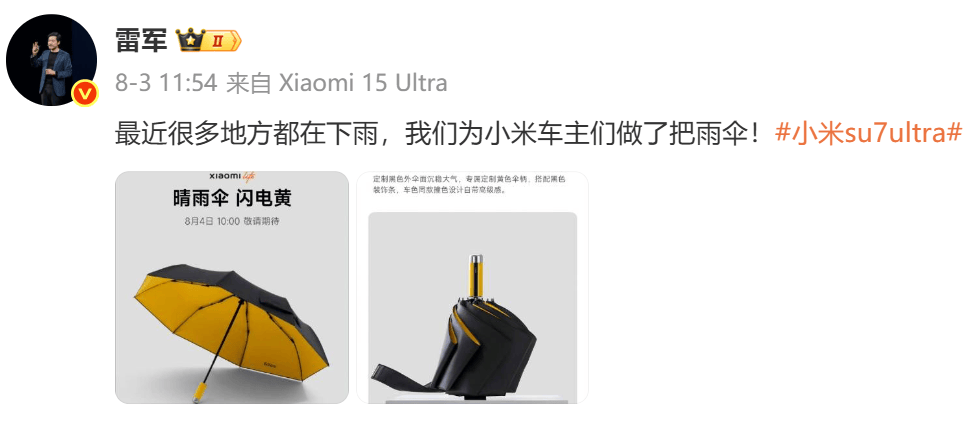
凤凰网科技讯 8月5日,小米商城信息显示,雷军于8月4日刚刚发售的小米SU7 Ultra同款配色晴雨伞已宣告售罄。这款专为小米车主打造的周边产品,在短 时间内便迎来热销,同时也因定价引发网友热议。 据悉,雷军8月4日在社交媒体平台公布这款雨伞时表示:"最近很多地方都在下雨,我们为小米车主们做了把雨伞!" 官方定价169元的消息一出,迅速引发 网友关注与讨论。 不少网友对这一价格提出质疑,认为售价偏高; 还有网友调侃式提问 "是自研吗?不是自研我不支持"。 尽管伴随价格争议,小米晴雨伞上架后仍迅速售罄。 据悉,今年7月,小米曾推出一款售价169元的磁吸车载纸巾盒,同样因价格引发热议并登上微博热搜,但次日便售罄。 更有网友模仿"雷军风格",将其称为"车规级晴雨伞",为这场讨论增添了几分趣味。 【免责声明】本文仅代表作者本人观点,与和讯网无关。和讯网站对文中陈述、观点判断保持中立,不对所包含内容的准确性、可靠性或完整性提供任何明 示或暗示的保证。请读者仅作参考,并请自行承担全部责任。邮箱:news_center@staff.hexun.com 对比其他汽车品牌,问界折叠伞售价228元,奔驰迎宾雨伞售价513元。 ...
BBA集体失守中国市场
2 1 Shi Ji Jing Ji Bao Dao· 2025-08-04 23:13
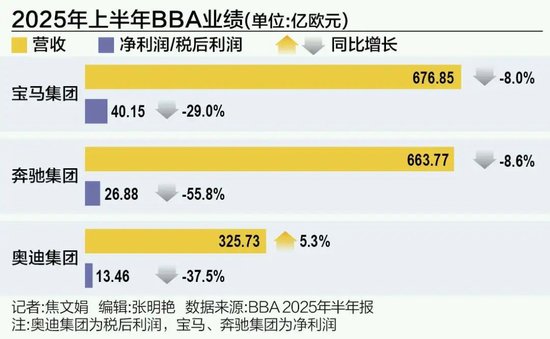
Core Viewpoint - The traditional luxury car giants BBA (BMW, Mercedes-Benz, Audi) are facing significant growth challenges, with declining revenues and profits, particularly in the Chinese market, indicating a critical phase in their transformation efforts [1][2][4]. Financial Performance - In the first half of 2025, BBA's financial results showed a mixed performance: BMW led with €67.685 billion in revenue, down 8% year-on-year; Mercedes-Benz followed with €66.377 billion, experiencing the largest revenue drop of 8.6% and a net profit decline of over 50%; Audi was the only brand with revenue growth, reaching €32.573 billion, but its net profit was only €13.46 billion, one-third of BMW's [2][4][5]. - The overall net profit for Mercedes-Benz fell by 55.8% to €2.688 billion, while BMW's net profit decreased by 29% to €4.015 billion, and Audi's net profit dropped by 37.5% [7][8]. Market Challenges - BBA collectively struggled in the Chinese market, with delivery volumes declining by 15.5% for BMW, 14.2% for Mercedes-Benz, and 10.3% for Audi [4][6]. - The entry-level models of BBA are facing intense competition from domestic brands, leading to significant sales declines in the mid-range price segment [7][8]. Electric Vehicle Transition - The shift towards electric vehicles (EVs) is critical for BBA, with distinct strategies emerging: BMW is leading in EV sales, with 220,600 units sold in the first half of 2025, a 15.7% increase; Audi's EV sales grew by 32.3%, while Mercedes-Benz's EV sales fell by 14% to 87,300 units [9][12][13]. - Audi is cautiously pursuing electrification, planning to launch new internal combustion and hybrid models between 2024 and 2026, while BMW is focused on its new generation platform to boost EV sales [12][13][14]. Strategic Adjustments - BBA is adjusting its electrification goals, with Mercedes-Benz postponing its target for full electrification to 2030, aiming for a maximum of 50% of new models to be electric or hybrid by that year [14][15]. - The competitive landscape is shifting, with BBA needing to enhance their smart technology capabilities alongside their electrification efforts to regain their former market dominance [15].
BBA的下跌叙事中,谁将率先突围?
2 1 Shi Ji Jing Ji Bao Dao· 2025-08-04 14:01
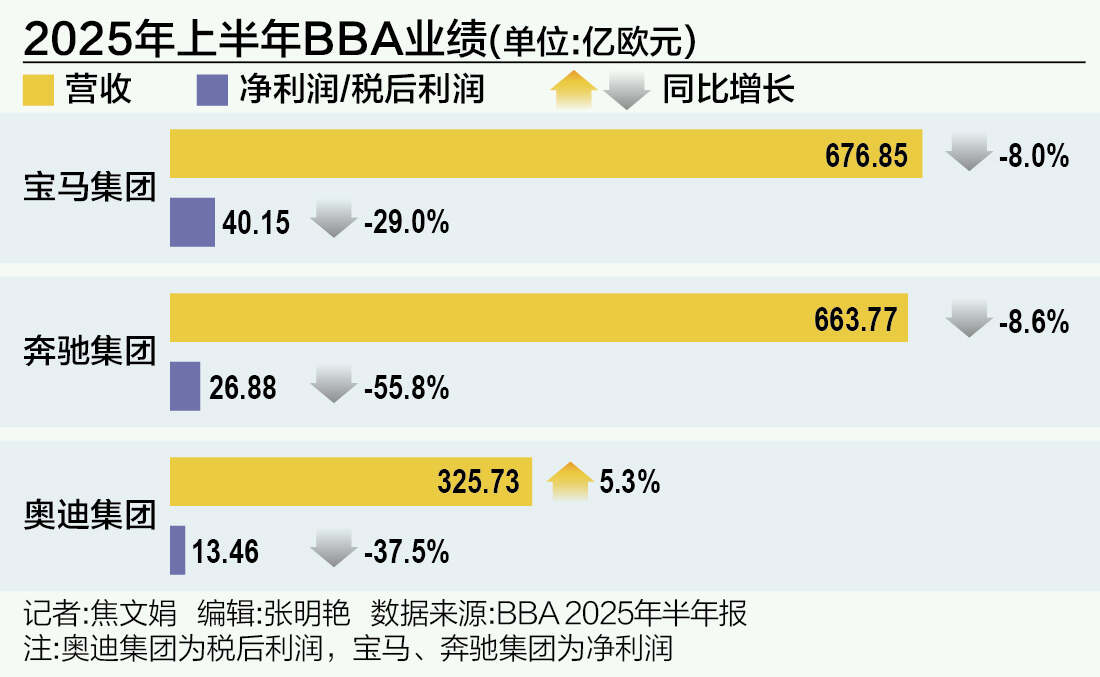
Core Viewpoint - The traditional luxury car giants BBA (BMW, Mercedes-Benz, Audi) are facing significant growth challenges, with declining revenues and profits, particularly in the Chinese market, indicating a critical transformation phase for these companies [1][2][4]. Financial Performance - In the first half of 2025, BBA's financial results showed a mixed performance: BMW led with revenues of €67.685 billion, down 8% year-on-year; Mercedes-Benz followed with €66.377 billion, experiencing the largest revenue drop of 8.6%, and a net profit halved to €26.88 billion; Audi reported revenue growth to €32.573 billion but with a net profit of only €1.346 billion, one-third of BMW's [2][4][8]. - The overall net profit for BBA saw significant declines, with Mercedes-Benz's net profit dropping 55.8%, BMW's down 29%, and Audi's down 37.5% [7][8]. Market Challenges - BBA collectively struggled in the Chinese market, with delivery volumes down 15.5% for BMW, 14.2% for Mercedes-Benz, and 10.3% for Audi, making it the largest single market decline globally for these brands [4][10]. - The entry-level models of BBA are facing intense competition from domestic brands, leading to a decline in both volume and profit margins [9][10]. Strategic Adjustments - BBA has lowered their profit forecasts: Audi revised its revenue target to €65-70 billion with a profit margin expectation of 5-7%; BMW anticipates a decline in its automotive EBIT margin to 5-7%; Mercedes-Benz expects lower sales than the previous year with a revised return on sales (ROS) of 4-6% [4][10]. - The companies are adjusting their strategies towards electric vehicle (EV) production, with BMW leading in EV sales, while Mercedes-Benz has delayed its full electrification target to 2030 [11][16]. Electric Vehicle Transition - Audi reported a 32.3% increase in EV sales, leading BBA, with a total of 101,400 units delivered; BMW's EV sales reached 220,600 units, up 15.7%, while Mercedes-Benz saw a 14% decline in EV sales to 87,300 units [14][16]. - BMW is focusing on its new generation platform to boost EV sales, aiming for 50% of its sales to be electric by 2035, while Audi is cautiously expanding its EV lineup [15][16]. Future Outlook - The BBA's transition to electric and smart vehicles is seen as a necessary response to market pressures, with the potential for new growth opportunities emerging from current challenges [17].
汽车与零部件行业周报:中国长安汽车集团有限公司挂牌成立,乐道L90、理想i8等重磅车型上市-20250804
Shanghai Securities· 2025-08-04 11:50
Investment Rating - The industry investment rating is "Overweight (Maintain)" [1] Core Viewpoints - The automotive sector has shown a mixed performance, with a recent decline of 2.36% in the automotive sector compared to a 1.75% decline in the CSI 300 index, ranking 21st among 31 first-level industries [4] - The report highlights the establishment of China Changan Automobile Group Co., Ltd., which aims to innovate in smart vehicles and expand globally, targeting an annual revenue of 355 billion yuan and a production goal of 3 million vehicles [6] - New vehicle launches, such as the Leidao L90 and Li Auto i8, are expected to enhance market competitiveness and consumer interest [7] Market Review - The automotive sector's performance has been underwhelming, with commercial vehicles performing the best among sub-sectors, while passenger vehicles and automotive services saw significant declines [4] - In July, heavy truck sales reached approximately 83,000 units, showing a year-on-year increase of about 42%, driven by trade-in policies [9] Investment Recommendations - The report suggests focusing on companies involved in smart vehicle technology, those with potential for overseas sales, and component manufacturers benefiting from domestic substitution effects [10] - Specific companies to watch include Beiqi Blue Valley, Great Wall Motors, and China National Heavy Duty Truck Group [12]
新能源二手车是中产省钱的那道光
3 6 Ke· 2025-08-04 08:37
Core Insights - The growing acceptance of second-hand electric vehicles (EVs) reflects a shift in consumer behavior, driven by the desire for cost-effective options while still enjoying the benefits of new energy vehicles [1][3][30] - The second-hand EV market is thriving due to increased supply from the rising ownership of new energy vehicles and the high cost-performance ratio of these second-hand options [4][9][23] Group 1: Market Dynamics - The penetration rate of new energy vehicles has surged, leading to a significant increase in the availability of second-hand EVs [2][23] - In the first five months of this year, the transaction volume of second-hand new energy vehicles exceeded 545,000 units, marking a nearly 30% year-on-year increase, with a market penetration rate approaching 10% [9][12] - The price drop of second-hand EVs, often by 30-40%, makes them attractive to consumers seeking practical and economical choices [3][12][16] Group 2: Consumer Preferences - Consumers are increasingly viewing second-hand new energy vehicles as their first choice, particularly for commuting and as a second family car, due to lower costs and various benefits such as tax exemptions [3][18][30] - The typical buyer profile includes budget-conscious individuals who desire quality vehicles without the high price tag of new models [17][20] - The market is particularly appealing to first-time electric vehicle users and those looking for a practical second vehicle for short-distance travel [20][22] Group 3: Quality Concerns and Market Trends - Despite the growing popularity, there are concerns regarding the quality of second-hand EVs, with some consumers wary of potential issues related to battery health and vehicle condition [7][23][27] - The depreciation rates for new energy vehicles are significant, with first-year depreciation ranging from 15% to 30%, making second-hand options more appealing [12][14][16] - The market is witnessing a trend where second-hand EVs are being marketed as "quasi-new cars," which can sometimes mask underlying issues [23][30] Group 4: Buying Considerations - Consumers are advised to be cautious and conduct thorough research before purchasing second-hand EVs, focusing on battery health, vehicle age, and maintenance records [27][28][30] - Key factors to consider include the vehicle's battery health, warranty transferability, and the presence of a comprehensive maintenance history [27][30] - The importance of clear contractual agreements is emphasized to protect consumer rights and ensure transparency in the purchase process [27][30]
问界发布六大交付承诺:不强制和捆绑销售
Zhong Guo Zhi Liang Xin Wen Wang· 2025-08-04 03:31
Group 1 - The company emphasizes integrity, transparency, and compliance with national regulations, ensuring no forced or bundled sales [2] - All transactions are conducted through corporate accounts to guarantee fund security, with clear records for every inflow and outflow [2] - Each vehicle undergoes rigorous quality inspections at multiple stages to ensure high-quality delivery [2] Group 2 - The company offers a streamlined delivery process, allowing customers to pick up their vehicles in as little as one hour by handling most paperwork online [3] - Professional vehicle knowledge is provided during the delivery process through video and on-site explanations [3]
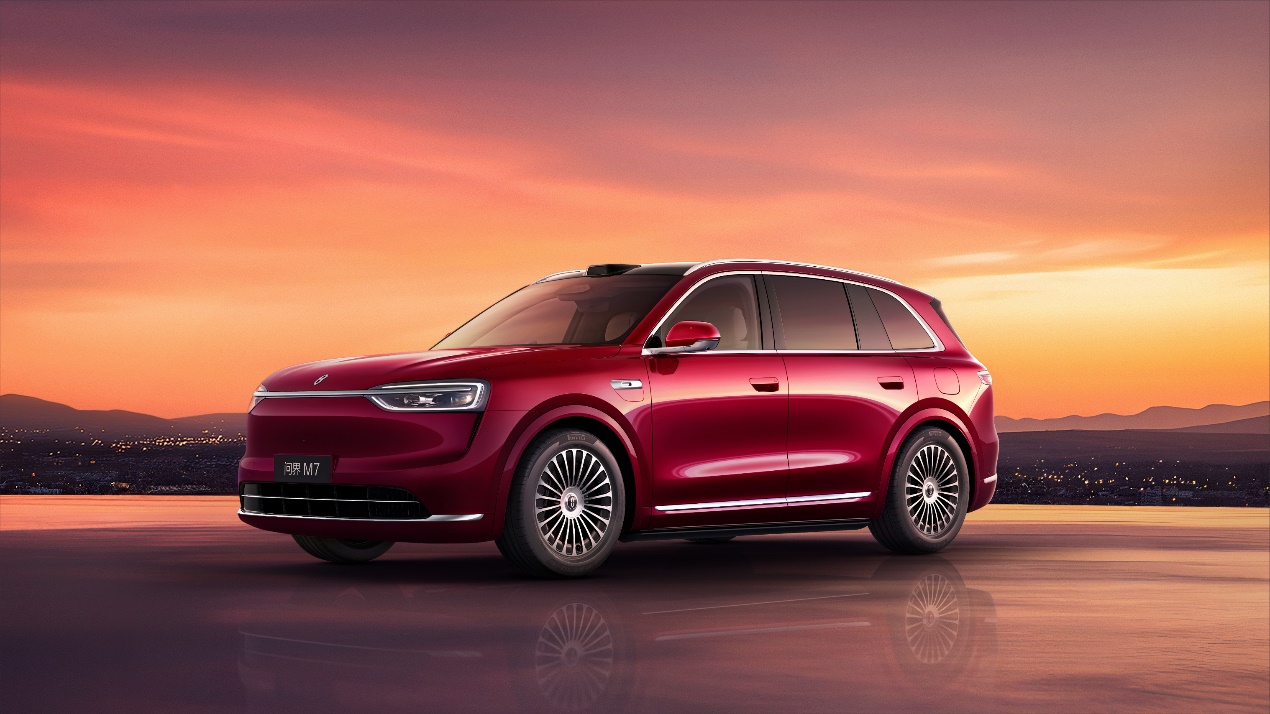
理想i8、问界M8争30万+纯电,三元电池锁定“后50%”?
高工锂电· 2025-08-02 11:38
Core Viewpoint - The article discusses the competitive landscape of the high-end electric vehicle (EV) market in China, particularly after the penetration rate of new energy vehicles (NEVs) surpassed 50%. The focus is on the strategies of automakers to capture the market above 300,000 yuan, where fuel vehicles still dominate, and the emergence of "super range extension" and "high-end pure electric" models as key strategies for growth [2][4][5]. Group 1: Market Dynamics - The market is experiencing a battle for the "post-50%" incremental market, particularly in the high-value segment where fuel vehicles still hold a significant share [2]. - The share of new energy vehicles in the 300,000 yuan and above segment is approximately 40%, which includes a substantial number of hybrid models [2]. - The high-end pure electric SUV market shows considerable potential, as evidenced by the rapid order volume for models like the AITO M8 [5]. Group 2: Strategic Differentiation - Automakers are adopting two main strategies: "super range extension" through larger battery packs and ultra-fast charging, and direct competition in the high-end pure electric SUV market [4][5]. - The "super range" strategy aims to blur the lines between range-extended and pure electric vehicles, with companies like Zhiji and Zeekr introducing models with significant battery capacities [4]. - The high-end pure electric SUV segment is being targeted by brands like Li Auto and Audi, indicating a shift in consumer demand towards premium electric offerings [5]. Group 3: Technological Foundations - Both strategies rely on a common technological foundation of high-capacity, high-rate fast-charging batteries [6]. - Consumer "charging anxiety" has been a significant barrier to the growth of high-end pure electric vehicles, with hybrid models currently dominating the market [7]. - New models like the Li i8 and AITO M8 are equipped with large capacity batteries, indicating a trend towards higher energy density and faster charging capabilities [7][8]. Group 4: Industry Implications - The competition in the high-end market is opening new opportunities for the battery supply chain, particularly for companies that can deliver high-performance batteries [8]. - The demand for high energy density, fast-charging, and safety in batteries is creating high entry barriers, leading to market consolidation around leading battery manufacturers like CATL [8]. - The ongoing transformation in the automotive market is reshaping the value and structure of the upstream battery industry, with a focus on differentiated products that meet the evolving needs of high-end electric vehicles [8].


理想i8,撑得起李想的“纯电梦”吗?
Xin Lang Cai Jing· 2025-08-02 01:34
Core Viewpoint - The launch of Li Auto's second pure electric model, the Li i8, represents a significant step in the company's pursuit of its "pure electric dream," with a focus on enhanced performance and advanced technology [1][3]. Group 1: Product Launch and Features - The Li i8 is officially on sale as of July 29, with three versions priced between 321,800 yuan and 369,800 yuan, approximately 30,000 yuan lower than the previous pre-sale price [1][3]. - The i8 features longer pure electric range, lower drag coefficient, and the introduction of the MindVLA autonomous driving architecture, which has been in development for years [3][14]. - The i8's dimensions are 5085mm in length, 1960mm in width, and 1740mm in height, with a wheelbase of 3050mm, providing spacious interior comfort [9][11]. Group 2: Competitive Landscape - The i8 enters a competitive market segment for six-seat pure electric SUVs, facing rivals such as the Aito M8, Leapmotor L90, and Tesla Model Y L [4][29]. - The pricing strategy of the i8 is not aggressive, which means it must rely on its overall strength to attract consumers [4][30]. - The market for pure electric models priced above 300,000 yuan is limited, with less than 80,000 units sold in the first four months of 2025, indicating a challenging environment for the i8 [29][30]. Group 3: Strategic Adjustments and Organizational Changes - Following the underperformance of the MEGA model, Li Auto made significant organizational adjustments, merging sales and service teams into a new smart vehicle group to enhance product development [3][21]. - The company has invested approximately 2 billion yuan in design changes for the i8, emphasizing low drag and brand recognition [25][27]. - Li Auto's internal discussions led to a clearer product line strategy, distinguishing the i series from the MEGA brand and focusing on the pure electric SUV market [21][25]. Group 4: Technological Innovations - The i8 is equipped with a self-developed silicon carbide drive motor, achieving a noise level of just 3.5 decibels at high speeds [14]. - The vehicle's dual motor system delivers a combined power of 400 kW (approximately 544 horsepower) and a maximum torque of 660 Nm, with a 0-100 km/h acceleration time of 4.5 seconds [14][15]. - The MindVLA system, a new visual-language-behavior model, allows the i8 to adapt to driving conditions in real-time, enhancing the driving experience [16][18].
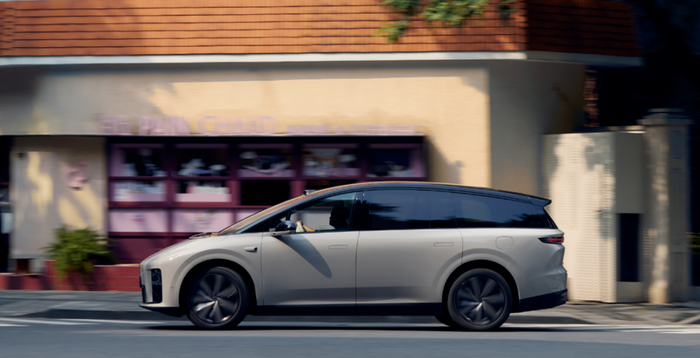
蔚来的“复读”,总算在乐道 L90 上见效了
Xin Lang Cai Jing· 2025-08-02 01:34
Core Viewpoint - NIO's recent launch of the L90 model demonstrates a significant turnaround in its strategy and market positioning, aiming for profitability in Q4 2025 amidst previous challenges in sales and stock performance [1][4][25] Product Launch and Market Response - The L90 was officially priced at 265,800 CNY, with a BaaS version starting at 179,800 CNY, generating positive reactions and over 30,000 orders within a week of pre-sales [2][4] - NIO's stock price surged nearly 50% following the L90 pre-sale announcement, indicating strong market confidence in the new model [4][17] Product Features and Innovations - The L90 effectively addresses the challenges of space, design, and aerodynamics, achieving a drag coefficient of 0.25 and a weight of 2,250 kg for the rear-wheel-drive version, which is significantly lighter than competitors [9][10] - The vehicle features innovative storage solutions, including a 430L trunk and a 240L front storage compartment, enhancing its practicality for families [10][11] Market Positioning and Competitive Landscape - The L90 targets the 200,000 to 300,000 CNY market segment, which is currently underserved in the electric three-row SUV category, allowing NIO to capture market share from competitors priced above 300,000 CNY [14][15] - The pricing strategy positions the L90 as a competitive option, with the potential to quickly gain traction in a growing market for electric SUVs [15][16] Operational Efficiency and Delivery Challenges - NIO has improved its operational efficiency, with a clear plan for rapid delivery following the L90's launch, contrasting with previous issues faced during the L60's rollout [24][25] - The new leadership under Shen Fei is focused on enhancing service and sales processes to ensure successful delivery and customer satisfaction [22][24] Future Outlook - The success of the L90 is critical for NIO to achieve its profitability goals in Q4 2025, with expectations for it to become a best-selling model in the electric SUV market [5][25] - The company aims to leverage the L90's launch momentum to improve overall brand perception and sales performance, setting the stage for future models like the L80 and the next-generation ES8 [25]
