
鹏华基金

Search documents
卫星ETF年内普涨15%吸金49亿,商业航天资金分化 华夏航空航天ETF净流出超4亿,华泰柏瑞通用航空ETF同步流出
Xin Lang Cai Jing· 2026-01-09 08:48
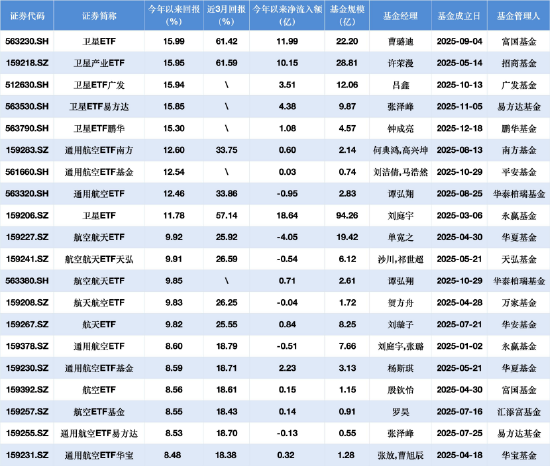
Core Viewpoint - The commercial aerospace and satellite industry is experiencing significant market interest, driven by a combination of policy, technology, and capital, leading to rapid development in this sector [1][5]. Market Performance - As of January 9, the China Securities Satellite Industry Index has increased by 22% year-to-date, while the National Certificate Commercial Satellite Communication Industry Index has risen over 18%, both showing a trend of consecutive daily gains [1][5]. - Several satellite and general aviation-themed ETFs have dominated the top of the ETF performance list, with notable returns: - The satellite ETF from Fortune Fund (563230.SH) has a year-to-date return of 15.99% and a three-month return of 61.42% - The satellite industry ETF from China Merchants Fund (159218.SZ) has a year-to-date return of 15.95% and a three-month return of 61.59% [2][6]. Fund Flows - The satellite ETF from Yongying Fund (159206.SZ) has seen a net inflow of 1.864 billion yuan, nearing a total scale of 9.426 billion yuan. Other satellite ETFs from Fortune and China Merchants have also experienced net inflows exceeding 1 billion yuan [2][7]. - In contrast, some aerospace-themed ETFs have shown signs of profit-taking, with the China Merchants Aerospace ETF (159227.SZ) experiencing a net outflow of 405 million yuan year-to-date [4][8]. Industry Outlook - The year 2026 is anticipated to be a significant year for China's commercial aerospace launches, with expected launch counts surpassing 100. Several private aerospace companies plan to complete key model first flights or recovery validations [4][8]. - Breakthroughs in rocket recovery technology are projected to reduce launch costs by 70% to 90%, facilitating a shift towards a "flight-like" era for satellite launches. Additionally, large-scale networking plans from companies like China Star Network are expected to drive demand across the entire supply chain, including satellite manufacturing, rocket launches, and ground equipment [4][8].


2025年度QDII业绩出炉:最高汇添富香港优势精选涨超112%VS易方达原油跌逾13%(附涨跌榜)
Xin Lang Cai Jing· 2026-01-09 08:36
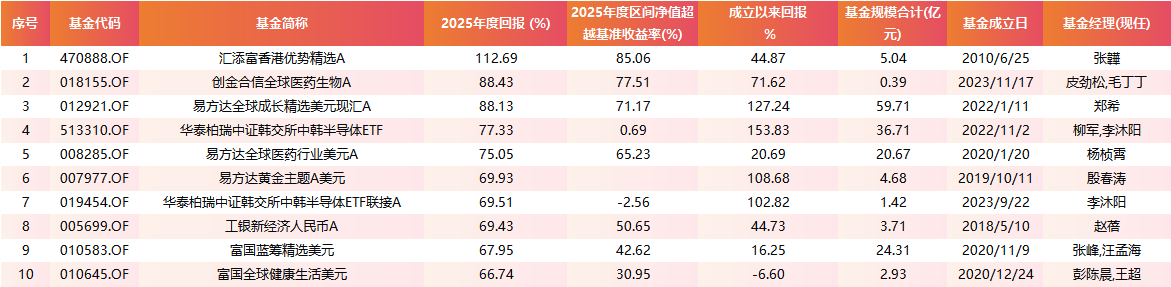
Core Insights - The QDII (Qualified Domestic Institutional Investor) funds have shown significant performance differentiation in 2025, with some funds achieving remarkable returns while others faced substantial losses due to market volatility and sector-specific challenges [1][4][6]. Performance Highlights - The top-performing QDII fund, Huatai-PB Hong Kong Advantage Selection, achieved a return of over 112%, benefiting from the global rise in innovative pharmaceuticals and biotechnology [2][9]. - Other notable funds include China Universal Global Pharmaceutical Biology and E Fund Global Growth Selection, both with returns exceeding 88%, driven by the global pharmaceutical sector's growth [2][9]. - The E Fund Gold Theme QDII also performed well, nearing a 70% return amid global risk aversion and monetary policy adjustments [2][9]. Underperformers - In contrast, several QDII funds focused on oil and real estate faced significant declines, with returns ranging from -10.78% to -13.76% for oil-themed funds like E Fund Oil and Southern Oil [4][11]. - Funds tracking the Saudi Arabian market also struggled, with returns exceeding -12% since their inception in 2024 [4][11]. - Real estate-focused funds, such as Penghua US Real Estate and Nuveen Global Real Estate, reported negative annual returns, reflecting broader market challenges [4][11]. Market Trends - The performance of QDII funds in 2025 highlights the importance of sector-specific trends, with technology and healthcare being key drivers of growth, while traditional cyclical assets like oil and real estate remain sensitive to macroeconomic conditions [6][13]. - The ability to diversify across different asset classes and geographic regions is emphasized as a critical strategy for investors to mitigate risks associated with concentrated investments [6][13].
1.2万亿!易方达、富国、鹏华等成大赢家,华宝一新基金7个月夭折
Xin Lang Cai Jing· 2026-01-09 07:33
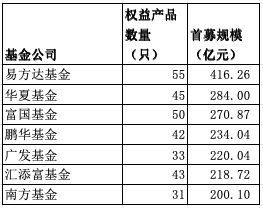
来源:资市会 Wind数据显示,以基金成立日为统计口径,2025年全市场新成立了1555只基金(只显示初始基金,剔 除转型基金和后分级基金),新产品成立数量创近四年来新高,首募规模合计达1.21万亿元。 2025年新成立的基金,发行有哪些新变化?哪些基金公司成立的数量多、规模大,谁的数量少、规模 小?哪些基金经理成大赢家?2025年未拿到"准生证"新基金又是什么情况? 2025年,伴随A股市场震荡上升,公募行业深耕高质量发展,从"重规模"向"重回报"转型,整体管理规 模接连突破多个整数关口,实现稳步增长。 根据基金业协会最新数据,截至2025年11月末,公募基金管理规模达37.02万亿元,基金数量达13490 只,再创历史新高。 除了存量产品规模增长之外,也离不开新基金的大量发行。 新基金发行有何变化?哪些公司成立的数量多、规模大,哪些数量少、规模小?哪些基金经理成大赢 家?2025年未拿到"准生证"新基金情况又是怎么样的? 作者|资市分子 01 权益新基金数占比超七成 2022年至2024年,新成立公募基金数量分别为1457只、1272只、1135只。2025年一举遏制了过去三年新 基金成立下滑趋势,成立了 ...
国源信达史江辉:2026年股票和黄金有望继续走牛!电池和储能或有机会!
私募排排网· 2026-01-09 03:34
Core Viewpoint - The 20th Private Equity Development Forum will be held on January 8, 2026, focusing on high-quality development paths for China's private equity industry, with discussions on AI-enabled investment paradigms, equity market opportunities, and the value of CTA strategy allocation [1]. Group 1: Market Outlook - Both stocks and gold are expected to continue rising in 2026, driven by liquidity and fundamentals. The liquidity factor is particularly emphasized for 2025 due to changes in IPO restrictions and new regulations on share reductions impacting A-share funding [5][7]. - Historical trends indicate that A-shares transition from bear to bull markets are often accompanied by turning points in monetary growth, with significant shifts noted in 2008, 2018, and the latter half of 2024 [5][7]. Group 2: Economic Indicators - The expectation for 2026 is a potential economic bottoming out, which could lead to increased investor optimism and willingness to invest, creating a resonance with fundamentals [9]. - The real estate market is crucial for domestic economic stability, with indicators suggesting a potential bottoming out in 2026, supported by demographic trends in newborns and marriage registrations [10][15]. Group 3: Investment Strategies - The battery and energy storage sectors are identified as key investment themes for 2026, with expectations of long-term growth driven by rising electricity demand and climate change factors [18][19]. - Gold is viewed as a strong investment due to its anti-inflation properties and demand outpacing supply, with central banks increasing their gold purchases significantly in recent years [21][22]. Group 4: Market Dynamics - The A-share market has seen continuous inflows from personal investors, insurance funds, and private equity, despite a high supply of stocks, indicating a robust demand environment [7][8]. - The Hong Kong stock market is not expected to outperform the A-share market due to liquidity being drawn away by IPOs and valuation comparisons showing no significant advantage [20]. Group 5: Gold Market Insights - The gold market is anticipated to remain bullish, with a strong correlation to global economic conditions and monetary policy, particularly with expected interest rate cuts from the Federal Reserve in 2026 [24][25].

卫星ETF鹏华(563790)开盘涨超2.7%,政策不断催化商业航天
Xin Lang Cai Jing· 2026-01-09 02:01
Group 1 - The core viewpoint of the news highlights the rapid development of the commercial aerospace sector in China, driven by government initiatives and increasing demand for satellite internet [1][2]. Group 2 - The Guangzhou Municipal Government has issued a plan to accelerate the construction of an advanced manufacturing city, aiming to establish a globally influential "Sky City" and a new hub for commercial aerospace by 2035 [1]. - The construction of satellite internet in China is accelerating, with the GW constellation entering a mass launch phase, and a total of 13 groups of low Earth orbit satellites planned for launch between July and December 2025 [2]. - The demand for commercial rockets is expected to surge due to satellite internet projects, with an estimated need for 150 rocket launches per year based on the planned deployment of 44,816 satellites [2]. - Policy support for the commercial rocket industry is evident, with the Shanghai Stock Exchange releasing guidelines for the IPO process of commercial rocket companies, including Blue Arrow Aerospace and Galactic Glory [2]. - The commercial rocket industry in China is transitioning from initial development to a new phase of engineering and industrialization, poised for significant growth alongside the satellite industry [2]. Group 3 - As of January 9, 2026, the China Satellite Industry Index has risen by 2.81%, with notable increases in stocks such as Xinke Mobile and Aerospace Electronics [3]. - The Satellite ETF Penghua, which tracks the China Satellite Industry Index, has also seen a rise of 2.79%, reflecting the overall performance of companies involved in satellite manufacturing, launching, and communication [3]. - The top ten weighted stocks in the China Satellite Industry Index account for 63.64% of the index, indicating a concentrated investment in key players like China Satellite and Aerospace Electronics [3].


科创债ETF鹏华(551030)单日成交额超94亿,机构称债券投资或已逐步开始恢复收益属性
Xin Lang Cai Jing· 2026-01-08 09:49
Group 1 - The core viewpoint is that the bond market is gradually recovering from a bearish phase, with increasing liquidity and potential for a bond bull market to start soon [1][2] - The Penghua Science and Technology Innovation Bond ETF (551030) has shown active trading with a turnover of 41.38% and a transaction volume of 9.407 billion yuan, indicating strong market interest [1] - Over the past eight trading days, there have been five days of net inflows totaling 503 million yuan, with an average daily net inflow of approximately 62.9 million yuan [1] Group 2 - Huaxi Securities believes that the policy benefits will create a broad market space for science and technology innovation bonds, with the ETF being the only indexed tool in this sector, enhancing its long-term value and market influence [2] - Penghua Fund has been actively developing a long-term strategy for fixed-income tools since the second half of 2018, aiming to become a domestic expert in fixed-income indices [2] - The Penghua Fund plans to continue providing high-quality bond index investment tools, leveraging its expertise in bond index investment management and product operation experience [2]
6万亿ETF大盘点,谁是细分赛道隐形冠军?
Sou Hu Cai Jing· 2026-01-08 09:42
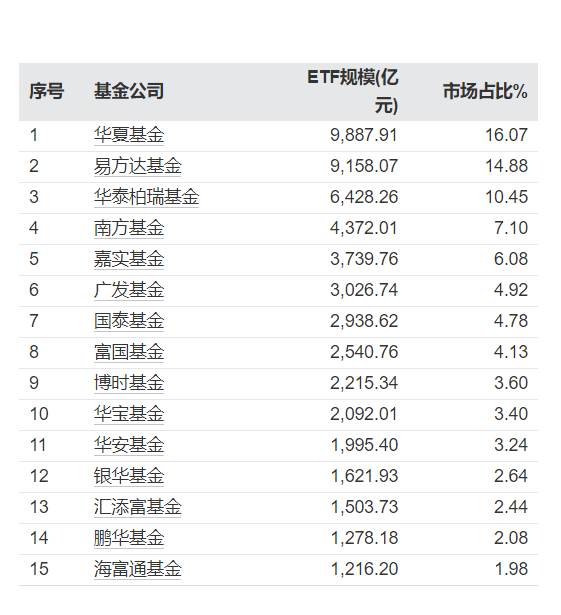
Core Insights - The total scale of ETFs has surpassed 6 trillion, specifically reaching 6.15 trillion [8] - Leading companies in the ETF market include Huaxia and E Fund, both exceeding 900 billion, followed by Haitai Baichuan, which has emerged as a significant player due to its performance in the CSI 300 ETF [9][10] - The ETF market is characterized by a mix of established leaders and emerging champions across various segments, indicating a competitive landscape [10] ETF Market Overview - The top three ETF companies by scale are Huaxia Fund (7,896.61 billion), E Fund (6,981.13 billion), and Haitai Baichuan Fund (5,671.73 billion) [2] - Other notable companies include Southern Fund, Huarun Fund, and GF Fund, which are also recognized as leading public funds in the industry [10] Segment Analysis - In the bond ETF segment, Haifutong Fund leads with a market share of 15.07%, being the only bond ETF to exceed 100 billion [12] - The money market ETF segment is led by Huabao Fund, followed closely by Yinhua Fund, both around 80 billion [13] - The commodity ETF segment is dominated by Huarun Fund with 980 billion, primarily benefiting from the rise in precious metals [13] Emerging Champions - In the cross-border ETF segment, major public funds dominate, with Morgan Fund emerging as a notable player due to its global investment capabilities [14] - The industry index ETF segment is led by Guotai Fund, which, despite being outside the top ten in total scale, excels in this specific category [14] - The thematic index ETF market is primarily held by established public funds, with Huaxia Fund leading at over 1,300 billion [14] Future Outlook - The ETF market is expected to continue growing, with projections suggesting it could reach 10 trillion in the next two years, indicating significant potential for expansion [15]
超百亿,净流出
Zhong Guo Ji Jin Bao· 2026-01-08 06:26
Core Viewpoint - The stock ETF market in China has experienced a significant net outflow of over 12.6 billion yuan, marking the first occurrence of a net outflow exceeding 10 billion yuan in 2026, despite a strong performance in the A-share market [1][3]. Summary by Category Market Performance - As of January 7, 2026, the total scale of 1,291 stock ETFs (including cross-border ETFs) reached 4.72 trillion yuan, with a net outflow of 12.649 billion yuan on that day [3]. - The A-share market has shown a "spring rally" with the Shanghai Composite Index returning to 4,000 points and achieving a record of 14 consecutive days of gains [1][3]. Fund Flows - The net outflow of stock ETFs was primarily driven by wide-based ETFs, which saw a total outflow of 15.866 billion yuan, while specific ETFs like the Hong Kong stock ETFs and commodity ETFs attracted inflows of 4.086 billion yuan and 1.107 billion yuan, respectively [5][10]. - Over the first three trading days of the year, the cumulative net outflow from stock ETFs exceeded 11.9 billion yuan [3]. Specific ETF Performance - On January 7, the top three ETFs by net inflow were the Hong Kong Internet ETF, the Hong Kong Non-Bank ETF, and the Hang Seng Technology ETF, with inflows exceeding 1.151 billion yuan, 1.148 billion yuan, and 0.687 billion yuan, respectively [8][9]. - Conversely, the top ETFs by net outflow included the CSI 1000 ETF and the CSI 300 ETF, with outflows of 1.545 billion yuan and 1.545 billion yuan, respectively [11]. Future Outlook - The macroeconomic environment is expected to remain favorable for the stock market, with anticipated acceleration in local government special bond issuance and increased government spending [12]. - The market is currently in a phase of valuation expansion, supported by long-term factors such as policy support for A-shares and a low-interest-rate environment [12].

超百亿,净流出
中国基金报· 2026-01-08 06:17
Core Viewpoint - The stock ETF market in China has experienced a significant net outflow of over 12.6 billion yuan, marking the first occurrence of a net outflow exceeding 10 billion yuan in 2026, despite a strong performance in the A-share market [2][4]. Group 1: Market Overview - As of January 7, 2026, the total scale of all stock ETFs (including cross-border ETFs) reached 4.72 trillion yuan, with a net outflow of 12.649 billion yuan on that day alone [4]. - In the first three trading days of the year, the cumulative net outflow exceeded 11.9 billion yuan [4]. Group 2: Fund Flows by Type - On January 7, the net inflows were led by Hong Kong stock ETFs and commodity ETFs, with inflows of 4.086 billion yuan and 1.107 billion yuan, respectively [6]. - Conversely, broad-based ETFs experienced significant net outflows, totaling 15.866 billion yuan, with a scale decrease of 14.372 billion yuan [6]. Group 3: Specific ETF Performance - ETFs tracking the Hong Kong Internet Index saw a net inflow of 1.462 billion yuan, while those tracking the CSI A500 Index faced a net outflow of 4.477 billion yuan [6]. - Over the past five trading days, ETFs tracking the SGE Gold 9999 Index attracted over 6.8 billion yuan, and those tracking specific non-ferrous indices saw inflows exceeding 4.7 billion yuan [6]. Group 4: Notable Fund Managers - Several ETFs managed by large fund companies continued to see net inflows, including the Securities Insurance ETF from E Fund, which reached a scale of 20.524 billion yuan with a net inflow of 557 million yuan [6]. - The China Concept Internet ETF from E Fund also performed well, with a scale of 42.025 billion yuan and a net inflow of 547 million yuan [6]. Group 5: Market Outlook - According to Huaxia Fund, the macro environment is expected to remain favorable for long positions, with anticipated acceleration in local government special bond issuance and central budget investments [13]. - The market is currently in a phase of valuation expansion, supported by long-term factors such as new growth drivers, policy support for A-shares, and a low-interest-rate environment [13].

10只ETF公告上市 最高仓位62.01%
Zheng Quan Shi Bao Wang· 2026-01-08 04:43
Group 1 - Three stock ETFs have released listing announcements, with the highest stock allocation being 62.01% for the Xingquan CSI 300 Quality ETF, followed by 40.68% for the Jianxin Growth Enterprise Board Comprehensive Enhanced Strategy ETF [1] - In January, a total of 10 stock ETFs announced their listings, with an average allocation of only 19.47% [1] - The lowest allocations were noted for the Penghua CSI All Share Food ETF at 0.40%, the Guotai CSI Hong Kong Internet ETF at 4.80%, and the E Fund Shanghai Stock Exchange Sci-Tech Innovation Board Chip ETF at 5.37% [1] Group 2 - The average number of shares raised by the newly announced ETFs in January is 3.79 million, with the Xingquan CSI 300 Quality ETF leading at 11.57 million shares [2] - Institutional investors hold an average of 11.55% of the shares, with the highest proportions in the Ping An Hang Seng China Central Enterprise Dividend ETF at 25.59%, Jianxin Growth Enterprise Board Comprehensive Enhanced Strategy ETF at 20.28%, and Xingquan CSI 300 Quality ETF at 18.88% [2] - The newly established stock ETFs have varying construction periods, with the Jianxin Growth Enterprise Board Comprehensive Enhanced Strategy ETF set to have a stock allocation of 40.68% upon listing [2]