
芒果超媒

Search documents
对国产科幻剧最有用的AI,竟然是语言类大模型?
3 6 Ke· 2025-11-10 11:51
Core Insights - The Chinese sci-fi drama industry is experiencing a significant transformation, largely initiated by the success of the series "The Three-Body Problem," which has opened doors for more domestic sci-fi productions [1][3][6] - The market is showing a strong commitment to exploring the sci-fi genre, with a notable increase in the number of projects being developed [3][6] - The integration of AI technology in the production process is seen as a potential game-changer for enhancing efficiency and creativity in sci-fi content creation [5][10][38] Group 1: Industry Trends - The current wave of sci-fi dramas is characterized by a focus on hard sci-fi adaptations, particularly from renowned author Liu Cixin's works, indicating a trend towards high-quality, original content [8][10] - There is a notable shift towards "sci-fi+" projects, which combine sci-fi elements with other genres, allowing for a broader appeal and easier production [10][13] - New production companies are entering the market, bringing fresh ideas and resources, which could lead to a more diverse range of sci-fi content [14][21] Group 2: AI Integration - AI is being increasingly utilized in the production of sci-fi dramas, particularly in the early stages of development, to streamline processes and enhance creative output [24][30][38] - Despite the potential benefits, the current capabilities of AI in producing high-quality content are still limited, particularly in terms of visual fidelity and accuracy [25][30] - The industry is optimistic about the future of AI in film production, with ongoing experimentation and adaptation expected to yield better results over time [30][42] Group 3: Market Dynamics - The 2026 streaming platform project list includes over 400 titles, with 17 dedicated to sci-fi, indicating a growing interest and investment in the genre [6][7] - The success of "The Three-Body Problem" has set a benchmark for future projects, with expectations for similar high-quality adaptations to follow [8][10] - The competitive landscape is evolving, with established and new players vying for a share of the burgeoning sci-fi market, which is seen as a critical area for growth in the Chinese entertainment industry [14][21][44]



数字媒体板块11月10日涨1.97%,掌阅科技领涨,主力资金净流入4.76亿元
Zheng Xing Xing Ye Ri Bao· 2025-11-10 08:49
Market Performance - The digital media sector increased by 1.97% on November 10, with Zhangyue Technology leading the gains [1] - The Shanghai Composite Index closed at 4018.6, up 0.53%, while the Shenzhen Component Index closed at 13427.61, up 0.18% [1] Stock Highlights - Zhangyue Technology (603533) closed at 22.68, up 9.99% with a trading volume of 298,300 shares and a turnover of 671 million yuan [1] - Zhidema (300785) closed at 35.08, up 5.16% with a trading volume of 108,600 shares and a turnover of 377 million yuan [1] - ST Fanli (600228) closed at 6.97, up 4.97% with a trading volume of 78,300 shares and a turnover of 54.06 million yuan [1] - Xinhua Net (603888) closed at 20.43, up 3.08% with a trading volume of 253,400 shares and a turnover of 519 million yuan [1] Capital Flow - The digital media sector saw a net inflow of 476 million yuan from institutional investors, while retail investors experienced a net outflow of 369 million yuan [2][3] - Major stocks like Zhangyue Technology had a net inflow of 231 million yuan from institutional investors, but a net outflow of 124 million yuan from retail investors [3]


ST华通申请摘帽;理性看音乐格局:——互联网传媒周报20251103-20251107-20251110
Shenwan Hongyuan Securities· 2025-11-10 07:51
Investment Rating - The industry investment rating is "Overweight," indicating that the industry is expected to outperform the overall market [12]. Core Insights - The report highlights that the gaming sector is experiencing a recovery with increased clarity on new products for 2026, which may lead to upward revisions in performance. The report emphasizes the importance of differentiated competition based on user preferences and game categories [5]. - The music streaming landscape is undergoing adjustments, particularly with the rise of "Soda Music," which has surpassed 100 million MAU. The report suggests a rational perspective on the music market dynamics, focusing on the ROI of user engagement and content monetization strategies [5]. - AI investments are shifting towards a focus on return on investment (ROI), with significant capital expenditures expected in the domestic market. The report identifies key players in the AI and cloud computing sectors, highlighting their potential for revenue growth and valuation attractiveness [5]. Summary by Sections Gaming Sector - The gaming sector is seeing a recovery with more game licenses being issued, and companies are focusing on differentiated competition based on user and genre [5]. - Key companies to watch include Tencent Holdings, Giant Network, and ST Huatuo, with a focus on their performance and product launches in 2026 [5]. Music Industry - The rise of "Soda Music" has led to adjustments in the music streaming market, with a focus on low-cost content production and user community engagement [5]. - The report emphasizes the importance of high-quality user communities for monetization and the challenges of traditional advertising models in music streaming [5]. AI and Technology - The report anticipates a shift in AI investments towards a focus on ROI, with domestic companies increasing their capital expenditures in AI and cloud computing [5]. - Key companies in the AI space include Tencent, Alibaba, and Baidu, with a focus on their cloud computing capabilities and AI applications [5].





Kimi-k2thinking模型发布;关注年末AI、IP边际催化:传媒行业周观察(20251103-20251107)
Huachuang Securities· 2025-11-10 07:51
Investment Rating - The report maintains a "Recommended" investment rating for the media industry, expecting the industry index to rise more than 5% over the next 3-6 months compared to the benchmark index [52]. Core Insights - The media sector experienced a slight increase of 0.16% last week, underperforming the CSI 300 index, which rose by 0.82%, resulting in a relative underperformance of 0.66% [9]. - The report emphasizes the need for both sharpness and allocation in the media sector, highlighting the potential for significant growth in AI and IP applications as catalysts for the industry [6]. - The gaming market remains strong, with notable performances from Tencent's products, while the film market is expected to see a boost from the upcoming release of several high-profile imported films [6][21]. Market Performance Review - The media sector's overall market capitalization is approximately 1,959.53 billion yuan, with 140 listed companies [3]. - The absolute performance of the media index over the past month is 3.1%, 28.2% over six months, and 72.0% over the past year [4]. - The gaming market continues to show resilience, with Tencent's titles dominating the iOS sales rankings [16]. Industry Highlights - The report notes that the film market has recovered approximately 76% of its total box office compared to 2019, with a total box office of 40.31 billion yuan and 1.06 billion viewers as of November 7, 2025 [21]. - Upcoming films such as "Demon Slayer: Infinity Castle" and "Now You See Me 3" are expected to drive box office growth in November and December [30]. - The AI sector is highlighted for its ongoing advancements, with the launch of the Kimi-k2 thinking model, which enhances AI capabilities in complex problem-solving [33]. Company Announcements - ST Huatuo announced its application to revoke risk warnings, indicating a positive shift in its operational status [37]. - Damai Entertainment expects a significant increase in net profit for the first half of 2025, projecting a net profit of no less than 500 million yuan, up from 337 million yuan in the same period last year [39]. - Fubo Group reported a record high revenue of over 800 million HKD for Q3 2025, marking a 27% year-on-year increase [41].
ST华通申请摘帽,理性看音乐格局
Shenwan Hongyuan Securities· 2025-11-10 06:12
Investment Rating - The industry investment rating is "Overweight" indicating that the industry is expected to outperform the overall market [13]. Core Insights - The report highlights a positive outlook for the gaming sector, particularly with the recent news of ST Huatuo applying to lift its risk warning, which is expected to alleviate valuation pressures in the gaming sector [5]. - The report emphasizes the importance of differentiated competition among gaming companies, focusing on user and genre-based strategies rather than just the number of licenses issued [5]. - In the music sector, the report suggests a rational perspective on the competitive landscape, noting that platforms like Qishui Music are leveraging low-cost content to grow their user base, which may impact traditional music advertising ROI [5]. - The report anticipates a shift in global AI investment focus from capital expenditure to return on investment, with a notable increase in domestic chip listings and rapid commercialization of AI applications [5]. Summary by Sections Education Publishing - Attention is drawn to companies like Zhongwen Chuanmei and Shandong Publishing, which are showing signs of operational turnaround in Q3 2025 [5]. Gaming Sector - Key companies to watch include Tencent Holdings, Giant Network, ST Huatuo, and others, with a focus on their performance and potential for revenue upgrades in 2026 [5]. - The report notes that the issuance of new game licenses is increasing, but this does not necessarily indicate a worsening competitive landscape [5]. Music Industry - The report discusses the impact of Qishui Music achieving over 100 million MAU, suggesting a need for a rational view of the music market dynamics [5]. - It highlights the challenges of monetizing long-tail music content and the importance of building a high-quality user community for future revenue generation [5]. AI Investment - The report predicts that AI investments will increasingly focus on return on investment, with significant developments in domestic chip production and AI applications [5]. - Companies like Tencent, Alibaba, and Baidu are highlighted for their strong positions in AI and cloud computing, with recommendations for investment based on their growth potential [5]. Valuation Table - A detailed valuation table is provided, showing the market capitalization, revenue, and profit forecasts for key companies in the sector, indicating varied growth rates and profitability metrics [7].


微短剧产业进阶
Xin Hua Wang· 2025-11-10 02:55
Core Insights - The micro-short drama market is projected to exceed 50 billion yuan in 2024, with significant growth expected this year compared to last year [1][2]. Group 1: Industry Transformation - The industry is shifting from a "traffic-oriented" model to a "value-oriented" approach, emphasizing quality over quantity [3]. - The past year has seen a significant "quality reshuffle," with platforms raising content review standards, pushing creators to focus on script logic and character development [4][5]. - The production costs for high-quality micro-short dramas have increased dramatically, from approximately 50,000 yuan in 2022 to 1.5 million yuan for a premium short drama [4]. Group 2: Cross-Industry Integration - The "micro-short drama+" model is creating multiplier effects across various industries, integrating content with brand marketing and tourism [8][10]. - Successful case studies include collaborations with brands like Dicos and Pizza Hut, which have effectively merged product promotion with storytelling [8]. - The industry is also exploring "long-short linkage," where long dramas and micro-short dramas co-create content to extend IP lifecycles and maximize user value [8][10]. Group 3: Technological Empowerment - AI is becoming a crucial tool for enhancing quality and efficiency in micro-short drama production, with estimates suggesting a 50% increase in planning efficiency and a 30% reduction in production costs [11]. - The application of AI in content creation and user engagement is rapidly expanding, with significant growth in the market for AI-generated content [11]. Group 4: Cultural Resonance - The market is evolving from "emotional consumption" to "emotional resonance," focusing on deeper connections with audiences [12][13]. - Works that depict nuanced emotional experiences are gaining popularity, reflecting a shift in user demand towards more meaningful content [12]. - The industry is increasingly producing content that embodies social concerns and cultural heritage, appealing to younger audiences [12]. Group 5: Global Expansion - The micro-short drama industry is entering a "global localization" phase, with companies establishing local teams overseas and expanding distribution channels [14]. - The volume of overseas productions and adaptations has surged, with significant numbers of both local and translated dramas being released globally [14]. - Micro-short dramas are becoming an effective cultural vehicle for reaching international markets, leveraging their engaging and easily digestible format [14].

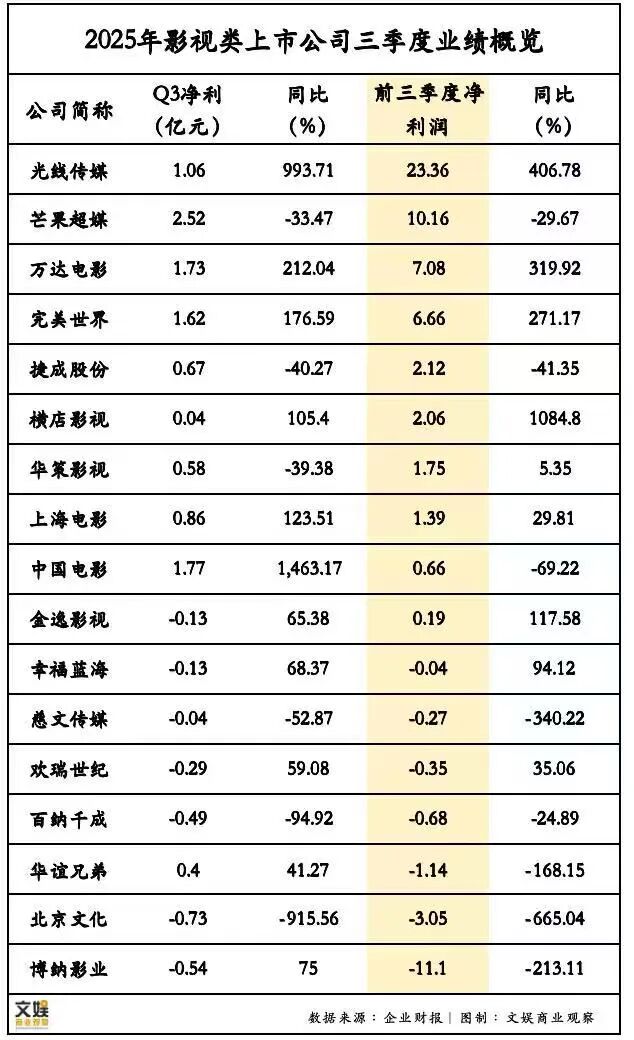
光线狂奔、博纳亏损, 影视行业Q3再现“世界的参差”
Xin Lang Cai Jing· 2025-11-10 02:24
Core Insights - The Q3 financial reports of film and television companies reveal a stark contrast in performance, highlighting a significant divide within the industry [1][3][17] Company Performance Overview - Light Media reported a staggering 993.71% increase in Q3 net profit and a 406.78% increase in net profit for the first three quarters, driven by successful film releases and IP derivative businesses [2][4] - Wanda Film achieved a Q3 net profit of 1.73 billion, a 212.04% year-on-year increase, supported by strong box office performance and strategic marketing initiatives [2][9] - Perfect World also saw substantial growth, with a 176.59% increase in Q3 net profit, bolstered by new game releases and a significant rise in film revenue [2][10] - In contrast, Bona Film reported a net loss of 11.1 billion for the first three quarters, reflecting a severe decline in performance due to reliance on a single film project [2][11] - Mango Super Media experienced a decline in revenue and net profit but showed potential for growth through strategic investments and international expansion [2][14][16] Industry Trends and Strategies - The industry is witnessing increased differentiation, with successful companies focusing on content quality and diversified business models to mitigate cyclical fluctuations [3][4][10] - Light Media's growth strategy emphasizes collaboration between film and IP derivative businesses, showcasing the importance of a balanced business structure [4][5] - Wanda Film's success is attributed to its "Super Entertainment Space" strategy, enhancing customer engagement and optimizing revenue streams through diverse offerings [9][10] - Bona Film's struggles highlight the risks of over-reliance on specific projects and the need for strategic diversification to ensure long-term viability [11][12] - Mango Super Media's proactive approach in content investment and international expansion indicates a shift towards sustainable growth despite short-term challenges [14][16] Conclusion - The Q3 financial results serve as a critical assessment of survival strategies and execution capabilities within the film and television industry, emphasizing the divide between long-term thinkers and short-term opportunists [17]

新华网财经观察丨微短剧产业进阶
Xin Hua Wang· 2025-11-10 02:21
Core Insights - The micro-short drama market is projected to exceed 50 billion yuan in 2024, with significant growth expected this year compared to last year [2] - The industry is transitioning from a "traffic-oriented" model to a "value-oriented" model, emphasizing quality over quantity [4] Group 1: Quality Enhancement - The industry has shifted from being a "cost-effective" space to a "quality-centric" one, where high-quality content is essential for survival [5] - The production costs for quality micro-short dramas have increased significantly, from approximately 50,000 yuan in 2022 to 1.5 million yuan currently [5] - User expectations have risen, leading to a strong willingness to pay for high-quality content, which drives the industry's transformation towards premium offerings [5][7] Group 2: Cross-Industry Integration - The "micro-short drama+" model is creating multiplier effects across various industries, enhancing content's value beyond mere entertainment [8] - Successful case studies include collaborations with brands like Dicos and Pizza Hut, integrating product features into storylines to achieve significant exposure [8] - The integration of long and short formats is becoming crucial, with platforms developing strategies to extend IP lifecycles and maximize user value [8][10] Group 3: Technological Empowerment - AI is becoming a vital tool for enhancing quality and efficiency in micro-short drama production, with estimates suggesting a 50% increase in planning efficiency and a 30% reduction in production costs [11] - The application of AI in content creation and user engagement is reshaping the production process, making it a core component of the creative economy [11] Group 4: Cultural Resonance - The market is evolving from superficial emotional expressions to deeper emotional connections with audiences, reflecting a shift in user demands [12] - Works that portray nuanced emotional experiences are gaining popularity, indicating a trend towards content that resonates on a personal level [12][14] Group 5: Global Expansion - The micro-short drama industry is entering a "global localization" phase, with companies establishing local teams and platforms in over 200 countries [15] - The range of themes is diversifying, moving from traditional genres to urban, suspense, and realism, making micro-short dramas effective cultural carriers in global markets [15]


太好了,淘宝摇一摇霸屏广告要被治了
3 6 Ke· 2025-11-10 00:07
Core Viewpoint - The article discusses the increasing frustration among users due to aggressive advertising practices by platforms like Taobao, which forcefully redirect users to promotional pages across various apps, leading to widespread complaints and regulatory scrutiny [1][3][7]. Group 1: User Experience and Complaints - Users are experiencing unwanted redirections to Taobao when using other apps, causing significant annoyance and frustration [1][3]. - Complaints have emerged regarding the difficulty in closing these ads, with users often unable to find the close button quickly enough [3][4]. - The issue has escalated to the point where regulatory bodies, such as the Hangzhou Yuhang District Market Supervision Administration, have begun investigating these advertising practices following numerous reports [7]. Group 2: Advertising Techniques and Industry Response - The article highlights the problematic nature of "shake to interact" advertising, which has evolved from a popular feature into a source of user frustration due to its misleading design [16][18]. - Historical context is provided, noting that previous regulations aimed at curbing misleading ads had initially reduced the incidence of such practices significantly, but the industry has since adapted by creating new methods to bypass these regulations [22][23]. - The rise of "shake to interact" advertising is attributed to the need for platforms to maintain advertising revenue, with the technique being widely adopted across the industry despite its negative reception from users [25][28]. Group 3: Industry Innovations and Criticism - The article mentions the controversial figure behind the "shake to interact" feature, Chen Chao, who has been criticized for creating advertising methods that prioritize revenue over user experience [29][32]. - Chen's previous invention, "super pause," which forces ads to take over the screen when a video is paused, has also drawn significant backlash from users [32][33]. - The article speculates on future advertising innovations that may further infringe on user experience, suggesting that as long as there are financial incentives, companies may continue to develop intrusive advertising methods [35].


短剧市场规模近千亿,漫剧成为新增长极
Tai Ping Yang Zheng Quan· 2025-11-09 14:12
Investment Rating - The industry investment rating is "Positive," indicating that the overall return is expected to exceed the CSI 300 Index by more than 5% in the next six months [51]. Core Viewpoints - The short drama market in China is projected to reach nearly 100 billion yuan by 2025, driven by a supply-demand resonance and a significant increase in user scale [3][7]. - The emergence of "manhua dramas" as a new growth driver in the short drama sector is noted, with distinct user demographics compared to traditional short dramas [4][7]. - The integration of AI technology and platform support is expected to enhance the manhua drama industry's growth, with a projected market size exceeding 20 billion yuan in 2025 [5][7]. Summary by Sections Industry Overview - The short drama market is anticipated to grow rapidly, with a market size of 505 billion yuan in 2024 and close to 1 trillion yuan in 2025, reflecting nearly a doubling in size [3]. - Regulatory frameworks are evolving, promoting quality improvements in the short drama sector [7]. User Demographics - Manhua dramas attract a predominantly male audience (86%), while traditional short dramas have a more balanced gender distribution [4][7]. - The user base for short dramas is expected to grow to 600-700 million by 2025, up from 300-500 million in 2024 [3][4]. Market Dynamics - The manhua drama segment is projected to see a compound annual growth rate of 83%, with 3,000 new titles expected to launch in the first half of 2025 [5][7]. - AI technology is significantly reducing production costs and time, enhancing the variety of content available in the manhua drama category [6][7]. Investment Opportunities - Companies with substantial IP content reserves and AI video generation capabilities are recommended for investment, such as Bona Film Group [7].