
今世缘

Search documents
告别传统渠道?五粮液低度酒营销“出狠招”!
Nan Fang Du Shi Bao· 2025-10-27 02:20
Core Insights - The article discusses a marketing revolution in the competitive Chinese liquor market, led by major players like Wuliangye, focusing on innovative sales strategies to attract younger consumers [1][8]. Group 1: Marketing Innovation - Wuliangye has launched a "fission" sales system for its product "29-degree Wuliangye · First Love," allowing consumers to become "recommendation officers" and earn cash rewards for referrals [1][3]. - This fission model is seen as a breakthrough in the brand's efforts to appeal to younger demographics, transforming traditional advertising budgets into user incentives and fostering emotional connections through social sharing [1][5]. - The brand's marketing strategy has shifted towards social-driven approaches, with celebrity endorsements and a focus on engaging younger audiences through platforms they frequent [3][10]. Group 2: Market Trends - The low-alcohol liquor segment is rapidly growing, with projections indicating the market will exceed 74 billion yuan by 2025, reflecting a compound annual growth rate of 25%, significantly outpacing the overall liquor industry [5][6]. - Many liquor companies are investing in low-alcohol products, with 21.1% of firms planning to enhance their offerings in this category as part of their 2025 strategies [5]. - The trend towards low-alcohol beverages aligns with younger consumers' preferences for lighter drinking experiences and more flexible consumption scenarios [6][8]. Group 3: Industry Challenges - The liquor industry is facing significant challenges, including high inventory pressure and price imbalances, with average inventory turnover days reaching 900, a 10% increase year-on-year [8][10]. - Traditional distribution models reliant on intermediaries are becoming less effective, prompting a shift towards user-centric marketing and direct consumer engagement [8][10]. - Companies are exploring diverse marketing innovations to establish deeper emotional connections with consumers, particularly the younger generation [8][10].


食品饮料周观点:三季报窗口期,关注绩优成长与边际改善-20251026
GOLDEN SUN SECURITIES· 2025-10-26 08:17
Investment Rating - The industry investment rating is "Maintain Overweight" [5] Core Views - The report emphasizes the importance of focusing on high-performing growth stocks and marginal improvements during the third quarter reporting period [1] - In the liquor sector, the report anticipates accelerated clearing of Q3 financial statements, with risks related to wholesale prices and inventory gradually being released [2] - The beer and beverage sectors are highlighted for their ongoing premiumization and strong growth momentum, particularly for Yanjing Beer and Dongpeng Beverage [3] - The snack sector shows a mixed performance, with emerging channels performing well while traditional channels face pressure [4] Summary by Sections Liquor Sector - The first Q3 report from Jinhui Wine shows a revenue of 546 million yuan, down 4.89% year-on-year, and a net profit of 25 million yuan, down 33.02% [2] - The report notes that the industry is in an adjustment phase, with Q3 liquor sales continuing to decline, but risks are gradually being cleared [2] Beer Sector - Yanjing Beer reported Q3 revenue of 4.88 billion yuan, up 1.6% year-on-year, and a net profit of 670 million yuan, up 26.0% [3] - Zhujiang Beer reported Q3 revenue of 1.88 billion yuan, down 1.3% year-on-year, with a net profit of 330 million yuan, up 8.2% [3] Beverage Sector - Dongpeng Beverage reported Q3 revenue of 6.11 billion yuan, up 30.4% year-on-year, and a net profit of 1.39 billion yuan, up 41.9% [3] Snack Sector - Wanchen Group reported Q3 revenue growth of 44.2%, benefiting from store expansion [4] - Jinzhai Food returned to growth with a 6.5% increase in revenue, while Q3 revenue for Qiaqia Food decreased by 5.9% due to cost pressures [4] Dairy Sector - Tianrun Dairy reported Q3 revenue of 680 million yuan, down 4.8% year-on-year, with a net profit of 10 million yuan, down 77.6% [4]
酒香也怕巷子深?酿新篇:中国酒业的三味“新曲”
Sou Hu Cai Jing· 2025-10-26 03:03
Core Insights - The 23rd China International Wine Expo showcased a comprehensive display of the entire industry chain, moving beyond just finished products to include raw materials, smart equipment, and digital marketing [4][10] - The industry is undergoing significant transformations characterized by three main themes: youthfulness, digitalization, and internationalization, which are essential for the industry's evolution [2][12] Youthfulness - Wine companies are actively adapting to attract younger consumers, with products like "no high-low" yellow wine targeting health-conscious youth, and innovative offerings such as wine-infused chocolates and face masks [6][7] - The shift towards youthfulness is driven by the emergence of Generation Z as a new consumer force, emphasizing personalized experiences and health-conscious choices [7][9] Digitalization - The digital transformation in the wine industry is evident through automation in production processes and the integration of technologies like blockchain for transparency and AR/VR for immersive experiences [9][10] - However, the digitalization efforts are primarily benefiting larger enterprises, raising concerns about the potential widening gap between large and small companies in the industry [9][12] Internationalization - Chinese wine companies are increasingly engaging with global markets, supported by China's growing international influence and proactive industry reforms [10][12] - The internationalization of Chinese wine faces challenges, including the need to meet international quality standards and cultural recognition in foreign markets [12][13] Conclusion - The wine expo reflects a broader trend of transformation in traditional industries, where youthfulness, digitalization, and internationalization are interconnected and mutually reinforcing [13][15] - The industry must embrace change with an open mindset and innovative spirit to navigate the complexities of modern market dynamics [15]


迎驾贡酒(603198):基本面或已触底,静待需求复苏
Hua Yuan Zheng Quan· 2025-10-25 10:00
Investment Rating - The investment rating for the company is "Accumulate" (maintained) [5] Core Views - The report suggests that the fundamentals may have bottomed out, and the company is waiting for demand recovery. The Anhui province, being a traditional stronghold for liquor production and sales, is expected to see continued growth in the liquor market despite consumption downgrading. The projected market size for Anhui's liquor market in 2024 is approximately 400 billion RMB, supported by the province's active private economy and strong per capita drinking capacity [5][25]. Summary by Sections Market Performance - The closing price of the company is 40.45 RMB, with a market capitalization of 32,360 million RMB. The one-year high and low prices are 69.00 RMB and 37.79 RMB, respectively. The company has a total share capital of 800 million shares and a debt-to-asset ratio of 22.09% [3]. Profit Forecast and Valuation - The company’s net profit attributable to shareholders is forecasted to be 21.32 billion RMB, 22.58 billion RMB, and 24.61 billion RMB for the years 2025 to 2027, corresponding to P/E ratios of 15, 14, and 13 times, respectively. The company is expected to show resilience in revenue and net profit due to solid channel management and brand recognition in Anhui, with room for market expansion [7][10][48]. Strategic Product Line and Channel Development - The company has successfully positioned itself in the mid-to-high-end market, focusing on price bands above 150 RMB, which aligns with the consumption upgrade trend in Anhui. The introduction of the "Cave" series has significantly improved the product structure and market share. The company employs a deep distribution model that covers both core cities and lower-tier markets, enhancing its competitive edge [9][39][37]. Economic Environment and Market Dynamics - The Anhui province's economy has shown robust growth, with GDP increasing from 3,125.3 billion RMB in 2000 to 50,625.2 billion RMB in 2024. The active private economy in Anhui contributes significantly to the liquor market's resilience, with private enterprises accounting for 60.7% of the province's GDP and 59.7% of tax revenue [25][29]. Financial Performance and Ratios - The company’s revenue for 2025 is projected to be 6,225 million RMB, reflecting a year-on-year decline of 15.23%. However, the revenue is expected to recover with growth rates of 2.71% and 6.11% in 2026 and 2027, respectively. The gross margin is anticipated to remain strong, with a net profit margin of 35.33% in 2024 [8][48].

白酒板块10月24日跌1.53%,泸州老窖领跌,主力资金净流出15.36亿元
Zheng Xing Xing Ye Ri Bao· 2025-10-24 08:29
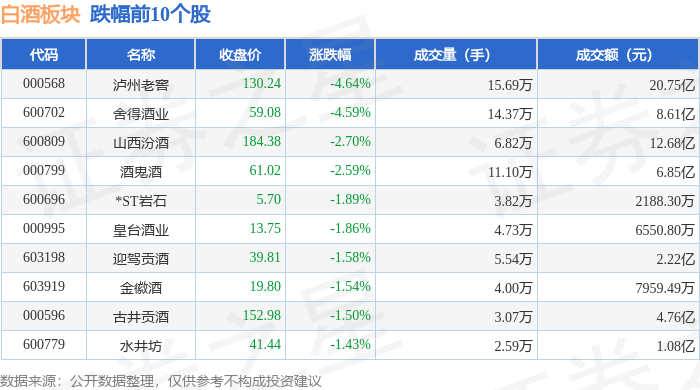
Core Insights - The liquor sector experienced a decline of 1.53% on October 24, with Luzhou Laojiao leading the drop [1] - The Shanghai Composite Index closed at 3950.31, up 0.71%, while the Shenzhen Component Index closed at 13289.18, up 2.02% [1] Liquor Sector Performance - Luzhou Laojiao's closing price was 130.24, down 4.64%, with a trading volume of 156,900 shares and a transaction value of 2.075 billion [1] - Other notable declines included Shede Liquor down 4.59%, Shanxi Fenjiu down 2.70%, and Jiu Gui Jiu down 2.59% [1] - The sector saw a net outflow of 1.536 billion from main funds, while retail investors contributed a net inflow of 794 million [1] Fund Flow Analysis - Guizhou Moutai experienced a main fund net outflow of 4.17 billion, with a retail net inflow of 7.28 million [2] - Luzhou Laojiao had a main fund net outflow of 2.57 billion, with retail inflows of 178 million [2] - Other companies like Wuliangye and Shanxi Fenjiu also faced significant main fund outflows of 2.06 billion and 1.92 billion respectively [2]
机构:白酒三季报亮红灯,5个龙头利润下降30%,动销数据大幅走弱
Sou Hu Cai Jing· 2025-10-23 20:42
Core Viewpoint - The Chinese liquor industry is facing a bleak outlook, with multiple securities firms predicting significant profit declines for major companies, including Moutai and Wuliangye, by Q3 2025, indicating a severe downturn compared to previous optimistic expectations [1][4]. Group 1: Industry Predictions - Analysts from various securities firms, including Zhongyou Securities and Guangfa Securities, predict that major liquor companies may experience profit declines of up to 30% or more, with Wuliangye's profits potentially halving [1][3]. - Moutai is expected to see near-zero profit growth, while Wuliangye, Luzhou Laojiao, and Gujinggongjiu are projected to face around a 20% profit decline [1][4]. - The overall liquor industry is anticipated to face a more than 20% decline in sales volume due to external demand shocks [4]. Group 2: Market Conditions - The retail sales growth of consumer goods has significantly slowed, particularly in the catering sector, which has nearly stagnated, directly impacting liquor consumption [1][8]. - The average turnover days for inventory in the industry are high, indicating a pressing need for companies to manage inventory effectively amid changing consumer demand [10]. Group 3: Company Responses - Companies are adopting pragmatic strategies to alleviate channel pressure, including adjusting inventory and reducing expenses to enhance operational efficiency [6][9]. - Wuliangye acknowledged the challenges in the market during the recent holiday season but emphasized that official data should be awaited for a clearer picture [3]. Group 4: Consumer Trends - There is a noticeable shift in consumer behavior towards more rational consumption, with increased sensitivity to prices and a decline in the enthusiasm for high-priced products [9]. - The demand is shifting from traditional business banquets to more casual settings, such as gatherings with friends and family, prompting companies to adjust their product offerings [9][10]. Group 5: Future Outlook - Despite the short-term profit declines, the fundamentals of the liquor industry, especially for leading companies, remain intact, with a potential shift towards quality-focused growth rather than mere scale expansion [11]. - The upcoming Q3 reports are expected to provide critical insights into how companies are navigating the current challenges and adapting to market changes [11].



白酒巨头集体降度“服软”,能否“拿捏”年轻人
第一财经· 2025-10-23 13:03
Core Viewpoint - The low-alcohol liquor segment has become a focal point in the industry, with many liquor companies actively developing products with alcohol content below 30 degrees, reflecting the industry's anxiety over growth challenges [3][4][5]. Industry Trends - The recent national sugar and liquor trade fairs highlighted low-alcohol liquor as a key product line, with major brands like Wuliangye and Gujinggongji launching new products [5]. - The shift towards low-alcohol products is seen as a response to changing consumer preferences and market dynamics, particularly among younger consumers who favor lighter, more casual drinking experiences [6][7]. Consumer Behavior - Young consumers, particularly those born in the 90s and 00s, are becoming the main market force, showing a preference for diverse and low-alcohol options, with only 11.2% favoring beverages above 30 degrees [6][7]. - The implementation of new regulations against wasteful drinking practices has further influenced drinking habits, pushing consumption towards home and casual settings [6]. Market Challenges - Despite initial enthusiasm for low-alcohol products, sales data indicates that many new offerings are not performing well in offline channels, suggesting that simply lowering alcohol content may not be sufficient to attract younger consumers [7][8]. - The industry faces a challenge in not only adjusting alcohol levels but also in effectively branding and marketing these products to resonate with the target audience [7][9]. Historical Context - The current trend of low-alcohol liquor mirrors a similar movement in the 70s and 80s, but the market shifted back to high-alcohol products in the 90s [5]. - Previous attempts at targeting younger consumers, exemplified by brands like Jiangxiaobai, have seen many competitors exit the market, raising questions about the sustainability of the current low-alcohol trend [9].

白酒巨头集体降度“服软”,能否“拿捏”年轻人
Di Yi Cai Jing· 2025-10-23 10:56
Core Insights - The low-alcohol liquor segment has become a focal point in the industry, with many companies actively developing products with alcohol content below 30 degrees [2][4] - The shift towards low-alcohol products reflects the industry's anxiety over growth challenges, as traditional high-alcohol liquor faces declining consumption due to changing consumer habits and regulatory policies [2][4] Industry Trends - Major brands like Wuliangye and Gujinggong have launched new low-alcohol products, indicating a trend towards lower alcohol content in response to market demands [2][3] - The implementation of the revised "Strictly Enforce Savings and Oppose Waste Regulations" in May 2025 has influenced drinking scenarios, pushing consumption towards more casual settings [2][4] Consumer Behavior - Younger consumers, particularly those born in the 1990s and 2000s, are becoming the main market force, showing a preference for lower alcohol content and diverse drinking options [3][4] - A report indicates that only 11.2% of young consumers prefer beverages with an alcohol content above 30 degrees, prompting companies to target this demographic with low-alcohol, fashionable products [3][4] Market Challenges - Despite initial enthusiasm for low-alcohol products, sales data shows mixed results, with some brands performing well while others struggle to gain traction in both online and offline channels [4][5] - Industry experts caution that simply lowering alcohol content may not be sufficient to attract younger consumers; a comprehensive approach involving brand positioning and marketing strategies is necessary [4][5] Historical Context - The current trend of low-alcohol products mirrors a similar movement in the 1970s and 1980s, but the market shifted back to high-alcohol products in the 1990s [2][6] - Previous attempts at youth-oriented products, exemplified by brands like Jiangxiaobai, have seen many competitors exit the market, raising questions about the sustainability of the current low-alcohol trend [6]
白酒三季报遭滑铁卢!5个龙头暴降30%,一个指标严重下滑
Sou Hu Cai Jing· 2025-10-23 01:57
Core Viewpoint - The Chinese liquor industry is facing a significant downturn, with major companies like Wuliangye and Luzhou Laojiao projected to experience substantial declines in revenue and profit for Q3 2025, indicating a broader industry crisis [1][4][10]. Financial Performance Predictions - Wuliangye's Q3 2025 revenue is expected to drop by 30% year-on-year, with net profit plummeting by 45% [1][2]. - Luzhou Laojiao is forecasted to see a 20% decline in profit, while other companies like Yanghe and Jiuqujiu are also expected to report profit drops exceeding 30% [4][8]. - Guizhou Moutai is projected to have near-zero profit growth, contrasting sharply with the declines seen in other brands [4][7]. Market Conditions - The overall retail sales growth has slowed significantly since July, particularly in the catering sector, which has fallen below 1% [6]. - Traditional festive gatherings and gifting demand have decreased, particularly affecting high-end liquor sales [6][10]. - Channel inventory pressures are mounting, with Wuliangye's pricing dropping from approximately 900 yuan to 820 yuan per bottle, leading to challenges for distributors [6]. Industry Trends - The liquor sector is experiencing a "sell less—dare not stock—worse performance" vicious cycle, exacerbated by high inventory levels and price inversions [10]. - The valuation of liquor stocks is under pressure, with some leading companies' price-to-earnings ratios nearing historical lows [10]. - The current performance downturn may be a precursor to future recovery, although the timing of any potential turnaround remains uncertain [10].

中信证券:预计Q3白酒基本面有望触底 看好行业底部配置机会
Zhi Tong Cai Jing· 2025-10-23 00:53
Group 1 - The performance of the 2025 Autumn Sugar and Wine Fair met expectations, with the industry actively embracing the consumer side and expanding market demand [1][2] - The fair attracted over 4,000 exhibitors, a significant decrease from over 6,500 at the Spring Fair in 2023, indicating a weaker招商 function and a shift towards market education opportunities [2] - Notable trends at the fair included an increase in customized liquor varieties and a higher number of raw liquor suppliers, reflecting the industry's bottom adjustment cycle [2] Group 2 - The outlook for Q3 2025 suggests that liquor companies should focus on balancing inventory and revenue growth, with a slowdown in growth rates expected [3] - High-end liquor brands are likely to respect market conditions, while mid-tier brands may experience a slight decline due to insufficient consumer demand [3] - Overall, the industry is expected to continue a de-inventory trend in Q3, with distributors and end-users showing low enthusiasm for stocking up [3]
