
广汇能源

Search documents
油气开采板块走高 首华燃气涨超10%
Xin Lang Cai Jing· 2025-11-14 06:11
Group 1 - The oil and gas extraction sector has seen a rise, with Shouhua Gas increasing by over 10% [1] - Other companies such as New Natural Gas, China National Offshore Oil Corporation (CNOOC), Potential Energy, Guanghui Energy, and Blue Flame Holdings also experienced gains [1]

行业ETF风向标丨港股创新药ETF交投持续活跃,油气资源ETF半日涨幅超2%
Mei Ri Jing Ji Xin Wen· 2025-11-14 05:01
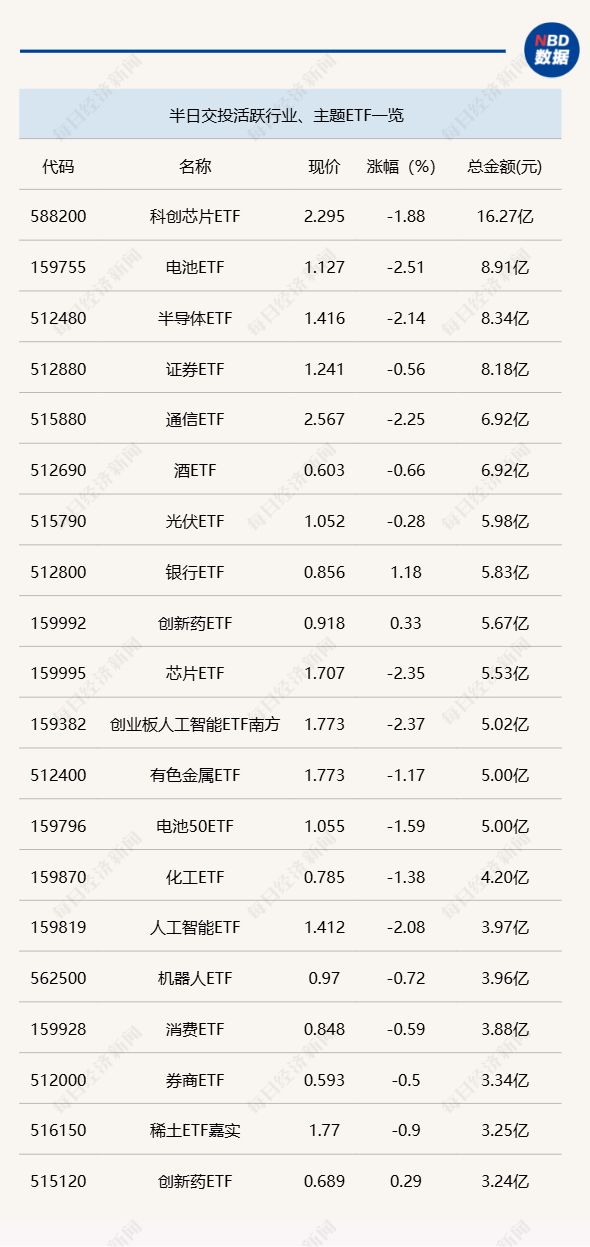
Core Insights - The trading activity of industry and thematic ETFs has decreased, with only the Sci-Tech Chip ETF (588200) exceeding a transaction amount of 1 billion yuan, reaching 1.627 billion yuan [1][3] - The Hong Kong Innovative Drug ETF (513120) remains active in cross-border ETFs, with a half-day transaction amount exceeding 5 billion yuan, reaching 6.258 billion yuan [1][4] Industry and Thematic ETFs Summary - The Sci-Tech Chip ETF (588200) had a current price of 2.295 yuan, with a decline of 1.88%, and a total transaction amount of 1.627 billion yuan [3] - Other notable ETFs include: - Battery ETF (159755): 1.127 yuan, -2.51%, 0.891 billion yuan - Semiconductor ETF (512480): 1.416 yuan, -2.14%, 0.834 billion yuan - Securities ETF (512880): 1.241 yuan, -0.56%, 0.818 billion yuan - Communication ETF (515880): 2.567 yuan, -2.25%, 0.692 billion yuan [3] Cross-Border ETFs Summary - The Hong Kong Innovative Drug ETF (513120) had a current price of 1.42 yuan, with an increase of 0.35%, and a total transaction amount of 6.258 billion yuan [4] - Other significant cross-border ETFs include: - Hong Kong Securities ETF (513090): 2.195 yuan, -1.48%, 4.084 billion yuan - Hang Seng Technology ETF (513130): 0.778 yuan, -2.14%, 3.300 billion yuan - Hang Seng Technology Index ETF (513180): 0.793 yuan, -2.1%, 2.542 billion yuan [4] Oil and Gas Resource ETFs Summary - The Oil and Gas Resource ETF (563150) saw a half-day increase of 2.04%, with a current price of 1.1 yuan and a transaction amount of 2.884 million yuan [5][6] - The ETF tracks the China Securities Oil and Gas Resource Index, which includes companies involved in oil and gas extraction, services, equipment manufacturing, refining, processing, transportation, and sales [6][7] - Key stocks in the index include: - China Petroleum (601857): 9.85% weight - Sinopec (600028): 8.45% weight - Jereh Group (002353): 7.53% weight [7]




2025年1-9月新疆维吾尔自治区能源生产情况:新疆维吾尔自治区发电量4192亿千瓦时,同比增长4%
Chan Ye Xin Xi Wang· 2025-11-13 03:48
Core Insights - The report highlights the growth in electricity generation in the Xinjiang Uygur Autonomous Region, with a total generation of 475.1 billion kWh in September 2025, marking a year-on-year increase of 14.5% [1] - The breakdown of electricity generation by type shows that thermal power accounted for 67.5% of the total generation, while hydropower, wind power, and solar power contributed 6.9%, 14.8%, and 10.7% respectively, with solar power experiencing the highest growth at 41.3% year-on-year [1] Electricity Generation Statistics - From January to September 2025, the total electricity generation in Xinjiang reached 4,192 billion kWh, reflecting a year-on-year growth of 4% [1] - Thermal power generation was 2,830.8 billion kWh, showing a slight decline of 0.2% year-on-year [1] - Hydropower generation was 290.3 billion kWh, with a year-on-year increase of 1% [1] - Wind power generation reached 621.5 billion kWh, up by 5.4% year-on-year [1] - Solar power generation totaled 449.41 billion kWh, with a significant year-on-year increase of 41.3% [1] Industry Context - The report is part of a broader market research analysis and investment outlook for the energy industry in China from 2026 to 2032, published by Zhiyan Consulting [1][2] - The data is sourced from the National Bureau of Statistics and is based on large-scale industrial enterprises with annual main business revenues of 20 million yuan or more [2]

广汇能源(600256):价格下跌叠加缴纳水土保持费,Q3业绩承压
Changjiang Securities· 2025-11-12 08:12
Investment Rating - The investment rating for the company is "Buy" and is maintained [8] Core Views - The company reported a revenue of 22.53 billion yuan for the first three quarters of 2025, a year-on-year decrease of 14.63% - The net profit attributable to shareholders was 1.01 billion yuan, down 49.03% year-on-year - In the third quarter alone, revenue was 6.78 billion yuan, a decline of 25.81% year-on-year, with net profit at 159 million yuan, down 71.01% year-on-year - The decline in performance is attributed to falling coal prices and increased water and soil conservation fees, alongside pressure on natural gas prices and a decrease in long-term contract gas sales - The approval and progress of the Marang coal mine project are expected to support future production growth, while the Zaisang oil and gas project is set to become a significant growth point after coal and natural gas [2][5][11] Summary by Sections Financial Performance - For the first three quarters of 2025, the company achieved a total revenue of 22.53 billion yuan, a decrease of 14.63% year-on-year - The net profit attributable to the parent company was 1.01 billion yuan, down 49.03% year-on-year - In Q3 2025, the company reported revenue of 6.78 billion yuan, a decline of 25.81% year-on-year, and a net profit of 159 million yuan, down 71.01% year-on-year [2][5] Market Conditions - The domestic coal market saw a rebound in prices in Q3 2025, with the average price for 5000 kcal coal at 599.48 yuan/ton, up 6.77% quarter-on-quarter but down 20.32% year-on-year - The average price for 5500 kcal coal was 673.68 yuan/ton, up 5.16% quarter-on-quarter but down 20.95% year-on-year - Despite a 75.97% year-on-year increase in coal sales volume in the first half of 2025, Q3 saw a decline in both production and sales volume due to previous low prices [11] Future Growth Prospects - The Marang coal mine has received necessary approvals and is progressing well, which is expected to enhance production capacity - The Zaisang oil and gas project is advancing, with geological research and drilling activities ongoing, positioning it as a future growth driver [11]
油气ETF(159697)涨近1%,我国“页岩革命”取得重大成果
Sou Hu Cai Jing· 2025-11-12 02:04
Core Insights - The oil and gas sector is experiencing active performance, with significant stock price increases among key companies, indicating a positive market sentiment [1] - China's largest shale oil production base, Changqing Oilfield, has achieved a cumulative production of over 20 million tons, marking a major milestone in the country's shale revolution [1] - The current oil market faces an oversupply situation, but OPEC+'s decision to slow down production increases is expected to mitigate this risk [1] Industry Summary - As of November 12, 2025, the National Petroleum and Natural Gas Index (399439) rose by 0.31%, with notable increases in stocks such as Shengli Oilfield (10.10%) and PetroChina (6.38%) [1] - The International Energy Agency (IEA) projects a global oil demand increase of 700,000 barrels per day in 2026, while supply is expected to grow by 2.4 million barrels per day, with both OPEC+ and non-OPEC+ contributing equally [1] - The top ten weighted stocks in the National Petroleum and Natural Gas Index account for 65.09% of the index, highlighting the concentration of market influence among major players like China National Petroleum and Sinopec [2]

煤炭专题:布局PPI转正关键时点
Xinda Securities· 2025-11-10 07:45
Investment Rating - The coal industry is rated as "Positive" [2] Core Viewpoints - The coal industry is currently in a new round of prosperity cycle that started in 2021, with price fluctuations gradually returning to a reasonable range [3][11] - The impact of coal prices on the Producer Price Index (PPI) is significant, with expectations that coal PPI will turn positive by the second quarter of 2026 [3][41] - The supply-demand situation in the coal market is expected to remain balanced, with regional disparities, driven by policies that restrict supply and increasing mining costs [3][12] Summary by Sections 1. Coal Supply and Demand Review and Outlook - The coal market has experienced a significant price increase since 2021 due to global economic recovery and structural mismatches in supply and demand [11] - From 2023 to June 2025, coal prices have declined to recent lows due to a phase of supply-demand loosening, but have stabilized since July 2025 due to policy constraints [3][11] - The demand for coal is expected to remain stable, supported by electricity generation and industrial needs, despite a peak in overall coal demand [16][19] 2. Correlation Analysis between Coal and PPI - The coal mining sector has a weight of approximately 2.3% in the PPI index, and coal price fluctuations have a strong transmission effect on PPI [38][39] - The coal industry has been a significant contributor to PPI changes, especially during periods of PPI recovery [41][44] 3. Historical Opportunities in Coal Sector during PPI Recovery - Historical data shows that the coal sector has experienced significant price increases during previous PPI recovery phases, particularly in 2016 and 2021 [3][4] - The coal sector's performance is often led by small to mid-cap companies with high growth potential during the early stages of PPI recovery [4] 4. Investment Recommendations - The report suggests focusing on companies that benefit from rising coal prices, such as Shanxi Coking Coal, Lu'an Environmental Energy, and Shenhua Shares [4] - Companies with stable performance and dividend attributes, such as Shaanxi Coal and China Coal Energy, are also recommended for investment [4]
浙商证券:煤炭涨势未止 行业基本面向上
Zhi Tong Cai Jing· 2025-11-10 05:56
Core Viewpoint - The report from Zheshang Securities indicates that coal prices are experiencing a strong upward trend, with expectations for further increases in the fourth quarter, driven by supply constraints and rising demand from power plants [1] Group 1: Coal Market Overview - As of November 6, 2025, the average daily coal sales from key monitored enterprises reached 7.25 million tons, a week-on-week increase of 0.6% and a year-on-year increase of 0.1% [1] - The average daily coal production from key monitored enterprises was 7.37 million tons, a week-on-week increase of 2.5% but a year-on-year decrease of 0.4% [1] - Total coal inventory (including port storage) stood at 23.8 million tons, a week-on-week increase of 3.8% and a year-on-year decrease of 19.9% [1] Group 2: Price Trends - The price of thermal coal (Q5500K) in the Bohai Rim region was 694 CNY/ton as of November 7, 2025, reflecting a week-on-week increase of 1.31% [2] - The price of coking coal at Jingtang Port was 1800 CNY/ton, with a week-on-week increase of 3.4% [3] - The price of anthracite coal in Yangquan remained stable at 930 CNY/ton [4] Group 3: Supply and Demand Dynamics - The report anticipates a supply-demand gap to widen, with an expected increase in coal consumption of approximately 50 million tons due to heating needs, potentially leading to localized coal shortages [1] - The cumulative coal sales from key monitored enterprises this year reached 215.6 million tons, a year-on-year decrease of 2.4% [1] Group 4: Investment Recommendations - The report suggests focusing on flexible thermal coal companies such as China Shenhua (601088), Shaanxi Coal and Chemical Industry (601225), and others, as well as coking coal companies like Huaibei Mining (600985) and Shanxi Coking Coal (000983) [5][6]




迎接煤炭新周期 - 煤价强势上涨超预期
2025-11-10 03:34
Summary of Coal Industry Conference Call Industry Overview - The coal industry is experiencing a new cycle with coal prices rising unexpectedly to 1,860 CNY/ton due to a reduction in market coal trading entities, leading to concentrated supply and increased marginal sensitivity [1][2][3] - Current prices for thermal coal and coking coal are strong, with Shanxi Datong 5,500 kcal thermal coal rising to 720 CNY and Shaanxi Yulin 5,800 kcal thermal coal also at 720 CNY [1][4] Key Points and Arguments - **Supply and Demand Dynamics**: The tight supply-demand balance is the primary reason for the recent price increases. The number of coal trading entities has significantly decreased, concentrating market supply and increasing sensitivity to price changes [2][3] - **Logistics and Pricing Mechanisms**: The implementation of logistics bundling and price-volume linkage mechanisms has raised entry barriers, disadvantaging small coal operators and forcing them out of the market. This has led to a more concentrated supply and increased price volatility [3][4] - **Inventory Levels**: National power plant inventories have decreased by 2.3% year-on-year, while port inventories have dropped by 7.8%, indicating tight inventory conditions [1][5][6] - **Global Commodity Market Influence**: The global commodity market is showing a resonance effect, with European and Australian thermal coal futures prices rising by 3.9% and 6.0%, respectively, indicating a continued upward trend in domestic and international thermal coal prices [1][8] Additional Important Insights - **Future Price Predictions**: Coal prices are expected to remain high and may exceed expectations, potentially reaching between 800-1,000 CNY depending on weather conditions. A colder winter could push prices above 900 CNY [13][14] - **Impact of Safety Inspections**: Ongoing safety checks and capacity verifications are limiting production in certain regions, contributing to a tighter supply situation despite strong downstream demand [11][12] - **Investment Recommendations**: For large investors, it is recommended to consider state-owned enterprises like China Shenhua and China Coal Energy for stable dividends. Smaller investors should focus on more elastic stocks like Yanzhou Coal and Shanxi Coal International, which have low valuations and significant upside potential [14][15] Conclusion The coal industry is currently characterized by rising prices driven by supply constraints and strong demand. The market dynamics are influenced by logistics mechanisms and global commodity trends, with future price movements expected to remain robust. Investors are advised to strategically position themselves in both large-cap and elastic stocks to capitalize on potential gains.
动力煤价上破800元,炼焦煤联动走强 | 投研报告
Zhong Guo Neng Yuan Wang· 2025-11-10 03:08
Core Viewpoint - The coal industry is experiencing a significant price increase, particularly in thermal coal, with prices surpassing key thresholds and indicating a potential upward trend in the market [1][2][3]. Group 1: Thermal Coal Price Dynamics - As of November 7, the Qinhuangdao Q5500 thermal coal price reached 817 RMB/ton, marking a substantial increase, with other ports reporting prices as high as 778 RMB/ton [1][2]. - The price surge is attributed to a combination of supply constraints due to strict production checks post-National Day and increased demand driven by colder weather in northern regions [2][3]. - The current price has surpassed the previously indicated target of 750 RMB/ton for coal-electricity profit sharing and is now within the anticipated price range of 800-860 RMB/ton [1][2][3]. Group 2: Coking Coal Market Trends - As of November 7, the price of coking coal at the Jingtang Port was reported at 1860 RMB/ton, rebounding from a low of 1230 RMB/ton in July [2]. - Coking coal futures have shown a significant rebound, increasing from 719 RMB in June to 1270 RMB, representing a cumulative increase of 76.6% [2]. - The price of coking coal is closely linked to thermal coal prices, with a notable price ratio of 2.4 times, suggesting that coking coal prices will follow the upward trend of thermal coal [2][3]. Group 3: Investment Logic - The upward movement in thermal coal prices is expected to follow a four-step process, including the restoration of long-term contracts and reaching a profit-sharing equilibrium for coal and power companies [3]. - The ideal target price for coal is projected to be around 750 RMB by 2025, with the potential for further increases driven by market dynamics [3]. - Coking coal prices are influenced more by market supply and demand, with target prices derived from the ratio to thermal coal prices, indicating potential future price levels [3]. Group 4: Investment Recommendations - The coal sector presents dual investment logic: cyclical elasticity and stable dividends, with both thermal and coking coal prices positioned for upward movement due to improving supply-demand fundamentals [4][5]. - Key stocks to consider include those benefiting from cyclical logic such as Jinko Coal and Yanzhou Coal, and those with strong dividend potential like China Shenhua and Shaanxi Coal [5].
旺季需求临近,煤价涨势未休 | 投研报告
Zhong Guo Neng Yuan Wang· 2025-11-10 02:15
Core Insights - The report indicates a significant increase in coal prices, with Qinhuangdao port's thermal coal price rising to 808 RMB/ton, a weekly increase of 40 RMB/ton [1][2] - The report highlights a mixed trend in coal consumption, with coastal provinces experiencing an increase while inland provinces saw a decrease [4] - The overall sentiment in the coal industry remains optimistic, with expectations of continued price increases due to supply constraints and seasonal demand [5][6] Thermal Coal Prices - As of November 8, the market price for Qinhuangdao port thermal coal (Q5500) is 808 RMB/ton, up 40 RMB/ton week-on-week [1][2] - Prices for thermal coal from various production areas have also increased, with Shaanxi Yulin's thermal block coal (Q6000) at 760 RMB/ton (+50 RMB/ton) and Inner Mongolia Dongsheng's large block premium coal (Q5500) at 634 RMB/ton (+42.8 RMB/ton) [2] Coking Coal Prices - Coking coal prices have also risen, with the price for main coking coal at Jing Tang port reaching 1800 RMB/ton, an increase of 60 RMB/ton [3] - The price for premium coking coal from Linfen is now 1670 RMB/ton, up 60 RMB/ton week-on-week [3] Consumption Trends - Coastal provinces have seen a weekly increase in coal consumption by 7,000 tons/day (+3.88%), while inland provinces experienced a decrease of 9,400 tons/day (-2.82%) [4] - The overall coal inventory in coastal provinces decreased by 104.20 million tons (-3.09%), indicating tighter supply conditions [4] Industry Outlook - The coal industry is entering a new upward cycle, supported by fundamental and policy factors, with a recommendation for low-cost coal sector investments [5] - The report emphasizes the importance of high-quality coal companies with strong cash flow and dividend yields, suggesting that the coal sector remains undervalued [5][6] - The anticipated seasonal demand increase and low inventory levels at ports and power plants are expected to drive further price increases in the coming months [5]