361度

Search documents
财经早报:265.03万户!8月A股新开户数大增,宇树科技将在四季度提交IPO申请
Xin Lang Zheng Quan· 2025-09-02 23:34
Key Points - The number of new A-share accounts opened in August reached 2.6503 million, a year-on-year increase of 165% and a month-on-month increase of 34.97% [6][7] - The total number of new A-share accounts for the first eight months of the year is 17.2117 million, representing a year-on-year growth of 47.90% [7] - The margin trading balance has exceeded 2 trillion yuan for 20 consecutive trading days, reaching 2.30 trillion yuan as of September 1, surpassing the previous historical peak [8] - The Chinese government announced a visa-free policy for Russian passport holders from September 15, 2025, to September 14, 2026, to facilitate personnel exchanges [4] - The Ministry of Finance and the State Taxation Administration released four tax exemption policies to support the transfer and management of state-owned equity and cash income for social security funds, effective from April 1, 2024 [5] - The stock prices of major domestic sports brands such as Anta, Xtep, 361 Degrees, and Li Ning have seen significant increases, with 361 Degrees rising nearly 50% this year [14] - China National Petroleum Corporation plans to transfer 541 million shares (0.30% of total shares) to China Mobile Group to deepen strategic cooperation [15]




运动童装,不再只讨好“爸妈”
3 6 Ke· 2025-09-02 23:26
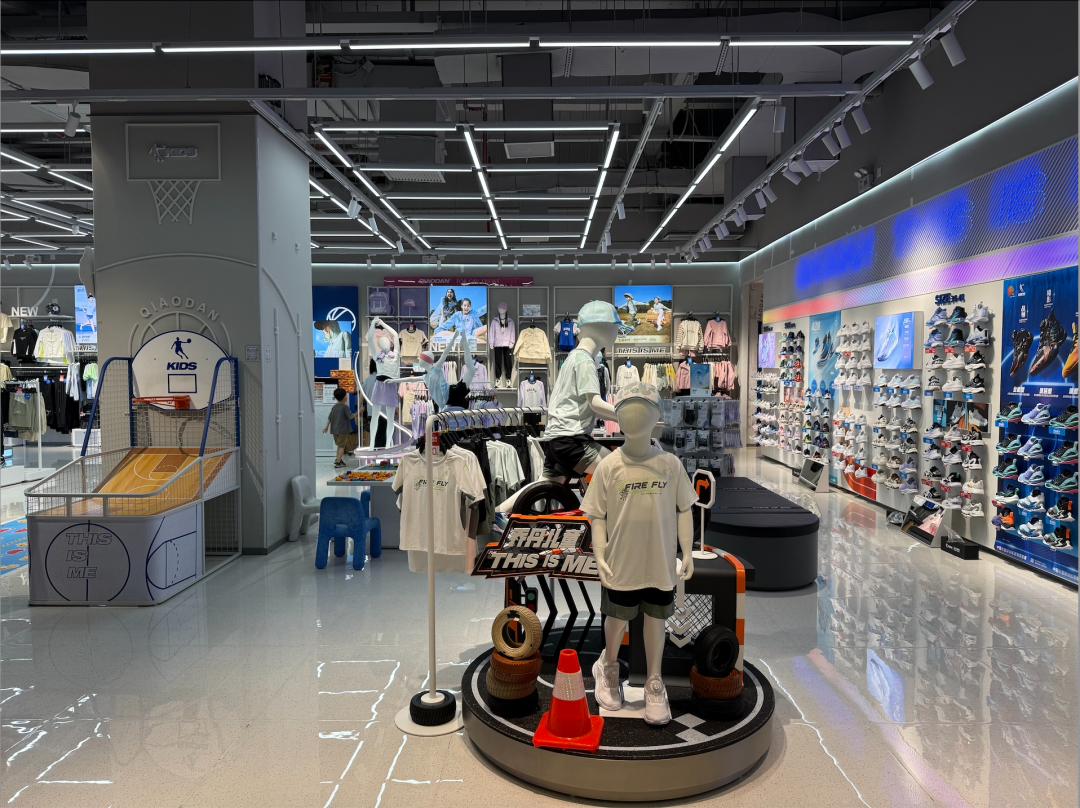
Core Insights - The sports children's clothing market is increasingly focusing on the youth demographic, with brands like Li Ning and Skechers launching dedicated youth stores, reflecting a shift in consumer targeting [1][2][6] - Anta's children's division has achieved significant sales, surpassing 10 billion yuan, indicating a strong market presence and growth potential in the youth segment [1][2] - The rise of the "alpha generation" (children born after 2010) is influencing purchasing decisions, as they exhibit independent aesthetic awareness and decision-making capabilities [2][4] Market Trends - The market for children's sportswear is evolving, with brands shifting focus from younger children to the larger youth demographic due to declining birth rates and changing consumer preferences [2][6] - Brands are increasingly recognizing the need for specialized marketing strategies that engage youth directly, rather than solely targeting parents [2][4] - The trend towards more sophisticated and nuanced consumer preferences among youth is driving brands to adopt refined operational strategies [5][6] Retail Innovations - The physical retail landscape is adapting to cater to youth consumers, with a variety of store formats emerging, including specialized youth stores and concept stores [6][8] - Anta's strategy includes separating children's and infant's business lines, focusing on enhancing store efficiency for youth products [6][8] - The expansion of store sizes and the introduction of interactive and experiential elements are becoming common, with brands creating dedicated areas for specific sports and activities [12][19] Product Development - Brands are increasingly offering products that cater to niche sports and activities, reflecting a broader range of consumer interests and preferences [12][19] - The integration of technology in product design and retail experiences is becoming more prevalent, with brands focusing on specialized footwear and apparel for youth [16][19] - The emphasis on functionality and professional-grade products is evident, as brands like Anta and Skechers introduce advanced materials and designs tailored for young athletes [16][19] Consumer Engagement - The approach to engaging young consumers is evolving, with brands implementing interactive experiences in stores to attract and retain youth customers [19][21] - The use of technology for personalized services, such as foot arch assessments and AI-driven recommendations, is becoming a key differentiator in the retail experience [19][21] - The trend towards immersive retail environments, such as Nike's "active experience store," highlights the importance of creating engaging shopping experiences for young consumers [21]




港股运动鞋服四巨头:营收普增利润分化,折扣战致毛利率承压
3 6 Ke· 2025-09-02 23:26
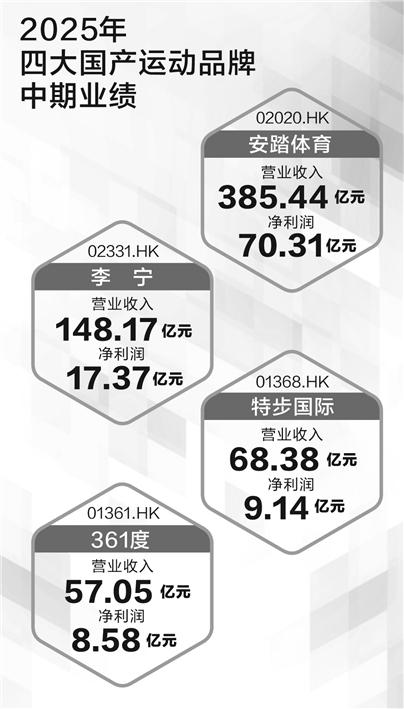
Core Insights - The four major sports brands in Hong Kong—Anta Sports, Li Ning, Xtep International, and 361 Degrees—achieved revenue growth in the first half of 2025, but profit performance varied significantly [1][5] - Increased discounting has become a common strategy in the industry, impacting profit growth and gross margins [1][2] - Trends such as "opening large stores" and professional upgrades are becoming prominent in the industry [1][8] Revenue and Growth - In the first half of 2025, Anta Sports led with revenue of 38.54 billion yuan, a growth rate of 14.26%. Li Ning, Xtep International, and 361 Degrees reported revenues of 14.82 billion yuan, 6.838 billion yuan, and 5.705 billion yuan, with growth rates of 3.29%, 7.14%, and 10.96% respectively [2] - Over the past three years, except for Anta Sports, the other three brands showed a decline in growth rates: Xtep's growth fell from 14.76% to 7.14%, 361 Degrees from 18.00% to 10.96%, and Li Ning from 12.98% to 3.29% [2] - Anta Sports has maintained double-digit revenue growth for four consecutive years, but its main brands, Anta and FILA, have seen growth rates drop to single digits, with over 10% growth driven by outdoor brands like Descente and Kolon [2] Online Sales Performance - Online channels have become a common growth highlight for all four companies, but they have also negatively impacted gross margins. In the first half of 2025, online revenue growth rates were 17.6% for Anta Sports, 7.4% for Li Ning, and 45% for 361 Degrees [2][3] - The online revenue share for Anta Sports, Li Ning, and 361 Degrees was 34.8%, 29%, and 31.8% respectively, indicating that online business has become an important revenue pillar [3] Gross Margin Analysis - Anta Sports' gross margin decreased by 0.7 percentage points to 63.37%, attributed to increased costs in professional categories and higher online discounting [3] - Li Ning's gross margin fell by 0.4 percentage points to 50.04%, due to changes in channel structure and intensified promotional competition [3] - 361 Degrees experienced a unique situation where its gross margin increased by 0.2 percentage points to 41.5%, driven by a "price for volume" strategy that lowered average wholesale prices while increasing sales [3] Net Profit Performance - The net profit performance of the four brands showed divergence, with Anta Sports and 361 Degrees facing slowing net profit growth, while Li Ning experienced a decline. Li Ning's net profit was 1.737 billion yuan, down 10.99% year-on-year [5] - Anta Sports reported a net profit of 7.031 billion yuan, a decrease of 8.9%. However, excluding the impact of Amer Sports' listing in the previous year, net profit grew by 14.5% [5] - 361 Degrees' net profit was 858 million yuan, reflecting a growth of 8.61%, down from 12.23% in the previous year [5] Industry Trends - The industry is witnessing significant trends in market behavior and strategic layout, particularly in the competitive running shoe market, where brands are focusing on original research and development [7] - Brands are increasingly targeting niche markets and launching "precisely segmented" running shoes to meet diverse consumer needs [7] - The trend of "opening large stores" is common among the four brands, with flagship stores often exceeding 1,000 square meters and offering a mix of experience, service, and social interaction [8]
港股国产运动品牌 “四巨头”上半年业绩分化
Zheng Quan Shi Bao· 2025-09-02 22:07
Group 1: Market Performance - The Hong Kong stock market has shown recovery, leading to positive stock price movements for domestic sports brands, with Anta, Li Ning, Xtep, and 361 Degrees all experiencing increases in the first half of 2025, particularly 361 Degrees with over 50% growth [1] - Anta maintains its leading position with a revenue of 38.5 billion yuan, which is 1.4 times the combined revenue of the other three companies, and a net profit of 7 billion yuan, more than double that of the other three [1] - Xtep's revenue increased by 7.1% to 6.837 billion yuan, with a significant net profit growth of 21.47%, attributed to the divestment of loss-making businesses and improved profits from the Saucony brand [1] Group 2: Financial Performance - Anta's net profit decreased by 9% year-on-year, primarily due to the dilution of equity from the listing of Amer Sports, but if this factor is excluded, the actual growth is 14.5% [1] - Li Ning reported the lowest growth among the four companies, with a revenue increase of 3.28% and a net profit decline of 10.99%, impacted by adjustments in direct sales channels and rising tax rates [1] - 361 Degrees showed stable performance with revenue and net profit growth of 10% and 8%, respectively [1] Group 3: Strategic Focus - Anta continues its multi-brand acquisition strategy, recently completing the acquisition of JACK WOLFSKIN to strengthen its outdoor sports segment [2] - Li Ning emphasizes "steady operation" to solidify its product and channel foundation [2] - Xtep focuses on upgrading stores and penetrating lower-tier cities, while strategically concentrating on the running sector to build a running ecosystem [2] Group 4: Market Outlook - Despite pressures from the consumer environment and intensified industry competition, all four brands remain confident in the Chinese sports consumption market [2] - In the first half of 2025, the retail sales of sports goods on four major e-commerce platforms reached 218.1 billion yuan, a year-on-year increase of 17.5%, significantly outpacing the growth rate of general online retail [2]
港股国产运动品牌“四巨头”上半年业绩分化
Zheng Quan Shi Bao· 2025-09-02 18:12
Group 1 - The core viewpoint is that the Hong Kong stock market is recovering, leading to a positive trend in the stock prices of domestic sports brands, with Anta, Li Ning, Xtep, and 361 Degrees all showing growth in the first half of 2025, particularly 361 Degrees with over 50% increase [2] - Anta maintains its leading position with a revenue of 38.5 billion yuan, which is 1.4 times the combined revenue of the other three companies, and a net profit of 7 billion yuan, more than double that of the other three [2] - Xtep's revenue increased by 7.1% to 6.837 billion yuan, with a significant net profit growth of 21.47%, attributed to the divestment of loss-making businesses and improved profits from the Saucony brand [2] Group 2 - The four major brands exhibit different strategic focuses in response to the rationalization of the consumer market and the rising demand for quality-price ratios, with Anta pursuing a multi-brand acquisition strategy, Li Ning emphasizing stable operations, 361 Degrees focusing on store upgrades and penetration into lower-tier cities, and Xtep concentrating on building a running ecosystem [3] - Despite facing pressures from the consumer environment and intensified industry competition, the four brands remain confident in the Chinese sports consumption market, with retail sales of sports goods on four major e-commerce platforms reaching 218.1 billion yuan in the first half of 2025, a year-on-year increase of 17.5%, significantly higher than the growth rate of general online retail [4]
四大国产运动品牌上半年“成绩单”出炉!
Zheng Quan Shi Bao· 2025-09-02 15:45
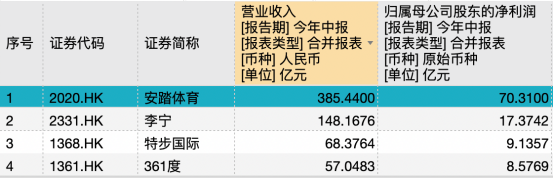
Core Viewpoint - The Hong Kong stock market has been recovering since 2025, leading to a resurgence for domestic sports brands, with notable stock price increases for companies like Anta, Xtep, 361 Degrees, and Li Ning, although challenges remain in consumer spending and industry competition [1] Financial Performance - Anta continues to dominate the market, with a revenue of 38.54 billion RMB in the first half of the year, approximately 1.4 times that of Li Ning, Xtep, and 361 Degrees combined; its net profit reached 7 billion RMB, more than double that of the other three brands combined [3][4] - Among the four brands, Anta had the highest revenue growth rate at 14.26%, although its net profit saw a nearly 9% decline; when excluding certain gains, its net profit increased by 14.5% year-on-year [4][5] - Xtep was the only company to report a revenue decline of about 5%, but its net profit growth was the highest at 21.47%, attributed to the exclusion of losses from divested brands and strong performance from its main brand [5][6] - Li Ning lagged behind with a revenue growth of only 3.29% and a significant net profit decline of over 10%, impacted by a drop in retail channel performance [6][7] - 361 Degrees showed balanced performance with a revenue growth of 10% and a net profit increase of over 8% [7] Stock Performance - The stock price increases for the four companies varied significantly, with 361 Degrees leading at nearly 50%, followed by Anta with over 20%, while Xtep and Li Ning had increases of 16% and 14%, respectively [8][9] Strategic Directions - Anta is focused on strategic acquisitions to enhance its multi-brand matrix, believing that a differentiated brand portfolio is key to sustained growth [17] - Li Ning aims to maintain a cautious approach while solidifying its business foundation and capturing structural opportunities in the market [18] - 361 Degrees is encouraging the opening of larger stores and upgrading to the latest store formats, focusing on a multi-category product ecosystem [19] - Xtep is strategically concentrating on the running segment to solidify its position as a leading brand in this category, enhancing its brand influence and market share [20]
四大国产运动品牌上半年“成绩单”出炉!
证券时报· 2025-09-02 15:42
Core Viewpoint - The Hong Kong stock market has been recovering since 2025, leading to a resurgence of domestic sports brands, with notable stock price increases for companies like Anta, Xtep, 361 Degrees, and Li Ning. However, analysts caution that achieving significant growth remains challenging due to consumer pressure and intensified competition in the industry [1]. Group 1: Company Performance - Anta continues to dominate the market, with a revenue of 38.5 billion RMB in the first half of the year, which is approximately 1.4 times the combined revenue of Li Ning, Xtep, and 361 Degrees. Its net profit reached 7 billion RMB, more than double that of its competitors [3][4]. - Among the four brands, Anta recorded the highest revenue growth rate at 14.26%, although its net profit saw a nearly 9% decline. Excluding certain factors, Anta's profit attributable to shareholders increased by 14.5% to 7.03 billion RMB [4][5]. - Xtep was the only company to report a revenue decline of about 5%, but its net profit growth was the highest among the four, at 21.47%, attributed to the exclusion of losses from divested businesses and strong performance in its main brand [6][7]. - Li Ning lagged behind with a revenue growth of only 3.29% and a significant net profit decline of over 10%. The company cited a drop in retail channel performance and increased tax rates as contributing factors [6][7]. - 361 Degrees showed balanced performance with a revenue growth of 10% and a net profit growth exceeding 8%, making it the second fastest-growing company after Anta [7]. Group 2: Stock Performance - The stock price increases for the four companies varied significantly, with 361 Degrees leading at nearly 50%, followed by Anta with over 20%, while Xtep and Li Ning had increases of 16% and 14%, respectively [8][9]. Group 3: Strategic Directions - Anta plans to continue its strategic acquisitions to enhance its multi-brand matrix, believing that a differentiated and complementary brand portfolio is key to sustained growth. The company completed the acquisition of Jack Wolfskin in the first half of the year [17]. - Li Ning aims to maintain a cautious approach, focusing on solidifying its business foundation while seizing structural opportunities in the market [18]. - 361 Degrees is encouraging the opening of larger stores and upgrading to the latest store formats, emphasizing a product ecosystem based on sports science and material innovation [19]. - Xtep is strategically focusing on the running segment to solidify its position as a leading brand in this category, enhancing its brand influence and market share through innovation and collaboration among its core brands [21].

361度(1361.HK):大装及童装业务齐头并进
Ge Long Hui· 2025-09-02 12:17
Group 1: Core Business Insights - The company's large-scale business achieved revenue of 7.38 billion yuan in 2024, representing a year-on-year growth of 19.1% [1] - The product structure remains stable over the past five years, with footwear accounting for an average of 58.1% and apparel for 41.9% of the large-scale business [1] - The company is focusing on both offline and online channel development, targeting lower-tier markets for offline growth while exploring e-commerce potential online [1] Group 2: Children's Wear Business Strategy - The children's wear segment is expanding its store count while enhancing store quality through image upgrades [2] - The company is leveraging technology to enhance product functionality, introducing advanced technologies in footwear such as soft bounce columns and shock-absorbing materials [2] - The children's brand is creating popular products by incorporating IP elements and addressing niche market demands with items like yoga pants and competition suits [2] Group 3: Investment Outlook - The company is positioned to benefit from two growth curves in large-scale and children's wear businesses, alongside the sports and outdoor market boom [3] - Revenue projections for 2025-2027 are estimated at 11.34 billion yuan, 12.66 billion yuan, and 14.08 billion yuan, with year-on-year growth rates of 12.5%, 11.7%, and 11.2% respectively [3] - The target price for the company is set at 7.20 HKD, indicating a potential increase of 13.2% from the closing price on August 29, 2025, with a "recommended" rating [3]
港股运动鞋服四巨头:营收普增利润分化 折扣战致毛利率承压
经济观察报· 2025-09-02 11:42
Core Viewpoint - The article highlights the intense competition in the sportswear industry, leading to increased discounting practices that negatively impact profit growth and gross margins [2][4]. Revenue and Growth - In the first half of 2025, the four major sports brands in Hong Kong—Anta Sports, Li Ning, Xtep International, and 361 Degrees—achieved revenue growth, with Anta leading at 38.54 billion yuan and a growth rate of 14.26%. Li Ning, Xtep, and 361 Degrees reported revenues of 14.82 billion yuan, 6.838 billion yuan, and 5.705 billion yuan, with growth rates of 3.29%, 7.14%, and 10.96% respectively [4]. - Over the past three years, except for Anta, the other three brands have shown a decline in growth rates, with Xtep's revenue growth dropping from 14.76% to 7.14%, 361 Degrees from 18.00% to 10.96%, and Li Ning from 12.98% to 3.29% [4]. - Anta's revenue growth is primarily driven by its outdoor brands, while its main brands, Anta and FILA, have seen growth rates decline to single digits [4]. Online Channel Performance - Online channels have become a common growth highlight for the four companies, with Anta, Li Ning, and 361 Degrees reporting online revenue growth rates of 17.6%, 7.4%, and 45% respectively. Xtep did not disclose its overall online growth but noted that its main brand's e-commerce business grew and accounted for over 30% of total revenue [4][5]. - The online business expansion has negatively impacted gross margins, with Anta's gross margin decreasing by 0.7 percentage points to 63.37%, attributed to increased costs and discounts [5]. - Li Ning's gross margin fell by 0.4 percentage points to 50.04%, due to changes in channel structure and increased promotional discounts [5]. Profitability Analysis - Despite 361 Degrees experiencing a slight increase in gross margin by 0.2 percentage points to 41.5%, its net profit margin declined due to a significant rise in sales expenses, which increased by 13.2% to 1.037 billion yuan [6][7]. - Anta's net profit for the first half of 2025 was 7.031 billion yuan, a decrease of 8.9% year-on-year, while Li Ning's net profit fell by 10.99% to 1.737 billion yuan [7]. Industry Trends - The industry is witnessing a trend towards professionalization and specialization, with brands focusing on core categories and launching targeted products [9]. - The "big store" strategy is being adopted by all four brands, with flagship stores exceeding 1,000 square meters, offering a mix of sales, experience, and service [10]. - Overall, while the four major sports brands in Hong Kong reported revenue growth in the first half of 2025, they face challenges of differentiated growth rates and profit pressures, actively responding to industry competition through online initiatives, product segmentation, and channel upgrades [10].

NEW REALITY 2025|中国户外市场的密码与隐忧(上)
Sou Hu Cai Jing· 2025-09-02 03:21
Core Insights - The outdoor brand market in China is experiencing rapid growth, driven by a shift towards outdoor lifestyles and social experiences, with the market expected to exceed 500 billion RMB by 2025 [2][5][11] - The outdoor sports market in China has transitioned from a niche segment to a mainstream cultural phenomenon, with increasing consumer demand for high-performance products that cater to various activities and settings [7][9][18] - The rise of social media has significantly boosted interest in outdoor activities, with specific segments like cycling and fishing projected to see explosive growth, with some areas expected to exceed 100% growth [11][13] Market Dynamics - The outdoor market in China is projected to surpass 150.4 billion RMB in 2024, reflecting a 23% growth rate, indicating a shift from rapid growth to a more refined market approach [5][20] - Over 20 international outdoor brands have entered the Chinese market in the past three years, alongside more than 10 local brands, leading to increased competition and market saturation [20][23] - Local brands are increasingly targeting the high-end market, with average product prices rising by 25%-65% among the top 30 local outdoor brands [24][25] Consumer Behavior - Consumers are shifting their focus from luxury brands to high-performance outdoor products, valuing functionality and experience over mere brand prestige [16][18] - The outdoor lifestyle is becoming a significant aspect of social interaction among urban professionals, with outdoor gear symbolizing health and community connection [18][29] - The demand for outdoor products is evolving, with consumers preferring comprehensive lifestyle solutions rather than individual items [9][16] Competitive Landscape - The outdoor market is becoming increasingly crowded, with both high-end and mid-range brands competing for market share, leading to potential product homogenization [20][23] - Brands are focusing on differentiation through localized services, scene adaptation, and supply chain efficiency to maintain a competitive edge [27][29] - The market is expected to continue to segment, with a focus on high-quality, stylish, and functional products that meet specific consumer needs [28][31]