拓荆科技

Search documents
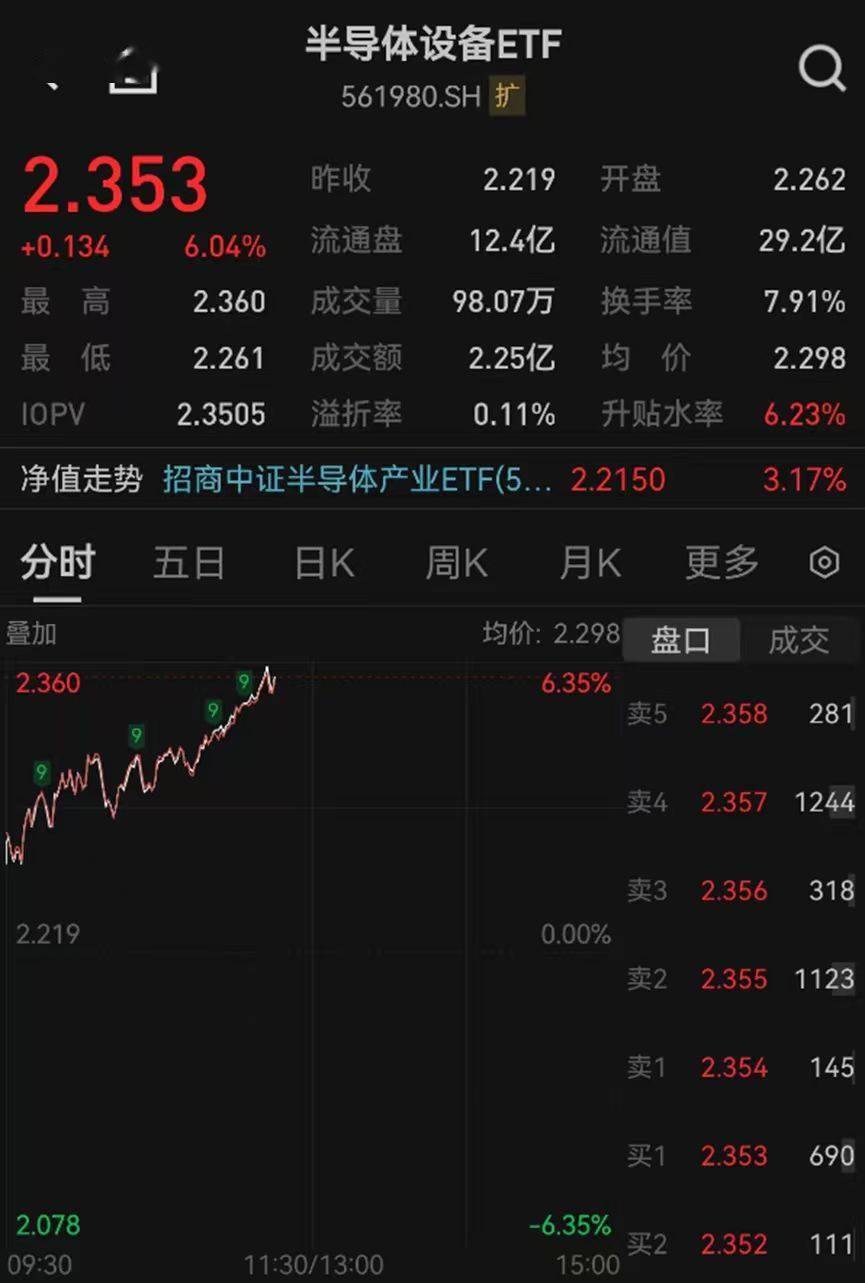
半导体设备ETF(561980)飙涨6%!超级周期开启+国产替代需求合驱板块新高!
Sou Hu Cai Jing· 2026-01-07 03:38
Core Viewpoint - The semiconductor equipment sector is experiencing significant growth in the A-share market, driven by a "super cycle" and deepening domestic substitution, with key stocks reaching new highs [1][4]. Group 1: Market Performance - The semiconductor equipment ETF (561980) surged over 6%, reaching a new high since its launch, with a trading volume of 2.25 billion yuan [1][2]. - Key stocks such as Nanda Optoelectronics and Chipone Technology hit the 20% daily limit, while leading companies like Zhongwei and Northern Huachuang rose over 7%, setting historical price records [1]. Group 2: Industry Trends - The global semiconductor industry is entering a new super cycle, with the World Semiconductor Trade Statistics (WSTS) predicting a market size of $975 billion by 2026 [4]. - The International Semiconductor Industry Association (SEMI) forecasts that global semiconductor equipment sales will reach a record $133 billion by 2025, continuing to grow through 2027 [4]. - AI-driven demand is expected to significantly increase storage chip prices, with DDR4 16Gb prices projected to rise by 1800% by 2025, and a continued shortage anticipated in 2026 [4]. Group 3: Equipment Demand - The shift towards 3D architectures in DRAM and NAND will significantly boost demand for etching and thin-film deposition equipment, with the corresponding service market expected to grow by 1.7 times and 1.8 times, respectively [4]. - Domestic semiconductor equipment companies like Northern Huachuang and Zhongwei are expected to strengthen their market positions as demand increases [4]. Group 4: ETF Composition - The semiconductor equipment ETF (561980) tracks the CSI semiconductor index, focusing on high-value, high-barrier upstream segments, with nearly 60% equipment content [5]. - The index effectively captures growth momentum from leading companies such as Zhongwei, Northern Huachuang, Cambricon, SMIC, and Haiguang Information, providing a convenient option to share in the growth of the semiconductor equipment industry [5].



午评:沪指半日涨0.29%逼近4100点,稀土、半导体设备板块涨幅居前
Xin Lang Cai Jing· 2026-01-07 03:33
Core Viewpoint - The three major indices collectively rose in early trading, with significant gains in various sectors, particularly semiconductor equipment and rare earth permanent magnets, while some sectors like oil and gas experienced declines [1] Market Performance - As of midday, the Shanghai Composite Index increased by 0.29%, the Shenzhen Component Index by 0.35%, the ChiNext Index by 0.41%, and the North China 50 Index by 0.91% [1] - The total trading volume across the Shanghai, Shenzhen, and Beijing markets reached 185.36 billion yuan, an increase of 57.5 billion yuan compared to the previous day [1] - Over 2,500 stocks in the market saw an increase [1] Sector Highlights - The semiconductor equipment sector experienced a significant surge, with stocks like ChipSource Microelectronics hitting the daily limit, and companies such as Tuojing Technology, Zhongwei Company, and Northern Huachuang reaching historical highs [1] - The rare earth permanent magnet sector also showed strength, with stocks like China Rare Earth and Jinli Permanent Magnet seeing notable gains [1] - The controllable nuclear fusion sector was active, with companies like China Nuclear Engineering and Wangzi New Materials hitting the daily limit [1] - Other sectors that performed well included non-ferrous metals, storage chips, and CRO concept stocks [1] Declining Sectors - The oil and gas sector saw a decline, with China National Offshore Oil Corporation dropping over 4%, along with other companies like Zhongman Petroleum and Sinopec Oilfield Services [1] - The digital currency and cross-border payment sectors experienced adjustments, with stocks such as Sifang Precision and Cuivai Co. seeing declines [1]
半导体设备股集体上涨,芯源微、中微公司、北方华创等多股创历史新高
Ge Long Hui· 2026-01-07 03:19
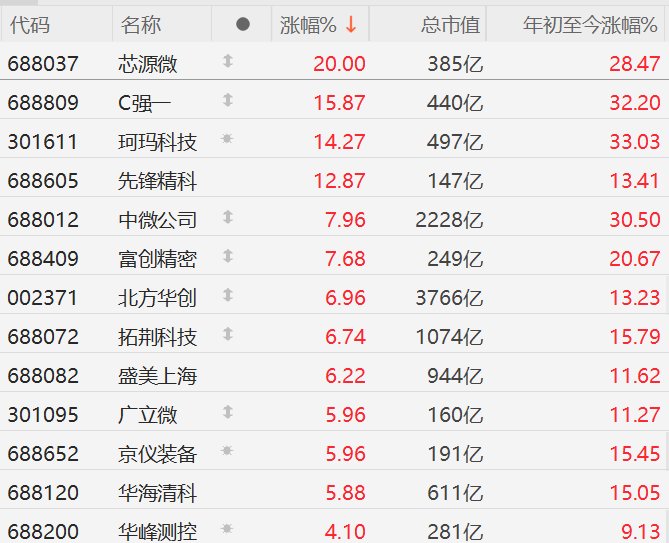
Core Viewpoint - The semiconductor equipment stocks in the A-share market experienced a collective rise, with several companies reaching historical highs in their stock prices [1]. Group 1: Stock Performance - Xinyuan Micro (芯源微) saw a 20% increase, reaching a market capitalization of 38.5 billion [2]. - Kema Technology (珂玛科技) rose by over 14%, with a total market value of 49.7 billion [2]. - Pioneer Precision (先锋精科) increased by over 12%, with a market cap of 14.7 billion [2]. - Zhongwei Company (中微公司) experienced a 7.96% rise, bringing its market value to 222.8 billion [2]. - Fuchuang Precision (富创精密) rose by 7.68%, with a market capitalization of 24.9 billion [2]. - Northern Huachuang (北方华创) increased by 6.96%, with a total market value of 376.6 billion [2]. - TuoJing Technology (拓荆科技) saw a 6.74% rise, reaching a market cap of 107.4 billion [2]. - Several companies, including Xinyuan Micro, Kema Technology, Zhongwei Company, Northern Huachuang, TuoJing Technology, and Huahai Qingke (华海清科), reached historical highs [1]. Group 2: Year-to-Date Performance - Xinyuan Micro has a year-to-date increase of 28.47% [2]. - Kema Technology has a year-to-date increase of 33.03% [2]. - Zhongwei Company has a year-to-date increase of 30.50% [2]. - Northern Huachuang has a year-to-date increase of 13.23% [2]. - TuoJing Technology has a year-to-date increase of 15.79% [2].


A股半导体设备股集体上涨,芯源微、中微公司、北方华创等多股创历史新高
Ge Long Hui A P P· 2026-01-07 03:13
Group 1 - The A-share semiconductor equipment stocks collectively rose, with notable gains including a 20% increase for Xinyuan Microelectronics, over 14% for Kema Technology, and over 12% for Pioneer Precision [1] - Several companies, including Xinyuan Microelectronics, Kema Technology, Zhongwei Company, and others, reached historical highs [1] - The overall market sentiment in the semiconductor sector appears positive, as indicated by the MACD golden cross signal formation [2] Group 2 - Xinyuan Microelectronics (688037) had a market cap of 38.5 billion and a year-to-date increase of 28.47% [2] - Kema Technology (301611) reported a market cap of 49.7 billion with a year-to-date increase of 33.03% [2] - Zhongwei Company (688012) had a significant market cap of 222.8 billion and a year-to-date increase of 30.50% [2]
下游资本开支上行-国产化率提升-看好半导体设备新机遇
2026-01-07 03:05
Summary of Semiconductor Equipment Industry Conference Call Industry Overview - The global semiconductor equipment market is expected to reach $133 billion by 2025, growing by 14% year-on-year, primarily driven by front-end wafer fabrication [1][4] - By 2026, the market is projected to grow to $145 billion, with a 10% increase, driven by AI, advanced logic storage, and advanced packaging [1][4] - The market is anticipated to further increase to $156 billion by 2027 [1][4] Key Insights - China is becoming increasingly significant in the global semiconductor equipment market, expected to exceed 40% market share in Q3 and Q4 of 2025, maintaining a range of 30%-40% in 2026 [1][5] - Major players like SMIC and Hua Li are actively expanding advanced logic capacity, with SMIC's capacity utilization reaching 95.8% and ongoing capital expenditure [1][6][7] - Changxin Storage (CXMT) has applied for an IPO on the Sci-Tech Innovation Board, planning to raise approximately $30 billion for technology expansion and DRAM production line upgrades, with projected revenue of $58 billion by 2025 [1][8] Investment Opportunities - Two main investment directions in the semiconductor equipment industry are identified: 1. Front-end wafer fabrication, with significant capital expenditure expected in 2026, particularly in memory and advanced logic plants, leading to a substantial increase in orders for etching and thin film deposition equipment. New order growth is conservatively estimated at 20%-30%, with a neutral to optimistic estimate of 40%-50% [2] 2. Domestic AI computing-related testing machines and advanced packaging equipment, with companies like Huafeng, Changchuan, and Maiwei positioned for growth [2] Market Dynamics - The unit investment cost in semiconductor manufacturing is rapidly increasing with advancing process nodes, with the cost for 5nm nodes reaching $3 billion per 10,000 wafers, indicating a trend of rising capital expenditure [2][9] - The domesticization rate in the semiconductor equipment industry is crucial, expected to reach 22% by 2025, driven by sanctions and national policy support [2][11] Competitive Landscape - There is competition among semiconductor equipment companies, but differentiation is achieved through specialization in various etching and deposition technologies [2][13] - Recommended companies in front-end semiconductor equipment include North Huachuang, Zhongwei Company, Tuojing Technology, Weidao Nano, and Maiwei Technology, each focusing on different processes and showing significant order growth [2][14] Emerging Areas - Current low domesticization rates in areas such as metrology, photoresist coating, and ion implantation equipment are highlighted as potential growth segments, especially with increased storage expansion [2][12] - Investment opportunities in domestic AI computing are emphasized in advanced packaging and testing fields, with key companies identified for potential growth [2][15]
连创新高!机构:半导体设备自主可控可能是确定性最高的趋势之一
Jin Rong Jie· 2026-01-07 03:04
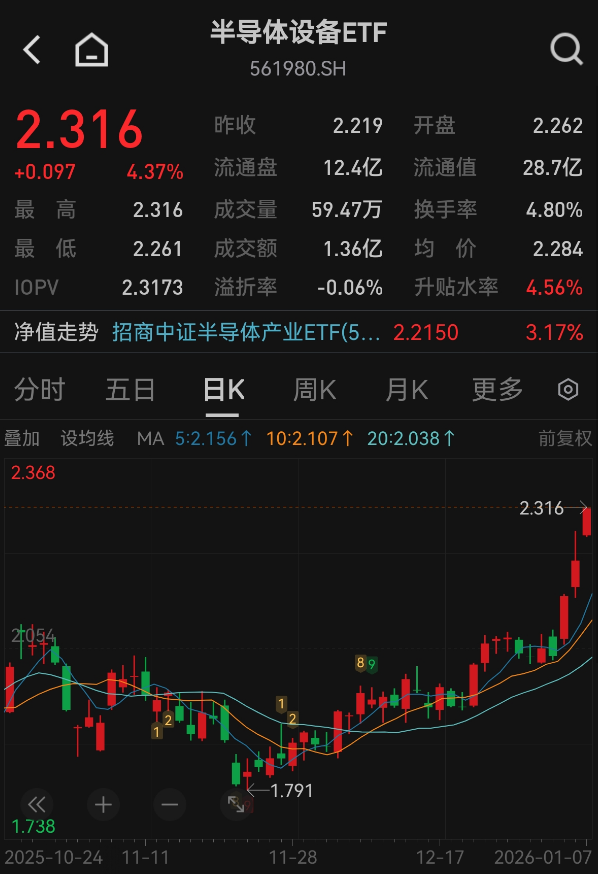
Core Viewpoint - The semiconductor equipment sector is experiencing strong momentum driven by the explosive demand for AI computing power, rising storage chip prices, and accelerated capital investment in domestic capabilities. Group 1: Market Performance - The semiconductor equipment ETF (561980) opened with a significant jump of 2.4% and is currently up 4.37%, reaching a new high since its listing with a latest scale of 2.747 billion yuan and attracting 153 million yuan in the last five trading days [1] - Key stocks in the sector have shown remarkable performance, with companies like Zhongwei Company, North Huachuang, and Nanda Optoelectronics seeing increases of over 5%, 11%, and 13% respectively [1] Group 2: Industry Trends - The global semiconductor market is projected to reach $975 billion by 2026, with a growth rate exceeding 25%, driven by AI computing and a recovery in consumer electronics and automotive sectors [3] - The semiconductor manufacturing equipment market is expected to reach $133 billion by 2025, marking a 13.7% increase, with further growth anticipated in subsequent years [3] Group 3: Demand Drivers - The demand for semiconductor equipment is being significantly boosted by technological advancements, with equipment usage increasing by 1.7 to 1.8 times compared to traditional processes due to the competition in advanced processes and storage chip upgrades [6] - The domestic substitution trend is accelerating, with predictions indicating that the localization rate of semiconductor equipment could reach 22% by 2025, particularly in etching, cleaning, and CMP processes [7] Group 4: Policy and Financial Support - Recent capital movements, including Longxin's IPO raising approximately 30 billion yuan and the increase in funding for SMIC, indicate a robust financial backing for the semiconductor sector [8] - The semiconductor equipment ETF (561980) tracks an index that focuses on high-tech barriers and value concentration in the upstream sector, with nearly 60% equipment content [9] Group 5: Historical Performance - The CSI Semiconductor Equipment Index has shown a remarkable increase of 62.33% in 2025, with a maximum increase exceeding 80%, outperforming other mainstream semiconductor indices [11]
全球存储芯片供应持续紧张!科创芯片ETF(588200)涨超2%!
Jin Rong Jie· 2026-01-07 03:04
Group 1 - The Shanghai Composite Index rose by 0.14% and the Sci-Tech Chip Index increased by 2.13% as of 09:58 on January 7 [1] - Notable individual stock performances included Zhongwei Company up over 6%, Lanke Technology up over 4%, and Huahai Qingke up over 3% [1] - The Sci-Tech Chip ETF (588200) saw a 2.04% increase with a trading volume of 1.29 billion yuan and a turnover rate of 2.99%, achieving a 65.69% increase over the past six months [1] Group 2 - Global supply of memory chips remains tight with prices surging; Samsung and SK Hynix plan to increase server DRAM prices by 60% to 70% in Q1 2026 compared to Q4 2025 [2] - NAND Flash contract prices are expected to rise by 33% to 38%, with DDR4 16Gb prices projected to increase by 1800% and DDR5 16Gb by 500% by 2025 [2] - The AI industry is driving demand, with NVIDIA's new Rubin AI supercomputing platform achieving five times the GPU inference performance of the previous generation, and North American tech giants expected to invest $600 billion in AI infrastructure by 2026 [2] Group 3 - The Sci-Tech Chip ETF (588200) tracks the Shanghai Sci-Tech Chip Index, with the top ten weighted stocks including SMIC, Haiguang Information, and Cambrian, accounting for over 58.29% of the total weight [3] - The current management fee for the Sci-Tech Chip ETF is 0.50% annually, and the custody fee is 0.10% annually [3] - Investors without stock accounts can access investment opportunities through linked funds [3]
先进封装解芯片难题-封装摩尔时代的突破
Zhong Guo Neng Yuan Wang· 2026-01-07 02:47
Core Insights - The report from Jinyuan Securities highlights the exponential growth in costs associated with advanced processes in the semiconductor industry, particularly noting that the design cost of a 2nm chip is approximately $725 million, which is 25 times that of a 65nm chip [1][2] - Capital expenditures (CapEx) for building semiconductor manufacturing facilities also reflect this trend, with the investment required for a 5nm chip factory being five times that of a 20nm factory [1][2] Advanced Packaging Trends - The shift towards advanced packaging is driven by the combination of chiplets and high-end advanced packaging, which allows for mixed processes, reduced time to market, reusability, and improved yield [2] - Chiplets can utilize different processes based on demand, such as using 3nm technology for CPUs while employing mature processes for I/O or analog circuits, thus shortening R&D cycles and design costs [2] - The performance per watt per dollar (Perf/Watt/Dollar) indicates that large chips combined with 3D stacking are more suitable for medium and small systems, while complex systems benefit from the "small die with better yield" approach [2] AI Chip Performance - In terms of raw computational performance, AI-specific chips (ASICs) are weaker than AI GPUs, and even large language models like GPT-4 cannot run on a single chip [3] - To match the performance of AI GPUs, ASICs require larger clusters of dedicated chips, and advanced packaging through chiplets and heterogeneous integration is key to maximizing performance while controlling costs [3] Technological Evolution in Advanced Packaging - The core of technological evolution in advanced packaging is the continuous increase in interconnect I/O count and bandwidth density, transitioning from high-density electronic interconnects to incorporating optical interconnects [4] - The second generation of packaging aims to support higher interconnect I/O demands in the AI era, addressing bandwidth and power consumption bottlenecks [4] 2.5D Packaging Technology - Silicon bridge packaging technology serves as a 2.5D solution, integrating one or more silicon bridges within a specific packaging substrate to ensure interconnectivity between multiple chips [5] - The main factors limiting 2.5D interconnect density include solder bridging risks, intermetallic compounds, and underfill process challenges [5] - Direct bonding and hybrid bonding techniques are crucial for enhancing interconnect density by eliminating solder layers and achieving closer interconnect spacing [5] Advanced Packaging Market Outlook - The advanced packaging market in China is projected to reach approximately 96.7 billion yuan in 2024, accounting for 30.95% of the global market, with expectations to grow to 188.8 billion yuan by 2029, reflecting a compound annual growth rate (CAGR) of 14.30% [7] - By 2029, China's advanced packaging and testing market is anticipated to represent 36% of the global market size [7] - The unit packaging cost is higher due to the complexity of processes and the use of silicon interposers and embedded silicon bridge technology [7] Related Companies - Equipment manufacturers include Tuojing Technology (688072.SH), Zhongwei Company (688012.SH), Shengmei Shanghai (688082.SH), Guangli Technology (300480.SZ), Beifang Huachuang (002371.SZ), and Zhongke Feimiao (688361.SH) [7] - Material suppliers include Dinglong Co., Ltd. (300054.SZ), Anji Technology (688019.SH), and Feikai Materials (300398.SZ) [7] - OSAT companies include Shenghe Jingwei (unlisted), Changdian Technology (600584.SH), and Shenzhen Technology (000021.SZ) [7]
存储芯片板块领涨,半导体设备ETF广发(560780)盘中涨近5%,近3日涨超14%!标的指数半导体设备材料权重占比超80%!
Xin Lang Cai Jing· 2026-01-07 02:35
Group 1: Market Dynamics - The A-share storage chip sector opened strong on January 7, 2026, with stocks like Purun Co. hitting a 20% limit up, reaching a historical high, while others like Hengshuo Co., Jucheng Co., Jiangbolong, and Xiangnong Chip Innovation rose over 10% [1] - AMD showcased its MI455 GPU chip at CES, claiming significant performance improvements, while SK Hynix presented its 48GB 16-layer HBM4, the next generation of high-bandwidth memory [1] - Following NVIDIA CEO Jensen Huang's emphasis on memory and storage demand at CES, U.S. semiconductor stocks saw a continued rise, with reports indicating Samsung and Hynix proposed a 60%-70% price increase for DRAM in Q1 compared to Q4 of the previous year [1] Group 2: Domestic Developments - The domestic DRAM industry is making significant progress, with Changxin Storage's IPO on the Sci-Tech Innovation Board accepted, aiming to raise 29.5 billion yuan for technology upgrades and forward-looking research [2] - Aijian Securities believes this financing will accelerate the transition of Changxin's process platform to higher generations and promote the overall development of the domestic storage industry [2] - Despite the global DRAM market being dominated by Korean and American manufacturers, domestic firms have made breakthroughs in mainstream product lines, with Changxin launching JEDEC-certified DDR5 and LPDDR5X memory products [2] Group 3: Semiconductor Materials and Domestic Production - The domestic semiconductor materials localization process is accelerating, driven by high-performance computing and advanced packaging, increasing demand for key materials like CMP polishing materials and photoresists [2] - Although the overall localization rate of semiconductor materials in China remains low—less than 15% for wafer manufacturing materials and below 30% for packaging materials—there have been breakthroughs in multiple areas supported by policies and industry collaboration [2] - As AI chips, HBM, and Chiplet technologies become more prevalent, demand for high-end electronic resins and low dielectric constant materials is expected to grow, providing opportunities for domestic companies to increase their market share through technological iterations [2] Group 4: ETF Performance - As of January 7, 2026, the CSI Semiconductor Materials and Equipment Theme Index surged by 5.36%, with the semiconductor equipment ETF Guangfa (560780) rising by 4.98%, marking a three-day consecutive increase [3] - The top ten weighted stocks accounted for 65.08% of the index, with significant gains from stocks like Anji Technology (up 14.37%), Chip Source Micro (up 13.21%), and Nanda Optoelectronics (up 12.35%) [3] - The latest scale of the semiconductor equipment ETF Guangfa reached 1.6 billion yuan, a new high in nearly a month, with a notable increase of 690 million shares over the past six months [3]
AI浪潮推动算力需求爆发,数字经济ETF(560800)盘中涨超1%
Sou Hu Cai Jing· 2026-01-07 02:18
Group 1 - The core viewpoint of the news highlights the positive performance of the digital economy theme index and its constituent stocks, with significant increases in stock prices and ETF growth [1][2] - The digital economy ETF has seen a notable increase in trading volume, with an average daily transaction of 20.84 million yuan over the past year and a recent growth of 13.66 million yuan in the last two weeks [1][2] - Major semiconductor companies like ASML and TSMC have reached historical market highs, indicating strong demand in the semiconductor sector, particularly in AI and server DRAM markets [1][2] Group 2 - The AI wave is driving a surge in computing power demand, significantly enhancing the value of hardware sectors such as servers, AI chips, optical chips, and storage [2] - The global DRAM market is expected to grow at a compound annual growth rate of 15.93% from 2024 to 2029, driven by the need for massive data processing [2] - The domestic DRAM industry in China is entering a critical phase, with opportunities arising from advancements in R&D and production capabilities among local manufacturers [2] Group 3 - As of December 31, 2025, the top ten weighted stocks in the digital economy theme index account for 52.63% of the index, indicating a concentrated investment in key players [3] - The digital economy ETF closely tracks the digital economy theme index, selecting companies with high digital infrastructure and application levels [2][3]