宝马

Search documents
402批公告:亿纬三元上车宝马iX1,宁德5C超充配套东风日产NX8
高工锂电· 2025-12-09 13:11
Group 1 - The core announcement from the Ministry of Industry and Information Technology (MIIT) includes the release of the last batch of new vehicles for 2025, featuring a total of 163 new models, with a significant majority of 83% using lithium iron phosphate (LiFePO4) batteries and 17% using ternary batteries [2] - Among the new electric vehicles, 82 are pure electric models and 81 are plug-in hybrid or range-extended models, indicating a narrowing gap between these two categories [2] - The announcement highlights the presence of major brands such as Audi, BMW, and Cadillac, with a focus on SUV models that predominantly favor ternary batteries [4] Group 2 - The BMW iX1 is noted to be equipped with the sixth-generation eDrive system and a new cylindrical battery supplied by EVE Energy, which is expected to start mass production in Q3 of this year [3] - CATL's supply ratio in this batch is less than one-third, with only 48 vehicles, while other companies like Fudi, Guoxuan High-Tech, and Ruipu LanJun secured 10 or more new vehicle supplies each [3][4] - The Dongfeng Nissan NX8 is highlighted for its 800V high-voltage platform and 5C supercharging battery, with battery suppliers including CATL and Dongyu Xinseng [3]




公司问答丨江苏北人:公司直接客户多以汽车零部件厂商为主
Ge Long Hui· 2025-12-09 08:53
Core Viewpoint - Jiangsu Beiren is actively involved in providing intelligent manufacturing solutions, primarily serving automotive parts manufacturers, and has indirect connections with several well-known international electric vehicle brands and technology companies [1] Group 1: Company Engagement - Jiangsu Beiren offers "product + technology + service" turnkey solutions in the intelligent manufacturing sector [1] - The company's direct clients are mainly automotive parts manufacturers [1] Group 2: Clientele and Partnerships - Jiangsu Beiren indirectly serves notable international electric vehicle brands, including Tesla, as well as domestic companies such as Huawei, Xiaojun, Li Auto, NIO, Xpeng, Leap Motor, BMW, Volvo, Geely, Volkswagen, Hongqi, General Motors, Nissan, and Dongfeng [1]

财经观察:从特斯拉“遇冷”看印度电动车发展现状
Huan Qiu Shi Bao· 2025-12-08 22:44
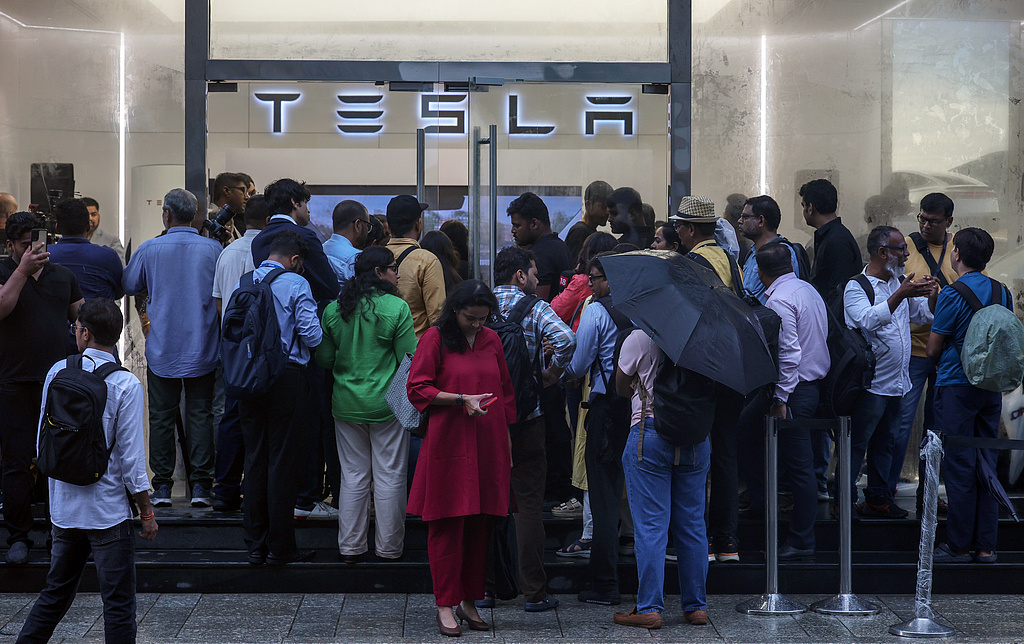
Core Viewpoint - Tesla's entry into the Indian market has been disappointing, with only 157 vehicles sold since its launch, highlighting significant challenges in pricing, infrastructure, and consumer preferences for traditional vehicles [1][3]. Group 1: Sales Performance - Tesla aimed to sell 2,500 vehicles in India within the first year but has faced continuous low sales, with only about 100 vehicles sold by mid-September [3][4]. - The company initially saw over 600 online orders, but interest waned significantly after September, leading to a "high opening, low closing" scenario [3][4]. - In comparison, local brands like Tata and Mahindra have sold electric vehicles at prices below $20,000, making them more appealing to Indian consumers [4]. Group 2: Pricing and Taxation - Tesla's Model Y is priced at $67,000 in India due to high import tariffs of 70% to 100%, making it unaffordable for most consumers [4][8]. - In contrast, German luxury brands like Mercedes, BMW, and Audi have sold around 4,000 electric vehicles in India, outperforming Tesla despite their high prices [4][8]. - The high cost of Tesla vehicles is compounded by the lack of local manufacturing, as the company has not yet established a factory in India [7][8]. Group 3: Infrastructure Challenges - Tesla's charging infrastructure in India is underdeveloped, with only two operational Supercharger stations and two more under construction [4][6]. - The current ratio of electric vehicles to charging stations in India is 235:1, indicating a significant gap in necessary infrastructure for widespread adoption [10][11]. Group 4: Market Dynamics and Consumer Preferences - The Indian electric vehicle market is still nascent, with electric vehicles accounting for less than 3% of the total passenger vehicle market, dominated by local brands [1][10]. - Indian consumers have specific preferences for vehicle types, and Tesla's limited offering of only the Model Y has reduced purchase interest [6][10]. - The Indian government is actively promoting electric vehicle adoption through subsidies and tax incentives, aiming for 30% of new car sales to be electric by 2030 [11].

新声半导体完成2.69亿元C轮融资
Zhong Zheng Wang· 2025-12-08 13:16
Group 1 - Shenzhen Xinsong Semiconductor Co., Ltd. successfully completed a C-round financing of 269 million yuan, attracting strategic investments of 249 million yuan from leading automotive PCB company Shiyun Circuit and its affiliates, along with an additional 20 million yuan from existing shareholder Hongsheng Capital [1] - Xinsong Semiconductor specializes in the filter field, having established a stable supply chain for well-known brands such as Xiaomi, Honor, Samsung, and Motorola, and is the first domestic filter company to pass AEC-Q200 automotive certification, achieving mass production of several automotive-grade filters [1] - Shiyun Circuit is a leading player in the automotive PCB sector, serving major global electric vehicle brands like Tesla, BMW, and Mercedes-Benz, and acts as a crucial link in the supply chain between components and vehicle manufacturers [1] Group 2 - Leveraging Shiyun Circuit's industry resources, the financing is expected to accelerate the entry of Xinsong Semiconductor's automotive-grade filters into the front-loading market, significantly shortening the cycle from certification to mass supply and enhancing service capabilities for domestic ODM manufacturers and consumer electronics clients [2] - The strategic investment will enable both companies to develop integrated solutions combining PCB and filters, focusing on new modular products tailored to smart vehicle demands, thereby strengthening their competitive advantage in the automotive PCB sector and expanding business growth opportunities [2]

以色列人预测,未来10年世界上科技实力最强大的“6个国家”
Xin Lang Cai Jing· 2025-12-08 10:23
Core Insights - The report titled "Great Power Competition: Future Global Technology Development Trends Forecast" predicts that by 2033, the top six countries in technological strength will be the United States, Israel, Germany, Japan, China, and Russia, based on 82 indicators such as R&D investment and patent numbers [3][5]. Group 1: Country Rankings and Strengths - The United States holds the top position, with a projected global innovation index ranking of third by 2025, leading in technology output, particularly in AI and quantum computing [8][10]. - Israel ranks second, with a high-tech industry that contributes significantly to its GDP, and an R&D expenditure of 6.35% of GDP, which is double the OECD average [12][13]. - Germany is ranked third, with a strong industrial base and a projected innovation index ranking of ninth by 2025, heavily investing in smart manufacturing and industrial 4.0 [15]. - Japan is in fourth place, with an innovation index ranking of twelfth by 2025, known for its meticulous attention to detail in technology and high R&D spending [16]. - China ranks fifth, showing rapid progress with a projected innovation index ranking of tenth by 2025, leading in patents and advancements in quantum computing and 5G technology [18]. - Russia is sixth, with a strong legacy in aerospace and nuclear energy, and a focus on advancing its scientific research capabilities [20]. Group 2: Future Outlook and Trends - The report anticipates that by 2025, the total number of patents among these six countries will increase by 15%, indicating a growing trend in international collaboration and project partnerships [22]. - By 2033, advancements in quantum networks and sustainable energy are expected to reshape the global technological landscape, benefiting the general public through improved technologies in mobile payments, healthcare, and green energy [24].
如何看待高成长与经典价值?柏基“传奇基金经理”詹姆斯·安德森2019年深度撰文︱重阳荐文
重阳投资· 2025-12-08 07:33
Core Viewpoint - The article discusses the evolving perspectives on growth and value investing, highlighting the need to reassess traditional investment principles in light of modern economic realities and the success of high-growth companies [5][6][7]. Group 1: Growth vs. Value - There is an acknowledged and widening divergence between growth and value investing, with traditional value principles struggling to account for the sustained high growth of companies like Microsoft, Google, and Amazon [7][8]. - The underlying economic structure has shifted, suggesting that reliance on historical value metrics may no longer be sufficient for investment success [7][8]. - Despite the differences, there are fundamental commonalities between growth and value investing, particularly in the importance of honest long-term cash flow estimation and risk management [8][9]. Group 2: Historical Context and Evolution - Historically, there has been a lack of literature supporting growth investing compared to the extensive documentation of value investing, which has created a bias in the investment community [13][14]. - The belief that "value will ultimately prevail" remains entrenched, despite evidence that growth strategies have outperformed passive indices over the long term [14][15]. - The past decade has seen a significant deviation from Graham's observations, with high-growth stocks yielding substantial returns, contrary to his predictions [18][19]. Group 3: Case Studies - Microsoft serves as a prime example of a company that has achieved remarkable long-term growth, with revenue increasing from $60 billion in 2008 to $110 billion in 2018, showcasing a compound annual growth rate of 24% [20]. - Google also exemplifies this trend, with its revenue growing from $21.8 billion in 2008 to $136.8 billion in 2018, reflecting the potential of high-growth companies to deliver exceptional returns [21]. - The article contrasts Coca-Cola's stagnation in stock value over the past 20 years with Facebook's growth trajectory, suggesting that the latter may align more closely with modern investment principles [70][75]. Group 4: Future Investment Landscape - The future of investing will likely be shaped by structural changes in the global economy, necessitating a shift in focus from short-term financial metrics to long-term transformative trends [40][41]. - The concept of "creative destruction" is becoming increasingly relevant, indicating that traditional investment strategies may need to adapt to a rapidly changing economic environment [41][42]. - Companies that can leverage network effects and platform positions may exhibit "super-linear growth," challenging traditional value investment assumptions [61][62].




临时取消访华,荷兰大臣承认:没想到中方真的叫停芯片出口!打了他们一个措手不及
Sou Hu Cai Jing· 2025-12-08 06:40
Group 1 - The Dutch government's decision to take over Nexperia, a semiconductor company, is driven by national security concerns and reflects political maneuvering influenced by U.S. pressure [1][3] - Nexperia holds approximately 20% of the global automotive chip market, making it crucial for major automotive brands like BMW and Volkswagen [1] - The takeover has triggered a global supply chain crisis in the automotive industry, highlighting the interconnectedness of global supply chains and the potential for unilateral actions to cause widespread disruption [3][5] Group 2 - The cancellation of the Dutch economic minister's planned visit to China indicates a shift in diplomatic relations and reflects the internal and external pressures faced by the Netherlands [5] - The situation reveals deeper issues within Europe regarding how smaller nations navigate great power competition and their relationships with allies [5][7] - The semiconductor crisis serves as a lesson for countries on the importance of adapting to current international dynamics and the need for flexible responses in geopolitical strategies [7]

世运电路战略投资,新声半导体完成近3亿元C轮融资
Sou Hu Wang· 2025-12-08 02:35
Core Insights - Shenzhen New Sound Semiconductor Co., Ltd. successfully completed a C-round financing of 269 million yuan, attracting strategic investments totaling 249 million yuan from leading automotive PCB company Shiyun Circuit and its affiliates, along with an additional 20 million yuan from existing shareholder Hongsheng Capital [1][3] Group 1: Market Expansion and Strategic Collaboration - The capital cooperation injects momentum into New Sound Semiconductor's expansion in the automotive market and initiates a new chapter of industrial chain collaboration between the filter and PCB sectors, which is significant for the scaling and diversification of domestic filters [3] - New Sound Semiconductor is a leading domestic filter company with strong capabilities in technology research and commercialization, supplying well-known brands such as Xiaomi, Honor, Samsung, and Motorola, particularly excelling in the BAW and TC-SAW high-end markets [3][4] - New Sound Semiconductor is the first domestic filter company to pass the AEC-Q200 automotive certification, achieving mass production of several automotive-grade filters, which is a key reason for Shiyun Circuit's investment [3][4] Group 2: Value Creation from Financing - The financing will enhance New Sound Semiconductor's market breakthroughs and service upgrades, allowing its automotive-grade filters to enter the front-end market rapidly, significantly shortening the cycle from certification to mass supply [4] - The funding will also strengthen New Sound Semiconductor's service capabilities for domestic ODM manufacturers and consumer electronics clients, enabling a more precise response to evolving technical demands during the chip localization process [4] Group 3: Synergistic Effects and Competitive Advantage - Shiyun Circuit's strategic investment will extend and enhance the value of the industrial chain, integrating its business with filters as a core automotive component to create a "PCB + filter" integrated solution capability [4][5] - The collaboration will focus on efficient implementation and technological integration in the automotive market, systematically reducing market expansion risks and compressing technology conversion cycles, thereby establishing competitive barriers in the accelerating AI hardware and application landscape [5]

车fans社群话题:如何看待2026年的汽车政策与行情?
车fans· 2025-12-08 01:29
Core Viewpoint - The automotive market is transitioning from a policy-driven phase to a more competitive environment focused on existing market share, with significant changes in subsidies and tax policies expected by 2026 [2][3]. Policy Changes - Key adjustments in policies include the reduction of the new energy vehicle purchase tax from full exemption to a 50% reduction, with a maximum rebate of 15,000 yuan per vehicle [2]. - The "trade-in" subsidy is likely to continue but will decrease from 20,000 yuan to 15,000 yuan, leading to increased consumer costs [2]. - UBS estimates that consumers will need to spend an additional 15,000 yuan for a new energy vehicle priced at 300,000 yuan due to these policy changes [2]. Market Behavior - The tightening of subsidies has created a cautious consumer sentiment, with some opting to purchase vehicles early to avoid future policy changes, although this has not resulted in a significant surge in sales [2]. - The market is expected to experience a structural shift where competition will focus on technology, product quality, brand, and service rather than just price [3]. Price Trends - The ongoing price war is evolving into a scenario of "ice and fire," where companies with genuine competitive advantages will thrive in a saturated market [3]. - The average transaction price of new cars is expected to rise due to a decrease in the sales of low-priced models, as many manufacturers are moving away from the sub-50,000 yuan market [6]. - The introduction of high-spec models, like the Zhiji LS9, is pushing competitors to enhance their offerings, which may lead to a general increase in market prices [7]. Consumer Insights - The expectation is that subsidies will not continue in the same form, and prices are likely to rise due to increasing battery costs and other components [9]. - The overall price increase is not driven by inflation but by structural changes in the market, with a shift towards higher-value vehicles [6][9]. - Consumers may find 2026 to be a better time to purchase high-quality vehicles rather than the cheapest options available [8]. Industry Outlook - The automotive industry is likely to face a period of adjustment following subsidy reductions, similar to experiences in other markets like Germany, where a shift to higher-value vehicles stabilized prices after initial declines [8]. - Companies are expected to adopt more cautious production strategies to avoid overproduction and maintain price stability, moving away from aggressive price competition [7][10].
全球大公司要闻 | 好莱坞工会反对奈飞收购华纳兄弟
Wind万得· 2025-12-07 22:59
Group 1 - Netflix announced an agreement to acquire Warner Bros. Discovery for an enterprise value of approximately $82.7 billion, focusing on its film studios and HBO Max streaming assets, including top IPs like Harry Potter and Game of Thrones, aiming to build a "super content" empire, with the deal expected to face strict antitrust scrutiny [3] - OpenAI plans to respond to Google's Gemini 3 with the upcoming GPT-5.2, which is now expected to launch on December 9, ahead of its original schedule [3] - SpaceX is reportedly seeking an $800 billion valuation through a share sale, although Elon Musk denied the accuracy of this report, stating that revenue from NASA is expected to account for no more than 5% of the company's income by 2026 [4] Group 2 - X, the social platform owned by Musk, was fined €120 million under the EU's Digital Services Act for allegedly violating content moderation regulations [4] - Microsoft is in talks with Broadcom to design future custom chips, potentially shifting from its current supplier Marvell [4] Group 3 - Xingqi Eye Care has multiple products included in the National Medical Insurance Directory, with a notable product priced at 1.78 yuan per piece, expected to positively impact long-term operations [6] - Kexin Pharmaceutical's CAR-T drug has entered the commercial insurance innovative drug directory, drawing market attention [6] - Wuliangye will adjust the price of its eighth-generation product starting next year, offering a discount of 119 yuan per bottle from a base price of 1019 yuan [7] Group 4 - Huawei's CEO emphasized the importance of AI research while focusing on the application of large models and big data in agriculture and technology over the next 3-5 years [6] - BYD's chairman noted a decline in domestic sales due to technological lag and user demand issues, indicating the need for significant technological breakthroughs [7] - Baidu Kunlun Chip plans to file for an IPO in Hong Kong as early as Q1 next year, with a recent valuation of 21 billion yuan [7] Group 5 - Samsung Electronics achieved a key breakthrough in 4nm process technology, improving yield rates to 60-70%, which is expected to enhance its competitiveness in advanced manufacturing [12] - SK Hynix announced plans to localize EUV photoresist to reduce dependence on Japanese suppliers [12]