
罗氏

Search documents
中国药促会宋瑞霖:如果手机价格被管控 就不会有今天的华为
Jing Ji Guan Cha Bao· 2025-10-27 09:50
Core Viewpoint - The key to the pharmaceutical industry's growth in China lies in improving market mechanisms, as highlighted by the comparison with successful companies like Huawei and BYD in other sectors [1]. Group 1: International Comparisons - The U.S. has successfully attracted significant investments from major pharmaceutical companies by establishing price benchmarks and tariff threats, with 60% of their profits coming from the U.S. market [1]. - In contrast, Europe’s social welfare policies have led to a "decentralization" of the pharmaceutical industry, with major companies like Roche and Novartis choosing to launch new drugs in the U.S. due to its larger and more attractive market [1][2]. - The UK's exit from the EU has resulted in reduced market attractiveness, causing large pharmaceutical companies to reconsider their investments [1]. Group 2: Current State of China's Pharmaceutical Industry - China's innovation drug industry is currently mismatched with its market potential, as evidenced by the low per capita spending on innovative drugs compared to Japan, where per capita spending is 24.4 times higher despite a GDP that is only 3.9 times greater [2]. - The pricing logic for innovative drugs differs significantly between China and the U.S., with China initiating price negotiations at the outset, leading to immediate price reductions upon market entry [2]. Group 3: Challenges in Commercialization - While China excels in the invention and transformation stages of the pharmaceutical chain, it struggles in the commercialization phase, often acting merely as a "project provider" due to insufficient market support [3]. Group 4: Recommendations for Improvement - Two core recommendations were proposed: 1. Reform the entry and evaluation mechanisms for innovative drug insurance, suggesting a direct connection between drug approval and insurance coverage, with a two-year evaluation period based on real-world data [4]. 2. Develop commercial health insurance significantly, with a proposed model that could generate over 3.4 trillion yuan annually if 350 million middle-class individuals contribute 800 yuan monthly [5]. Group 5: Economic Impact - If China's innovative drug payment system could reach the level of Japan's, the pharmaceutical industry could become a true economic pillar, allowing companies to pay more taxes and better support public welfare [5].

渤海证券研究所晨会纪要(2025.10.27)-20251027
BOHAI SECURITIES· 2025-10-27 05:48
Macro and Strategy Research - The report emphasizes the need for "high-quality" development, with a focus on technology and reform as the main themes for the upcoming five years [2][3] - The "15th Five-Year Plan" will specifically highlight "technological self-reliance" and "comprehensive deepening of reform," indicating a shift towards more concrete and detailed goals compared to the previous plan [2][3] - The modern industrial system will prioritize "intelligent, green, and integrated" development, with advanced manufacturing playing a crucial role [3] - The report stresses the importance of domestic circulation and consumer demand, aiming to enhance living standards and stimulate new consumption [4] - There is a strong emphasis on social welfare, including education and social security, to address the immediate concerns of the populace [5] - The report outlines a commitment to accelerate the green transition and build a new energy system, with specific targets for carbon neutrality and renewable energy [6] Fixed Income Research - The report notes a narrow fluctuation in interest rates, with the yield curve flattening, indicating a stable but cautious market environment [12][14] - Recent fiscal data shows an improvement in tax revenue due to inflation, while government spending is increasingly focused on technology and public welfare [12] - The issuance of local government bonds has been significant, with a total of 789.5 billion yuan issued, aimed at stabilizing economic operations in the fourth quarter [13] - The bond market is currently influenced by uncertainties in U.S.-China relations and expectations of monetary policy adjustments [14] Industry Research - The report highlights significant achievements by Chinese pharmaceutical companies at the ESMO conference, showcasing advancements in cancer treatment and innovative therapies [18][19] - A notable collaboration between Innovent Biologics and Takeda Pharmaceuticals has been established, with a potential total deal value of up to 11.4 billion USD, marking a significant milestone in the Chinese biopharmaceutical sector [19][20] - The report indicates a mixed performance in the pharmaceutical sector, with a slight decline in the industry index, but suggests that the outlook remains positive due to ongoing innovation and market opportunities [19][20]
三诺生物20251024
2025-10-27 00:31
Summary of Sanofi Biologics Q3 2025 Earnings Call Company Overview - **Company**: Sanofi Biologics - **Industry**: Biopharmaceuticals, specifically focusing on Continuous Glucose Monitoring (CGM) products Key Points Financial Performance - Q3 2025 revenue reached **1.19 billion CNY**, a year-on-year increase of **13.4%** [3] - Net profit attributable to shareholders was **30 million CNY**, a decline of **47.5%** primarily due to cross-licensing fees with Trividia and Roche [3][5] - Excluding these fees, net profit for Q3 would have increased by over **82%** [2][3] Business Segments - **Traditional Business**: - Q3 revenue growth exceeded **10%**, showing robust performance [6] - **CJM Business**: - Revenue increased by over **80%** year-on-year, continuing to reduce losses [6] - **Overseas Market**: - Trividia's market share improved, with revenue growth quarter-on-quarter [6] CGM Product Sales - CGM products generated approximately **80 million CNY** in overseas sales in the first three quarters, with a gross margin exceeding **50%** [7] - Sales in Europe are temporarily affected by a patent lawsuit from Abbott, which has led to a sales halt in certain countries [7][8] - The company plans to launch a second-generation CGM product in the U.S. with a budget of **20 million USD**, unaffected by the European lawsuit [10] Legal Challenges - Abbott filed two patent lawsuits against Sanofi, one of which resulted in a temporary sales ban in several European countries [8][9] - The company is appealing the decision and evaluating strategies for the second-generation product to mitigate legal risks [9] Future Outlook - The company anticipates a **4-5 times** increase in CGM sales in unaffected countries like the UK and Spain in 2026, contingent on the success of the appeal against the temporary ban [7] - Overall sales for the year are expected to exceed **400 million CNY**, with a strong performance in the domestic market despite ongoing losses in CGM [11] Cost Management and Profitability - The gross margin for Q3 was impacted by the **19 million USD** patent fee, but is expected to stabilize around **63.5% to 64%** when excluding this cost [17] - Future gross margins are projected to improve through cost reduction and pricing adjustments [18] Market Strategy - The company employs a differentiated pricing strategy across various online platforms to cater to different consumer segments [12] - Domestic government subsidies are decreasing, with a shift towards consumer vouchers [13] BGMI and PTS Business - BGMI business is integrated into traditional business metrics, showing growth above **5-10%** for the year [14] - PTS is nearing completion of capacity optimization, with expectations for improved profitability in the upcoming quarters [15] User Demographics - Domestic repurchase rate is approximately **35-40%**, with type 2 diabetes patients constituting **60-70%** of the user base [21] Challenges - The company faces significant legal challenges from major competitors, which could impact its growth trajectory in the European market [22]

美联储降息周期开启 医药化工行业正迎来分化和巨变
Sou Hu Cai Jing· 2025-10-26 10:28
Group 1: Federal Reserve Policy Shift - The Federal Reserve is transitioning from prioritizing inflation control to focusing on growth, with a consensus expectation of interest rate cuts in October and December, indicating a potential continuous rate-cutting cycle [1] - This policy adjustment is driven by reduced inflation pressures and signs of weakness in the job market, rather than economic panic [1] Group 2: Impact on Pharmaceutical and Chemical Industries - The interest rate cuts will lower financing costs and improve global liquidity, significantly benefiting the pharmaceutical sector, especially innovative drug and CXO companies reliant on financing for R&D [3] - The pharmaceutical sector is expected to see increased capital flow towards emerging market assets, supported by recent policy events and conferences [3] - In contrast, the chemical industry may experience a replenishment cycle, stimulating capital expenditures and production investments, but faces challenges from rising raw material costs and weak global demand [3] Group 3: Company Performance Highlights - Sanofi expects high single-digit sales growth and low double-digit earnings per share growth driven by innovation, despite challenges in its vaccine business [4] - Roche reported a 7% year-on-year sales increase to 45.9 billion Swiss francs, primarily driven by its pharmaceutical division, which saw a 9% increase due to high demand for key innovative drugs [5] - Dow Inc. experienced an 8% year-on-year decline in net sales, with all operational segments showing a downturn, although cash flow improved significantly due to working capital optimization [5] Group 4: Trends in the Pharmaceutical and Chemical Sectors - Chinese companies are gaining global competitiveness in the pharmaceutical sector, particularly in the CXO field, which is becoming a crucial base for global pharmaceutical innovation [5] - Traditional sectors like raw material and chemical pharmaceuticals must upgrade technology and collaborate across the supply chain to avoid market share and profit erosion [5] - The future competitiveness of the global market and China's pharmaceutical and chemical industries will increasingly depend on technological innovation and global operational capabilities [6]



Daily Jobs Feed: 25 Oct. 2025
Medium· 2025-10-26 06:22
Job Opportunities Overview - A variety of job openings are available across multiple states in the U.S., including positions in customer service, healthcare, engineering, and management roles [2][3][5][22][49]. Industry Insights - The healthcare sector is prominently represented with roles such as Registered Nurse, Medical Staff Associate, and Dialysis Clinical Manager, indicating a strong demand for healthcare professionals [5][28][52]. - The technology and engineering fields are also highlighted, with positions for Data Analysts, Project Managers, and Software Engineers, reflecting ongoing growth in these sectors [10][30][52]. Regional Highlights - In Alabama, notable job openings include positions at major companies like Belk and Circle K, showcasing opportunities in retail and customer service [2][3]. - In California, there are significant roles in healthcare and customer service, with companies like AbbVie and Walgreens offering various positions [24][25]. - Texas shows a diverse range of job opportunities, particularly in Houston, with roles in healthcare, IT, and project management [52]. Specific Job Roles - Key roles include Customer Service Representatives, Medical Staff Associates, and various engineering positions, indicating a broad spectrum of employment opportunities across different skill sets [5][22][52]. - Positions such as Compliance Coordinator and Project Manager highlight the need for professionals in regulatory and project management fields [37][52]. Conclusion - The job market is robust with a wide array of opportunities across various industries, particularly in healthcare and technology, suggesting a favorable environment for job seekers [5][22][52].



华创医药周观点:色谱行业专题2025/10/25
华创医药组公众平台· 2025-10-25 10:10
Core Viewpoint - The current valuation of the pharmaceutical sector is at a low level, with public funds (excluding pharmaceutical funds) having low allocation to the sector. Considering the positive recovery of macroeconomic factors such as US Treasury rates and the driving effect of large categories and varieties on the industry, the growth of the pharmaceutical industry is expected to remain optimistic through 2025 [10]. Market Review - The CITIC Pharmaceutical Index rose by 0.56%, underperforming the CSI 300 Index by 2.69 percentage points, ranking 27th among CITIC's 30 primary industries [7]. - The top ten stocks by increase this week included Jianfa Zhixin, Te Yi Pharmaceutical, and Bi De Pharmaceutical, while the top ten stocks by decrease included Tuo Jing Life, Xin Nuo Wei, and Shu Tai Shen [7]. Overall View and Investment Themes - The pharmaceutical sector is expected to see a blooming of investment opportunities, particularly in innovative drugs, medical devices, and the innovative chain (CXO + life science services) [10]. - The innovative drug sector is transitioning from quantity logic to quality logic, emphasizing the importance of products that can ultimately generate profits [10]. - The medical device market is witnessing a recovery in bidding volumes, with a focus on home medical devices and orthopedic procurement [10]. - The innovative chain is expected to see a rebound in domestic financing, with a long-term trend towards high growth in the CXO sector [10]. - The pharmaceutical industry is anticipated to enter a new growth cycle, particularly in the specialty raw materials sector, which is currently at a near ten-year low in valuation [10]. Chromatography Industry Focus - Chromatography technology is crucial for the separation and analysis of components in various fields, especially in biopharmaceuticals, where it plays a key role throughout the drug development process [16][19]. - The global biopharmaceutical market is projected to grow from approximately $503 billion in 2023 to $892 billion by 2028, with a compound annual growth rate (CAGR) of 9.5%-12.5% [24]. - The Chinese biopharmaceutical market is also expanding rapidly, with a projected growth from ¥262.2 billion in 2018 to ¥534.8 billion in 2024, reflecting a CAGR of 12.61% [29]. Market Size and Growth - The global chromatography consumables market is expected to grow from $6.9 billion in 2023 to $9 billion by 2026, with a CAGR of 9.26% [37]. - The Chinese chromatography consumables market is projected to grow from ¥11.2 billion in 2023 to over ¥20.3 billion by 2026, with a CAGR of 21.92% [37]. - The global small molecule liquid chromatography market is expected to increase from $3.6 billion in 2021 to $7.7 billion by 2026, with a CAGR of 16.7% [30]. Domestic Industry Dynamics - Domestic chromatography companies are making significant strides in key areas such as chromatography media and industrial chromatography systems, accelerating the process of domestic substitution [44]. - The domestic chromatography media market is currently dominated by foreign companies, but advancements in domestic technology are enhancing competitiveness [44]. - The demand for chromatography products is driven by the need for cost-effective and reliable purification materials in biopharmaceutical production, where purification processes account for a significant portion of production costs [43].
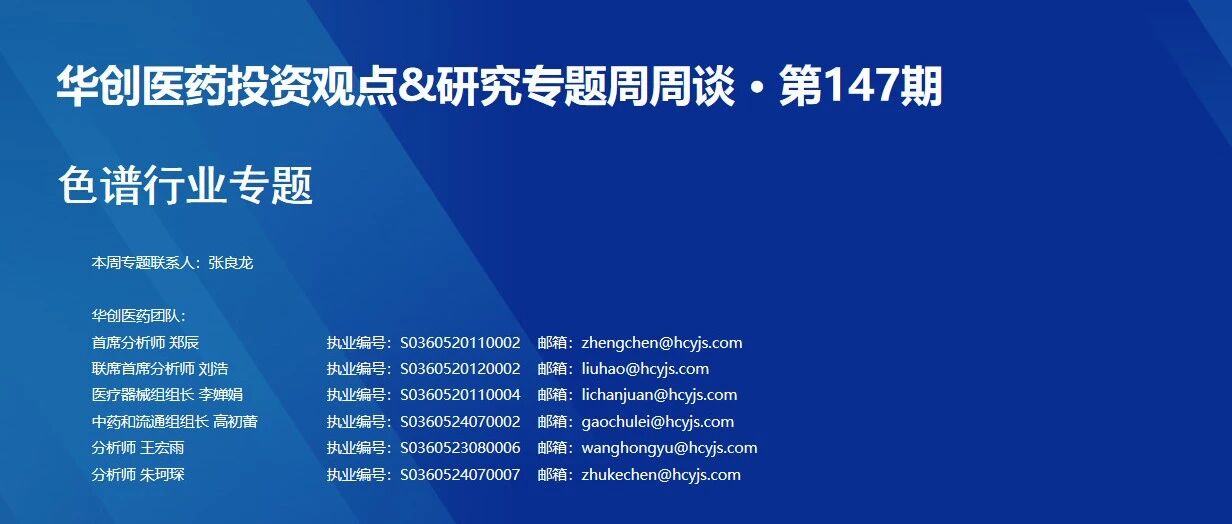
第147期:色谱行业专题:华创医药投资观点&研究专题周周谈-20251025
Huachuang Securities· 2025-10-25 09:58
Investment Rating - The report maintains a "Recommended" rating for the companies involved in the chromatography industry, particularly focusing on domestic innovation and market potential [57]. Core Insights - The chromatography industry is experiencing significant growth, driven by the increasing demand in the biopharmaceutical sector, which accounts for 80% of the chromatography medium applications [22][37]. - The global biopharmaceutical market is projected to grow from approximately $503 billion in 2023 to $892 billion by 2028, with a compound annual growth rate (CAGR) of 9.5%-12.5% [30]. - Domestic biopharmaceutical market growth is robust, with projections indicating an increase from ¥262.2 billion in 2018 to ¥534.8 billion in 2024, reflecting a CAGR of 12.61% [37]. Market Overview - The chromatography industry includes core consumables, instruments, and software services, with a complete product system that plays a crucial role in drug purification and analysis [15][16]. - The chromatography equipment market is expected to see significant growth, with the small molecule liquid chromatography system market projected to grow from $3.6 billion in 2021 to $7.7 billion by 2026, representing a CAGR of 16.7% [40]. - The chromatography medium market in China is expected to grow from ¥112 billion in 2023 to over ¥203 billion by 2026, with a CAGR of 21.92% [47]. Key Segments - **Innovative Drugs**: The report highlights the transition from generic to innovative drugs in China, with a focus on companies like BeiGene and Innovent Biologics, which are expected to lead in product pipelines and market share [9][57]. - **Medical Devices**: The report notes a recovery in the bidding for imaging devices and a growing market for home medical devices, driven by government subsidies [61]. - **IVD (In Vitro Diagnostics)**: The report emphasizes the acceleration of domestic replacement in the luminescence sector, with companies like Mindray and New Industries leading the charge [59][60]. Industry Trends - The report identifies a shift towards domestic production and innovation in the chromatography sector, with local companies making significant strides in filling the gaps left by international firms [53][56]. - The biopharmaceutical sector's increasing reliance on chromatography technology for drug development and production is expected to drive demand for high-quality chromatography products [22][37]. - The report also discusses the impact of national policies aimed at promoting domestic high-end scientific instruments, which are expected to further enhance the growth of the chromatography industry [53].
勃林格殷格翰IPF新药获批,打破十年市场垄断,百亿级呼吸赛道迎来重估
Ge Long Hui· 2025-10-24 10:40
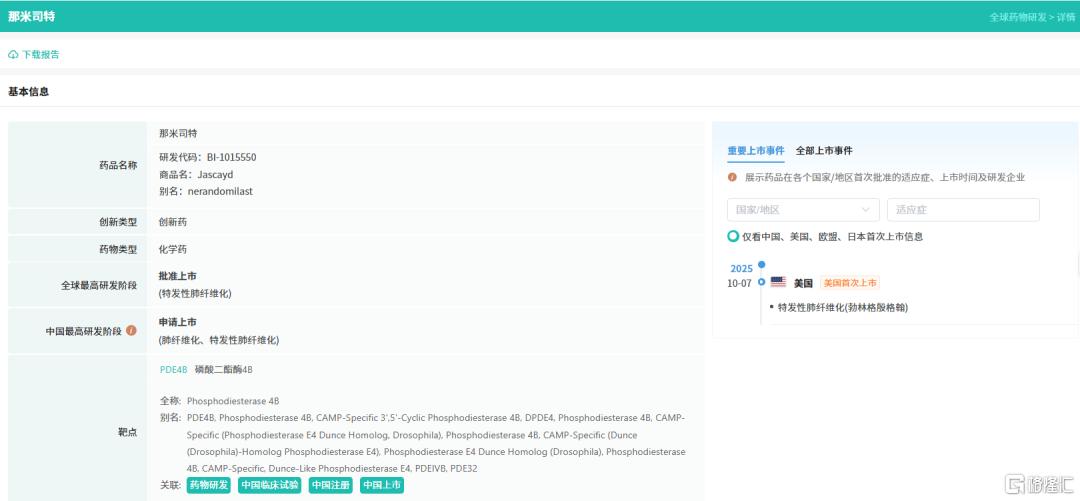
Core Insights - Boehringer Ingelheim's oral PDE4B inhibitor Nerandomilast has received priority review approval for the treatment of idiopathic pulmonary fibrosis (IPF), marking the first new drug approval in this area in over a decade [1][6] - This approval signifies a breakthrough in IPF treatment, as it is the first drug to meet primary endpoints in a Phase III clinical trial in ten years [1][6] Drug Information - Nerandomilast, also known as Jascayd, is a novel PDE4B inhibitor developed by Boehringer Ingelheim, targeting the PDE4B enzyme which is highly expressed in the lungs and associated with fibrosis and inflammation [3][6] - The drug has shown dual effects of anti-fibrosis and anti-inflammation, potentially benefiting IPF patients clinically [3] Market Dynamics - The IPF market is currently dominated by Boehringer Ingelheim's Nintedanib and Roche's Pirfenidone, with Nerandomilast's entry creating a "three-horse race" in IPF treatment [7] - Nintedanib's patent expiration is set for 2029, and Pirfenidone faces generic competition, indicating a shift in market dynamics with the introduction of Nerandomilast [7] Clinical Development - Nerandomilast received breakthrough therapy designation from the FDA in 2022, highlighting its potential in IPF treatment [6] - The drug's approval in China was based on positive results from the pivotal Phase III clinical trial FIBRONEER™-IPF, which was the first to achieve primary endpoints in a decade [6][10] Future Prospects - Following its approval, Nerandomilast is expected to bring new hope to patients with rare pulmonary fibrosis conditions [10] - The company has submitted an application for Nerandomilast for the indication of progressive pulmonary fibrosis, which could further expand its treatment scope [10]
“减肥药巨头”诺和诺德裁 9000 人,跨国药企裁员风暴来袭,中国市场凭创新成“破局密钥”
Hua Xia Shi Bao· 2025-10-24 02:32
Core Insights - The global pharmaceutical industry is facing a significant downturn, with a total of 190 layoffs in the biopharmaceutical sector in the first three quarters of 2023, approaching the total of 192 expected for the entire year of 2024 [2][3] - Major companies like Merck and Novo Nordisk are leading this wave of layoffs, with Merck cutting 6,000 jobs and Novo Nordisk planning to lay off 9,000 employees, reflecting a broader industry trend [3][4] - The layoffs are driven by a combination of factors including patent cliffs, market competition, and inefficiencies in research and development [7][10] Layoff Trends - In Q3 2023, there were 62 layoffs in the global biopharmaceutical sector, with over 20,000 jobs cut in the second half of the year alone [2][3] - Merck's layoffs are part of a strategy to save $3 billion by 2027, while Novo Nordisk aims to save $1.26 billion by the end of 2026 [3] - Smaller companies are also affected, with companies like Biogen and Moderna announcing significant layoffs [4][5] Regional Focus: China - The Chinese market is experiencing unique adjustments, with companies like Gilead and Sumitomo Pharma restructuring their resources, while AstraZeneca is increasing its R&D investment by $2.5 billion [2][6] - The layoffs in China reflect a targeted approach, with Gilead confirming layoffs related to the integration of resources for a new HIV drug [4][6] - The Chinese market is becoming a critical area for innovation, with a significant increase in licensing deals for innovative drugs [6][10] Industry Dynamics - The underlying logic of the layoffs is attributed to pressures from patent expirations, low R&D efficiency, and intense market competition [7][10] - Companies are increasingly focusing on core therapeutic areas and optimizing resource allocation to adapt to changing market conditions [3][7] - The Chinese market is seen as a potential solution to these challenges, with lower clinical trial costs and a shift towards local innovation [7][10] Future Outlook - The ongoing layoffs are reshaping the industry landscape, with a notable talent migration from multinational companies to local firms in China [8] - The rise of CDMO (Contract Development and Manufacturing Organization) companies in China is facilitating the outsourcing of production by multinational firms [8] - The transformation of the industry is expected to continue, with China emerging as a core hub for innovation and development in the pharmaceutical sector [10]



中国医疗保健 - 影响新兴口服 GLP-1 管线前景的关键争论-一个超 450 亿美元的领域-China Healthcare-Key Debates Shaping the Outlook for Emerging Oral GLP-1 Pipelines – A $45bn+ Field
2025-10-24 01:07
Summary of Key Points from the Conference Call on Emerging Oral GLP-1 Pipelines Industry Overview - The global oral GLP-1 market is projected to peak at **$45-75 billion** with significant opportunities for emerging players, particularly from China biopharma innovators [9][13][24] - The obesity therapeutics market could reach approximately **$150 billion** by **2035**, with oral therapies expected to capture **30-50%** of the GLP-1 market share [13][9] Core Debates and Insights Debate 1: Leading Contenders and Partnership Opportunities - Over **20 oral GLP-1 candidates** are being developed by Chinese biopharma companies, with most retaining global rights [16] - Hengrui/Kailera, Huadong, and Regor are identified as having the most advanced assets, with key clinical data expected in **2H25-1H26** [24][26] - The evolving business development environment suggests further out-licensing and partnership opportunities for candidates demonstrating differentiated clinical profiles [18] Debate 2: Efficacy and Tolerability Profiles - **Orforglipron** and **oral semaglutide** set benchmarks for follow-on pipelines, with Orfor's Phase 3 data showing **11.5%** placebo-adjusted weight loss at **72 weeks** [20][21] - Notable differences in baseline characteristics and titration schedules complicate direct cross-trial comparisons, as Chinese trials generally involve healthier populations [21][28] Debate 3: Factors Influencing Market Adoption - Tolerability profiles are crucial for oral candidates, especially for "mildly obese" patients. Adverse event-related discontinuation rates were low across Chinese trials [28] - Emerging candidates like Hengrui/Kailera's **HRS-7535** and **HRS-9531** show competitive efficacy, with HRS-7535 under Phase 3 trials in China [26][27] Key Players and Their Developments - **Hengrui**: HRS-7535 and HRS-9531 are in advanced stages, with global development through Kailera [17][26] - **Huadong**: HDM1002 is the most advanced small molecule GLP-1 candidate domestically, with Phase 3 interim data expected by **1H26** [26] - **Regor**: RGT-075 is progressing in the US with Phase 2 trials, with readouts expected in **4Q25** [26][33] Market Dynamics and Future Outlook - The oral GLP-1 market is becoming more fragmented, creating opportunities for emerging pipelines as leading candidates face challenges [14] - The potential for strategic partnerships remains high, especially as major US biopharma companies seek exposure to this asset class [18] Additional Considerations - The report highlights the importance of understanding the clinical trial designs and data comparisons for accurate market assessments [33] - A catalyst-rich period is anticipated over the next **6-12 months**, with significant trial readouts expected [33] This summary encapsulates the critical insights and developments within the emerging oral GLP-1 market, emphasizing the potential for growth and the competitive landscape shaped by both established and emerging players.