
奈雪的茶

Search documents
港交所一杯茶:茶饮中场激战正酣,半年报透视生死局
Ge Long Hui· 2025-09-01 19:18
Core Insights - The new-style tea beverage industry is undergoing rapid differentiation and reshuffling, shifting from "scale expansion" to "quality competition" [1] - The industry is experiencing a Matthew effect, where strong players dominate while weaker ones struggle [1] Company Performance - Mixue Ice City reported revenue of 14.875 billion and net profit of 2.718 billion, with both revenue and net profit growth exceeding 39% [1] - Gu Ming demonstrated impressive growth with revenue of 5.663 billion, a year-on-year increase of 41.2%, and net profit soaring by 121.5% to 1.625 billion [1][3] - Hu Shang A Yi achieved revenue of 1.818 billion, up 9.7%, and net profit of 203 million, an increase of 20.9% [3] - Cha Bai Dao's total revenue was 2.5 billion, a slight increase of 4%, but net profit rose significantly by 40% to 333 million [3] - Nai Xue's Tea faced challenges with revenue of 2.178 billion, a year-on-year decline of 14.4%, and a net loss of 118 million [3] Market Dynamics - The number of stores and supply chain capabilities have become critical competitive advantages for tea beverage giants [4] - Mixue Ice City has over 53,000 stores globally, adding nearly 10,000 in the first half of 2025, while Gu Ming has 11,179 stores [4] - Supply chain management is increasingly viewed as a key differentiator in the industry, with companies like Mixue and Gu Ming focusing on self-sourcing and efficient logistics [4][13] Consumer Trends - There is a growing consumer preference for low-sugar, low-calorie, and functional tea beverages, while many brands remain focused on traditional offerings [6] - The industry faces cost pressures, with significant portions of revenue consumed by material, labor, and rental costs [6] Strategic Directions - Major tea beverage companies are targeting lower-tier markets as a new growth area, with Mixue and Gu Ming establishing a strong presence in these regions [8] - The coffee segment is emerging as a secondary battleground, with companies like Mixue and Gu Ming expanding their coffee offerings significantly [9][10] Investment Landscape - The tea beverage industry is seeing a wave of IPOs, emphasizing the importance of profitability over mere expansion [12][15] - Companies that can effectively manage their supply chains and demonstrate profitability are more likely to attract investor interest [13][15]
江南春:消费品牌反内卷的10个顶级思维
创业家· 2025-09-01 10:42
Core Viewpoint - The article emphasizes that consumer brands need to adopt ten "don'ts" to avoid internal competition and effectively market and communicate their products in a fragmented consumer landscape [2][6][10]. Group 1 - Do not chase after dividends anymore [2] - Do not use diligent traffic investment to cover the lack of core brand competitiveness [3] - The essence of consumer goods has not changed over the past 30 years: deep distribution both online and offline, and occupying consumers' minds as the first choice [4][5] Group 2 - Do not look for consumers anymore [6] - Consumer touchpoints are increasingly complex, and limited budgets cannot follow all of them [7][8] - To win the mind war, brands must concentrate their efforts and saturate the market to penetrate consumers' mental barriers [8] Group 3 - Do not add more products [10] - The core of a business is not about adding but focusing resources on core products [11] - Focus on core products, core media, and core brand value [12] Group 4 - Do not embrace change anymore [13] - Instead of trying to grow in areas of weakness, brands should focus on the unchanging rules of their industry and consumers' enduring needs [13][14] Group 5 - Do not talk about products anymore [15] - China does not lack quality products; instead, brands should create scenarios that stimulate consumer desire [16] - Consumers need solutions to their scenario problems and the emotional significance of those scenarios [18] Group 6 - Do not learn from leading brands anymore [19] - When facing a strong leader brand, the tactical approach should be to differentiate rather than imitate [20][21] Group 7 - Do not fantasize about winning through extraordinary means anymore [22] - Betting on significant events and public opinion has a low success rate [23] - The resonance between online social media and offline community media is the most reliable paradigm for brand communication today [24] Group 8 - Do not strive for change anymore [26] - Sometimes, doing less but doing it thoroughly is more effective than trying to innovate excessively [26] Group 9 - Do not trust numbers anymore [27] - Online data does not equate to consumer recognition; true value lies in being a brand that consumers think of first in its category [28][29] Group 10 - Do not go with the flow anymore [31] - When everyone is following trends, consider taking a contrary approach for unexpected experiences and rewards [32]


“秋天的第一杯奶茶”,流行到海外了
3 6 Ke· 2025-09-01 09:09
Core Insights - The article highlights the successful overseas expansion of Chinese tea brands, particularly focusing on the innovative product offerings and localized strategies that resonate with international consumers [1][26][36] Group 1: Product Innovation and Market Strategy - The introduction of the "抹云椰蓝" drink by Heytea, which combines blue spirulina, coconut water, and matcha, has led to over 700,000 cups sold in overseas markets, showcasing the brand's ability to create visually appealing and health-oriented products [1][9] - The trend of leveraging local ingredients and flavors is evident, with brands like Mixue and Bawang Tea integrating local tastes into their menus, such as using local spices in Malaysia and tropical fruits in Vietnam [5][6][21] - The success of products like "Triple Supreme Matcha Latte" is attributed to thorough market research and the ability to create buzz through social media, particularly influenced by celebrity endorsements [2][4] Group 2: Supply Chain and Operational Challenges - Establishing a supply chain that meets local regulations and consumer preferences is a significant challenge for tea brands entering foreign markets, with varying standards for food safety and ingredient sourcing [15][16] - Companies like Heytea have set up multiple warehousing centers in key regions to ensure consistent product quality and efficient logistics, which is crucial for maintaining brand integrity across different markets [23][21] Group 3: Cultural Integration and Brand Positioning - The article emphasizes the importance of cultural integration, where brands adapt their offerings to align with local customs and preferences, thus creating a "resonance" with consumers [33][36] - The global market for ready-to-drink beverages is projected to grow significantly, with a compound annual growth rate of 7.2% from 2023 to 2028, indicating a ripe opportunity for Chinese tea brands to expand their footprint [26][28] - The branding strategies employed by these companies often include collaborations with local influencers and culturally relevant marketing campaigns, enhancing their appeal to diverse consumer bases [31][32]

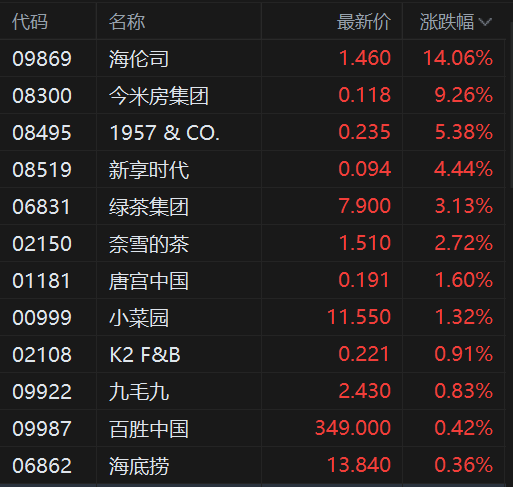
港股异动丨餐饮股普涨 海伦司绩后涨超14% 日前商务部称扩大服务消费措施9月出台
Ge Long Hui· 2025-09-01 03:35
Group 1 - The core viewpoint of the article highlights the significant rise in Hong Kong restaurant stocks, particularly Helen's, which surged over 14% after its earnings report [1] - Helen's reported a mid-year revenue of 291 million RMB, a year-on-year decrease of 34.02%, and a net profit of 50.33 million RMB, down 27.77% year-on-year [1] - The company proposed an interim dividend of 0.1051 RMB per share, while its net profit margin improved from 15.7% to 17.8% compared to the same period last year [1] Group 2 - The Chinese Ministry of Commerce indicated a shift in consumption patterns towards a balance of goods and service consumption, with plans to introduce policies to boost service consumption in September [1] - The Ministry aims to enhance service supply capabilities and stimulate new service consumption through coordinated use of fiscal and financial measures [1]
一周新消费NO.324|Babycare官宣郭碧婷成为全新品牌代言人;喜茶上新网纹瓜瓜冰浆
新消费智库· 2025-08-31 13:04
Group 1 - The core viewpoint of the article highlights the recent product launches in the food and beverage industry, showcasing innovation and market expansion strategies by various brands [4][6][19]. Group 2 - Mixue Ice City has launched a new "Lemon Milk" series, which includes Lemon Milk Coffee and Snow King Lemon Milk, emphasizing rich and refreshing flavors [4][24]. - Want Power, a brand under Wangwang, introduced a new product "Berry Care," featuring five core ingredients aimed at health-conscious consumers [4]. - Joyoung has released a new fig and flaxseed soy milk powder, targeting female consumers with high protein and fiber content [4]. - Kirin Beverage has launched a roasted tea latte, designed for various consumption scenarios such as studying and working [5]. - Yili's Ikahuo has introduced a new health drink made from iron skin dendrobium and western ginseng, utilizing advanced preservation techniques [6]. - Menglong Ice Cream has unveiled a new glowing ice pop, appealing to health-conscious consumers with its low-calorie content [7]. - Heytea has launched a new ice drink made from a specific type of melon, highlighting unique production techniques [7]. - Nongfu Spring has introduced a new series of bottled water sourced from various locations across China [7]. - Sanofi Group has launched a new herbal tea product, focusing on light health benefits [7]. Group 3 - Babycare has announced actress Guo Biting as its new brand ambassador, launching a themed short film [8]. - Mengniu has appointed a new CFO, indicating a shift in its executive leadership [8]. - KFC has opened its first KPRO restaurant in Henan, focusing on balanced meal options [10]. - Lucky Coffee has opened its first overseas store in Malaysia, marking its global expansion [10]. Group 4 - Shibeikang has completed a nearly 100 million RMB Series B financing round, aimed at accelerating its drug development pipeline [14]. - Pure Fitness has secured $50 million in funding, indicating strong investor interest in the fitness sector [16]. - Sleep.ai has raised $5.5 million in funding, transitioning to a focus on commercialization and partnerships [17]. - Anta has announced an investment in the Korean fashion group MUSINSA, establishing a joint venture in China [17]. Group 5 - Coca-Cola has launched customized snack products for bulk retail, expanding its product offerings [19]. - Kangshifu has undergone significant management changes, indicating a strategic shift within the company [19]. - Nayuki has collaborated with a brand to launch a new beverage line, enhancing its product diversity [19]. - Ganyuan Food has introduced a new rice cake series with various flavors, focusing on quality ingredients and innovative cooking methods [19].






“烘焙+”模式乘风起,跨界融合成增长新引擎
Sou Hu Cai Jing· 2025-08-31 03:09
Core Insights - The baking industry is transitioning from a supporting role to a primary growth driver across various sectors, including tea, coffee, hot pot, and supermarkets, due to its strong synergy, high profit margins, and rapid response to trends [1][9]. Group 1: Baking Integration in Tea and Coffee - The "main category + baking" model is emerging, with tea brands increasing the sales proportion of baked goods from 5% to 15% in 2023, projected to exceed 30% market penetration [3]. - Major tea brands like Nayuki and others are actively pursuing baking strategies, with Nayuki aiming for equal emphasis on baking and tea by 2025 [3]. - Coffee brands are also adopting the "coffee + baking" model, with Starbucks and Luckin Coffee expanding their baking product lines significantly [4]. Group 2: Hot Pot and Supermarket Integration - Hot pot brands are entering the baking space, with Haidilao launching a bakery brand that incorporates hot pot elements into baked goods [4]. - Supermarkets are increasingly adopting the "supermarket + baking" model, with major chains like Sam's Club and Walmart focusing on high-cost performance strategies to capture market share [5]. - By 2024, offline supermarkets are expected to account for 37.7% of the baking product consumption channels, creating a balanced market structure with specialty stores and e-commerce [6]. Group 3: Consumer Demand and Market Trends - The rise of baking as a primary growth engine is driven by upgraded consumer demand and improved supply chain efficiency, making it a significant contributor to various industries [7]. - Young consumers are the main drivers of baking consumption, with nearly 90% of purchases coming from the middle-aged and young demographic [7]. - Brands are leveraging the "main category + baking" model to maximize commercial value, enhancing customer spending through combined offerings [7]. Group 4: Operational and Supply Chain Innovations - Supermarkets are utilizing large-scale supply chain management and standardized production to enhance efficiency and product quality in the baking sector [8]. - Leading brands are breaking down category barriers to create integrated membership systems that enhance user engagement and value extraction [8]. - The ability of baking to serve as a "second growth curve" for various industries is attributed to its strong synergy with existing businesses and high profit potential [9].

新茶饮企业上半年冷热不均:蜜雪赚了26.9亿,奈雪仍处关店调整期
第一财经· 2025-08-30 12:49
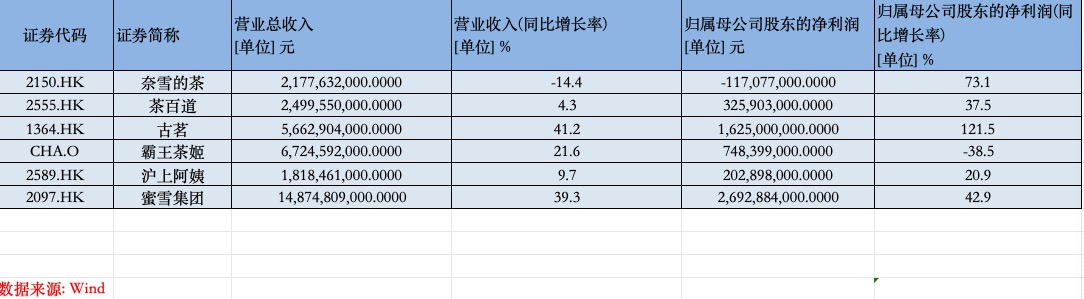
Core Viewpoint - The new tea beverage industry is experiencing significant growth, with companies like Mixue Group leading in revenue and net profit, while others like Naixue Tea are struggling with losses but showing signs of improvement [3][4]. Group 1: Company Performance - Mixue Group (2097.HK) reported the highest revenue of 14.87 billion yuan, with a year-on-year growth of 39.3%, and a net profit of 2.69 billion yuan, up 42.9% [4]. - Gu Ming (1364.HK) achieved a net profit growth of 121.51%, ranking first in the industry for profit increase [3][4]. - Naixue Tea (2150.HK) was the only company to report a loss in the first half of the year, with a revenue of 2.18 billion yuan, down 14.4%, and a net loss of 117 million yuan, although the loss narrowed compared to the previous year [4][3]. Group 2: Market Strategy - Mixue Group has a significant presence in lower-tier cities, with 57.6% of its 48,000 stores located in third-tier cities and below, while only 4.9% are in first-tier cities [6][5]. - Gu Ming also focuses on lower-tier markets, with 52% of its stores in third-tier cities and only 3% in first-tier cities [6]. - Naixue Tea's strategy differs, with 29.5% of its stores in first-tier cities, indicating a focus on higher-end markets [7]. Group 3: Business Model - The franchise model is a key revenue driver for many new tea beverage companies, with Mixue Group having 99% of its 52,996 stores as franchises [8]. - The majority of revenue for these companies comes from selling raw materials and providing management services to franchisees, indicating a "to B" supply chain business model [8][9]. - The scale of stores directly impacts the revenue ceiling for headquarters, with Mixue's extensive network providing strong economies of scale and bargaining power [9]. Group 4: Market Trends - The new tea beverage industry is expanding into lower-tier markets, where lower operational costs allow for higher profit margins and increased customer traffic [7]. - The competitive landscape is changing, with some companies benefiting from delivery subsidies while others, like Bawang Tea Ji, are experiencing declines in performance due to not participating in discount activities [10]. - The overall market for ready-to-drink beverages is projected to grow significantly, with a compound annual growth rate of 7.2% expected from 2023 to 2028, indicating ongoing opportunities despite challenges in the industry [11].

霸王茶姬二季度海外GMV猛增77%,创始人称坚决不打价格战
中国基金报· 2025-08-30 09:05
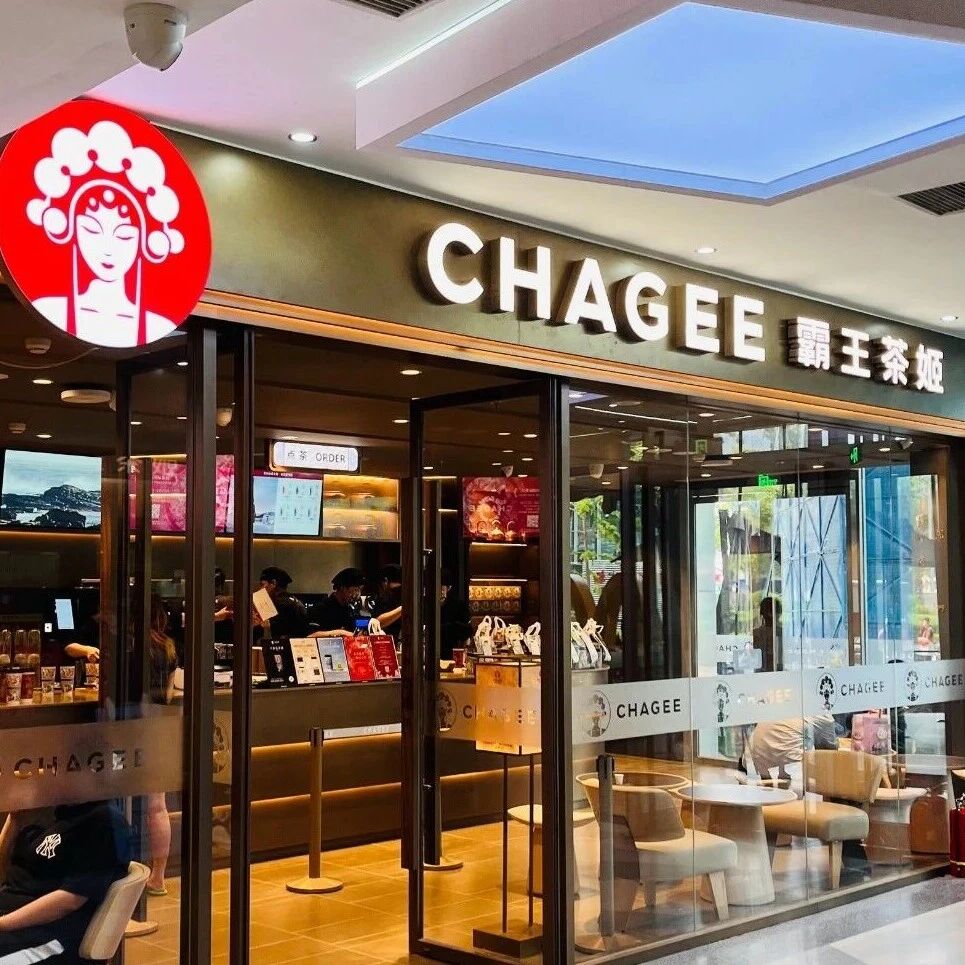
Core Viewpoint - The company aims to establish itself as a high-value brand and will not engage in price wars, despite the competitive landscape in the new tea beverage industry [4][9]. Financial Performance - For Q2 2025, the company reported a total GMV of 8.1031 billion yuan, a year-on-year increase of 15.5% [2]. - Net revenue reached 3.3319 billion yuan, up 10.2% year-on-year, while adjusted net profit was 629.8 million yuan, showing a slight increase of 0.1% [2][5]. - The company's net profit margin stands at 18.9%, which is considered strong within the new tea beverage sector [7]. Market Dynamics - The overseas market showed significant growth, with Q2 overseas GMV reaching 235.2 million yuan, a year-on-year increase of 77.4% and a quarter-on-quarter increase of 31.8% [4][14]. - The total number of global stores surpassed 7,000, with over 200 stores located overseas, marking a 40.9% year-on-year increase [13]. Strategic Focus - The company is committed to not participating in price wars, emphasizing a high-value brand strategy and focusing on product innovation and operational efficiency [9][11]. - The company plans to upgrade core ingredients, including tea leaves and milk sources, to enhance product quality [11]. Product Innovation - New product launches, such as "Yi Qi Hong Chen," have shown strong sales performance, contributing to a significant increase in GMV [7]. - The company has successfully localized products, with the "Gu Xiang Bei Cha" becoming a hit in Southeast Asia [16]. Management and Expansion - The company has established a management team with international experience to support its global expansion efforts, particularly in North America [16]. - The first North American store opened in Los Angeles in May, with a second store beginning trial operations in August [17].
新茶饮企业上半年冷热不均:蜜雪赚了26.9亿 奈雪仍处关店调整期
Di Yi Cai Jing· 2025-08-30 08:51
Core Insights - The new tea beverage companies have reported their performance for the first half of the year, with Mixue Group leading in both revenue and net profit, followed by Cha Yujia and Gu Ming in respective rankings [1][2] - Gu Ming achieved the highest net profit growth rate in the industry at 121.51% year-on-year, while Nayuki Tea was the only company to report a loss, although the loss has narrowed compared to the previous year [1][2] Revenue and Profit Summary - Mixue Group: Revenue of 14.87 billion yuan, net profit of 2.69 billion yuan, with a year-on-year revenue growth of 39.3% and net profit growth of 42.9% [2] - Cha Yujia: Revenue of 6.72 billion yuan, net profit of 748.4 million yuan, with a revenue growth of 21.6% but a net profit decline of 38.5% [2] - Gu Ming: Revenue of 5.66 billion yuan, net profit of 1.63 billion yuan, with a revenue growth of 41.2% and net profit growth of 121.5% [2] - Tea Baidao: Revenue of 2.50 billion yuan, net profit of 325.9 million yuan, with a revenue growth of 4.3% and net profit growth of 37.5% [2] - Hu Shang A Yi: Revenue of 1.82 billion yuan, net profit of 202.9 million yuan, with a revenue growth of 9.7% and net profit growth of 20.9% [2] - Nayuki Tea: Revenue of 2.18 billion yuan, with a revenue decline of 14.4% and a net loss of 117.1 million yuan, although the loss has narrowed [2] Market Expansion and Strategy - Mixue Group has opened over 53,000 stores globally, with approximately 57.6% of its stores located in third-tier cities and below, indicating a strong focus on lower-tier markets [3][4] - Gu Ming also emphasizes expansion in lower-tier cities, with 52% of its stores located in third-tier cities and below [3] - The trend of expanding into lower-tier markets is becoming a common strategy among new tea beverage companies, allowing for lower operational costs and higher profit margins [4] Business Model and Operations - The majority of Mixue Group's stores are franchise-based, with 99% of its 52,996 stores being franchise outlets, which contributes significantly to its revenue through the sale of raw materials and equipment [6][7] - Nayuki Tea has a higher proportion of direct-operated stores, with 1,321 out of 1,638 stores being direct-operated, which poses challenges in terms of operational costs in high-rent areas [8] Impact of External Factors - The "takeaway war" in July led to increased subsidies from delivery platforms, benefiting some companies while negatively impacting others like Cha Yujia, which chose not to participate in discount activities [9] - Nayuki Tea reported an increase in revenue from takeaway orders, contributing 48.1% of total revenue, up from 40.6% in the previous year [9] Industry Outlook - The global ready-to-drink beverage market is expected to grow from $598.9 billion in 2018 to $779.1 billion in 2023, with a projected compound annual growth rate of 7.2% from 2023 to 2028 [10] - Despite the growth potential, the saturation of tea beverage stores and declining investment interest may lead to challenges for smaller or independent tea shops [11]
新茶饮企业上半年冷热不均:蜜雪赚了26.9亿,奈雪仍处关店调整期
Di Yi Cai Jing· 2025-08-30 08:38
Core Insights - The new tea beverage industry is experiencing varied performance among companies, with some achieving significant growth while others face challenges [1][8] - The expansion into lower-tier cities is a common strategy among leading brands, contributing to their revenue growth [3][4] - The impact of delivery platform subsidies is uneven, benefiting some companies while negatively affecting others [8] Group 1: Company Performance - Mixue Group (2097.HK) leads the industry in both revenue and net profit, with a revenue of CNY 14.87 billion and a net profit of CNY 2.69 billion, reflecting a 42.9% increase [2] - Gu Ming (1364.HK) shows the highest net profit growth at 121.5%, with a net profit of CNY 1.63 billion [2] - Nayuki (2150.HK) is the only company reporting a loss in the first half of the year, with a net loss of CNY 117 million, although the loss has narrowed compared to the previous year [2][1] Group 2: Market Strategy - Mixue Ice City has over 53,000 stores globally, with 57.6% located in lower-tier cities, leveraging low prices to capture market share [3][6] - Gu Ming also focuses on lower-tier cities, with 52% of its stores in these areas [3] - Nayuki's strategy differs, with a higher proportion of its 1,638 stores located in first-tier cities, leading to higher operational costs [4][7] Group 3: Impact of Delivery Subsidies - The "delivery war" has led to increased subsidies from platforms, benefiting companies like Mixue, which saw a rise in daily sales and order volume [8] - Ba Wang Cha Ji (CHA.O) experienced a decline in same-store GMV by 23% due to its non-participation in discount activities [8] - Nayuki reported that delivery orders contributed 48.1% of its total revenue, up from 40.6% in the previous year [8] Group 4: Industry Outlook - The global ready-to-drink beverage market is projected to grow from USD 799 billion in 2023 to USD 1,103.9 billion by 2028, with a compound annual growth rate (CAGR) of 7.2% [9][10] - Despite growth potential, the saturation of tea beverage stores and declining investment interest pose challenges for smaller brands and independent shops [10]