甘源食品

Search documents
传统产业增数添智谋升级
Jing Ji Ri Bao· 2025-05-05 22:01
Core Insights - The automation and intelligent transformation of Ganyuan Food has led to a 60% increase in production efficiency, positioning the company as a national leader in modern industrialization [1] - The Pingxiang Economic and Technological Development Zone has implemented a "smart matrix" for digital transformation in manufacturing, significantly boosting industrial development [1] Group 1: Digital Transformation Initiatives - The Pingxiang Economic and Technological Development Zone has introduced the "Digital Transformation Action Plan (2024-2025)" and supportive policies, achieving recognition as an excellent digital transformation development zone [1] - A total of 117 enterprises have completed digital diagnostics, with 59 enterprises undergoing digital transformation, and 6 enterprises achieving L6 level or above in digital standardization [1] Group 2: Service Platform and Support - The "Smart Development Zone" service platform has been established, integrating a comprehensive service platform that has reduced project approval times by over 80% [2] - The digital transformation promotion center has provided over 60 technical training sessions, serving more than 800 enterprises [2] - The "Gantong Code" platform has launched a unique application for enterprises, achieving full coverage for over 600 companies [2] Group 3: Economic Impact and Future Goals - The Pingxiang Economic and Technological Development Zone has added 21 new industrial enterprises and disbursed over 30 million yuan in enterprise subsidies since last year [2] - The "Science and Technology Loan" program has issued a total of 340 million yuan in loans to support enterprises [2] - Future goals include focusing on the deep integration of "AI + Industrial Internet," aiming for over 80% of large-scale enterprises to achieve digital transformation [2]
食品饮料行业周报:一季报白酒稳健增长,零食新品红利表现突出
KAIYUAN SECURITIES· 2025-05-05 12:23
Investment Rating - The industry investment rating is "Positive" (maintained) [1] Core Viewpoints - The first quarter of 2025 showed a slight decline in the food and beverage index by 0.5%, ranking 13th among 28 sub-industries, underperforming the CSI 300 by approximately 0.1 percentage points. Other liquor categories (+2.2%), dairy products (+1.4%), and snacks (+1.4%) performed relatively well [10][12] - The food and beverage sector's revenue grew by 4.6% year-on-year in Q1 2025, a slight decrease from 6.6% in Q4 2024. Profit increased by 0.3%, a significant improvement from the -13.0% in Q4 2024. The liquor segment saw a revenue growth of 1.7% in Q1 2025, slightly up from 1.2% in Q4 2024, indicating resilience in consumption during the Spring Festival [10][11] - The report highlights a divergence in performance within the liquor industry, with high-end liquor and leading real estate liquor brands maintaining stable performance, while some mid-range brands experienced significant declines. The report anticipates a gradual recovery in liquor consumption as economic policies take effect [10][11] Summary by Sections Weekly Insights - The report notes a pressured tone in Q1 results but indicates a month-on-month improvement. The food and beverage index's performance is under scrutiny, with specific attention to the liquor sector's resilience [10][12] Market Performance - The food and beverage sector underperformed the broader market, with a 0.5% decline in the index. The report identifies leading stocks and those that lagged behind, emphasizing the need for strategic focus on top-performing companies [10][12] Upstream Data - Some upstream raw material prices have decreased, with specific data on dairy and meat prices indicating fluctuations that could impact the overall cost structure for food and beverage companies [17][23] Liquor Industry News - Notable developments include the pre-sale of Moutai's 2025 Dragon Boat Festival gift box and the launch of new products by Qingdao Beer, reflecting ongoing innovation and market engagement within the liquor sector [41][42] Memorandum - The report includes a memorandum highlighting significant upcoming events, such as the unlocking of restricted shares for Angel Yeast on May 9, which could influence market dynamics [43]





食品综合2024年报及2025年一季报总结:零食继续领跑,餐饮链有望企稳
Soochow Securities· 2025-05-05 07:05
Investment Rating - The report maintains an "Overweight" rating for the food and beverage industry [1] Core Viewpoints - The snack sector continues to lead, while the restaurant chain industry is expected to stabilize [2] - The report emphasizes the structural growth opportunities within the snack industry, driven by channel transformation and product innovation [11][31] - The frozen food sector is gradually overcoming its pressure phase, with leading companies seeking new growth [44] - The restaurant chain sector shows signs of stabilization, although single-store revenue still faces challenges [65] Summary by Sections 1. Snack Foods - The snack food industry exhibits structural growth opportunities, with a notable increase in revenue growth rates among key players [11][31] - In 2024, seven major listed companies in the snack sector achieved revenue growth exceeding 20%, with three maintaining this growth into Q1 2025: Wancheng Group, Youyou Foods, and Yanjinpuzi [12][11] - The growth in the snack sector is attributed to channel innovations, particularly through snack wholesale channels and e-commerce platforms like Douyin [14][21] - Wancheng Group and Mingming Group are expanding their store numbers significantly, validating their business model [14][20] - Profitability in the snack sector is influenced by raw material costs, with Wancheng Group showing efficiency improvements [32][34] 2. Frozen Foods - The frozen food sector is gradually recovering, with leading companies like Lihai Foods and Anjifoods showing resilience [49][44] - Revenue performance in the frozen food sector aligns closely with the overall restaurant industry, with Lihai Foods demonstrating notable growth driven by its cream product line [49][44] - The report highlights that the small B channel and rice noodle products are under significant pressure due to market saturation and competition [50][51] - Profit margins are under pressure due to rising raw material costs and increased competition, although Lihai Foods has managed to improve its profitability through internal efficiency measures [54][57] 3. Restaurant Chains - The restaurant chain sector is experiencing a stabilization trend, with essential food brands like Babi Foods performing better than optional brands [65] - Despite growth in the number of stores, many companies still face revenue gaps compared to pre-pandemic levels, with Babi Foods and Guoquan showing positive revenue growth [65] - The report notes that cost control measures have led to improved profitability for some companies, while others continue to struggle with high expenses [65]
食品饮料行业周报:业绩稳健收官,持续关注零食等景气催化
SINOLINK SECURITIES· 2025-05-05 04:25
投资建议 白酒板块:本周年季报业绩期收官,整体而言:白酒板块 24 年年报及 25 年一季报的兑现度均较为不错,绝大多数酒 企的表观业绩高度契合市场预期。在当下白酒行业景气度仍有所承压的背景下,一方面市场期待酒企能发挥其品牌/ 渠道/组织等优越性,积极紧抓消费需求、拼抢巩固自身市场份额;另一方面,市场亦深知欲速则不达,只有基本面 底盘企稳、酒企方能伴随景气上行而厚积薄发。因此,业绩的平稳兑现已是行业磨底期酒企交出的不错答卷。 当下已至白酒消费淡季,酒企的营销重心也逐步倾斜至流通渠道稳价盘、团购商务做客情、宴席聚饮抢需求。从目前 的动销反馈来看,宴席场景动销普遍反馈可圈可点、部分区域因民俗因素致使今年宴席有所回补,但团购商务、聚饮 动销仍较承压。考虑到春糖后外部贸易环境等不确定性进一步提升,我们预计短期白酒行业动销或仍处于小幅回落的 磨底状态,拐点仍待促内需、顺周期相关政策落地后从需求端曳引。 目前我们维持行业景气度仍处于下行趋缓阶段的判断,类似上一轮周期中 14 年下半年至 15 年,该时期行业景气度不 再断崖式回落、尤其淡季动销绝对量占比相对较低,但需求侧仍缺乏足够强的拉力。考虑产业层面已处于磨底阶段, 白 ...
国盛证券:零食行业景气延续 产品驱动成长
智通财经网· 2025-05-02 06:37
Core Viewpoint - The snack sector is expected to experience a slight decline in net profit margin in 2024, with a year-on-year decrease of 0.3 percentage points to 6.6%, primarily due to rising costs and increased expenditure by some companies to support market expansion, leading to short-term profit pressure. However, long-term profitability is expected to improve due to production efficiency and management enhancements, as well as the strengthening of major product advantages [1][2]. Group 1: 2024 and Q1 2025 Operational Review - In 2024, the snack sector is projected to achieve revenue of 54.89 billion yuan, a year-on-year increase of 6.9%, with companies embracing new channels and maintaining strong growth momentum. However, Q1 2025 revenue is expected to decline by 5.3% year-on-year to 14.42 billion yuan, primarily due to the timing of the Spring Festival affecting quarterly performance, particularly for companies with significant gift-giving attributes [1][2]. Group 2: Profitability Analysis - The snack sector is anticipated to achieve a net profit of 3.63 billion yuan in 2024, reflecting a year-on-year growth of 3.1%. However, Q4 2024 and Q1 2025 are expected to see significant declines in net profit, with year-on-year decreases of 15.5% and 33.6%, respectively, due to rising costs and limited scale effects from the Spring Festival [2]. Group 3: Growth Drivers - The growth of the snack industry is increasingly driven by channel transformation, with rapid expansion of discount snack stores and the rise of platforms like Douyin. The retail channel is expected to continue evolving in 2025, with discount formats expanding and supermarkets adjusting their operations to enhance efficiency and product differentiation [3]. Group 4: Investment Recommendations - Companies to focus on include: 1) Salted Fish (002847.SZ): Benefiting from the explosive demand for konjac products and strong brand-building capabilities 2) Wei Long Delicious (09985): Leading company in the konjac category with rapid growth 3) Youyou Food (603697.SH): Actively expanding into new channels with member products 4) Three Squirrels (300783.SZ): Opening up offline market space through distribution and expanding beverage categories 5) Good Idea (002582.SZ): Improvement in core business driven by cost advantages [4]. - Short-term focus on undervalued companies with growth potential includes: Ganyuan Food (002991.SZ), Jinzhai Food (003000.SZ), and Qiaqia Food (002557.SZ) [4].
泰国小学生迷上河南辣条,中国零食卷去东南亚
创业邦· 2025-05-02 00:56
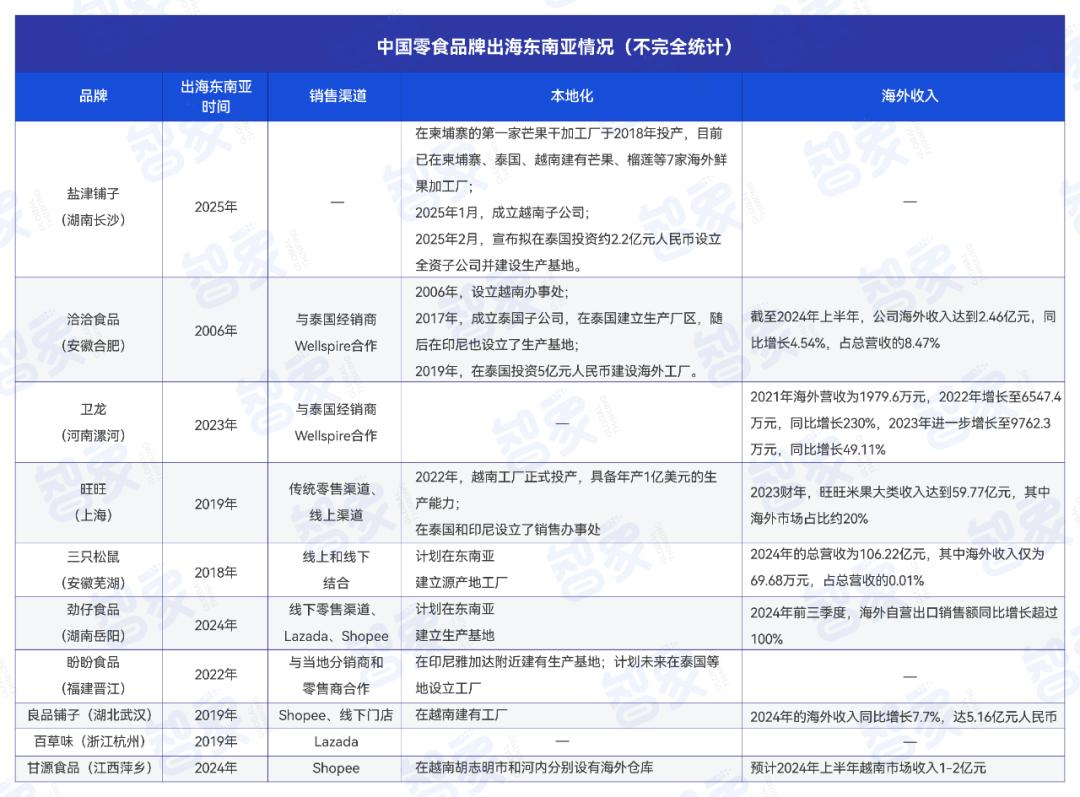
Core Viewpoint - The article discusses the increasing trend of Chinese snack brands expanding into Southeast Asia, highlighting the significant growth potential in this market and the strategies employed by various companies to establish their presence [4][8][12]. Group 1: Market Growth and Opportunities - Wangwang's overseas business saw a double-digit growth in fiscal year 2023, with revenue from the rice snack category reaching 5.977 billion yuan, and overseas markets accounting for about 20% of total revenue [4]. - The Southeast Asian snack market is projected to reach $13.1 billion by 2029, with a compound annual growth rate (CAGR) of 10.60% [6]. - Companies like Qiaqia Foods and Jinzhai Foods have successfully established operations in Southeast Asia, with Qiaqia's Thailand subsidiary contributing 400 million yuan in revenue in 2023 [5][6]. Group 2: Market Entry Strategies - Chinese snack brands are increasingly adopting proactive strategies for overseas expansion, particularly in Southeast Asia, where cultural similarities and large Chinese populations present favorable conditions [12][14]. - Different entry strategies are employed based on the characteristics of each Southeast Asian market, with brands targeting either mature markets like Thailand and Singapore or emerging markets like Vietnam and Indonesia [15][23]. - The article emphasizes the importance of localizing products and marketing strategies to cater to the unique preferences of Southeast Asian consumers [45][46]. Group 3: Distribution Channels - The choice of distribution channels is critical for success in Southeast Asia, with brands like Xu Fu Ji and Aice leveraging innovative channel strategies to penetrate local markets [19][22]. - Traditional retail channels, such as community stores, play a significant role in Indonesia, where a large portion of snack consumption occurs outside modern retail environments [26][27]. - The article highlights the need for brands to adapt their channel strategies to the specific retail landscape of each country, such as focusing on convenience stores in Thailand and schools in Indonesia [24][30]. Group 4: Compliance and Localization - Compliance with local regulations is a major hurdle for Chinese snack brands entering Southeast Asian markets, with specific requirements for product certification and labeling [44]. - Localization of products is essential, with brands like Xu Fu Ji and Panpan introducing flavors and products tailored to local tastes, such as durian-flavored candies [45][46]. - Establishing local supply chains is also crucial for reducing costs and improving efficiency, as seen with brands like Salted Fish and Qiaqia, which have set up production facilities in Southeast Asia [46][47]. Group 5: Competitive Landscape - The competitive landscape in Southeast Asia is characterized by the dominance of established Japanese snack brands, which have historically occupied the market [17]. - New entrants face challenges in differentiating their products and gaining market share, particularly in a market where local preferences may not align with traditional Chinese snack offerings [17][49]. - The article suggests that successful brands will be those that can effectively navigate the complexities of local consumer behavior and preferences while maintaining a strong brand identity [49].


新单品成长助零食企业去年增收,多家公司计划大笔分红
Cai Jing Wang· 2025-04-30 08:33
Core Insights - The snack industry has seen significant revenue growth, driven by new product launches and channel restructuring, including social e-commerce and discount stores [1][2] - Despite revenue growth, snack companies are facing challenges in maintaining profitability, with fluctuating sales expenses and gross margins [1][8] Revenue Growth Drivers - Major snack companies reported substantial revenue figures for 2024, with Three Squirrels leading at 10.622 billion, followed by other companies like Liangpinpuzi and Qiaqia Foods [2] - New product development has been highlighted as a key contributor to revenue, with Three Squirrels launching over 20 new products that achieved significant sales [3][4] Channel Expansion - The restructuring of sales channels has provided new opportunities for snack companies, with a focus on e-commerce and discount stores [5][6] - Three Squirrels reported an 81.73% increase in revenue from Douyin, indicating the effectiveness of digital marketing strategies [4] International Market Growth - Companies are increasingly targeting international markets, particularly Southeast Asia, to expand their growth potential [6][7] - Qiaqia Foods and other companies have reported significant growth in overseas sales, with Qiaqia's overseas revenue increasing by approximately 90% [6] Profitability Challenges - Many snack companies have experienced rising sales expenses, with increases ranging from 15.55% to 50.92%, primarily due to higher advertising costs [8][9] - Gross margins have shown volatility, with some companies reporting declines due to rising raw material costs and competitive pricing strategies [10] Dividend Distribution - Several companies have announced substantial cash dividends, reflecting confidence in their operational performance and future growth [11][12] - The total cash dividends and share buybacks for some companies represent a significant portion of their net profits, indicating a strong commitment to returning value to shareholders [11]



大消费组“消费的方向”四月观点:内需平稳复苏,新消费急先锋-20250430
CMS· 2025-04-30 06:03
证券研究报告 | 行业简评报告 2025 年 04 月 30 日 内需平稳复苏,新消费急先锋 大消费组"消费的方向"四月观点 研究部/消费品 食饮 陈书慧:白酒龙头平稳开局,食品小额消费看点不断 轻纺 王梓旭:关注拓品类&渠道运营力强的品牌龙头 农业 李秋燕:增配优质低估值猪企,重视粮食安全 风险提示:消费下行风险,消费复苏疲软风险、宏观经济变动风险等 推荐(维持) 行业规模 | | | 占比% | | --- | --- | --- | | 股票家数(只) | 1216 | 23.8 | | 总市值(十亿元) | 16360.1 | 19.6 | | 流通市值(十亿 | 14931.7 | 19.6 | 轻纺 王月:个护大单品红利期 Q1 业绩表现突出,金属包装 Q2 或盈利拐点 向上 家电 史晋星:一季报收官总结,抄底关税错杀+布局新消费 零售 丁浙川:万辰集团 Q1 净利率大超预期,关注鸣鸣很忙上市表现 医药 许菲菲:关税环境下关注创新药及产业链、内需复苏 商社 李秀敏:聚焦内需韧性&文旅复苏,节前关注出行链投资机会 行业简评报告 食饮-陈书慧:白酒龙头平稳开局,食品小额消费看 点不断 行业指数 % 1 ...
泰国小学生迷上河南辣条,中国零食卷去东南亚
3 6 Ke· 2025-04-30 02:40
Group 1 - Wangwang invested RMB 138 million in a business jet to facilitate management's domestic and international travel, with a focus on expanding overseas operations [1] - In the fiscal year 2023, Wangwang's overseas business grew by double digits, with snack revenue reaching RMB 5.977 billion, accounting for approximately 20% of total revenue [1] - Southeast Asia has become a primary target for Chinese snack brands due to its large population and cultural similarities, with many brands already establishing a presence in the region [2][5] Group 2 - Companies like Qiaqia, Jinzhai, and Panpan have successfully penetrated the Southeast Asian market, with Qiaqia's Thailand subsidiary contributing RMB 400 million in revenue and nearly RMB 90 million in net profit in 2023 [2] - The Southeast Asian snack market is projected to reach USD 13.1 billion by 2029, with a compound annual growth rate of 10.60% [3] Group 3 - Salted snacks and other unique Chinese products are gaining traction in Southeast Asia, with brands like Yanjin and Qiaqia focusing on local market education to introduce their products [11][12] - The entry strategies of Chinese snack brands vary by country, with some targeting mature markets like Thailand and Singapore, while others focus on emerging markets like Vietnam and Indonesia [11] Group 4 - The retail landscape in Southeast Asia is diverse, with traditional community stores still dominating in Indonesia, where 80% of consumption occurs outside modern retail channels [17] - Successful market entry often relies on innovative channel strategies, as demonstrated by the ice cream brand Aice, which focused on community stores rather than traditional retail [14] Group 5 - Compliance with local regulations is crucial for market entry, with specific requirements for product certification and labeling in countries like Thailand and Indonesia [27] - Localization of products and supply chains is essential for success, with brands adapting flavors and ingredients to meet local preferences [28][31]


食品饮料周报:政治局会议定调积极,看好饮料旺季催化-20250429
Tianfeng Securities· 2025-04-29 08:46
Investment Rating - The industry rating is "Outperform" (maintained rating) [5] Core Viewpoints - The report highlights a positive outlook for the beverage sector, driven by the upcoming peak season and supportive macroeconomic policies from the central government [2][12] - The report emphasizes the potential for valuation recovery in the liquor sector, particularly in light of the recent political bureau meeting that indicated a more proactive fiscal and monetary policy [2][12] Summary by Sections Market Performance Review - For the week of April 21 to April 25, the food and beverage sector declined by 1.36%, while the Shanghai Composite Index rose by 0.38%. Notable performances included snacks (+4.50%) and soft drinks (+2.21%), while categories like beer (-0.72%) and health products (-1.28%) saw declines [1][19] Weekly Perspective Updates - **Liquor Sector**: The liquor sector saw a decline of 1.75%, attributed to the off-peak consumption period and inventory adjustments. However, the upcoming May Day holiday is expected to boost demand for banquet scenarios, aiding in inventory reduction [2][12] - **Beer and Beverage Sector**: The beer sector decreased by 0.72%, but companies like Zhujiang Brewery saw a 5.7% increase in stock price due to better-than-expected Q1 performance. The report anticipates improved demand as the weather warms and consumption policies are implemented [3][13] - **Consumer Goods Sector**: The report identifies opportunities in the snack sector, with a focus on companies that have shown resilience and potential for growth. The upcoming sales season for soft drinks is also highlighted as a catalyst for growth [3][14] Investment Recommendations - **Liquor Sector**: Recommended stocks include strong alpha leaders like Moutai and Shanxi Fenjiu, as well as cyclical stocks like Luzhou Laojiao and Jiugui Liquor [4][18] - **Consumer Goods**: The report recommends focusing on snacks and dairy products, with specific mentions of companies like Ganyuan Foods and Yuyuan Foods, which are expected to benefit from low base effects in Q2 [4][18] Sector and Individual Stock Performance - The report provides detailed performance metrics for various sectors, indicating that the snack and soft drink sectors are currently outperforming others, while the liquor sector is under pressure [19][22]