荣盛石化

Search documents
信达证券:PPI企稳复苏背景下石化产品价格趋势及投资机会
智通财经网· 2025-11-14 07:29
Core Viewpoint - The report from Cinda Securities indicates that the price changes of petrochemical products are strongly correlated with the Producer Price Index (PPI), and recent policy efforts aimed at optimizing supply and expanding demand are expected to support a recovery in petrochemical prices, thereby stabilizing and potentially increasing the PPI [1] Group 1: Supply-Side Analysis - The optimization of the petrochemical downstream capacity structure is expected to initiate a new price cycle, with 2025 being a critical year for the refining industry, as the National Development and Reform Commission (NDRC) has set a cap on domestic crude oil processing capacity at 1 billion tons [1] - In 2024, domestic refining capacity is projected to be 923 million tons, with an expected addition of 58 million tons from 2025 to 2030, indicating that refining capacity expansion is nearing its limits [1] - The NDRC has emphasized the need to accelerate the elimination of inefficient and outdated refining capacities, which, combined with recent central government signals to reduce "involution," may lead to a quicker exit of outdated refining capacities [1] Group 2: Demand-Side Analysis - The overall demand for petrochemical products is gradually recovering, with structural highlights indicating that while the demand for major chemical products like polyolefins is weak, the demand for aromatics is expected to maintain high growth due to downstream capacity expansions [2] - High-end petrochemical materials are developing rapidly, aligning with national requirements for fine chemical innovation and the needs of emerging industries, with products like high-end polyolefins, engineering plastics, and lithium battery separators expected to see sustained high demand growth [2] Group 3: Market Performance and Investment Opportunities - Although the PPI has not yet turned positive, petrochemical downstream stock prices have shown signs of stabilization and recovery, indicating a favorable investment opportunity [3] - The government’s push for "de-involution" in key industries, including petrochemicals, and the recent "Stability Growth Work Plan for the Petrochemical Industry (2025-2026)" suggest a focus on eliminating outdated capacities and optimizing supply structures [3] - The expected gradual recovery in petrochemical product demand, coupled with improved profitability in the sector, supports the performance of petrochemical stocks, with companies like Rongsheng Petrochemical and Hengli Petrochemical showing significant quarter-on-quarter profit improvements [3] Group 4: Investment Recommendations - The report recommends focusing on state-owned chemical leaders such as Sinopec (600028.SH) and PetroChina (601857.SH), as well as private large refining enterprises like Hengli Petrochemical (600346.SH) and Rongsheng Petrochemical (002493.SZ) that have scale advantages and rich product layouts [4] - Additionally, companies like Tongkun Co., Ltd. (601233.SH) and Xin Fengming (603225.SH), which are enhancing their industrial chain synergy, are also highlighted as key investment opportunities [4] - The report suggests paying attention to Dongfang Shenghong (000301.SZ) as a potential investment target [4]





印度取消BIS认证叠加“反内卷”,PTA行业有望迎来向上拐点
Guotou Securities· 2025-11-14 07:01
Investment Rating - The industry investment rating is "Outperform the Market - A" [6] Core Viewpoints - The PTA industry is expected to reach an upward turning point due to the cancellation of BIS certification in India and ongoing "anti-involution" measures [1][3] - The expansion of PTA capacity is nearing its end, with a significant slowdown in new capacity additions anticipated in the coming years [2] - The cancellation of BIS certification by India is expected to boost PTA demand, potentially restoring export levels to those seen in the first half of 2023 [3] - The supply-demand dynamics for PTA are improving, with price elasticity indicating significant potential for price rebounds [4] Summary by Sections Industry Overview - The PTA industry has been experiencing prolonged low profitability, prompting strong calls for improvement from enterprises [1] - The industry structure is highly concentrated, with the top six companies holding a 77% market share, providing a solid foundation for self-discipline [1] Capacity Expansion - In 2025, three new PTA production facilities were launched, totaling 1.9 million tons, with no further expansions planned for the year [2] - Future PTA capacity growth is projected to slow significantly, with a compound annual growth rate (CAGR) of only 2.8% over the next three years, compared to 12.5% from 2019 to 2025 [2] Demand Drivers - The Indian government's removal of BIS certification requirements is expected to significantly increase PTA demand, with potential recovery in exports to India [3] - If exports return to previous levels, the demand increase could amount to approximately 125.4 million tons, representing about 2% of China's total PTA demand in 2024 [3] Price Outlook - The PTA supply-demand situation is improving, and prices are expected to rebound, with current prices at 4,550 yuan/ton, which is 71% lower than the peak price of 7,770 yuan/ton [4]
行业专题报告:PPI企稳复苏背景下石化产品价格趋势及投资机会
Xinda Securities· 2025-11-14 05:53
Investment Rating - The report maintains an investment rating of "Positive" for the petrochemical industry, consistent with the previous rating [2]. Core Insights - The petrochemical products are expected to benefit from a stabilization and recovery in the Producer Price Index (PPI), driven by strong correlations between petrochemical prices and PPI trends [3][20]. - The optimization of downstream capacity in the petrochemical sector is anticipated to initiate a new price cycle, with limited supply growth and ongoing policy efforts to eliminate inefficient production capacity [3][22]. - Demand for petrochemical products is gradually recovering, with structural highlights indicating that while some segments like polyolefins may see weak recovery, others such as aromatics and high-end petrochemical materials are expected to maintain strong growth [3][26]. - Stock prices in the petrochemical sector have begun to stabilize and rise ahead of the PPI index, indicating a favorable investment opportunity [3][20]. Summary by Sections 1. Petrochemical Price Recovery Supporting PPI Stabilization - Petrochemical products have a high weight in the PPI, with significant volatility impacting overall PPI trends [11][13]. - The correlation between petrochemical prices and PPI is strong, with key policies aimed at optimizing supply and expanding demand expected to support price recovery [20]. 2. Optimization of Downstream Capacity Expected to Drive New Price Cycle - The expansion cycle in refining is nearing its end, with a projected addition of 58 million tons of refining capacity from 2025 to 2030, approaching regulatory limits [22][23]. - Policies are actively promoting the exit of inefficient refining capacities, reshaping the competitive landscape [28][29]. 3. Gradual Recovery in Petrochemical Demand with Structural Highlights - Overall demand for petrochemical products is slowly recovering, with significant growth expected in high-end materials aligned with national innovation goals [3][26]. - The demand recovery shows structural differences, with some segments like aromatics benefiting from downstream capacity expansions [3][26]. 4. Investment Opportunities and Strategies - The report recommends key state-owned enterprises such as Sinopec and PetroChina, as well as private refining companies like Hengli Petrochemical and Rongsheng Petrochemical, which have strong competitive advantages [3][4].

2026宏观形势展望
2025-11-14 03:48
Summary of Key Points from Conference Call Records Industry Overview - The macroeconomic outlook for 2026 indicates a significant divergence in the A-share market compared to the commodity market, suggesting an early improvement in commodities and cyclical products, with signs of recovery in high-end consumption sectors like liquor and luxury goods, as well as in livestock industries such as egg-laying hens and pigs [1][4] - Domestic industrial profits are generally low, with some falling below 2015 levels, prompting companies to potentially reduce production capacity to achieve self-repair [5] - AI has emerged as a crucial economic pillar, similar to past real estate and infrastructure investments, with China leveraging its computing power exports to compete in the energy market [1][6][8] Core Insights and Arguments - The cyclical style in A-shares is expected to outperform the commodity market, indicating that investor expectations for future improvements will first manifest in commodities and cyclical products [4] - The short-term market signals suggest a value rebalancing throughout Q4, with large-cap stocks performing better in the first half and small-cap stocks in the latter half, particularly in sectors like chemicals, coal, machinery, and non-ferrous metals [2] - The AI technology is expected to lower corporate costs and increase profit margins for leading companies, while also exacerbating wealth inequality, necessitating a redesign of the social security system [12] Geopolitical and Economic Relations - The long-term deterioration of Sino-U.S. relations is anticipated, but the short-term costs of decoupling are high, as the U.S. relies on China's cheap labor and deflationary effects [9] - China should continue to reduce its U.S. Treasury holdings to below $300 billion to mitigate risks associated with geopolitical conflicts [9] Market Signals and Opportunities - Key short-term signals include the end of market fluctuations and the beginning of an upward trend, with the Shanghai Composite Index and ChiNext not yet entering a major upward wave [3] - The innovation drug sector has shown signs of bottoming out, and the global stock market is exhibiting structural trends, with A-shares focusing on large-cap defensive stocks and small-cap stocks trading on risk [3][15] Commodity Market Outlook - The outlook for the commodity market suggests that cyclical styles in A-shares are significantly stronger than in the commodity market, with expectations for price increases in coal due to production cuts and reduced imports [5][22] - The chemical industry is viewed positively due to a slowdown in global oil demand, which is expected to shift profits to the chemical sector [23] Gold and Precious Metals - There is a long-term bullish outlook for gold, driven by its monetary attributes and China's ongoing gold purchases while reducing U.S. debt holdings [24] - The current commodity market favors precious metals, while industrial products, particularly in the black series, are viewed less favorably [22] Challenges and Risks - The AI debt issue poses potential systemic risks, with companies like Oracle and COWAVE showing abnormal volatility [19] - The PCB industry is viewed cautiously due to high valuations and a lack of irreplaceability compared to leading tech firms [26] Future Trends - The future of technology competition will focus on AI, robotics, space technology, quantum computing, and manufacturing, with a strong emphasis on currency competition [11] - The development of solid-state batteries is seen as a crucial direction for the future, potentially altering pricing power in the automotive industry [21] Conclusion - The overall investment landscape is characterized by structural changes, with a focus on sectors that can adapt to the evolving macroeconomic and geopolitical environment, particularly in AI, chemicals, and gold, while being cautious of traditional manufacturing sectors and potential systemic risks associated with AI debt.
硫磺行业专家电话会
2025-11-14 03:48
Summary of the Sulfur Industry Conference Call Industry Overview - The sulfur market is currently experiencing tight supply conditions, with international prices remaining high due to factors such as maintenance at Central Asian refineries and the Russia-Ukraine conflict, leading to an expanded international supply gap. It is expected that prices will remain elevated in the short term, with a focus on the recovery of Russian supply impacting the market [1][2][11]. Key Points Supply and Demand Dynamics - In 2025, sulfur prices surged from approximately 1,500 RMB per ton at the beginning of the year to over 3,800 RMB, representing an increase of over 100% [2]. - Domestic apparent consumption is around 20 million tons annually, with half produced domestically and the other half imported. The main downstream demand comes from sulfuric acid production, phosphoric acid, and its derivatives, as well as titanium dioxide and caprolactam [2][12]. - The domestic sulfur production capacity is concentrated in Sinopec's Puguang gas field and Zhejiang Petrochemical, totaling approximately 16.8 million tons [1][4]. Inventory Levels - Current solid sulfur trade port inventory is about 2.23 million tons, with liquid inventory near 50,000 tons, leading to a total inventory of approximately 2.28 million tons [6]. Production Capacity and New Projects - The total production capacity for sulfuric acid from smelting flue gas is projected to be 60.09 million tons in 2025, with additional projects planned for the coming years [9][10]. - New domestic projects include a 400,000 tons/year sulfuric acid facility by Shandong Daon in March 2026 and several others with varying capacities scheduled for 2026 [10]. Impact of High Sulfur Prices - The high sulfur prices are exerting significant cost pressure on phosphate fertilizer producers, with many operating at a loss. The inability to pass on costs to end consumers due to the essential nature of fertilizers complicates the situation [12]. - Some companies may consider switching to direct procurement of smelting acid instead of producing acid from sulfur, depending on economic viability and environmental costs [14]. Regional Supply Sources - China primarily imports sulfur from the Middle East, Central Asia, and North America, with notable demand growth in Indonesia due to its metal smelting needs related to new energy and materials [3][16]. - Russian refineries are currently operating at about 60% capacity due to the ongoing conflict, with potential for supply recovery if geopolitical tensions ease [17]. Future Market Outlook - The sulfur market is expected to remain tight in 2026, with prices likely to stay high due to ongoing supply constraints and unpredictable geopolitical factors [11][12]. Other Considerations - The impact of the "anti-involution" policy on refinery operation rates is minimal, with the primary factor affecting operations being the decline in gasoline and diesel consumption due to the rise of electric vehicles [19]. - The cost of producing sulfur as a byproduct is not separately accounted for by refineries, but rough estimates suggest liquid sulfur costs around 30 RMB per ton and solid sulfur costs between 120-150 RMB per ton [18].
行业自律,化工“反内卷”的新范式
Guotou Securities· 2025-11-14 03:02
Investment Rating - The report maintains an investment rating of "Outperform the Market - A" for the chemical industry [4] Core Viewpoints - The "anti-involution" policies introduced in 2024 are expected to gradually show effects by curbing low-price competition and eliminating outdated production capacity, which may lead to a rebound in industrial product prices, positively impacting PPI and CPI [1][12] - The chemical industry is a key area influencing PPI, with its price fluctuations significantly affecting industrial inflation levels, making it a focal point for boosting inflation [2][17] - The profitability of chemical companies has been under pressure, with a notable decline in net profits in 2023, which strengthens the urgency for "anti-involution" measures [2][17] - The current supply-demand dynamics in the chemical industry are improving, with supply expansion nearing its end and demand gradually stabilizing, creating upward elasticity potential for the industry [2][20] Summary by Sections 1. The Effectiveness of "Anti-Involution" Policies - The "anti-involution" policies have been frequently introduced since 2024, aiming to create a systematic environment to combat disorderly competition [12] - As of October 2025, CPI has increased by 0.2% year-on-year, indicating a shift from negative to positive, while PPI has decreased by 2.1%, with the decline narrowing for three consecutive months [1][15] 2. Importance of "Anti-Involution" in the Chemical Sector - The energy chemical sector accounts for approximately 25%-30% of PPI statistics, making its price changes crucial for industrial inflation [2][17] - Chemical companies are experiencing significant profit declines, with net profits down by 45.3% year-on-year in 2023, indicating a strong motivation for "anti-involution" [2][17] 3. Case Study of Polyester Filament - Polyester filament has been a pioneer in implementing industry self-discipline, with the first round of collaboration in 2024 leading to a price increase and improved profit margins [3][28] - The second round in 2025 adopted a more flexible pricing strategy, which has resulted in a more stable industry operation compared to the previous round [3][30] 4. Potential for Replicating Self-Discipline Models - Other sectors such as polyester bottle chips, PTA, and organic silicon are also exploring self-discipline to improve profitability, sharing common characteristics like high concentration and low profitability [9][35] - The report suggests monitoring specific companies within these sectors that are likely to benefit from the self-discipline model [9][35]
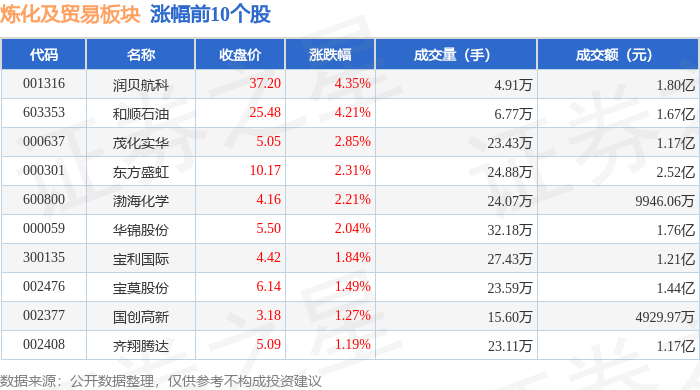
炼化及贸易板块11月13日跌0.12%,大庆华科领跌,主力资金净流出4.1亿元
Zheng Xing Xing Ye Ri Bao· 2025-11-13 08:51
Market Overview - The refining and trading sector experienced a slight decline of 0.12% on November 13, with Daqing Huake leading the drop [1] - The Shanghai Composite Index closed at 4029.5, up 0.73%, while the Shenzhen Component Index closed at 13476.52, up 1.78% [1] Stock Performance - Notable gainers in the refining and trading sector included: - Runbei Hangke (Code: 001316) with a closing price of 37.20, up 4.35% [1] - Heshun Petroleum (Code: 603353) with a closing price of 25.48, up 4.21% [1] - Maohua Shihua (Code: 000637) with a closing price of 5.05, up 2.85% [1] - Conversely, Daqing Huake (Code: 000985) saw a decline of 2.14%, closing at 20.55 [2] Trading Volume and Capital Flow - The refining and trading sector saw a net outflow of 410 million yuan from main funds, while retail investors contributed a net inflow of 331 million yuan [2] - The trading volume for Daqing Huake was significant, with 140,500 shares traded, resulting in a transaction value of 284 million yuan [2] Capital Inflow Analysis - Key stocks with notable capital inflow included: - Tongkun Co. (Code: 601233) with a main fund net inflow of 29.56 million yuan [3] - Baomo Co. (Code: 002476) with a main fund net inflow of 16.71 million yuan [3] - Retail investors showed a mixed response, with some stocks like Guochuang Gaoxin (Code: 002377) experiencing a net inflow of 666.52 million yuan [3]


每日报告精选-20251113
GUOTAI HAITONG SECURITIES· 2025-11-13 07:33
Group 1: Macro Insights - The monetary policy continues to emphasize "implementing a moderately loose monetary policy" and "maintaining reasonable growth in financial aggregates" [6] - The report highlights a shift towards combining "counter-cyclical and cross-cyclical adjustments" in monetary policy, indicating a more forward-looking approach [6][7] - There is a reduced urgency for short-term monetary easing, focusing instead on implementing previous policies and preparing for cross-cyclical adjustments [7] Group 2: Technology and Manufacturing - The technology manufacturing sector remains buoyant, driven by global AI infrastructure investments, leading to increased demand in the semiconductor and energy sectors [9][12] - The real estate sector is experiencing a downturn, with a significant drop in property sales, particularly in first, second, and third-tier cities [10] - The lithium battery industry is seeing a substantial increase in demand, with prices for lithium hexafluorophosphate rising significantly [12] Group 3: Energy Storage - The introduction of a capacity pricing mechanism is expected to enhance the economic viability of energy storage across more provinces, driving significant growth in the sector [15][16] - Inner Mongolia's compensation for energy storage discharge is set at 0.28 yuan/kWh for 2026, which is expected to stimulate demand [17] - The bidding volume for energy storage in October 2025 showed a year-on-year increase of 24% and 29% for new installations, indicating strong market demand [18] Group 4: Cement Industry - Zambia and Malawi are experiencing a significant cement supply gap, with Malawi's demand far exceeding its production capacity [26][27] - Huaxin Cement is the leading cement producer in Zambia, holding a substantial market share, and is expected to alleviate some supply shortages in Malawi [27] - Cement prices in Malawi are high, reaching $200 per ton, while Zambia's prices remain stable, contributing to strong profitability in the region [28] Group 5: Oil Industry - OPEC's decision to halt production increases is expected to support oil prices, with a projected increase in production of 137,000 barrels per day in December [31] - The oil market is anticipated to remain balanced in 2026, with demand growth primarily coming from OECD countries [32] - Investment recommendations include companies with strong cash flows and dividends, such as China National Offshore Oil Corporation and PetroChina [32] Group 6: Tourism Industry - The hotel industry is expected to benefit from a narrowing decline in operating data and positive changes in company structures, leading to improved valuations [34] - The RevPAR (Revenue per Available Room) for leading hotel groups has shown a significant recovery, indicating a positive trend in the hospitality sector [35] - The supply structure in the hotel industry is diversifying, with smaller properties growing faster than larger ones, reflecting a shift in market dynamics [35] Group 7: Food and Beverage - The recent CPI data indicates a warming market sentiment, with expectations for white liquor to benefit from a style switch as the year ends [37] - The white liquor industry is experiencing a downturn, with Q3 revenues down 18% year-on-year, but a recovery is anticipated in the coming quarters [39] - The valuation of white liquor stocks is currently low, with a high dividend yield, making them attractive for investors [39] Group 8: Medical Devices - The medical device sector is poised for recovery, driven by government policies promoting equipment updates, with significant growth in tendering for new devices [46][48] - Major medical device companies are expected to benefit from the increasing demand for imaging and innovative treatment equipment [48] - The domestic market for medical devices is showing signs of improvement, with a notable increase in revenue for leading companies [48]
国泰海通:OPEC停止增产提振原油 行业盈利修复预期增加
Zhi Tong Cai Jing· 2025-11-13 05:52
Group 1: Oil Market Insights - OPEC has decided to halt its production increase plans for Q1 2026, which is interpreted as a neutral to bullish signal for oil prices [1] - OPEC's production increase in December is set at 137,000 barrels per day, but the overall increase since April has not met expectations, with remaining capacity significantly reduced to 3 million barrels per day [1] - The market is expected to remain in a loose supply-demand balance in 2026, with demand growth primarily coming from OECD countries, while non-OPEC+ countries are projected to increase production by 2 million barrels per day in 2025 and 700,000 barrels per day in 2026 [1] Group 2: Investment Recommendations - The company recommends maintaining focus on anti-involution and new materials sectors, with expectations of profit recovery in the petrochemical industry due to stable oil prices and policy catalysts [2] - Specific stock recommendations include leading polyester filament companies such as Xinfengming (603225.SH), Tongkun (601233.SH), and Rongsheng Petrochemical (002493.SZ) [2] - Long-term recommendations include undervalued, high-dividend companies like CNOOC (600938.SH) and PetroChina (601857.SH), as well as companies benefiting from trends in robotics and green plastics, such as Juheshun (605166.SH) and Wankai New Materials (301216.SZ) [2]

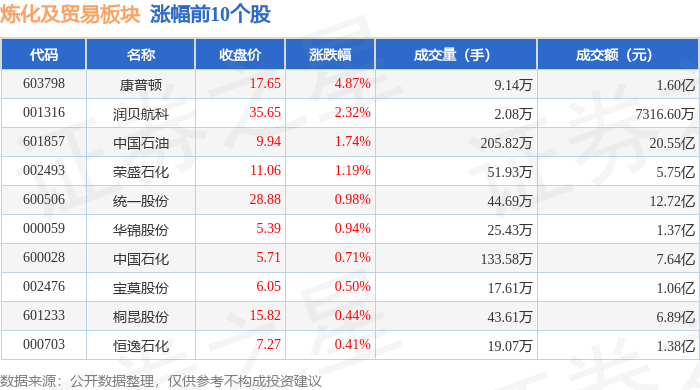
炼化及贸易板块11月12日涨1.12%,康普顿领涨,主力资金净流出1.89亿元
Zheng Xing Xing Ye Ri Bao· 2025-11-12 08:51
Core Insights - The refining and trading sector saw an increase of 1.12% on November 12, with 康普顿 leading the gains [1] - The Shanghai Composite Index closed at 4000.14, down 0.07%, while the Shenzhen Component Index closed at 13240.62, down 0.36% [1] Sector Performance - 康普顿 (603798) closed at 17.65, up 4.87% with a trading volume of 91,400 shares and a transaction value of 160 million yuan [1] - 润贝航科 (001316) closed at 35.65, up 2.32% with a trading volume of 20,800 shares and a transaction value of 73.17 million yuan [1] - 中国石油 (601857) closed at 9.94, up 1.74% with a trading volume of 2,058,200 shares and a transaction value of 2.055 billion yuan [1] - 荣盛石化 (002493) closed at 11.06, up 1.19% with a trading volume of 519,300 shares and a transaction value of 575 million yuan [1] - 统一股份 (600506) closed at 28.88, up 0.98% with a trading volume of 446,900 shares and a transaction value of 1.272 billion yuan [1] - 中国石化 (600028) closed at 5.71, up 0.71% with a trading volume of 1,335,800 shares and a transaction value of 764 million yuan [1] Capital Flow - The refining and trading sector experienced a net outflow of 189 million yuan from institutional investors, while retail investors saw a net inflow of 10.3 million yuan [2] - The main stocks in the sector showed varied capital flows, with 荣盛石化 (002493) having a net inflow of 68.83 million yuan from institutional investors [3] - 中国石化 (600028) had a net inflow of 39.06 million yuan from institutional investors but a net outflow from retail investors of 24.41 million yuan [3]