
久立特材

Search documents
钢铁反内卷的动力和难点
Changjiang Securities· 2025-07-14 12:46
Investment Rating - The industry investment rating is Neutral, maintained [9] Core Viewpoints - The market's focus on the "anti-involution" policy is high, with steel being a key industry for this initiative due to its large scale, strong externalities, and current low profitability [2][5] - The "anti-involution" policy aims to address the supply-demand imbalance in the steel industry, which is crucial for long-term profitability stability [6][7] - The current environment shows a rapid rebound in steel prices and profitability, driven by the "anti-involution" policy and positive expectations in the real estate sector [4] Summary by Sections Market Dynamics - Steel consumption has decreased, with a year-on-year decline of 3.55% and a month-on-month decline of 1.54% [4] - Daily average rebar sales dropped to 99,300 tons, down by 750 tons per day from the previous week [4] - The average daily pig iron output fell to 2.3981 million tons, a decrease of 10,400 tons per day [4] Profitability and Pricing - The total inventory of steel has slightly decreased, with a week-on-week change of -0.02% [4] - Shanghai rebar prices increased to 3,240 CNY/ton, up by 60 CNY/ton, while hot-rolled prices rose to 3,310 CNY/ton, up by 40 CNY/ton [4] - The estimated profit per ton of rebar is 228 CNY, indicating a stable profit margin [4] Challenges in Implementation - The execution of the "anti-involution" policy is expected to be more challenging than the previous capacity reduction in 2016 due to limited demand-side stimulus [7] - The current capacity is mostly compliant, making it harder to eliminate excess capacity compared to the past [7] Investment Opportunities - The report suggests focusing on four main investment lines: 1. Companies with strong operational flexibility due to favorable supply-demand conditions [29] 2. Stocks with low price-to-book ratios that may see significant performance recovery [30] 3. Mergers and acquisitions under state-owned enterprise reforms [30] 4. High-quality processing and resource companies that are well-positioned in the market [30]
钢铁周报:“反内卷”信号将带动行业走出底部-20250713
ZHESHANG SECURITIES· 2025-07-13 09:56
Investment Rating - The industry investment rating is "Positive" [1] Core Viewpoints - The report suggests that signals of "anti-involution" will drive the industry out of its bottom phase [1] - The report highlights that the SW Steel Index has increased by 4.4% week-to-date and 10.2% year-to-date, indicating a positive trend in the steel sector [3] - The total social inventory of five major steel products is 9.13 million tons, showing a slight increase of 0.2% week-to-date but a significant increase of 20.4% year-to-date [5] - The report notes that the iron ore port inventory stands at 13,769 million tons, with a week-to-date increase of 0.8% and a year-to-date decrease of 7.3% [5] Price Data Summary - The report provides various price data for steel products, including: - Rebar (HRB400 20mm) at 3,240 CNY/ton, with a week-to-date increase of 1.9% and a year-to-date decrease of 5.0% [3] - Hot-rolled coil at 3,310 CNY/ton, with a week-to-date increase of 1.2% and a year-to-date decrease of 3.2% [3] - Cold-rolled steel at 3,640 CNY/ton, with a week-to-date increase of 0.3% and a year-to-date decrease of 11.4% [3] Supply and Demand - The weekly production of five major steel products is reported, with a notable increase in daily molten iron output [9] - The report indicates that the operating rate of blast furnaces across 247 companies is being monitored, reflecting the industry's production capacity utilization [12][14]
“反内卷”持续发酵,钢价偏强运行
Minsheng Securities· 2025-07-13 08:08
Investment Rating - The report maintains a "Buy" recommendation for the steel sector, highlighting strong price performance and potential recovery in profitability for steel companies [5][6]. Core Insights - The "anti-involution" policy continues to influence the market, leading to stronger expectations for supply-side constraints and supporting higher steel prices [5]. - As of July 11, 2025, steel prices have increased, with notable rises in various categories such as rebar and hot-rolled steel [3][11]. - The report indicates a decrease in steel production and inventory levels, suggesting a tightening supply situation [4][5]. Price Summary - As of July 11, 2025, the prices for key steel products are as follows: - Rebar (20mm HRB400): 3,240 CNY/ton, up 60 CNY/ton from last week - High-line (8.0mm): 3,410 CNY/ton, up 50 CNY/ton - Hot-rolled (3.0mm): 3,350 CNY/ton, up 60 CNY/ton - Cold-rolled (1.0mm): 3,680 CNY/ton, up 70 CNY/ton - Common medium plate (20mm): 3,330 CNY/ton, up 10 CNY/ton [3][11][12]. Production and Inventory - As of July 11, 2025, total steel production for the five major categories was 8.73 million tons, a decrease of 124,400 tons week-on-week [4]. - Total social inventory of the five major steel products decreased by 20,200 tons to 9.1278 million tons, while steel mill inventory increased by 17,700 tons to 4.2557 million tons [4]. Profitability Analysis - The report notes fluctuations in steel profitability, with rebar, hot-rolled, and cold-rolled steel margins changing by -14 CNY/ton, -13 CNY/ton, and +33 CNY/ton respectively week-on-week [3][4]. Investment Recommendations - The report recommends several companies based on their performance and market position: - For flat steel: Baosteel, Hualing Steel, Nanjing Steel - For special steel: Xianglou New Materials, CITIC Special Steel, Yongjin Co. - For pipe materials: Jiuli Special Materials, Youfa Group, Wujin Stainless Steel - Additionally, it suggests paying attention to high-temperature alloy companies like Fushun Special Steel [5].


“反内卷”政策持续发力,钢铁板块估值修复未止
Xinda Securities· 2025-07-12 13:18
Investment Rating - The investment rating for the steel industry is "Positive" [2] Core Viewpoints - The steel sector has shown a 3.90% increase this week, outperforming the broader market, with specific segments like special steel and plate steel also experiencing gains [2][10] - Despite a decrease in iron and steel production, the average daily molten iron output remains above last year's levels, indicating resilience in the market [3][25] - The report highlights the ongoing "anti-involution" policies aimed at stabilizing the market, which may lead to a gradual recovery in steel prices and profitability [3][41] - The demand for steel is expected to stabilize or slightly increase due to government policies supporting real estate and infrastructure investments [3][34] Summary by Sections 1. Market Performance - The steel sector's performance this week was 3.90%, with sub-segments like special steel up by 1.64% and plate steel up by 4.51% [2][10] - Iron ore prices increased by 7.16%, indicating strong demand for raw materials [12] 2. Supply Data - As of July 11, the capacity utilization rate for blast furnaces was 89.9%, down by 0.39 percentage points week-on-week [25] - The total production of five major steel products was 7.61 million tons, a decrease of 1.59% from the previous week [25][30] 3. Demand Data - The consumption of five major steel products was 8.73 million tons, reflecting a week-on-week decrease of 1.38% [34] - The transaction volume for construction steel was 99,000 tons, down 7.04% week-on-week [34] 4. Inventory Levels - Social inventory of five major steel products was 9.14 million tons, a slight decrease of 0.23% week-on-week, but down 29.02% year-on-year [41][39] - Factory inventory increased to 4.26 million tons, up 0.42% week-on-week [41][40] 5. Price and Profitability - The comprehensive index for ordinary steel increased to 3,428.5 CNY/ton, up 1.14% week-on-week [47] - The profit for rebar production was 196 CNY/ton, an increase of 4.81% week-on-week [56] - The average cost of molten iron was 2,173 CNY/ton, reflecting a week-on-week increase of 25 CNY/ton [56] 6. Company Valuations - The report includes a valuation table for key listed companies, indicating potential investment opportunities in firms like Baosteel and Hualing Steel, which are expected to see earnings growth [72]
趋势研判!2025年中国高性能材料行业产业链、发展规模、重点企业及发展趋势分析:产业规模持续快速增长,国产化趋势加速,应用场景广阔[图]
Chan Ye Xin Xi Wang· 2025-07-11 01:33
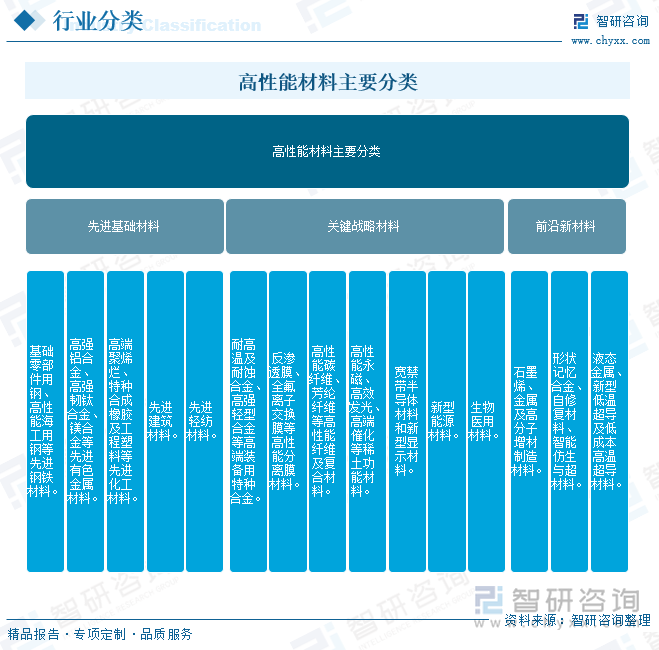
Core Viewpoint - The high-performance materials industry in China is experiencing rapid growth driven by policy support, market demand, and technological innovation, becoming a crucial pillar for economic stability. The industry is expected to reach a total output value of 8.48 trillion yuan in 2024, maintaining double-digit growth for 14 consecutive years, with a market size projected to be 8.78 trillion yuan [1][10]. Group 1: Industry Definition and Classification - High-performance materials are defined as newly emerged materials with superior properties or special functions, or traditional materials that have significantly improved performance or gained new functions. They are essential for extreme environments and high-end applications, primarily used in aerospace, energy, electronics, medical, and defense sectors. The main categories include advanced basic materials, key strategic materials, and frontier new materials [1][12]. Group 2: Development Environment and Policies - The Chinese government has implemented various policies to promote the research and development of high-performance materials, recognizing them as a foundational and strategic industry. Key policies include encouraging foreign investment in new materials and prioritizing the development of advanced materials such as graphene and biodegradable materials [5][6]. Group 3: Current Industry Status - The high-performance materials industry in China has evolved from a weak foundation to a robust sector, with expectations for future development to focus on intelligence and sustainability, integrating high technology with emerging industries [7][23]. Group 4: Industry Chain - The industry chain for high-performance materials includes upstream sectors such as steel, non-ferrous metals, rare earths, petrochemical products, and polymers; midstream focuses on R&D and production; and downstream applications span new information technology, renewable energy, automotive, home appliances, medical, environmental protection, aerospace, and rail transportation [12][14]. Group 5: Competitive Landscape - The market is characterized by competition among foreign enterprises, large state-owned enterprises, and private companies. Foreign firms dominate the high-end market, while domestic companies primarily serve the mid-range market. Notable companies include Wanhua Chemical, Ganfeng Lithium, Hengli Petrochemical, and North Rare Earth [16][18]. Group 6: Key Enterprises - Major players in the high-performance materials sector include: - Wanhua Chemical, which operates globally and focuses on various chemical and new material sectors [17][19]. - Ganfeng Lithium, which covers the entire lithium battery supply chain from resource extraction to battery manufacturing [18]. - Hengli Petrochemical, recognized for its extensive production capabilities in petrochemicals and new materials [21]. - North Rare Earth, which has established a significant production base for rare earth materials [18]. Group 7: Future Development Trends - The high-performance materials industry is transitioning from self-sufficiency in low-end products to independent R&D of mid-to-high-end products, with increasing domestic competitiveness. The rapid development of emerging industries like renewable energy and smart manufacturing is driving innovation in high-performance materials, leading to new application scenarios and a promising market outlook [23][25].




反内卷不止是光伏,稀缺场内品种·钢铁LOF(502023)盘中涨1.41%!
Xin Lang Cai Jing· 2025-07-08 07:36
Group 1 - The steel sector experienced a rebound, with Liugang Co. hitting the daily limit and achieving five consecutive trading limits in six days, while other stocks like Taigang Stainless and Hualing Steel also rose [1] - The Central Financial Committee's sixth meeting emphasized the need to advance the construction of a unified national market and to govern low-price disorderly competition, which could lead to an orderly exit of backward production capacity, benefiting industry profit recovery [1] - The comprehensive gross profit of the steel industry is expected to increase by 52.45% year-on-year to 281 yuan/ton in the first half of 2025, driven by the implementation of capacity exit policies [1] Group 2 - Longjiang Securities believes that the end of 2025 will be a critical node for the implementation of capacity reduction policies, with small and medium-sized private enterprises facing significant challenges to meet standards [1] - The "anti-involution" trend aims to clear out not only backward production capacity but also manufacturing and platforms with significant private enterprise participation, which are crucial for local employment and tax revenue [1] - The capital market exhibits a strong learning effect, with stock price reactions becoming increasingly anticipatory based on past supply-side reform experiences, suggesting that investors should seize policy opportunities early [2]
超超临界发电概念涨2.20%,主力资金净流入41股
Zheng Quan Shi Bao Wang· 2025-07-07 09:57
Core Viewpoint - The supercritical power generation concept has seen a 2.20% increase, ranking 7th among concept sectors, with significant gains from several stocks within the sector [1][2]. Group 1: Stock Performance - 72 stocks within the supercritical power generation sector experienced gains, with Huayin Power, YN Energy, and Huadian Liaoning reaching the daily limit up [1]. - Notable stock performances include: - Guangdong Power A: +8.05% - Gan Energy: +7.45% - Jiantou Energy: +6.59% [1][5]. - The stocks with the largest declines include: - Shengde Xintai: -3.28% - ST Huaxi: -1.82% - Jiuli Special Materials: -1.59% [1][7]. Group 2: Capital Flow - The supercritical power generation sector attracted a net inflow of 544 million yuan, with 41 stocks receiving net inflows [2][3]. - The top stocks by net inflow include: - Rongfa Nuclear Power: 433.42 million yuan - Huadian International: 84.74 million yuan - Jingneng Power: 82.74 million yuan [2][3]. - The net inflow ratios for leading stocks are: - Inner Mongolia Huadian: 18.31% - Jingneng Power: 17.48% - Huadian Energy: 15.44% [3].




钢铁行业反内卷的路径
Changjiang Securities· 2025-07-06 23:30
Investment Rating - The investment rating for the steel industry is Neutral, maintained [9] Core Insights - The report highlights a strong expectation for short-term production cuts as a "stopgap" measure against industry overcapacity, with a neutral assumption of a 30 million ton year-on-year reduction in crude steel production in 2025, potentially leading to a 229 CNY/ton increase in rebar prices and an 86 CNY/ton rise in profit per ton [2][7] - The report emphasizes the gradual advancement of medium-term capacity reduction, with the "2025 Steel Industry Normative Conditions" clarifying standards for "compliant capacity," indicating that about 20% of capacity, primarily from small private enterprises, may face exit pressure starting in 2026 [2][7] - Recent market sentiment has improved, with a slight increase in demand, as evidenced by a 0.68% week-on-week rise in average daily sales of construction steel to 106,800 tons [4][5] - The report notes a decrease in average daily pig iron production to 2.4085 million tons, reflecting a 1.44 million ton day-on-day drop, and a year-on-year decline of 4.09% in total steel production [4][5] Summary by Sections Section 1: Market Dynamics - The central financial committee's meeting has sparked optimism regarding supply-side optimization in the steel market, leading to a recovery in steel prices [4] - The report indicates that the total inventory of steel has decreased slightly, with a year-on-year decline of 30.61% for long products and 15.96% for sheet products [5] Section 2: Policy Implications - The report discusses the significance of the "anti-involution" policy, which aims to address overcapacity in the steel industry, suggesting that administrative measures could stabilize steel prices and improve profitability [6][30] - The report anticipates that the "anti-involution" policy could lead to a significant transformation in the industry, comparable to previous supply-side reforms [6][30] Section 3: Investment Opportunities - The report identifies four main investment lines: 1. Companies benefiting from cost reductions due to new capacities in iron ore and coke, such as Nanjing Steel and Baosteel [30] 2. Companies with low price-to-book ratios that may see significant performance and valuation recovery, such as New Steel and Fangda Special Steel [30] 3. Mergers and acquisitions under the state-owned enterprise reform initiative, which could enhance asset quality and valuation [31] 4. High-quality processing leaders and resource companies, particularly those in specialized fields or benefiting from macroeconomic recovery [31]
钢铁行业2025年度中期投资策略:枕戈待旦
Changjiang Securities· 2025-07-06 08:41
Core Insights - The report highlights the steel industry's two main contradictions: weak demand and strong costs, with the industry entering its fourth year of a downward cycle in 2025. The effective demand has significantly decreased, particularly in the real estate sector, leading to a 42.9% drop in demand for steel used in real estate from 377 million tons in 2020 to 215 million tons in 2024 [6][18][25]. - The report anticipates a marginal rebound in the steel sector due to weakening costs and resilient demand, driven by a decline in coking coal prices and an expected increase in iron ore supply [6][37][45]. Demand and Cost Analysis - Weak demand is characterized by insufficient effective demand, making it easier to maintain volume than prices. The real estate sector's demand for steel has plummeted, contributing to a significant overall decline in steel prices [6][18][25]. - Strong costs are attributed to tight supply of raw materials like iron ore and coking coal, which have severely squeezed steel profits. The profit share of steel in the industrial chain has dropped to 16%, significantly below the historical average of 28% [6][31][34]. Supply-Side Strategies - The report discusses the "anti-involution" policy aimed at addressing excess capacity in the steel industry, which is expected to stabilize steel prices and improve profitability for steel companies. A potential reduction of 30 million tons in crude steel production in 2025 could lead to a price increase of 229 yuan per ton for rebar [6][8][37]. - Long-term capacity reduction is expected to be gradual, with approximately 20% of capacity facing compliance challenges, particularly among small private enterprises, which may face pressure to exit the market starting in 2026 [6][8][37]. Investment Opportunities - The report suggests focusing on leading companies in high-end steel products, such as Nanjing Steel, Hualing Steel, and Baosteel, which are expected to maintain profitability and enhance shareholder returns through capital expenditure and asset optimization [6][8][37]. - It also highlights the potential for recovery in valuation and performance for companies with low price-to-book ratios, such as New Steel and Fangda Special Steel, as well as opportunities in state-owned enterprise reforms and mergers and acquisitions [6][8][37].


“反内卷”政策拉动钢价上涨,继续看好钢铁板块价值修复
Xinda Securities· 2025-07-06 07:12
Investment Rating - The report maintains a "Positive" investment rating for the steel industry, consistent with the previous rating [2]. Core Viewpoints - The "anti-involution" policy has driven an increase in steel prices, leading to a positive outlook for value recovery in the steel sector [3][4]. - The steel sector outperformed the broader market, with a weekly increase of 5.27%, compared to a 1.54% rise in the CSI 300 index [11]. - The report highlights that while the steel industry faces supply-demand imbalances, the implementation of "stability growth" policies is expected to support steel demand, particularly in real estate and infrastructure [4]. Summary by Sections Market Performance - The steel sector saw a weekly increase of 5.27%, outperforming the market, with specific segments like long products rising by 8.32% and flat products by 6.95% [3][11]. - The average daily pig iron production was 2.4085 million tons, showing a week-on-week decrease of 1.44 tons but a year-on-year increase of 1.41 tons [3][26]. Supply Data - As of July 4, the capacity utilization rate for blast furnaces was 90.3%, down 0.54 percentage points week-on-week, while electric furnace utilization was at 51.1%, down 3.45 percentage points [3][26]. - The total production of five major steel products reached 7.734 million tons, a week-on-week increase of 3.06 thousand tons [3][26]. Demand Data - The consumption of five major steel products increased to 8.853 million tons, a week-on-week rise of 5.41 thousand tons [3][35]. - The transaction volume of construction steel by mainstream traders was 107 thousand tons, up 0.81 thousand tons week-on-week, reflecting an increase of 8.23% [3][35]. Inventory Levels - Social inventory of five major steel products rose to 9.161 million tons, an increase of 9.62 thousand tons week-on-week, but down 29.01% year-on-year [3][42]. - Factory inventory decreased to 4.238 million tons, down 9.72 thousand tons week-on-week, and down 13.43% year-on-year [3][42]. Price Trends - The comprehensive index for ordinary steel increased to 3,390.0 CNY/ton, a week-on-week rise of 45.42 CNY/ton [3][49]. - The comprehensive index for special steel decreased to 6,576.5 CNY/ton, down 14.61 CNY/ton week-on-week [3][49]. Profitability - The profit per ton for rebar was 187 CNY, an increase of 42.0 CNY/ton week-on-week [3][58]. - The average iron water cost was 2,148 CNY/ton, with a week-on-week increase of 10.0 CNY/ton [3][58]. Investment Recommendations - The report suggests focusing on regional leaders with advanced equipment and environmental standards, as well as companies benefiting from the new energy cycle and high-margin special steel producers [4].
