海康威视

Search documents
首批15家领航级智能工厂出炉!长三角成智造标杆集聚高地
Guo Ji Jin Rong Bao· 2025-12-03 13:04
Core Insights - The Ministry of Industry and Information Technology, along with five other ministries, has announced the first batch of 15 leading smart factories for 2025, showcasing advancements in key industries such as equipment manufacturing, raw materials, electronic information, and consumer goods [1] - The Yangtze River Delta region, particularly Shanghai, Jiangsu, and Zhejiang, has excelled in this initiative, with Shanghai leading the nation in the number of selected factories [1][3] - The establishment of a tiered cultivation system for smart factories began in 2024, categorizing them into four levels: basic, advanced, excellent, and leading, with the leading level representing the pinnacle of smart manufacturing in China [1][4] Industry Developments - Leading smart factories are demonstrating significant innovation value, with Shanghai Aerospace Equipment Manufacturing Factory achieving a reduction in launch costs through an intelligent full-process chain model [2] - In the raw materials sector, Nanjing Steel has achieved a 98.5% on-time delivery rate for customized steel production using digital twin and AI technologies, while Baosteel has gained a competitive edge through data-driven manufacturing [2] - Hikvision in the electronic information sector has reduced production line changeover time by 50% through self-developed IoT, AI, and big data technologies, providing replicable solutions for the electronics manufacturing industry [2] Regional Performance - Shanghai has cultivated 2 national leading smart factories, 28 national excellent smart factories, and over 300 advanced smart factories, maintaining its position as the top city in China for smart manufacturing [3] - The city plans to focus on a three-pronged development strategy that includes tiered cultivation of smart factories, providing smart manufacturing system solutions, and building a standard framework for smart manufacturing [3] - Leading smart factories serve as demonstration models, promoting innovation and transformation across the supply chain, with modular solutions available for small and medium-sized enterprises to facilitate their own smart upgrades [3] Construction Achievements - As of now, China has established over 35,000 basic smart factories, more than 7,000 advanced smart factories, 230 excellent smart factories, and 15 leading smart factories [4] - Smart factory upgrades have led to an average reduction of 29% in product development cycles, a nearly 22% increase in production efficiency, and a 20% decrease in carbon emissions [4] - Leading smart factories are positioned as integrated platforms for technological innovation, standard output, and industry collaboration, aligning with the core demands of high-quality manufacturing development during the 14th Five-Year Plan [4]


2026计算机年度策略:算力聚沙成塔,应用乘风而起
Shenwan Hongyuan Securities· 2025-12-03 11:05
Core Insights - The report emphasizes that computational power is accumulating, leading to significant advancements in applications, particularly in AI, with a projected 10% impact point approaching in 2026 [3] - Institutional holdings in the computer sector are at a historical low of 2.4%, indicating potential for growth in valuations [3][21] - The report identifies three key focus areas for 2026: large models, computational power, and applications, all showing significant changes and accelerated iterations [3] Group 1: Market Overview - The computer index has shown a year-to-date increase of 18%, ranking 12th among all sectors, with AI computing, embodied intelligence, and AI applications as the main themes [9][10] - The report notes a basic performance turning point, with net profit rebounding and a stable overall performance expected for 2025 [10][13] Group 2: Valuation and Holdings - The report indicates that the computer sector's valuation is at a historical mid-to-high level, with PE (TTM) at 85.4, PS (TTM) at 3.6, and PCF (TTM) at 46.6 [18] - The report highlights that the computer sector's fund allocation is at a historical low, with a 2.4% allocation in Q3 2025 [21] Group 3: AI Model Developments - The report discusses the rapid narrowing of the performance gap between Chinese and American large models, with significant advancements in commercial applications expected [3][26] - It highlights the emergence of various large models in 2025, focusing on monetization, AI programming, and multi-modal capabilities [26][29] Group 4: Key Companies and Trends - The report identifies key companies in the computer sector, such as Zhongke Shuguang and Inspur Information, which have seen significant increases in their market values due to rising domestic computational capacity [23] - The report notes that the demand for AI applications is driving growth in various sectors, with companies like Alibaba and ByteDance leading in AI-related job creation [40]





NASA同款!哈工大团队最新球形机器人曝光!未来要上火星
机器人大讲堂· 2025-12-03 10:54
Group 1 - The article discusses the advancements in spherical robots designed for planetary exploration, highlighting their ability to navigate complex terrains such as sand dunes and craters, which traditional wheeled robots struggle with [1][4] - A spherical robot can roll quickly on flat surfaces and jump over obstacles, making it versatile for various exploration tasks [1][4] - The research team from Harbin Institute of Technology published a review in the journal "Robotics," detailing the design, movement principles, and key technologies of these spherical robots [1][4] Group 2 - Spherical robots have evolved from a simple round shell to various forms, including ellipsoidal and deformable structures, allowing them to adapt to different tasks and environments [4][6] - The classic spherical shape provides stability and energy efficiency, while other designs enhance sensor integration and movement capabilities [6][9] - Deformable spherical robots can switch between rolling and walking modes, improving their ability to traverse complex terrains [6][7] Group 3 - The article outlines various driving methods for spherical robots, including rolling, jumping, and flying, each with unique advantages for different environments [10][43] - Rolling is the most basic movement, with methods like wind-driven and friction-driven systems being explored for efficiency [10][16] - Jumping mechanisms are particularly useful in low-gravity environments, while flying capabilities are integrated for overcoming obstacles [43][50] Group 4 - Control and navigation are crucial for spherical robots, with advanced control methods like sliding mode control and neural networks being employed to enhance their autonomy [57][59] - The integration of sensors such as IMUs and cameras allows these robots to perceive their environment and navigate autonomously using SLAM technology [60][61] - Future applications for these robots include complex terrain navigation, sampling, and collaborative exploration, with a focus on improving autonomy and adaptability [61][62]

量化大势研判:继续增配低估值质量类资产
Guolian Minsheng Securities· 2025-12-03 07:16
Quantitative Models and Construction Methods 1. Model Name: Quantitative Market Trend Judgment Framework - **Model Construction Idea**: The model aims to address the systematic rotation of market styles by identifying the dominant asset characteristics that represent the future mainstream market style. It evaluates assets based on the priority of "g > ROE > D" to determine whether there are good assets and whether they are overvalued[5][8][12] - **Model Construction Process**: 1. Define five style stages based on the industry lifecycle: external growth, quality growth, quality dividend, value dividend, and bankruptcy value[8] 2. Use the "g > ROE > D" priority to compare assets, focusing on growth (g), profitability (ROE), and dividend yield (D)[5][8] 3. Incorporate factors such as expected growth (gf), actual growth (g), profitability (ROE), and valuation metrics (PB, DP, BP) to classify and evaluate assets[9][12] 4. Apply the framework to select industries and allocate them equally within each strategy[19] - **Model Evaluation**: The framework has demonstrated strong explanatory power for A-share market style rotation since 2009, achieving an annualized return of 27.06%[19] --- Model Backtesting Results Quantitative Market Trend Judgment Framework - **Annualized Return**: 27.06% since 2009[19] - **Excess Returns by Year**: - 2017: 27% - 2020: 44% - 2022: 62% - 2024: 52% - 2025 (YTD): 8%[22] --- Quantitative Factors and Construction Methods 1. Factor Name: Expected Growth (gf) - **Factor Construction Idea**: Measures the expected growth rate of industries based on analysts' forecasts, regardless of the lifecycle stage[9] - **Factor Construction Process**: 1. Calculate the expected growth rate (gf) for each industry 2. Rank industries based on the highest expected growth rates 3. Select top-performing industries for allocation[9][38] - **Factor Evaluation**: The factor has shown significant excess returns since 2019, with notable performance in 2014-2015 and 2025[38] 2. Factor Name: Actual Growth (g) - **Factor Construction Idea**: Focuses on industries with the highest earnings momentum (△g), particularly during transition and growth phases[9] - **Factor Construction Process**: 1. Use △g to represent earnings momentum 2. Rank industries based on △g and select the top-performing ones 3. Incorporate additional factors such as SUE, SUR, and JOR for refinement[40] - **Factor Evaluation**: The factor has consistently delivered significant excess returns, especially in growth-dominant environments[40] 3. Factor Name: Profitability (ROE) - **Factor Construction Idea**: Targets industries with high ROE and low valuation under the PB-ROE framework, focusing on mature stages[9] - **Factor Construction Process**: 1. Calculate PB-ROE residuals for each industry 2. Rank industries based on residuals and select the top-performing ones[43] - **Factor Evaluation**: The factor performed strongly from 2016 to 2020 but has weakened since 2021[43] 4. Factor Name: Quality Dividend (DP + ROE) - **Factor Construction Idea**: Combines dividend yield (DP) and ROE to identify industries with the highest scores, focusing on mature stages[9] - **Factor Construction Process**: 1. Calculate DP and ROE for each industry 2. Combine the two metrics into a composite score 3. Rank industries and select the top-performing ones[46] - **Factor Evaluation**: The factor has shown significant excess returns in 2016, 2017, and 2023[46] 5. Factor Name: Value Dividend (DP + BP) - **Factor Construction Idea**: Combines dividend yield (DP) and book-to-price ratio (BP) to identify undervalued industries, focusing on mature stages[9] - **Factor Construction Process**: 1. Calculate DP and BP for each industry 2. Combine the two metrics into a composite score 3. Rank industries and select the top-performing ones[49] - **Factor Evaluation**: The factor has delivered significant excess returns in 2009, 2017, and 2021-2023[49] 6. Factor Name: Bankruptcy Value (PB + SIZE) - **Factor Construction Idea**: Targets industries with the lowest PB and SIZE scores, focusing on stagnation and recession stages[9] - **Factor Construction Process**: 1. Calculate PB and SIZE for each industry 2. Combine the two metrics into a composite score 3. Rank industries and select the lowest-scoring ones[52] - **Factor Evaluation**: The factor has shown significant excess returns in 2015-2016 and 2021-2023[52] --- Factor Backtesting Results Expected Growth (gf) - **Recent Performance**: - Lithium: +51.15% (3 months) - Frozen Food: +14.08% (3 months)[38] Actual Growth (g) - **Recent Performance**: - Lithium Chemicals: +51.88% (3 months) - Other Home Appliances: +14.93% (3 months)[41] Profitability (ROE) - **Recent Performance**: - Network Equipment: +12.18% (3 months) - Buses: +10.46% (3 months)[43] Quality Dividend (DP + ROE) - **Recent Performance**: - Timber Processing: +145.24% (3 months) - Lithium Equipment: +21.95% (3 months)[46] Value Dividend (DP + BP) - **Recent Performance**: - Network Equipment: +12.18% (3 months) - Security: -2.24% (3 months)[49] Bankruptcy Value (PB + SIZE) - **Recent Performance**: - Gas: +15.88% (3 months) - Building Renovation: +16.42% (3 months)[52]
理财加码“含权”,新尝试与新挑战
Huan Qiu Wang· 2025-12-03 06:23
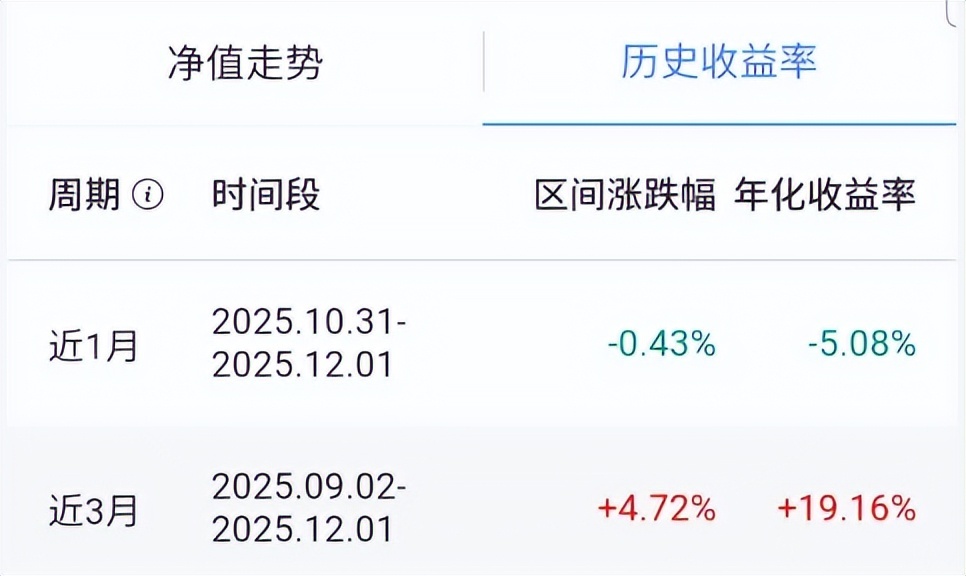
Core Viewpoint - The banking wealth management market is experiencing a shift towards the issuance of rights-containing products in response to low interest rates and an "asset shortage" environment, with a focus on balancing returns and risks [1][2]. Group 1: Market Trends - Since mid-November, the issuance of rights-containing products has increased, with 13 new equity products launched between November 17 and 18, including 12 index-type products from Huaxia Wealth Management [2]. - Currently, there are 63 existing equity wealth management products in the banking sector, reflecting a trend of increasing equity asset allocation to enhance product appeal and yield flexibility [2]. - The issuance of mixed and "fixed income +" products has increased by over 50% year-on-year since August, with expectations of raising performance benchmarks by 30-50 basis points to meet investor yield demands [2]. Group 2: Performance and Risks - The pursuit of yield flexibility has led to increased volatility risks, with recent market fluctuations causing rights-containing products to experience significant drawdowns, with a weekly withdrawal exceeding 25 basis points [3]. - For example, one equity product from a certain bank saw a monthly decline of 0.43% and an annualized return of -5.08% [3][4]. Group 3: Regulatory and Policy Framework - The rise in rights-containing product issuance is supported by regulatory frameworks, such as the "Implementation Plan for Promoting Long-term Funds into the Market," which allows wealth management funds to participate in new stock subscriptions on par with public funds [5]. - This policy has led to active participation from several wealth management companies in offline new stock subscriptions, with notable allocations in high-profile IPOs [5]. Group 4: Caution and Future Outlook - Despite the potential for increased returns through new stock subscriptions, many wealth management companies remain cautious due to associated risks and the need for specialized capabilities in stock analysis and pricing [7]. - The overall allocation of equity assets in wealth management remains low, with only 2.1% of total wealth management assets allocated to equity as of the end of Q3 [8]. - Future growth in equity allocations is expected to be driven by yield requirements, with a gradual increase in equity exposure anticipated if market conditions stabilize [9].
光模块发力上攻,新易盛涨幅超7%,人工智能AIETF(515070)盘中涨幅超1%
Mei Ri Jing Ji Xin Wen· 2025-12-03 02:34
(文章来源:每日经济新闻) 中信证券认为,AI正从"训练"走向"推理+终端",2026年国内端侧AI设备出货有望超2亿台,算力、存 储、光学、散热等国产供应链厂商迎来二次成长,建议关注模型压缩、边缘算力芯片及高端光学龙头。 人工智能AIETF(515070)跟踪CS人工智能主题指数(930713),成分股选取为人工智能提供技术、 基础资源以及应用端个股,聚集人工智能产业链上中游,俗称"机器人"大脑"缔造者",万物互联"地 基"。前十大权重股包括中际旭创、新易盛、寒武纪-U、中科曙光、科大讯飞、豪威集团、海康威视、 澜起科技、金山办公、紫光股份等国内科技龙头。 今日开盘科技赛道有所分化,5G通信、电子、半导体细分赛道表现较好,而传媒、军工、游戏、数据 等赛道跌幅居前,开盘半小时内光模块发力上攻,新易盛涨幅超7%,人工智能AIETF(515070)盘中 涨幅超1%,持仓股中科沃斯大涨超3%,石头科技、寒武纪、北京君正等涨幅均超1%。 消息方面,12月1日字节跳动旗下豆包发布手机助手技术预览版,与中兴通讯深度合作,首批3万台工程 机迅速售罄,第二代产品计划2026年上半年量产,带动端侧AI概念全线走强。 ...

趋势研判!2025年中国应急产业政策、产业链、市场规模、竞争格局及技术创新措施分析:已形成较为成熟的技术和产业链,产业规模不断壮大[图]
Chan Ye Xin Xi Wang· 2025-12-03 01:24
Core Viewpoint - The emergency industry in China is a comprehensive and emerging sector that spans multiple departments and fields, primarily consisting of emergency equipment and emergency services, with a significant focus on equipment. The development of this industry is crucial for enhancing national emergency systems, improving emergency capabilities, ensuring public safety, and promoting economic growth. The industry has entered a rapid growth phase, with projections indicating a market size of 13,934.7 billion yuan in 2024 and 14,589.2 billion yuan in 2025 [1][5]. Industry Definition and Classification - The emergency industry is defined as the sector that supports the response to sudden events requiring urgent handling, covering a wide range of applications and lacking clear industry boundaries. It is categorized into four main types: safety protection, monitoring and early warning, emergency rescue and disposal, and safety emergency services [2][4]. Current Development Status - The emergency industry in China has seen significant growth, with its market size increasing from 5,510.1 billion yuan in 2016 to an expected 13,934.7 billion yuan in 2024. The emergency equipment market is projected to reach 9,199.8 billion yuan in 2024, accounting for 66.02% of the total industry, while emergency services and maintenance are expected to reach 4,734.9 billion yuan, making up 33.98% [5][7]. Market Structure - The emergency industry consists of emergency equipment and emergency services, with equipment holding the majority share. The market for emergency services has been expanding in recent years, indicating a shift in focus within the industry [7]. Industry Chain - The emergency industry chain includes upstream suppliers of emergency equipment and software information services, midstream emergency system services, and downstream applications in various scenarios such as natural disasters, accidents, public health, and social security [8]. Development Environment and Policies - The Chinese government has made significant strides in emergency management, transitioning towards a preventive governance model. Key policies include the revision of laws such as the Emergency Response Law and the Safety Production Law, as well as the issuance of development action plans for emergency equipment [9][10]. Competitive Landscape - The main participants in the emergency industry include companies involved in safety protection equipment manufacturing, monitoring and early warning, and emergency rescue services. Notable companies include Hikvision, Dahua Technology, and China Shipbuilding Industry Corporation, among others [11][12]. Technological Innovation Measures - To enhance the technological innovation level of the emergency industry, measures such as talent cultivation, innovation platform construction, and promotion of result transformation are essential [14].


Ambarella (NasdaqGS:AMBA) 2025 Conference Transcript
2025-12-03 00:57
Ambarella Conference Call Summary Company Overview - **Company**: Ambarella Inc. (NasdaqGS: AMBA) - **Industry**: Edge AI and IoT technology, with a focus on automotive and portable video markets Key Points Business Transformation and Market Focus - Ambarella has transformed its business model, with IoT now driving the majority of revenue, surpassing the automotive sector [3][4] - The company identifies itself as an edge AI company, which includes automotive applications, emphasizing that autonomous driving is a significant edge AI market [3][4] - The addressable market for automotive is projected to be around 50% of potential revenue by 2030, indicating a balanced focus on both IoT and automotive sectors [5] Product Development and Platform Advantage - Ambarella has developed a common hardware and software platform for both IoT and automotive applications, allowing for efficient product development across various sectors [6][7] - The company has shipped over 36 million SoCs, establishing a significant install base that enhances its competitive position [6] - The platform's durability is emphasized despite competition from larger players like NVIDIA, which dominate the cloud and data center markets [8][9] Growth Drivers in Portable Video - Portable video is identified as a major growth driver, with applications extending beyond action cameras and drones to include wearable cameras and video conferencing [10][11] - The introduction of AI technology is expected to enhance product offerings in the portable video category, leading to further innovation [11] Market Dynamics and Competition - The drone market is estimated at approximately 10 million units, with a significant opportunity arising from the U.S. government's ban on DJI drones, creating a market gap for competitors [14][15] - Ambarella faces competition from major players like Mobileye, Qualcomm, and NVIDIA, but believes it has a competitive edge in power efficiency and software licensing models [20] Automotive Sector Insights - The company continues to invest in the CV3 family for advanced driver-assistance systems (ADAS), but faces challenges in securing OEM contracts due to competition and software solution delays [17][18] - The potential lifetime value of winning an OEM contract is significant, with estimates around $700-$800 million [21] Financial Performance and Strategy - Ambarella has seen growth in enterprise security revenue despite a declining percentage of total revenue, with a focus on non-Chinese markets [23] - The average selling price (ASP) of AI chips has increased from $6 to $16 over six years, with expectations for continued growth as new generations of chips are introduced [24][26] - The company maintains a long-term gross margin target of 59%-62% while balancing R&D investments and operating expenses [31][32] M&A and Future Outlook - Ambarella is open to M&A opportunities, particularly in algorithm and software sectors, to enhance its market offerings [34] - The company aims to maintain independence while recognizing the potential for faster growth under a larger platform that could invest in its technology [37] Additional Insights - The company has successfully generated positive operating cash flow for 16 consecutive years, indicating financial stability [33] - Ambarella's strategy includes leveraging existing technology across multiple applications to minimize R&D costs and maximize revenue potential [12][13]

江西省南昌市红谷滩区 VR+AI赋能数智转型 借势筑强数字经济产业高地
Jing Ji Ri Bao· 2025-12-02 22:09
Core Insights - Nanchang's Honggutan District is leveraging opportunities in the digital economy, focusing on the virtual reality (VR) industry as a key driver for high-quality development [1][4] - The district has established itself as a core area for VR in Jiangxi Province, attracting top companies and fostering innovation across various sectors [1][2] Group 1: Industry Development - The VR industry in Honggutan has seen significant growth, with the number of digital economy core enterprises increasing from 4,002 in 2021 to 6,198 in 2024, marking a substantial rise [2] - The district has gathered 7 of the national top 50 VR companies, creating a comprehensive innovation ecosystem that covers technology research, application, and results transformation [1][2][4] Group 2: Investment and Projects - During the 2025 World VR Industry Conference, 13 projects were signed with a total investment of 2.32 billion yuan, focusing on key areas such as VR optical display and AI algorithms [2] - Major projects like the Jiangxi Artificial Intelligence Computing Center and the National Virtual Reality Innovation Center are enhancing the region's innovation capabilities and industry chain [6][9] Group 3: Policy and Environment - Honggutan District has implemented supportive policies, including a 19.5% increase in digital economy policy funding to 23.9 million yuan for 2025, aimed at fostering enterprise innovation and expansion [3] - The district emphasizes a high-quality business environment as essential for industry development, establishing a service system that integrates online and offline support for enterprises [3][4] Group 4: Talent and Education - The National Vocational Education Virtual Simulation Demonstration Training Base has trained 3,000 individuals and hosted 7,000 visitors, contributing to the development of skilled talent for the industry [7] - Local companies are thriving under supportive policies, with firms like Lingxing Information and Xiaohutao Technology making significant strides in VR education and gaming [4][6] Group 5: Future Outlook - The Future Science City is being developed to integrate industry and urban growth, attracting major digital economy enterprises and enhancing the region's competitive edge [8][9] - Honggutan aims to become a global VR industry hub, supported by a 3 billion yuan VR industry fund and high-standard infrastructure for AI and smart manufacturing [9][10]
12月2日深证国企股东回报R(470064)指数跌0.36%,成份股洋河股份(002304)领跌
Sou Hu Cai Jing· 2025-12-02 11:00
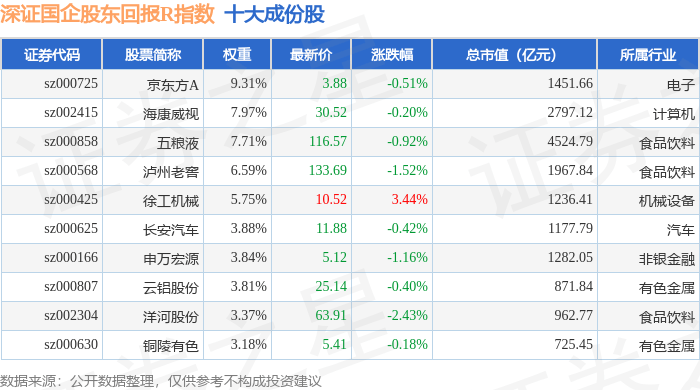
Core Points - The Shenzhen State-Owned Enterprises Shareholder Return Index (470064) closed at 2227.58 points, down 0.36%, with a trading volume of 18.448 billion yuan and a turnover rate of 0.74% [1] - Among the index constituents, 18 stocks rose while 31 stocks fell, with XCMG Machinery leading the gainers at 3.44% and Yanghe Brewery leading the decliners at 2.43% [1] Group 1: Index Performance - The Shenzhen State-Owned Enterprises Shareholder Return Index reported a decline of 0.36% on the trading day [1] - The total trading volume for the index was 18.448 billion yuan, indicating a relatively low turnover rate of 0.74% [1] Group 2: Stock Performance - The top-performing stock was XCMG Machinery, which increased by 3.44% [1] - The worst-performing stock was Yanghe Brewery, which decreased by 2.43% [1] - The index's top ten constituents included major companies such as BOE Technology Group, Hikvision, and Wuliangye, with varying weightings and market capitalizations [1] Group 3: Capital Flow - The index constituents experienced a net outflow of 769 million yuan from institutional investors, while retail investors saw a net inflow of 701 million yuan [3] - XCMG Machinery had a net inflow of 118 million yuan from institutional investors, despite overall negative trends in capital flow for many stocks [3] Group 4: Index Adjustments - Recent adjustments to the index included the addition of 10 new stocks and the removal of 10 existing stocks, reflecting changes in market dynamics [4] - Notable additions included companies from various sectors such as machinery, transportation, and food and beverage [4]