欧莱雅

Search documents
Key Events This Week: Payrolls, CPI And Retail Sales
ZeroHedge· 2026-02-09 14:55
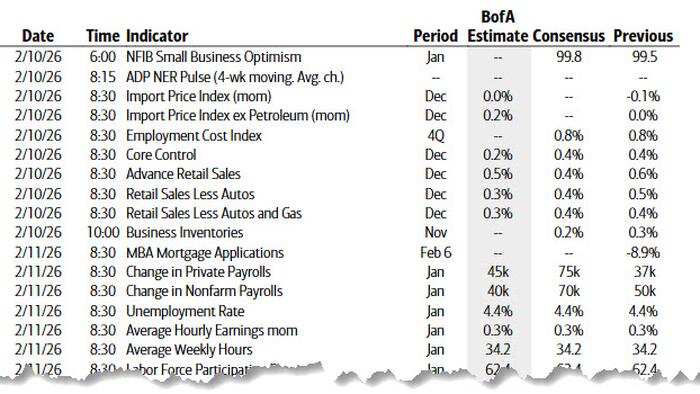
Economic Data Releases - The upcoming week will feature significant US economic data releases, including the January employment report and the January CPI report, which are typically not released in the same week [1] - December retail sales and the Q4 employment cost index will also be released, alongside global inflation updates from China and several European economies [1] Employment Report Expectations - DB economists project a rise in headline and private payrolls by 75k, with the unemployment rate expected to remain at 4.4% [2] - Average hourly earnings are anticipated to increase by 0.3%, with hours worked remaining unchanged at 34.2, leading to a year-over-year growth rate of payroll-based nominal compensation rising to 4.5% from 4.3% [2] Inflation Report Expectations - The headline CPI is expected to increase by 0.26%, influenced by a projected 2.4% drop in motor fuel prices, while core CPI is anticipated to rise by 0.35% [4] - This would result in a year-over-year headline CPI slowing to 2.46% from 2.68%, and core CPI to approximately 2.55% [4] Corporate Earnings - Corporate earnings reports are ongoing, with six of the Magnificent Seven having reported, which may reduce volatility until Nvidia's report on February 25th [1] - The week will also see earnings from major tech companies and consumer firms, including Cisco, Coca-Cola, and McDonald's [8] Fed Communications - Fed officials will be actively communicating throughout the week, discussing regulatory topics and the balance sheet outlook, particularly in light of the nomination of Kevin Warsh for Fed Chair [6] - Discussions will include perspectives on the labor market and inflation, with various Fed governors scheduled to speak [6][20] Global Economic Indicators - In Europe, key indicators include the UK's Q4 GDP and CPI reports from Denmark, Norway, and Switzerland [7] - In Asia, China's January inflation report is due, with forecasts indicating a slowdown in CPI inflation to 0.4% year-over-year [8]

未来10年,这18个赛道将带来48万亿美元收入
创业家· 2026-02-09 10:31
Core Insights - McKinsey's report identifies 18 industry sectors likely to reshape the global business landscape, predicting revenues of $29 trillion to $48 trillion by 2040, contributing 18-34% to global GDP growth [2] E-commerce - By 2040, e-commerce's share of global retail revenue is expected to rise to 27%-38%, up from approximately 20% currently [3] - Growth drivers include market expansion in developing countries and new product categories in developed nations, such as healthcare and emotionally valuable products [4] - Significant investments are anticipated in customer acquisition and last-mile delivery across e-commerce platforms [5] Electric Vehicles - Electric vehicles (EVs) are projected to exceed 50% of global passenger car sales by 2040 [6] - Breakthroughs in battery technology and smart algorithms will significantly influence this sector, prompting increased R&D investments from both EV manufacturers and traditional automakers [7] Cloud Services - The demand for higher storage and computing capabilities is driven by a more interconnected world and the need for AI products requiring substantial computational power [9] - The cloud services industry experienced a 17% compound annual growth rate (CAGR) from 2005 to 2020, with similar growth expected in the coming decades [10] Semiconductors - The semiconductor industry is essential for the digital world, with demand from computing, data storage, automotive, communication, and industrial electronics driving rapid growth [11] - A sustained CAGR of 6%-8% is forecasted for the semiconductor sector over the next decade [11] AI Software Services - The rapid development of AI has led to its classification as a distinct sector, with increasing numbers of users adopting AI assistants [12] - Companies in the AI space are engaged in a competitive race to develop advanced foundational models and applications [13] Digital Advertising - Digital advertising, through search, social media, and media services, is expanding in value as internet usage among the middle class increases [14] - Continuous algorithm improvements enhance platforms' abilities to target customers and track advertising costs, although competition for user attention necessitates higher investments in engaging content [15] Streaming Video - Increased investments in customer acquisition and content production are prompting streaming platforms to seek new revenue models [17] - Developing countries are expected to contribute to growth in subscription and advertising revenues, with projections indicating over 1 billion households subscribing to long-form video services by 2040 [18] Shared Autonomous Vehicles - The advent of autonomous driving technology may reduce the necessity for personal vehicle ownership [19] - By 2040, shared autonomous vehicles could account for 25%-51% of shared mobility revenue [20] Space Economy - The world is on the brink of entering a space economy era, with advancements in reusable rocket technology changing the aerospace industry [21][22] Cybersecurity - Cybercrime caused approximately $950 billion in direct economic losses in 2020, with indirect losses potentially reaching $4-6 trillion [24] - Increasing awareness of cybersecurity has led companies to enhance their investments in this area [25] Batteries - Significant advancements in battery technology have tripled energy density over the past few decades [26] - The global energy transition is driving demand for batteries, particularly from electric vehicles, energy storage, and consumer electronics, with EVs expected to comprise over 80% of the battery market by 2040 [28] Video Games - By 2030, an estimated 40% of the global population may become video game players [30] - New gaming models, such as mobile and cloud gaming, are accelerating market growth, with free-to-play games generating substantial revenue [32] Robotics - The integration of AI with robotics is creating significant expectations for humanoid robots, which are anticipated to become "ultimate intelligent agents" [33] Industrial and Consumer Biotechnology - Breakthroughs in gene editing and other technologies are accelerating the application of biotechnology in agriculture, alternative proteins, consumer products, and bio-materials [37] Modular Construction - Modular construction methods, which involve prefabricating building components for on-site assembly, can significantly enhance construction efficiency [38] Nuclear Fission Power - The development of safer, smaller modular reactors presents opportunities to supplement renewable energy sources [39] Air Traffic - Electric vertical takeoff and landing vehicles and delivery drones are expected to drive significant technological changes in air traffic [41] Obesity Treatment Drugs - The prevalence of obesity is projected to rise from 15% in 2020 to 24% by 2035, indicating a potential market for effective weight loss products [43]

可选消费W06周度趋势解析:海外消费业绩密集发布带动股价波动,A H股期待26年可选消费恢复
海通国际· 2026-02-09 00:30
Investment Rating - The report assigns an "Outperform" rating to multiple companies in the discretionary consumption sector, including Nike, Li Ning, Midea Group, JD Group, Haier Smart Home, Gree Electric, Anta Sports, and many others [1]. Core Insights - The report highlights that overseas consumer earnings releases have led to stock price volatility, with A/H shares anticipating a recovery in discretionary consumption in 2026 [1]. - The performance of various sectors is analyzed, with gaming, U.S. hotels, snacks, and retail showing positive trends, while luxury goods and overseas cosmetics are experiencing declines [4][12]. - The report notes that the gaming sector saw a strong increase in gross gaming revenue, with a year-on-year growth of 24%, exceeding market expectations [6][14]. Sector Performance Summary - **Gaming Sector**: Increased by 5.5%, driven by strong January gross gaming revenue growth and positive earnings from MGM China [6][14]. - **U.S. Hotels**: Also up by 5.5%, with Marriott and Hilton showing positive earnings forecasts [6][14]. - **Snacks**: Grew by 3.6%, with companies like Youyou Foods and Qiaqia Foods reporting significant growth expectations [6][14]. - **Retail Sector**: Increased by 3.5%, led by Walmart and Target, which exceeded market sales forecasts [8][14]. - **Domestic Sportswear**: Rose by 2.6%, with Li Ning benefiting from its partnership with the Chinese Olympic Committee [8][14]. - **Credit Card Sector**: Gained 2.3%, supported by strong earnings from Visa and Mastercard [8][14]. - **Domestic Cosmetics**: Increased by 2.1%, benefiting from overall strength in the beauty and skincare sector [8][14]. - **Luxury Goods**: Slightly up by 0.9%, influenced by a rebound in the U.S. market [8][14]. - **Overseas Cosmetics**: Decreased by 5.7%, with concerns over the sustainability of growth for Estée Lauder [9][15]. - **Pet Sector**: Down by 0.7%, with companies like Guai Bao Pet and Zhongchong Co. experiencing declines [8][14]. - **Gold and Jewelry**: Fell by 1.2%, affected by fluctuations in gold prices [8][14]. Valuation Analysis - The report indicates that the valuation of various sectors remains below their historical averages, with expected P/E ratios for 2025 showing significant discounts compared to the past five years [10].
中国市场亮眼 雅诗兰黛扭亏
Bei Jing Shang Bao· 2026-02-08 15:50
Core Insights - Estée Lauder's "Reimagining Beauty" transformation strategy has shown positive results after one year of implementation, with a net sales increase of $4.2 billion, representing a 6% year-over-year growth, and an organic net sales growth of 4% [1] - The company reported a net profit of $162 million, recovering from a loss of $746 million in the same period last year, indicating a significant turnaround [1] - The operating profit margin improved to 9.5% from -14.5% year-over-year, with an adjusted operating profit margin increase of 290 basis points to 14.4% [1] Financial Performance - For the first half of fiscal year 2026 (July 1, 2025 - December 31, 2025), net sales increased by 5% to $7.71 billion, with net profit turning positive at $209 million [1] - The company attributes its performance to the Profit Recovery and Growth Plan (PRGP), which offset the impacts of increased tariffs, business structure changes, and inflation [1] Market Performance - The China market was a standout performer, with organic net sales growth of 13% in the second quarter, marking the second consecutive quarter of double-digit growth [2] - Estée Lauder's growth in the high-end beauty market in China outperformed the overall industry, with significant contributions from brands like La Mer, TOM FORD, and Le Labo [2] Strategic Insights - Analysts suggest that the growth is a result of a combination of strategic alignment and market benefits, highlighting the dual advantages of high-end consumption recovery and precise targeting strategies [3] - The company has raised its full-year fiscal 2026 outlook, expecting organic net sales growth of 1% to 3% and an adjusted operating profit margin between 9.8% and 10.2% [3] Competitive Landscape - The high-end beauty market in China is becoming increasingly competitive, with rivals like L'Oréal expanding their presence through acquisitions and new brand launches [4] - Estée Lauder's strategy of focusing on high-end products while appealing to younger consumers is seen as a way to leverage structural growth in the market [4]

中国高端美妆市场表现亮眼,雅诗兰黛扭亏
Bei Jing Shang Bao· 2026-02-08 11:28
Core Viewpoint - Estée Lauder's "Reimagining Beauty" transformation strategy has shown positive results after one year, with significant improvements in sales and profitability in the second quarter of fiscal year 2026 [1][3] Financial Performance - In Q2 of fiscal year 2026, Estée Lauder achieved net sales of $4.2 billion, a 6% year-over-year increase, with organic net sales growing by 4% [1] - The company reported a net profit of $162 million, recovering from losses in the previous year [1] - For the first half of fiscal year 2026, net sales increased by 5% to $7.71 billion, with net profit turning from a loss of $746 million to a profit of $209 million [1] Market Performance - The growth in the Chinese mainland market was particularly notable, with organic net sales increasing by 13% in Q2, marking the second consecutive quarter of double-digit growth [3] - Estée Lauder's performance in the high-end beauty market in China outpaced the overall industry, with market share growth across all categories and channels [3] Strategic Insights - The growth is attributed to the "Profit Recovery and Growth Plan" (PRGP) and effective execution of product innovation and marketing strategies, including the "Double 11" shopping festival [3] - The company's dual strategy of "high-end consolidation and young consumer engagement" has effectively captured both mature and younger consumer segments, enhancing its competitive advantage [4] Future Outlook - Based on strong performance, Estée Lauder has raised its full-year fiscal 2026 outlook, expecting organic net sales growth of 1% to 3% and adjusted operating margin between 9.8% and 10.2% [4] - The company anticipates challenges in the second half of the year but remains optimistic about restoring organic sales growth and achieving operating margin expansion for the first time in four years [5]

整个社会都在喊没钱了,为什么这些公司反而年赚百亿?
创业家· 2026-02-08 10:00
Core Viewpoint - The article emphasizes that despite the prevailing narrative of economic hardship, certain industries are thriving and generating substantial profits, particularly in the context of Japan's "lost 30 years" and the evolving consumer behavior in China [3][4]. Group 1: Economic Shifts and Opportunities - The concept of a "low-desire society" does not equate to a lack of opportunities, as consumer demand is shifting towards different sectors [4]. - The article identifies eight key industries that are capitalizing on changing consumer preferences, highlighting that demand migration presents significant business opportunities [5]. Group 2: Key Industries - **Second-Hand Economy**: The second-hand luxury market in Japan, exemplified by companies like Daikokuya, has seen a dramatic revenue increase. In China, platforms like Hongbulin and Panghu are experiencing similar growth [6][7][8]. - **Pet Economy**: With declining birth rates, spending on pets is rising. Companies like Inaba in Japan and Guobao in China are benefiting from this trend, with various pet brands seeing continuous sales growth [12][13][14][15][16]. - **Adult Care**: The adult diaper market in Japan has surpassed $10 billion, indicating that aging populations can create substantial economic opportunities rather than being a burden [17][18][19]. - **Health Food and Beverages**: Changes in population structure and rising health awareness have led to the growth of sugar-free beverages and functional foods in both Japan and China [21][22]. - **Beauty Economy**: The demand for beauty products, such as collagen supplements and at-home beauty devices, remains strong, indicating that consumers prioritize personal care even in economic downturns [23][24][25][26]. - **Outdoor Recreation**: Companies in the outdoor equipment sector, like Snow Peak in Japan, are thriving as consumers seek leisure activities despite economic constraints [29][30][31]. - **Convenience Economy**: The rise of frozen foods and smart home appliances reflects a shift towards convenience, with brands like Anjijia and Kewotai seeing steady growth [39][40][42]. - **Lazy Economy**: The trend of reduced cooking time among younger generations has led to increased demand for time-saving products, suggesting that time-saving solutions may hold more commercial value than cost-saving ones in a low-desire economy [39][42]. Group 3: Market Sentiment - The article argues against the notion that the current market is in a "cold winter," suggesting that the true winners in a low-desire era are those who can identify and invest in counter-cyclical opportunities [44].

Global week ahead: Tech rotation puts European stocks back in play
CNBC· 2026-02-08 06:53
Group 1: Market Overview - The Stoxx 600 index in Europe is near record highs, having recorded its 7th positive week in eight, contrasting with the significant declines in U.S. tech stocks [1] - The S&P 500 has dropped nearly 30% from its peak in October 2025, while European stocks appear more resilient [2] Group 2: Corporate Earnings and M&A Activity - UniCredit is a significant player in European M&A, with minority stakes in Commerzbank and Alpha Bank yielding around 20% returns on investment [3] - Commerzbank's CEO indicated that a deal with UniCredit is "not sensible" due to the high valuation of the German bank [4] - L'Oreal is reporting earnings and may pursue acquisitions, having raised 3 billion euros for M&A financing, and recently increased its stake in Galderma [9] Group 3: Healthcare Sector Developments - AstraZeneca is focusing on the Chinese market for weight-loss drugs, while Philips aims to maintain a positive performance with new AI tools [7] - There are concerns following a sell-off in Novo Nordisk shares, which may impact investor sentiment towards AstraZeneca and Philips [7]


2025 线上护肤市场新品与成分趋势洞察
Sou Hu Cai Jing· 2026-02-08 04:41
Core Insights - The online skincare market in China is transitioning from a "traffic-driven" model to a "value-driven" approach, with a market size exceeding 190 billion yuan and a year-on-year growth of nearly 10% from January to September 2025 [1][16]. Market Overview - The overall sales in the skincare market are steadily increasing, with a total sales figure of 190.8 billion yuan (+9.3%) and a volume of 1.62 billion units (+0.6%) during the specified period [15][16]. - Despite the growth in sales, the volume of skincare discussions on social media has slightly decreased, indicating a shift from generalized discussions to more specialized and refined consumer needs [2][16]. Consumer Focus - Ingredients and efficacy remain the core selling points for skincare products, with Chinese consumers showing significantly higher attention to these aspects compared to overseas markets [2][17]. - The competition among brands is increasingly centered on ingredient research and efficacy validation, as traditional marketing strategies are becoming less effective [2]. Brand Landscape - The market is witnessing a stable head brand landscape, with domestic brands performing well. The top ten brands have only seen a slight increase in market share, while mid-tier brands (ranked 11-20) have achieved over 20% sales growth, indicating strong growth potential [3][18]. - Notably, Douyin has emerged as a key growth engine for many high-growth brands, with most of them pricing their products between 100 to 200 yuan [3][21]. New Product Strategies - The logic behind new product launches has fundamentally changed, with a decline of over 10% in the number of new products registered in 2025. However, the average price of launched new products has significantly increased, indicating a shift towards fewer, more specialized, and higher-value core products [4][21]. - Interest e-commerce platforms like Douyin are becoming crucial for product launches and market testing, while traditional e-commerce platforms focus on long-term brand value and stable sales of classic high-priced products [4]. Ingredient Trends - The ingredient landscape is evolving with diverse trends, including the maturation of "acid" skincare concepts and the cross-border migration of high-growth ingredients from oral beauty to skincare markets [5]. - "Food-grade" ingredients are gaining attention due to their natural and safe perception, although they currently dominate basic product categories [5]. - Traditional Chinese herbal ingredients are becoming popular in high-end anti-aging and repair products, helping brands establish differentiated images [5]. Protein Ingredients - Protein-related ingredients such as hexapeptide and collagen are closely associated with anti-aging effects, with hexapeptide seeing significant growth driven by leading domestic brands [6]. - The market for collagen is relatively fragmented, while the restructured collagen segment shows higher market concentration [6]. Conclusion - The online skincare market is entering a phase of deep value competition, driven by precise responses to consumer core needs through ingredient innovation, efficacy focus, and product refinement. Brands that can continuously delve into core technologies and express differentiated value while flexibly utilizing channel strategies are likely to achieve sustained growth in an increasingly rational and professional market [6].

马年 CNY 营销,当谐音梗开始失效,靠什么继续成立
3 6 Ke· 2026-02-08 02:24
Group 1 - The core idea of the article is that the marketing strategies for the Chinese New Year (CNY) are evolving, with brands focusing on emotional narratives, cultural significance, and innovative engagement methods to resonate with consumers during this competitive period [1][30] - This year's CNY marketing is characterized by a shift from traditional methods to more personalized and emotionally driven campaigns, reflecting changes in consumer sentiment and expectations [23][30] - Brands are increasingly leveraging celebrity endorsements, with a focus on names that resonate with the zodiac theme, such as those with the surname "Ma," to create engaging and relatable content [3][24] Group 2 - The use of emotional storytelling is prominent, with brands like Apple and Pepsi focusing on themes of companionship and family reunions, which align with the sentiments of the CNY [9][10] - Limited edition products are a common strategy, with brands like Mixue Ice City and Lancôme incorporating cultural elements into their offerings, enhancing both sales and brand identity [16][19] - The marketing landscape is shifting towards a deeper understanding of cultural nuances, with brands moving beyond superficial symbols to create meaningful connections with consumers [27][30] Group 3 - The article highlights the importance of adapting to changing consumer behaviors, with brands embracing humor and relatability to connect with younger audiences facing social pressures during the CNY [26][30] - There is a growing trend of brands focusing on individual emotional experiences rather than grand narratives of success, reflecting a societal shift towards personal well-being [25][30] - The competitive nature of CNY marketing is leading brands to seek innovative and authentic ways to engage consumers, moving away from formulaic approaches to more genuine expressions of understanding and empathy [31][30]

4541.8亿美妆护肤全景扫描:从规模竞争到技术竞争
FBeauty未来迹· 2026-02-07 10:54
Core Viewpoint - The beauty and skincare industry is undergoing a transformation where consumers are redefining what is worth spending on, shifting from impulsive buying to more rational decision-making focused on efficacy and long-term value [3][4]. Market Overview - By 2025, the beauty and skincare market is projected to reach a sales volume of 454.18 billion yuan, with a year-on-year growth of 9.7%, driven by both volume and price increases [5]. - The market growth is characterized by structural price changes, with a notable increase in the average transaction price due to a rise in the share of functional and mid-to-high-end products [8]. Consumer Behavior - Consumers are increasingly focused on efficacy, experience, and certainty of value, leading to a multi-tiered market with diverse price segments and consumer needs [4][8]. - The low-price segment (0-300 yuan) accounts for 74.1% of the beauty market, while the skincare market sees 56.3% in the same range, with the sub-100 yuan segment experiencing the fastest growth at 20.6% year-on-year [8]. Brand Dynamics - Leading brands are shifting from scale expansion to product innovation, with high-end anti-aging products becoming a significant growth driver, resulting in increased market concentration and share [11][12]. - Mid-tier brands face pressure but can achieve growth through targeted strategies, such as focusing on specific consumer needs like sensitive skin repair or anti-aging for younger demographics [14]. Anti-Aging Market Insights - The anti-aging market is entering a new phase driven by precise technology and widespread demand, with sales expected to reach 129.83 billion yuan in 2025, reflecting a year-on-year growth of 26.3% [15][17]. - Facial anti-aging products dominate the market, with facial care sets and serums leading in sales, emphasizing the importance of ingredient efficacy [19]. Product Trends - The demand for anti-aging products is increasingly focused on core functions such as hydration, wrinkle reduction, and skin repair, indicating a blend of basic skincare and anti-aging needs [24]. - New product innovations in the anti-aging segment are centered around collagen enhancement and multi-functional benefits, with brands like L'Oréal and Estée Lauder leading the way [28][29]. Makeup Market Trends - The makeup market is seeing a shift towards natural beauty and health-focused aesthetics, with sales growth of 15.8% year-on-year, reflecting changing consumer preferences [30]. - The demand for lightweight, hydrating makeup products is rising, with cushion foundations experiencing significant growth, indicating a balance between efficiency and effectiveness [35]. Marketing and Consumer Engagement - Social media platforms are becoming crucial for trend amplification, with discussions around natural beauty and individual expression reshaping consumer decision-making [43][44]. - The beauty and skincare industry is moving towards a competitive landscape focused on technology credibility, efficacy perception, and user understanding, indicating a shift from price-based competition to value-driven strategies [44].