vivo

Search documents
豆包AI手机,打响APP入口争夺战
21世纪经济报道· 2025-12-27 12:35
Core Viewpoint - The emergence of the Doubao mobile assistant has sparked significant interest in the smartphone industry, being recognized as a "truly AI phone" due to its autonomous cross-application capabilities, although it faces challenges regarding user privacy and data permissions [1][3][5]. Group 1: Doubao Mobile Assistant and Industry Response - The Doubao mobile assistant was launched at the end of 2025, creating a stir in the smartphone market due to its ability to operate autonomously across applications [1]. - Despite the initial excitement, the Doubao mobile assistant encountered restrictions in its application usage, leading to an announcement regarding adjustments to its AI operational capabilities [1][3]. - The assistant's features are not significantly different from previously demonstrated smart applications by other manufacturers, indicating that while technology is evolving, commercial application remains a challenge [5][6]. Group 2: Challenges and Legal Considerations - The core challenge for AI phones, including the Doubao assistant, lies in legal disputes over cross-application automation and whether it infringes on the interests of internet companies [6]. - Current compliance standards are inadequate for the demands of AI, which seeks to perform tasks across multiple applications, highlighting a "standard vacuum" in the industry [6][15]. - The need for a unified protocol and open ecosystem is emphasized, as the integration of multiple agents requires collaboration between smartphone manufacturers and third-party service providers [15]. Group 3: Technological Advancements and Market Dynamics - The rapid improvement of domestic open-source large models has provided a solid foundation for the iterative development of AI phones, shifting focus from cloud-based models to offline capabilities [3][11]. - The introduction of the AutoGLM model and its open-source nature marks a significant step towards "technological equality," potentially leading to an explosion of edge AI applications [10]. - The competition in AI phones is evolving from mere hardware specifications to a comprehensive race involving edge capabilities, ecosystem openness, and user experience [17]. Group 4: Future Prospects and Ecosystem Development - The ultimate competition in AI phones is fundamentally about ecosystem development, requiring breakthroughs in technology and the establishment of an open collaborative framework [15]. - The industry faces three main challenges: ecosystem openness, cross-application scheduling permissions, and user habit formation [15]. - The trend of software and hardware boundaries blurring is evident, with companies exploring AI hardware to enhance data collection and user interaction [16][17].


豆包的朋友又多了一个?
Hua Er Jie Jian Wen· 2025-12-27 11:27
Core Insights - ByteDance and ZTE launched the "Doubao Phone," intensifying competition for the next-generation super entry point in the industry [2] - Lenovo plans to unveil its first global "AI Super Intelligent Body" at CES, directly competing with Doubao Phone Assistant, focusing on cross-device connectivity [2][3] - Lenovo's strategy emphasizes a hybrid AI approach, integrating personal, enterprise, and public intelligence over the next decade [6] Group 1 - Lenovo is collaborating closely with ByteDance's Doubao and Volcano Engine, indicating a partnership despite potential competition with the new AI Super Intelligent Body [4][5] - The smartphone market is experiencing a "Matthew Effect," where Lenovo must leverage AI opportunities to enhance Motorola's global market position [8] - ByteDance's strategy involves pre-installing AIGC plugins on partner devices, empowering more hardware terminals with Doubao Phone Assistant's capabilities [9] Group 2 - Vivo and ByteDance are reportedly in discussions for collaboration, while Meizu has expressed interest in working with Doubao [10] - OPPO has denied rejecting collaboration with ByteDance, emphasizing an open approach to partnerships based on user experience [10][11] - The competition for AI super entry points is just beginning, with hardware manufacturers concerned about becoming mere hardware providers if they overly rely on ByteDance's Doubao Assistant [13]


新机遇来了!“国字号”平台落地东莞滨海湾
Nan Fang Du Shi Bao· 2025-12-27 10:54
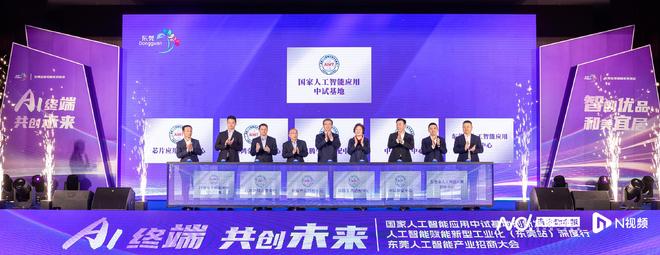
Core Insights - The event "AI Terminal Co-creating the Future" was held in Dongguan, focusing on the development of artificial intelligence applications and industrialization, with around 400 attendees from government, research institutions, and leading AI companies like Huawei and Alibaba Cloud [1][3] Group 1: Government Initiatives - The State Council issued an opinion in August 2025 to establish national AI application pilot bases, aiming to create common platforms for industry applications [3] - The Guangdong Provincial Department of Industry and Information Technology introduced 25 measures in April to support AI development in the Binhaiwan area, marking the first provincial policy document approved by the government for local AI development [4] Group 2: Infrastructure and Development - The national AI application pilot base, focusing on mobile terminals, was officially launched, with five capability centers unveiled, including a chip application development center and an AI application innovation center [3][6] - The newly opened pilot base building features three functional areas: a display platform, operational offices, and an ecological incubation area, designed to facilitate collaboration and resource integration [6] Group 3: Industry Focus and Goals - The pilot base aims to address common industry challenges such as low efficiency and high costs in terminal product development, focusing on "AI + terminal products" and "AI + production processes" [6] - Dongguan is positioning itself as a hub for AI industry development, targeting sectors like AI computing power, smart hardware, and industrial software, with the goal of leading breakthroughs in smart devices [4][6]
豆包搅动AI手机池水 厂商摸索数据、权限边界
2 1 Shi Ji Jing Ji Bao Dao· 2025-12-27 07:07
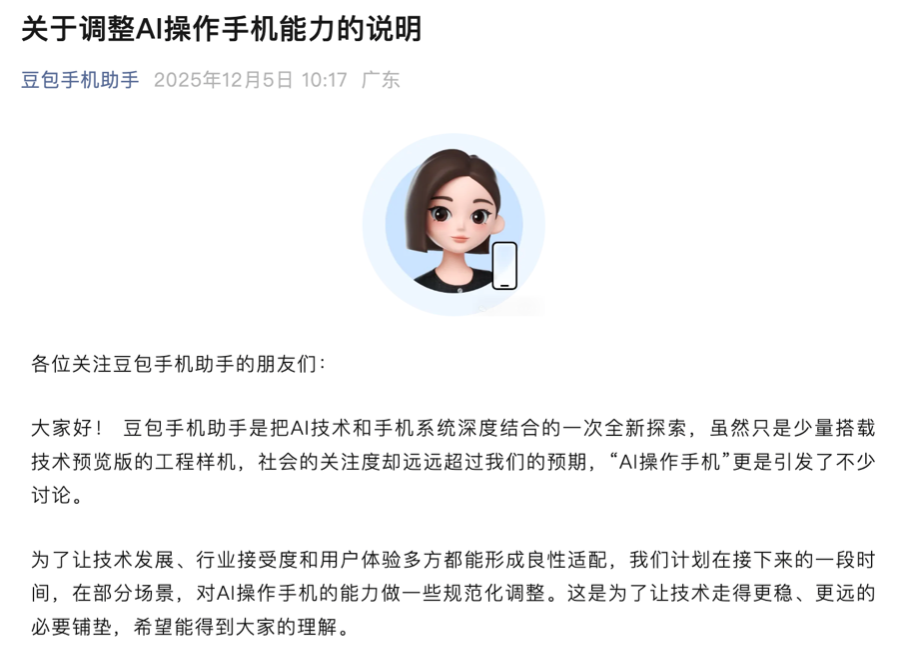
Core Insights - The launch of the Doubao mobile assistant in late 2025 has created significant waves in the smartphone industry, being recognized by users as a "truly AI phone" due to its autonomous cross-application operation capabilities [1][5] - However, the Doubao mobile assistant faced usage restrictions in multiple applications, leading to an official statement on December 5 regarding adjustments to its AI operation capabilities [1][3] - The challenges faced by Doubao reflect broader issues in the AI phone sector, particularly concerning user privacy and data rights, which require collaborative efforts from various stakeholders [3][7] Group 1: Technology and Development - The rapid improvement of domestic open-source large models has provided a solid foundation for the iterative development of AI phones, shifting focus from cloud-based models to offline capabilities [4][13] - The announcement of the open-sourcing of the AutoGLM model by Zhiyu on December 9 signifies a move towards "technological equality" in the mobile agent space, potentially lowering development barriers [3][12] - The evolution of AI phones is not just about technological advancements but also involves a complex interplay of patience, restraint, and ecosystem collaboration [4][17] Group 2: Market Dynamics and Competition - The Doubao mobile assistant's features are not significantly different from previously demonstrated smart applications by other manufacturers, indicating that the market is still in the early stages of realizing cross-application autonomous capabilities [5][6] - The competition in the AI phone market is fundamentally about ecosystem development, requiring a shift from traditional app models to a more integrated approach that allows for cross-application automation [17][21] - The emergence of AI agents is seen as a potential battleground for user engagement and control over data, with manufacturers needing to navigate the complexities of user habits and regulatory compliance [8][17] Group 3: Industry Challenges - The current landscape reveals a "standard vacuum" regarding user authorization and data rights, complicating the implementation of AI agents that require cross-application functionality [7][18] - The transition to AI agents necessitates a reevaluation of existing operational models, as traditional single-operation authorization methods are inadequate for the demands of AI-driven tasks [7][18] - The industry faces challenges related to memory and power consumption as the capabilities of end-side models expand, necessitating advancements in hardware to support these new demands [18][20] Group 4: Future Outlook - The AI phone competition is evolving from a focus on hardware specifications to a comprehensive race involving end-side capabilities, ecosystem openness, and user experience [21][22] - The integration of AI capabilities into hardware is expected to reshape traditional consumer electronics business models, moving towards subscription-based software services [20][22] - The developments surrounding the Doubao mobile assistant highlight the need for industry-wide collaboration to address the challenges of rights, interests, and standards in the evolving AI landscape [20][22]
全球围剿“苹果税”中国何以成“最后高地”?
Xin Lang Cai Jing· 2025-12-26 21:01
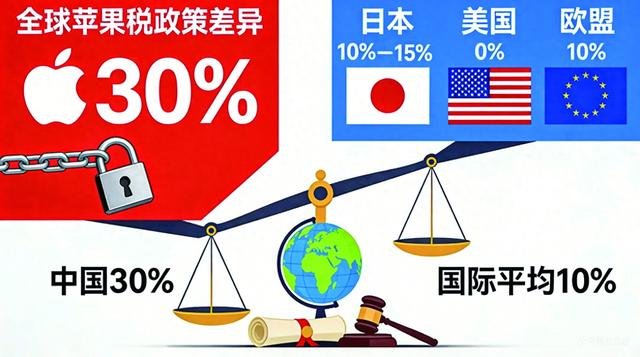
Core Viewpoint - The article discusses the global shift regarding the "Apple Tax," highlighting the contrast between international regulatory changes and the situation in China, where developers still face a high commission rate of 30% [2][3][6]. Global Regulatory Changes - Various countries, including the EU, Japan, and South Korea, have implemented measures to reduce Apple's App Store commission rates, with the EU's Digital Markets Act forcing Apple to lower its rates to between 10% and 17% [5][6]. - As of 2024, over 15 countries have initiated compliance regulations against the "Apple Tax," leading to a fragmented and differentiated approach to commission rates globally [5][6]. China's Unique Position - In contrast to global trends, China remains an outlier, with developers required to pay a 30% commission, significantly higher than the rates in Europe (4.6%) and the U.S. (8.8%) [6][8]. - Despite ongoing complaints and calls for policy changes, there has been no substantial shift in China's regulatory stance regarding the "Apple Tax" [6][9]. Developer Challenges - Developers in China face significant challenges, including strict regulations that prevent them from using third-party payment systems or directing users to external payment options [3][4]. - The high commission rates have led to financial strain on developers, with some considering pausing updates for iOS versions due to the unsustainable costs [13][14]. Market Dynamics - The Chinese market's unique structure, including high commission rates from Android platforms, has led some developers to view Apple's 30% fee as relatively reasonable [9][10]. - The perception of Apple's services as high-quality and secure contributes to a complex relationship between developers and the platform, where some developers have found ways to circumvent high fees [10][12]. Future Outlook - The future trajectory of the "Apple Tax" in China will depend on the interplay of regulatory intentions, market pressures, and the maturity of the digital ecosystem [14][19]. - There is potential for the development of a "Chinese version of the Digital Markets Act" or revisions to existing antitrust laws, which could lead to a reduction in commission rates [14][15]. Strategic Considerations - Apple has been adapting its narrative in response to global scrutiny, emphasizing its contributions to the developer community and the value of its ecosystem [7][11]. - The company’s localized strategies and cooperation with Chinese authorities have allowed it to maintain a favorable position in the market, despite the high commission rates [11][12].

商场消费太烧钱,月薪2万也扛不住,普通老百姓都这样买东西
Sou Hu Cai Jing· 2025-12-26 17:38
Core Insights - The article highlights the increasing pressure of high consumer prices in shopping malls, making it difficult for even middle-income earners to afford basic items [2][5][41] - There is a noticeable shift in consumer behavior towards online shopping due to better price-performance ratios and convenience [14][29][43] Group 1: High Prices in Malls - Shopping mall prices have become unaffordable for many, with even middle-class individuals feeling the strain of high costs [5][10] - A significant price discrepancy exists between online and mall prices, with some items marked up by over 100% in physical stores [6][8] - High operational costs, including rent and employee wages in prime locations, contribute to the elevated prices in malls [6][8] Group 2: Shift to Online Shopping - Online shopping is becoming the preferred choice for consumers seeking better value, as it often offers lower prices due to direct sourcing from manufacturers [14][18] - Promotional activities, such as subsidies and coupons, further enhance the affordability of online purchases, making them more attractive to consumers [22][24] - The convenience of online shopping, including home delivery and easy return policies, aligns well with the needs of busy consumers [26][28] Group 3: Changing Consumer Mindset - There is a growing awareness among consumers regarding the importance of value over brand prestige, leading to more rational purchasing decisions [31][39] - Consumers are increasingly prioritizing product quality and practicality, rather than being swayed by high prices or brand names [35][41] - This shift in mindset is prompting brands to focus more on online channels and offer competitive pricing to meet consumer demands [37][43]


荣耀推出WIN系列!智能手机呈现新趋势
Zhong Guo Zheng Quan Bao· 2025-12-26 14:37
Group 1: Core Insights - Honor launched its esports flagship smartphone series, Honor WIN, which includes two versions priced at 3999 yuan and 2699 yuan respectively, featuring upgrades in cooling and imaging technology [1] - The introduction of active cooling solutions, such as fans, is becoming essential for high-performance smartphones as passive cooling methods are insufficient to manage heat generated by advanced AI capabilities and chip performance [2] - The smartphone imaging sector is expected to enter a new growth phase, driven by increasing consumer demand for diverse imaging capabilities and continuous upgrades in camera specifications [3] Group 2: Industry Trends - The trend towards active cooling in smartphones is gaining momentum, with companies like OPPO and Honor integrating micro-fans into their devices, indicating a shift towards a new era of active cooling technology [2] - The Honor WIN series features innovative cooling technologies, including a dual 360-degree airflow design and a 30% improvement in cooling efficiency, showcasing advancements in thermal management [2] - The smartphone camera market is evolving with a focus on high pixel counts, optical zoom, and advanced stabilization technologies, suggesting a competitive landscape where imaging capabilities are a key differentiator among brands [3]
以开源破局,以赛事聚能,vivo蓝河掀起「Rust风暴」
3 6 Ke· 2025-12-26 13:32
Core Viewpoint - Vivo is establishing a "full-stack self-research + open-source kernel + industry-academia-research competition" strategy to innovate in the operating system sector, particularly focusing on the transition to Rust for enhanced security in the AI era [2][5][19]. Group 1: Technological Innovation - The third Vivo Blue River Operating System Innovation Competition showcased the industry's shift towards Rust language, addressing foundational software security challenges [2][4]. - The winning team, Blue Lotus, achieved a significant breakthrough in the "C2Rust project-level translation tool," successfully translating 11,000 lines of code with a 100% test pass rate and over 97.8% syntax safety [4][12]. - Vivo's strategy aims to bridge the gap between academia and industry, transforming innovative ideas into practical engineering capabilities for the advancement of domestic operating systems [5][19]. Group 2: Industry Context and Challenges - The AI wave has heightened the urgency for operating system security, as traditional C/C++ systems show vulnerabilities in handling complex data [6][8]. - Over 70% of severe security issues stem from memory safety, prompting a shift towards Rust, which offers a systematic solution with strict ownership and lifecycle management [8][9]. - Major tech companies, including Google and Microsoft, are increasingly adopting Rust, indicating a broader industry trend towards safer programming practices [9]. Group 3: Competition and Talent Development - The Vivo Blue River Operating System Innovation Competition has attracted over 150 teams from more than 50 top universities, reflecting its growing influence in the industry [21]. - The competition serves as a platform for addressing real industry challenges, accelerating the verification and accumulation of cutting-edge technologies while cultivating talent skilled in Rust system development [21]. - Vivo's approach of integrating competition with research fosters a continuous innovation loop, reinforcing its leadership in the Rust technology domain [19][21]. Group 4: Open Source and Ecosystem Development - Vivo has initiated the open-sourcing of the Blue River Operating System kernel, named "BlueKernel," which emphasizes security, lightweight design, and compatibility with various chip architectures [17][18]. - The open-source initiative aims to lower the barriers for industry-wide adoption of Rust, providing a sustainable technical foundation for system-level innovation [18]. - By promoting open-source collaboration and hosting competitions, Vivo is positioning itself as a key player in the evolution of domestic foundational software ecosystems [19][21].

以开源破局,以赛事聚能,vivo蓝河掀起「Rust风暴」
36氪· 2025-12-26 13:08
Core Viewpoint - vivo is establishing a "full-stack self-research + open-source kernel + industry-academia-research competition" three-in-one technology layout to enhance the security and performance of operating systems in the AI era [2][6][28]. Group 1: AI and Operating System Transformation - The rise of AI is transforming operating systems from mere resource managers to intelligent service gatekeepers, necessitating a shift towards more secure foundational systems [3][8]. - Traditional C/C++ based systems are facing significant memory safety challenges, prompting a shift towards Rust, which offers a systematic solution to these issues [10][11]. Group 2: Rust Language and Security - Over 70% of severe security issues are linked to memory safety, highlighting the urgent need for more secure operating systems as AI technologies become more prevalent [10]. - Rust's strict ownership and lifecycle management mechanisms provide a proactive approach to memory safety, significantly reducing risks associated with traditional programming languages [11][12]. Group 3: C2Rust Project and Innovation Competition - The C2Rust project aims to automate the translation of C code to Rust, addressing the challenge of migrating legacy code to a more secure language [13][15]. - The recent competition showcased significant advancements, with the winning team successfully translating 54 files and approximately 11,000 lines of code, achieving a 100% test pass rate and over 97.8% syntax safety [6][16]. Group 4: BlueKernel and Open Source Strategy - vivo has initiated the BlueKernel project, which is a lightweight, secure, and general-purpose kernel developed in Rust, aimed at reducing the technical barriers for industry-wide adoption of Rust [24][25]. - The open-sourcing of BlueKernel is intended to foster collaboration and innovation in the Rust ecosystem, providing a sustainable platform for developers [23][24]. Group 5: Industry Impact and Talent Development - The Blue River Operating System Innovation Competition has attracted over 150 teams from more than 50 top universities, enhancing the industry's influence and fostering talent in Rust system development [27]. - By linking real industry challenges to academic research, vivo accelerates the validation and accumulation of cutting-edge technologies, contributing to the cultivation of skilled professionals in the field [27][28]. Group 6: Strategic Positioning - vivo's comprehensive strategy of self-research, open-source collaboration, and competitive innovation positions it as a leader in the Rust technology domain, enhancing the technological barriers of the Blue River Operating System [28][29]. - This strategic approach not only strengthens vivo's market position but also supports the broader development of China's foundational software industry in the global landscape [28][29].

涨价潮,来了?
大胡子说房· 2025-12-26 09:33
Core Viewpoint - A new wave of price increases is anticipated across various industries, driven by factors such as supply reduction, wage increases, and government policies aimed at stimulating domestic demand [1][5][30]. Group 1: Price Increases in Various Industries - McDonald's will raise prices on several menu items by 0.5-1 yuan starting December 15, 2025 [2]. - Moutai's wholesale prices for all products have increased, with the 25-year Flying Moutai rising by 40 yuan to 1600 yuan per bottle, and the Zodiac Snake variant surging by 230 yuan to 2000 yuan per bottle [3]. - SMIC has implemented a price increase of approximately 10% on certain production capacities, particularly focusing on the 8-inch BCD process platform [4]. - Major global shipping companies, including MSC, CMA CGM, Maersk, and Hapag-Lloyd, have announced plans to adjust freight rates starting January 1, 2026, including seasonal surcharges [4]. - Smartphone manufacturers like Xiaomi, OPPO, vivo, and Honor have raised prices on new models by 100 to 600 yuan compared to previous generations since October [5]. Group 2: Reasons Behind Price Increases - Price increases are partly a response to policies aimed at reducing overcapacity and promoting quality over quantity in production, as seen in industries like Moutai and SMIC [5][6]. - The price of lithium carbonate has risen from 92,800 yuan per ton to 104,900 yuan per ton, reflecting a monthly increase of over 13%, driven by production cuts from leading companies [6]. - The government has emphasized the need to stimulate domestic demand by increasing residents' income, which may lead to higher wages and consequently higher prices [6][7]. Group 3: Economic Outlook and Market Trends - The expectation is that inflation will become the main theme moving forward, with CPI gradually rising as the economy recovers from deflation [28][45]. - Monetary policies, including potential interest rate cuts, are anticipated to continue, providing a basis for inflation as liquidity increases in the market [34][40]. - The A-share market is expected to experience a slow bull market due to improved regulations, increased long-term capital inflows, and enhanced liquidity [41][43]. - As capital markets stabilize and residents' financial conditions improve, consumer spending is likely to increase, further driving price rises across various sectors [42][44].