
康方生物

Search documents
上市公司集群崛起:大湾区经济跃迁“ C位担当” |魅力湾区·相约南沙
证券时报· 2025-11-12 02:15
Core Viewpoint - The Guangdong-Hong Kong-Macao Greater Bay Area (GBA) is a highly open and economically vibrant region in China, contributing approximately 1/9 of the national economic output with only 0.6% of the country's land area. The area has a high density of listed companies, showcasing significant growth in technology innovation and emerging industries, thus playing a crucial role in high-quality development [1]. Group 1: Innovation and R&D - The GBA has been recognized as the world's top innovation cluster, surpassing the Tokyo-Yokohama cluster, reflecting the continuous investment in R&D by listed companies in the region [3]. - In the first three quarters of this year, GBA listed companies invested a total of 237.31 billion yuan in R&D, a year-on-year increase of 9.69%, accounting for 20.69% of the total R&D expenses of all A-share companies [3]. - BYD led the A-share companies with 43.75 billion yuan in R&D expenses, developing advanced technologies such as fast-charging batteries and high-performance electric motors, thereby strengthening its competitive edge in the global electric vehicle market [3]. Group 2: Industry Upgrading and New Tracks - The GBA is a key player in nurturing new productive forces, achieving breakthroughs in emerging sectors such as autonomous driving, low-altitude economy, and robotics [6]. - Companies like WeRide and Pony.ai have made significant strides in autonomous driving, with WeRide operating in 30 cities across 11 countries and Pony.ai focusing on local operations in major Chinese cities [6]. - The establishment of the "Air-Ground Integrated Cluster Smart AI Ecological Alliance" indicates a growing market potential in low-altitude economy and robotics, projected to exceed one trillion yuan in the next five years [6]. Group 3: Global Expansion - GBA listed companies are increasingly pursuing internationalization, with total overseas revenue reaching 955.60 billion yuan in the first half of 2025, accounting for 19.5% of all A-share companies' overseas revenue [10]. - BYD achieved 135.36 billion yuan in overseas revenue, marking a 50.49% year-on-year increase, and has plans to derive 50% of its sales from international markets by 2030 [10]. - Transsion Holdings has captured over 40% of the African smartphone market by focusing on differentiated imaging technology, while also exploring collaborative opportunities with major domestic internet companies [11].

创新药概念活跃,港股创新药精选ETF(520690)强劲上涨近3%,机构称创新药出海趋势明确
Xin Lang Cai Jing· 2025-11-12 02:12
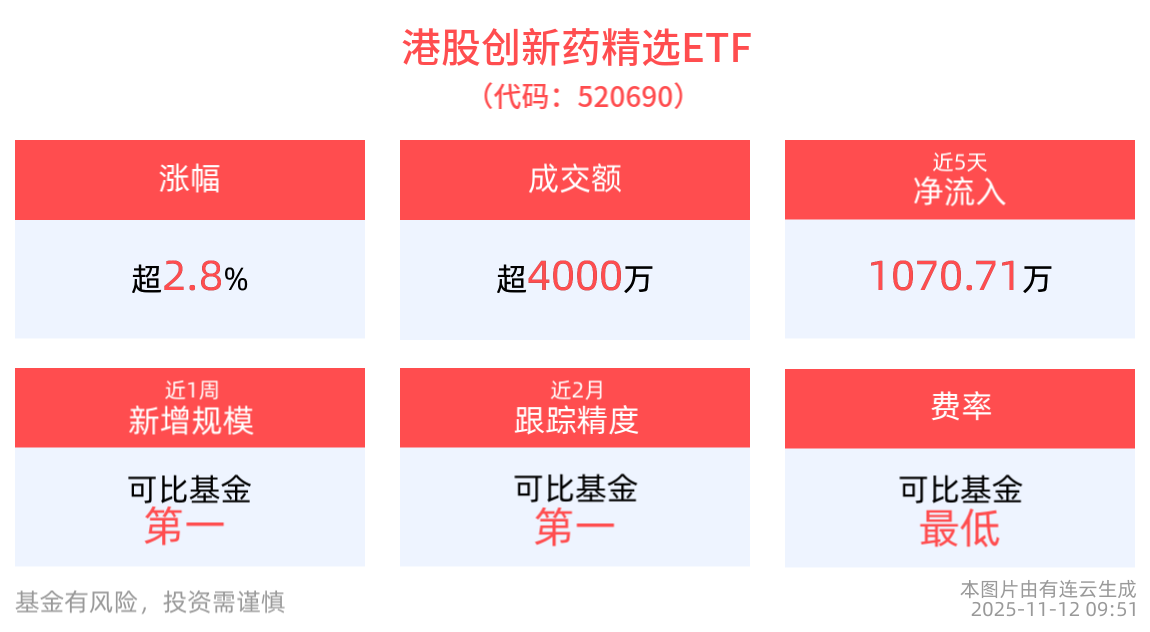
资金流入方面,港股创新药精选ETF最新资金流入流出持平。拉长时间看,近5个交易日内,合计"吸金"1070.71万元。 港股创新药精选ETF紧密跟踪恒生港股通创新药精选指数,恒生港股通创新药精选指数旨在反映可经港股通买卖,业务与创新药研究、开发及生产相关的香 港上市公司之表现。 数据显示,截至2025年10月8日,恒生港股通创新药精选指数前十大权重股分别为百济神州、中国生物制药、信达生物、石药集团、康方生物、三生制药、 翰森制药、科伦博泰生物-B、再鼎医药、诺诚健华,前十大权重股合计占比72.15%。 (文中个股仅作示例,不构成实际投资建议。基金有风险,投资需谨慎。) 截至2025年11月12日 09:51,恒生港股通创新药精选指数强势上涨3.17%,成分股百济神州上涨7.29%,映恩生物-B上涨4.74%,康方生物上涨4.63%,药捷安 康-B,三生制药等个股跟涨。港股创新药精选ETF(520690)上涨2.90%,最新价报0.92元。拉长时间看,截至2025年11月11日,港股创新药精选ETF近2周累计 上涨0.56%,涨幅排名可比基金1/2。 流动性方面,港股创新药精选ETF盘中换手8.57%,成交485 ...

康方生物涨近5% AK154单药或联合卡度尼利/依沃西辅助治疗胰腺癌Ⅰ期临床完成首例给药
Zhi Tong Cai Jing· 2025-11-12 02:05
Core Viewpoint - 康方生物's stock rose nearly 5%, reaching 119.9 HKD with a trading volume of 310 million HKD, following the announcement of the completion of the first patient dosing in a Phase I clinical trial for its personalized mRNA vaccine AK154 for postoperative adjuvant treatment of pancreatic cancer [1] Group 1: Company Developments - 康方生物 announced that its first self-developed personalized mRNA vaccine, AK154, has completed the first patient dosing in a Phase I clinical trial [1] - AK154 is the company's first mRNA drug to enter clinical stages, marking a significant breakthrough in the mRNA technology field after establishing advantages in multi-specific antibodies and antibody-drug conjugates [1] - The vaccine is developed based on an mRNA technology platform, utilizing tumor tissue sequencing and algorithms to select high-affinity immunogenic gene mutations for the preparation of specific mRNA vaccine sequences [1] Group 2: Clinical Trial Insights - AK154 aims to reverse the "cold tumor" characteristics of pancreatic cancer and is expected to enhance anti-tumor immunity when used in combination with immune dual antibodies [1] - The combination of AK154 with either the PD-1/CTLA-4 dual antibody or the PD-1/VEGF dual antibody is anticipated to produce a synergistic effect, further boosting the immune response against tumors [1]

港股异动 | 康方生物(09926)涨近5% AK154单药或联合卡度尼利/依沃西辅助治疗胰腺癌Ⅰ期临床完成首例给药
智通财经网· 2025-11-12 02:01
Core Viewpoint - 康方生物's stock rose nearly 5%, reaching 119.9 HKD with a trading volume of 310 million HKD following the announcement of the completion of the first patient dosing in a Phase I clinical trial for its personalized mRNA vaccine AK154 for postoperative adjuvant treatment of pancreatic cancer [1] Group 1: Company Developments - 康方生物 announced the completion of the first patient dosing in a Phase I clinical trial for its self-developed personalized mRNA vaccine AK154, in combination with either the PD-1/CTLA-4 dual antibody or the PD-1/VEGF dual antibody for pancreatic cancer treatment [1] - AK154 is 康方生物's first mRNA drug to enter clinical stages, marking a significant breakthrough in the mRNA technology field after establishing a leading position in multi-specific antibodies and antibody-drug conjugates [1] - The AK154 vaccine is developed based on an mRNA technology platform, utilizing tumor tissue sequencing and algorithms to select high-affinity immunogenic gene mutations, aiming to reverse the "cold tumor" characteristics of pancreatic cancer [1] Group 2: Clinical Research Insights - The combination of AK154 with immune dual antibodies is expected to produce a synergistic effect, further enhancing anti-tumor immunity [1]
中金2026年展望 | 生物医药:创新主旋律,出海与商保破局
中金点睛· 2025-11-11 23:41
Core Viewpoint - The article emphasizes the importance of the innovation-driven pharmaceutical industry in China, highlighting the trend of internationalization and the potential for growth in both innovative drugs and medical devices, while also addressing the challenges posed by domestic demand and healthcare financing [2][3][4]. Group 1: Innovation and Internationalization - The Chinese innovative pharmaceutical industry has transitioned from "importing and imitating" to "innovating and exporting," with significant internationalization evidenced by increasing license-out deals and collaborations [3][5]. - By 2025, Chinese innovative drugs are expected to demonstrate global competitiveness with high-quality clinical data presented at major international conferences [5][9]. - The trend of innovative drugs is supported by improved financing conditions and a favorable regulatory environment, leading to a new cycle for CXO and upstream sectors [3][4]. Group 2: Domestic Demand and Healthcare Financing - Domestic demand has been weak but is gradually improving, with commercial insurance playing a crucial role in alleviating payment conflicts [3][4]. - The healthcare sector is undergoing a normalization phase post-medical corruption investigations, which is expected to ease the impact on the industry by 2025 [3][4]. - The article highlights the need for a multi-layered healthcare financing system, with commercial insurance expected to inject new vitality into the payment landscape [24][25]. Group 3: Investment Strategies - The "barbell strategy" remains applicable in 2026, combining aggressive investments in innovative healthcare technologies with defensive positions in traditional dividend-paying stocks [4][22]. - The article suggests that high-dividend pharmaceutical stocks still have room for valuation recovery, particularly in light of the aging population and the essential nature of healthcare demand [23][24]. - Key investment windows are identified around the release of 2025 annual reports and the end of 2026, as these periods may attract institutional investment due to clearer assessments of dividend sustainability [23][24]. Group 4: Medical Devices and Equipment - The medical device sector is expected to see a recovery, with companies gradually clearing inventory and improving revenue growth [14][18]. - The article notes that the competitive landscape for medical devices is shifting, with high-end products maintaining price stability while lower-end products face price competition [18][19]. - Chinese medical device companies are accelerating their international expansion, with overseas revenue growth outpacing domestic revenue growth [19][20]. Group 5: Future Outlook - The integration of AI in healthcare is anticipated to create new tools and business models, particularly in drug development and clinical diagnostics [20][21]. - The article posits that while rapid growth in new technologies may be challenging in the short term, supportive policies and clear clinical needs will present investment opportunities in the healthcare sector [21][22].

关注器械及药房板块的低估值反转标的:医药生物行业2025年11月投资策略
Guoxin Securities· 2025-11-11 14:19
Core Insights - The report emphasizes the investment strategy for the pharmaceutical and biotechnology industry, particularly focusing on undervalued stocks in the medical device and pharmacy sectors, which are expected to experience a valuation reversal [1][5]. - The overall investment rating for the sector is maintained at "outperform the market" [2]. Industry Overview - The pharmaceutical manufacturing industry showed a cumulative revenue of 18,211 billion yuan with a year-on-year decline of 2.0% for the first nine months of 2025 [8]. - The total profit for the industry during the same period was 2,535 billion yuan, reflecting a decrease of 0.7% [8]. - The retail sales of Western and Chinese medicines reached 535.1 billion yuan, with a growth of 1.3% year-on-year [8]. Sector Performance - In October 2025, the pharmaceutical sector experienced an overall decline of 1.83%, underperforming the CSI 300 index by the same margin [9]. - Among sub-sectors, the pharmaceutical commercial sector saw an increase of 2.81%, while the medical services sector faced a decline of 4.14% [14]. Investment Strategy - The report recommends focusing on low-valuation stocks in the medical device and pharmacy sectors, highlighting companies such as Weigao Group, Yifeng Pharmacy, and Mindray Medical [5]. - The CXO sector is identified as having global competitiveness, with a strong long-term growth trajectory [5]. Company Recommendations - The investment portfolio for November 2025 includes A-shares such as Mindray Medical, WuXi AppTec, and Yeye Medical, and H-shares like Kangfang Biologics and Kelun-Botai [5][6]. - Specific companies are highlighted for their growth potential, including WuXi AppTec, which is expected to see significant revenue growth in the coming quarters [5]. Regulatory Environment - The report tracks ongoing centralized procurement projects for medical devices, indicating a structured approach to managing costs and ensuring compliance within the industry [29].



国内首款治疗儿童白血病的CAR-T获批上市;没能“嫁入”A股上市公司 海纳医药递表港交所|掘金创新药
Mei Ri Jing Ji Xin Wen· 2025-11-11 13:35
Market Performance - The pharmaceutical and biotechnology index declined by 2.62% from November 3 to November 7, underperforming the Shanghai Composite Index by 2.37 percentage points, marking seven consecutive weeks of underperformance [1] - The innovative drug sector (BK1106) fell by 3.51% during the week, while the Hang Seng Healthcare Index dropped by 2.39% and the Hong Kong innovative drug ETF (513120) decreased by 3.92% [1] Industry Commentary - After a strong rally, the innovative drug industry has entered a bubble-popping phase, with a return to rational investment not necessarily being negative for the sector. However, the current market adjustment appears excessive, with leading companies like Kangfang Biotech, Zai Lab, and Kelun-Biotech experiencing declines exceeding 30% [2] - Zai Lab's recent performance has been impacted by two public announcements: disappointing clinical data for its gastric cancer drug Bemarituzumab and a Q3 report showing total revenue of $116 million, a 14% year-on-year increase, but a net loss of $35.96 million, which is a narrowing of losses compared to the previous year. Revenue growth was primarily driven by sales of "Nusinersan" and "Dingyoule," offset by a slowdown in "Zele" sales [2] Short-term Outlook - In the short term, the innovative drug industry is undergoing emotional recovery and valuation reconstruction, with stock volatility heavily influenced by clinical data and earnings guidance. Zai Lab faces short-term emotional pressure due to the termination of a key clinical trial and downward adjustments in performance expectations. However, from a medium to long-term perspective, the innovative logic of the industry remains unchanged, with globally competitive pipeline assets being the core support for company valuations [3] IPO Developments - Nanjing Haina Pharmaceutical Technology Co., Ltd. has submitted an IPO application to the Hong Kong Stock Exchange, with CICC as the sole sponsor. This follows the termination of a major asset restructuring plan in June 2023, where Haina was to be acquired by Chengdu Xian Dao [4] - Haina Pharmaceutical, established in 2001, integrates drug research and manufacturing, providing CXO services and proprietary product pipelines. The company's revenue primarily comes from CXO services, with 398 ongoing CXO projects as of mid-2025 [4] Financial Performance - For 2024, Haina Pharmaceutical projects revenue of 425 million yuan, a year-on-year increase of 3.65%, but a net profit of 53.295 million yuan, reflecting a 27% decline, indicating a situation of "increased revenue but decreased profit." In the first half of the year, both revenue and net profit saw declines of 16.97% and 25.82%, respectively, attributed to a decrease in CRO service income and a 45.8% drop in sales of proprietary drugs [5] Clinical Trial Updates - From November 3 to November 7, the National Medical Products Administration disclosed 110 new clinical trial registrations, with 33 of these being innovative drugs in Phase II or above, primarily covering oncology, immunology, cardiovascular, and psychiatric fields [6] - Four innovative drugs were approved during the week [7] Notable Approvals - The first CAR-T therapy in China, Pucalunase injection (pCAR-19B), was approved for treating pediatric acute B lymphoblastic leukemia patients aged 3 to 21. This drug was previously included in breakthrough therapy and priority review categories [8] - Pucalunase is the fifth CD19 CAR-T product approved in China, following four others from various companies [9]


大消费强势爆发,互联网、医疗、银行等紧随其后
Ge Long Hui· 2025-11-11 12:30
Group 1 - The Hang Seng Index rose by 1.55% at the close, with significant gains in the consumer sector leading the market [1] - The consumer sector experienced a notable increase of 2.35%, with stocks like Mixue Group up by 8.98%, Pop Mart up by 8.11%, and Gu Ming up by 7.05% [3] - Other consumer stocks such as Haidilao, China Resources Beer, and Miniso also saw gains exceeding 4% [3] Group 2 - The internet sector rebounded, closing up by 1.26%, with Tencent Holdings increasing by 2.44%, Kuaishou by 2.27%, and Alibaba by 2.06% [3] - Other internet stocks like SenseTime, Meituan, and Baidu also recorded gains above 1% [3] Group 3 - The healthcare sector showed weak consolidation but had some intraday movements, closing up by 1.11% [3] - Notable healthcare stocks included JD Health, which rose by 3.28%, CSPC Pharmaceutical by 2.71%, and BeiGene by 2.63% [3] - Other healthcare stocks such as Hansoh Pharmaceutical and WuXi Biologics also saw gains above 1% [3]

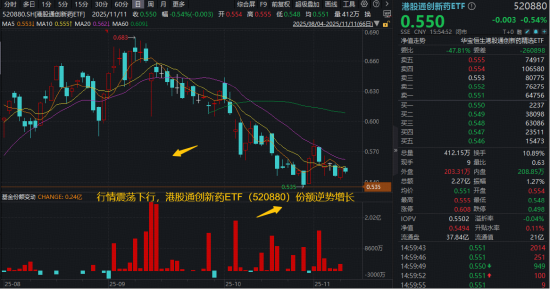
创新药震荡不止,资金却坚定逆行,什么原因?港股通创新药ETF(520880)基金经理最新解读来了!
Xin Lang Ji Jin· 2025-11-11 12:09
Core Viewpoint - The current adjustment in the innovative drug sector may still be in a bottoming phase, with mixed performance observed in the Hong Kong Stock Connect Innovative Drug ETF (520880) since November, indicating a lack of sustained momentum [1][5]. Fund Performance - The Hong Kong Stock Connect Innovative Drug ETF (520880) has seen a significant increase in both share count and fund size, with the fund size surpassing 2 billion yuan for the first time on November 3, marking a 392% increase since its launch on July 7 [3]. - As of November 10, the fund's share count reached 3.784 billion, setting a new record since its inception [3]. Market Analysis - The current market adjustment has been substantial in both time and price, with historical data indicating that the average correction duration for the innovative drug index is 30-40 days, with a typical decline of around 20% [5]. - Recent performance of leading innovative drug companies, such as BeiGene and CanSino Biologics, has shown strong earnings, suggesting a continued positive trend in the industry [5]. Investment Strategy - The fund manager emphasizes that the innovative drug market may soon rebound, suggesting that the current phase presents a high probability of success for investors [5]. - The upcoming year-end is expected to be an active period for mergers and acquisitions in the U.S. biopharmaceutical sector, along with the JPMorgan Healthcare Conference in early January, which could serve as catalysts for the market [6]. ETF Characteristics - The Hong Kong Stock Connect Innovative Drug ETF (520880) is the first ETF tracking the Hang Seng Hong Kong Stock Connect Innovative Drug Select Index, which has three key advantages: it is purely focused on innovative drugs, has a high concentration of leading companies, and offers better risk control by reducing the weight of less liquid stocks [6][7]. - The top ten holdings in the ETF account for over 71% of the total weight, highlighting the dominance of leading companies in the innovative drug sector [8].
A股生物医药行业2025三季报总结:创新药及产业链持续高景气,关注反转标的
Guoxin Securities· 2025-11-11 11:04
Investment Rating - The investment rating for the biopharmaceutical industry is "Outperform the Market" (maintained) [2] Core Insights - The biopharmaceutical industry in A-shares has shown marginal improvement in revenue and profit performance in Q3 2025, with a continued high prosperity in innovative drugs and the industry chain [6][7] - The innovative drug sector has demonstrated robust growth, with a revenue increase of 21.41% year-on-year in the first three quarters of 2025, while the CXO sector also showed significant growth [6][10] - There is a focus on undervalued turnaround targets in the medical device and pharmacy sectors, which have shown signs of stabilization and recovery [6][20] Summary by Sections Financial Summary - In the first three quarters of 2025, A-share pharmaceutical companies achieved a total revenue of 17,480.2 billion yuan, a year-on-year decrease of 1.22%, and a net profit of 1,355.8 billion yuan, down 1.00% year-on-year [6][7] - The innovative drug sector generated revenue of 485.6 billion yuan (+21.41%) and a net profit of -4.6 billion yuan, significantly reducing losses [6][10] - The CXO sector reported revenue of 698.7 billion yuan (+11.66%) and a net profit of 163.9 billion yuan (+56.78%) [6][15] Innovative Drug Sector - The innovative drug sector's revenue for Q3 2025 reached 191.7 billion yuan (+50.66%), with a net profit of 13.1 billion yuan (+155.49%) [10] - The growth in revenue is attributed to the rapid commercialization of innovative drug products and milestone payments from product licensing [10][11] CXO Sector - The CXO sector's revenue for Q3 2025 was 247.5 billion yuan (+10.03%), with a net profit of 51.1 billion yuan (+47.69%) [15] - The sector continues to show mid-to-high-speed growth, although there is some internal differentiation among companies [15] Medical Device Sector - The medical device sector reported revenue of 1,776.8 billion yuan (-2.26%) and a net profit of 265.9 billion yuan (-14.05%) in the first three quarters of 2025 [20] - The sector is expected to recover gradually, with recommendations to focus on leading companies benefiting from domestic demand and international expansion [20] Traditional Chinese Medicine Sector - The traditional Chinese medicine sector achieved revenue of 2,548.7 billion yuan (-3.58%) and a net profit of 302.6 billion yuan (-0.85%) in the first three quarters of 2025 [18] - The sector is stabilizing, with ongoing risks from national procurement policies [18] Life Sciences Upstream - The life sciences upstream sector reported revenue of 96.6 billion yuan (+7.96%) and a net profit of 8.6 billion yuan (+32.08%) in the first three quarters of 2025 [24] - The sector is expected to see improvements in demand as inventory depletion phases out and companies increase R&D investments [25]