
万华化学

Search documents
化工行业ETF易方达(516570)盘中冲高涨近3%,基础化工龙头率先突围,业绩修复弹性凸显
Xin Lang Cai Jing· 2026-01-19 03:04
Group 1 - The core viewpoint of the news highlights a strong performance in the chemical industry, particularly with the ETF E Fund (516570) experiencing significant gains and record high inflows, driven by a rebound in potassium and lithium product prices [1] - As of January 16, the E Fund chemical industry ETF reached new highs in both scale and shares since its inception, with a net inflow of 13.4475 million yuan [1] - A total of 21 A-share basic chemical companies have disclosed their annual performance forecasts, with 11 companies expecting growth, indicating a recovery in multiple sub-sectors within the industry [1] Group 2 - Huatai Securities predicts that the second half of 2025 will see a significant decline in profitability for bulk chemicals due to weak demand and the end of supply-side increases, marking a ten-year low for the industry [2] - The chemical raw materials and products sector is currently at a turning point from active destocking to passive restocking, with fixed asset completion growth turning negative starting June 2025 [2] - The E Fund ETF includes leading companies in the petrochemical and basic chemical sectors, employing a "dumbbell strategy" that combines high dividend and high growth components, outperforming comparable chemical industry indices since 2023 [2] Group 3 - The management and custody fee rates for the E Fund ETF are significantly lower than those of similar products in the petrochemical sector, which helps reduce costs for investors and enhances the value proposition for investing in the chemical industry [3]
涨超2.0%,石化ETF(159731)连续8天净流入
Sou Hu Cai Jing· 2026-01-19 02:41
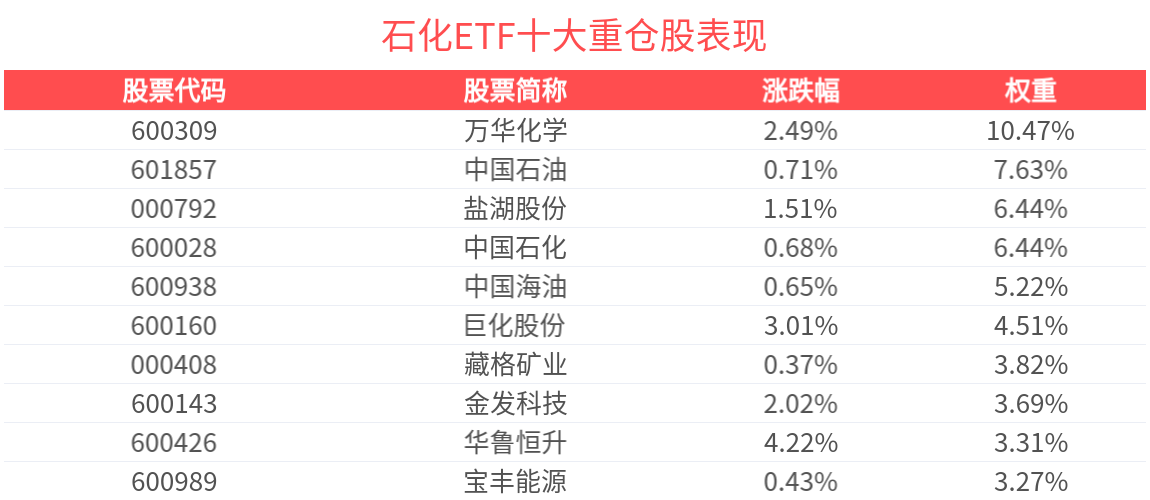
Core Insights - The petrochemical industry index has shown a strong increase of 1.88%, with significant gains in constituent stocks such as Yara International (up 4.93%) and Haohua Technology (up 4.58%) [1] - The Petrochemical ETF (159731) has experienced continuous net inflows over the past 8 days, totaling 269 million yuan, reaching a record high in both shares and scale [2] - The Petrochemical ETF has achieved a net value increase of 53.13% over the past two years, with a maximum single-month return of 15.86% since its inception [2] Fund Performance - The Petrochemical ETF's latest share count is 549 million, with a total scale of 522 million yuan [2] - The ETF has recorded an average monthly return of 5.25% during its rising months, with the longest consecutive rising streak lasting 8 months and a total increase of 41.60% [2] - The top ten weighted stocks in the index account for 56.73% of the total, including major companies like Wanhua Chemical and China Petroleum [2] Stock Performance - Notable stock performances include Wanhua Chemical (up 2.49%, weight 10.47%), China Petroleum (up 0.71%, weight 7.63%), and Salt Lake Potash (up 1.51%, weight 6.44%) [4] - Other significant stocks include China Petrochemical (up 0.68%, weight 6.44%) and Haohua Technology (up 4.22%, weight 3.31%) [4]

ETF盘中资讯|直线暴拉!化工ETF(516020)涨超2%,主力资金狂涌!机构高呼“盈利底+估值底”或现
Sou Hu Cai Jing· 2026-01-19 02:41
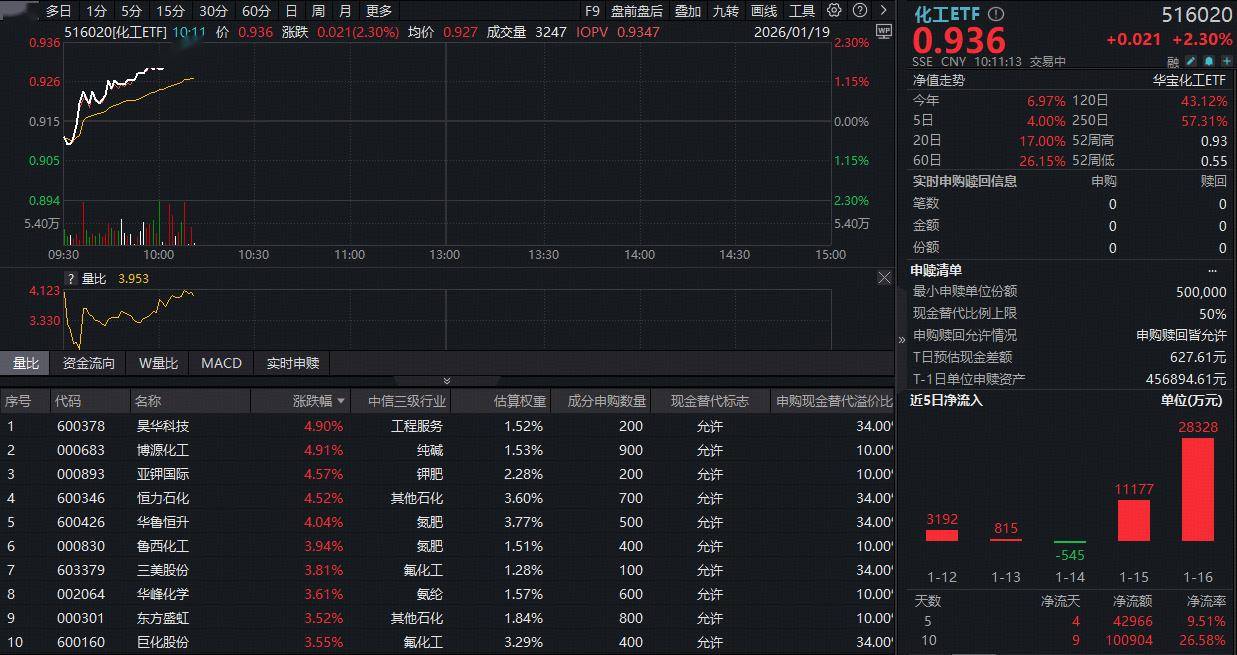
Group 1 - The chemical sector is experiencing a strong rally, with the chemical ETF (516020) rising by 2.3% after a slight opening dip [1] - Key stocks in the sector, including Haohua Technology, Yara International, and Hengli Petrochemical, have seen significant gains, with increases exceeding 4% [1] - The basic chemical sector has attracted substantial capital, with a net inflow of over 4.2 billion yuan in the last five trading days for the chemical ETF [3] Group 2 - The total export of power and energy storage batteries from China reached 305.0 GWh in 2022, marking a year-on-year growth of 50.7% [3] - Power batteries accounted for 189.7 GWh of the total exports, with a year-on-year increase of 41.9%, while energy storage batteries reached 115.3 GWh, growing by 67.9% [3] Group 3 - Analysts predict a recovery in profitability for the chemical industry in 2026, as the sector is at a new starting point for supply-demand rebalancing [4] - The current phase of the chemical sector is characterized by a bottoming out of profitability cycles and an end to the expansion cycle, suggesting potential upward movement in valuations [4] - The chemical ETF (516020) is recommended for investors looking to capitalize on the rebound opportunities in the chemical sector, with a focus on large-cap leading stocks and sectors undergoing changes [4]


再论2026年化工行业投资机会
2026-01-19 02:29
Summary of Key Points from the Conference Call Industry Overview - The chemical industry is expected to recover to standard or even overweight allocation levels due to improved industry sentiment and performance indicators such as revenue, profit, and gross margin starting from Q2 2025 [1][3][4]. Core Insights and Arguments - **Current State of Chemical Sector**: The basic chemical and petrochemical sectors are currently under-allocated, although there has been a recent uptick. Historical data suggests that these sectors typically outperform the market in the first two quarters following the initiation of a five-year plan [3][4]. - **Impact of European Capacity Closures**: Europe has closed approximately 11 million tons of chemical production capacity since 2023, alleviating supply-demand pressures in both domestic and international markets [1][6]. - **Investment in Infrastructure**: The State Grid's planned investment of 4 trillion RMB over the next five years is expected to drive demand in related chemical sectors [1][6]. Subsector Highlights - **Refrigerants**: The refrigerant sector is anticipated to maintain high levels of profitability due to the ongoing implementation of quota schemes. Prices are expected to stabilize at high levels, with shorter procurement cycles for downstream air conditioning manufacturers [1][5]. - **Phosphate Chemicals**: Phosphate rock prices remain stable, supported by unexpected demand in energy storage. Recent price increases in glyphosate and other pesticide varieties indicate a positive outlook for this sector [1][7]. Oil Price Projections - Oil prices are projected to stabilize between $55 and $60 per barrel in 2026, with potential geopolitical factors causing temporary spikes. The overall sentiment regarding oil prices remains optimistic, which is crucial for the petrochemical sector [2][11]. Potential Investment Opportunities - **High-Performing Sectors**: The refrigerant and phosphate chemical sectors are highlighted as areas of sustained high sentiment and favorable market expectations for investment in 2026 [1][5][17]. - **Recovery Potential**: Sectors currently experiencing low sentiment, such as refining and polyester, organic silicon, and PVC, may see a rebound due to limited new capacity and price elasticity [17][12]. - **Traditional Chemical Stocks**: Companies with reasonable or undervalued valuations, such as Wanhua Chemical and Huayu Chemical, may present opportunities for valuation recovery if industry sentiment improves [13][17]. Emerging Trends - **New Materials**: The new materials sector is expected to see continuous demand growth driven by applications in robotics, aerospace, and biofuels. Key areas include electronic chemicals and lightweight materials [14][18]. - **AI and Semiconductor Growth**: The development of AI applications and semiconductor chips is anticipated to drive sustained demand growth in the coming years [15]. Conclusion - The chemical industry is poised for recovery, with specific subsectors like refrigerants and phosphates showing strong potential. Investment strategies should focus on both high-performing sectors and those with recovery potential, while keeping an eye on emerging trends in new materials and technology applications [1][17].
化工ETF(159870)涨超2%,制冷剂R404A、R507陆续提升报价
Xin Lang Cai Jing· 2026-01-19 02:21
Group 1 - The core viewpoint of the news is that the prices of refrigerants R404A and R507 are increasing, driven by demand from overseas markets, particularly as A5 countries approach the end of their quota baseline year, leading to a surge in imports of high GWP refrigerants and boosting exports from China [1] - The external trade price of refrigerants has risen to approximately 35,000 yuan per ton, while domestic prices have increased to around 49,000 yuan per ton, indicating a growing market atmosphere as companies actively raise prices [1] - The overall inventory in the industry is at a near two-year low, combined with production constraints due to quota limitations and high industry concentration, resulting in widespread reluctance among companies to sell, which further supports price increases [1] Group 2 - The CSI Sub-Industry Chemical Theme Index (000813) has seen a strong increase of 1.86%, with constituent stocks such as Haohua Technology rising by 5.27%, Yara International by 4.68%, and Boyuan Chemical by 4.26% [1] - The Chemical ETF (159870) has risen by 2.10%, with the latest price reported at 0.88 yuan [1] - As of December 31, 2025, the top ten weighted stocks in the CSI Sub-Industry Chemical Theme Index include Wanhua Chemical, Salt Lake Shares, and others, collectively accounting for 45.31% of the index [2]
直线暴拉!化工ETF(516020)涨超2%,主力资金狂涌!机构高呼“盈利底+估值底”或现
Xin Lang Cai Jing· 2026-01-19 02:21
Group 1 - The chemical sector is experiencing a strong rally, with the chemical ETF (516020) rising by 2.3% after a slight opening dip [1][9] - Key stocks in the sector, including Haohua Technology, Yaqi International, and Hengli Petrochemical, have seen significant gains of over 4%, while others like Sanmei Co., Dongfang Shenghong, and Juhua Co. have increased by over 3% [1][9] - The basic chemical sector has attracted substantial capital, with a net inflow of over 4.2 billion yuan on the day, ranking second among 30 CITIC primary industries [1][10] Group 2 - Over the past 60 days, the basic chemical sector has accumulated a total net inflow of 253.9 billion yuan, placing it third among the 30 CITIC primary industries [1][10] - The chemical ETF (516020) has seen consistent net subscriptions, with over 4.2 billion yuan in net subscriptions over the last five trading days and more than 10 billion yuan over the last ten trading days [3][11] Group 3 - The China Automotive Power Battery Industry Innovation Alliance reported that the cumulative export of power and energy storage batteries reached 305.0 GWh in 2022, a year-on-year increase of 50.7% [4][12] - The chemical industry is expected to see a recovery in profitability by 2026, as it enters a new phase of supply-demand rebalancing, influenced by policies and advancements in AI and robotics [4][12] - Current conditions suggest that the chemical sector is at the bottom of its profitability cycle, with potential for upward valuation movement in a liquidity-rich environment [4][12] Group 4 - The chemical ETF (516020) tracks the CSI sub-sector chemical industry theme index, with nearly 50% of its holdings concentrated in large-cap leading stocks, providing investment opportunities in sectors like AI computing and new energy [5][13] - Investors can also access the chemical ETF through linked funds, which have specific subscription and redemption fee structures [6][7]
国际油价小幅上涨,丁二烯、环氧丙烷价格上涨 | 投研报告
Sou Hu Cai Jing· 2026-01-19 01:41
Core Viewpoint - The report highlights the current trends in the chemical industry, focusing on price movements, supply-demand dynamics, and investment opportunities in undervalued leading companies amid a backdrop of strong downstream demand and geopolitical tensions [1][3][7]. Industry Dynamics - In the week of January 12-18, 49 out of 100 tracked chemical products saw price increases, while 20 experienced declines, and 31 remained stable. The average price of 49% of products rose month-on-month, while 39% fell [2]. - The average price of WTI crude oil futures increased by 0.54% to $59.44 per barrel, and Brent crude oil futures rose by 0.66% to $63.76 per barrel during the same week [3]. - As of January 9, U.S. crude oil production averaged 13.753 million barrels per day, a decrease of 58,000 barrels from the previous week but an increase of 2.72 million barrels compared to the same period last year [3]. Price Movements - The price of butadiene rose to 9,663 yuan per ton, up 4.04% week-on-week and 25.98% month-on-month, although it is down 20.8% year-on-year [4]. - Epoxy propane prices increased to 8,620 yuan per ton, reflecting an 8.84% rise week-on-week and a 9.88% increase year-on-year [5][6]. Investment Recommendations - As of January 18, the price-to-earnings (P/E) ratio for the basic chemical sector is 14.68, while the oil and petrochemical sector stands at 13.44, indicating potential investment opportunities in undervalued leading companies [7]. - The report suggests focusing on sectors benefiting from strong downstream demand, including electronic materials and certain new energy materials companies, as well as companies that are well-positioned amid supply-side reforms [7]. - Recommended stocks include Wanhua Chemical, Hualu Hengsheng, and others, with a focus on companies in emerging fields such as semiconductor materials and OLED materials [7][8].
【基础化工】“AI+”赋能化工研发制造,26年小核酸药物迎快速增长期——行业周报(20260112-20260116)(赵乃迪/周家诺/蔡嘉豪/王礼沫)
光大证券研究· 2026-01-18 23:04
Core Viewpoint - The article emphasizes the ongoing integration of artificial intelligence (AI) in various industries, particularly in manufacturing and pharmaceuticals, driven by government policies and technological advancements [4][5][6]. Group 1: AI Integration in Manufacturing - The Chinese government has issued policies to promote the integration of AI in manufacturing, focusing on quality improvement and efficiency through technologies like large models and digital twins [4]. - Key players in the chemical industry, such as China National Petroleum, China Petroleum & Chemical, and China National Offshore Oil Corporation, are developing industry-specific AI models to enhance core business operations [5]. - Companies like Wanhua Chemical are leveraging third-party AI platforms to achieve cost reduction and efficiency in production management and material research [5]. Group 2: Growth of Small Nucleic Acid Drugs - The global market for small nucleic acid drugs has seen significant growth, with a compound annual growth rate (CAGR) of 217.8%, increasing from $0.1 billion in 2016 to $3.25 billion in 2021 [6]. - Projections indicate that the market for oligonucleotide drugs will exceed $15 billion by 2026, with a CAGR of 35% from 2020 to 2025 [6]. - The industry is expected to transition from technological breakthroughs to large-scale commercialization, indicating a promising future for the small nucleic acid drug sector [6]. Group 3: Key Players in Small Nucleic Acid Development - Bluestar Technology has established a comprehensive technology platform for small nucleic acids and peptide drugs, being one of only two global suppliers capable of providing integrated solutions for complex oligonucleotide synthesis [7]. - Lonza Technology is expanding its CDMO services globally, achieving significant progress in partnerships with leading pharmaceutical companies and enhancing its domestic collaborations [7].


万华化学,两大年产100万吨项目复产
DT新材料· 2026-01-18 16:05
Group 1 - The core viewpoint of the article highlights the recovery of Wanhua Chemical's MDI production capacity, which is crucial for supplying raw materials to downstream industries such as home appliances, construction, and automotive during the upcoming production peak season [2] - Wanhua Chemical currently has an MDI production capacity of 3.8 million tons per year and TDI capacity of 1.11 million tons per year, maintaining its leading position in the industry. After the completion of the Fujian base expansion project in 2026, the total MDI capacity will reach 4.5 million tons [3] - The successful resumption of a 1 million tons/year ethylene unit after a 7-month upgrade marks a significant transition from traditional propane cracking to ethane cracking, enhancing the flexibility of raw material sourcing [3][4] Group 2 - The domestic ethylene industry is accelerating its transition towards lighter and more diversified raw materials, with policies encouraging the exploration of ethane and propane cracking processes to optimize raw material structures and enhance competitiveness [4] - The newly implemented dual-feed flexible feeding system allows the upgraded unit to switch between ethane and propane based on market conditions, effectively mitigating supply chain risks associated with reliance on a single raw material [4]

股指周报:大盘短期或宽幅震荡,但中期股指上涨逻辑不变-20260118
Hua Lian Qi Huo· 2026-01-18 14:37
Report Industry Investment Rating No information provided on the report industry investment rating. Core View of the Report The short - term market may experience wide - range fluctuations, but the medium - term upward logic of stock index remains unchanged. After a sharp rise, the short - term market may have large - scale fluctuations. Heavy - position profit - takers are advised to reduce positions on last Tuesday and Wednesday, then cover positions on dips or conduct intraday short - term trading. The spring market long - position window has opened, and the market will maintain an oscillating upward pattern. The mid - term view of being bullish on the stock index remains unchanged under the continuous increase of margin trading funds and the stabilization of the third - quarter report performance [16]. Summary by Directory 1. Weekly View and Strategy - **Fundamental View**: Last week, the market rose first and then fell. The performance of the four major indexes was different, with small and medium - cap indexes rising and large - cap indexes falling. The growth and cyclical style indexes continued to rise, while the financial, consumer, and stable style indexes declined. In the Shenwan industry, TMT and cyclical sectors such as computer, electronics, non - ferrous metals, and media led the rise, while sectors such as military industry, real estate, agriculture, and coal led the decline. In December 2025, the manufacturing PMI was 50.1%, up 0.9 percentage points from the previous month; the non - manufacturing PMI was 50.2%, up 0.7 percentage points from the previous month. The supply and demand sides of the manufacturing PMI continued to recover. The A - share performance showed signs of stabilization in the first quarter, declined in the second quarter, and continued to stabilize and recover in the third quarter [7][10]. - **Strategy View and Outlook**: The short - term market may experience wide - range fluctuations, but the medium - term upward logic of the stock index remains unchanged. It is recommended that heavy - position profit - takers reduce positions and then cover positions on dips or conduct intraday short - term trading. The spring market long - position window has opened, and the market will maintain an oscillating upward pattern. The mid - term view of being bullish on the stock index remains unchanged. In operation, long - term mid - line positions can be held, and short - term long positions should set stop - profit levels. Call options can be held with short - term stop - profit levels set [16]. 2. Index Industry Trend Review - Last week, the market rose first and then fell. The performance of the four major indexes was different, with small and medium - cap indexes rising and large - cap indexes falling. The growth and cyclical style indexes continued to rise, while the financial, consumer, and stable style indexes declined. In the Shenwan industry, TMT and cyclical sectors such as computer, electronics, non - ferrous metals, and media led the rise, while sectors such as military industry, real estate, agriculture, and coal led the decline [22][25]. 3. Main Contract and Basis Trend - Among the four major indexes, IC and IM continued to rise, while IH and IF adjusted. In terms of basis, the quarterly main contract basis of IM returned to a reasonable level. In terms of arbitrage among main contracts, IC/IF and IC/IH oscillated upwards, IH/IF oscillated, IM/IF and IM/IH oscillated upwards, and IM/IC continued to decline [32][36]. 4. Policy and Economy - **Economic Data**: In December 2025, the manufacturing PMI was 50.1%, up 0.9 percentage points from the previous month; the non - manufacturing PMI was 50.2%, up 0.7 percentage points from the previous month. The supply and demand sides of the manufacturing PMI continued to recover. PPI has shown different trends since 2023. In November 2025, industrial enterprise revenue continued to decline to 1.6%, and inventory continued to rise to 4.6%. The growth rate of medium - and long - term credit has been falling since May 2023, reaching 5.89% in November 2025 [42][45][53]. - **Policy**: The Politburo set the tone for the real estate market to stop falling and stabilize and boost the capital market. The State Council issued the New Nine - Point Plan to strengthen investor returns. The central bank created two new monetary policy tools. The implementation plan for promoting the entry of medium - and long - term funds into the market was officially released, which is expected to add 800 billion yuan of long - term funds to the A - share market annually [10]. 5. Revenue and Net Profit of Each Index - The performance of A - shares showed signs of stabilization in the first quarter, declined in the second quarter, and continued to stabilize and recover in the third quarter. In the third quarter of 2025, the performance of the four major indexes rebounded again [79][83]. 6. Valuation - The Shanghai Composite Index's valuation is 17.0155, with an upper - limit value of 15.68, at the 92.32 percentile since 2010, indicating a high valuation. The ChiNext's valuation is relatively low [94]. 7. Fed Interest Rate No information provided on the Fed interest rate. 8. Capital Flows - **Margin Trading**: In 2024, the net inflow was 274.8 billion yuan; in 2025, it was 670 billion yuan; as of January 15, 2026, the net inflow was 177.1 billion yuan, with a large net inflow of 98.1 billion yuan in the first five trading days. - **ETF**: From April 7, 2025, to January 16, 2026, the ETF scale increased by 71.8 billion yuan, 137.1 billion yuan less than the previous week. As of January 16, 2026, the ETF funds had a small net outflow of 138.3 billion yuan. - **Private Securities Investment Funds**: The scale increased by 1.8253 trillion yuan in the first 11 months of 2025, with a significant increase of 1.040028 trillion yuan in October, and the current total scale is 7.0076 trillion yuan. The newly registered scale in the first 11 months of 2025 was 433.7 billion yuan. - **Insurance Funds**: In the third quarter of 2025, the market value of A - shares held by insurance funds increased by 552.4 billion yuan, a month - on - month increase of 18.00%. In the first three quarters of 2025, the market value of A - shares held by insurance funds increased by 1.193 trillion yuan, and after deducting the scale increase, it increased by 758.4 billion yuan. - **Newly Established Funds**: As of September 30, 2025, the newly established stock - type fund shares were 323.3 billion, of which 137 billion were in the third quarter; the newly established hybrid - type fund shares were 103.6 billion, of which 53 billion were in the third quarter. In 2025, index - type funds had a net inflow of 104.9 billion yuan, while active equity - type funds had a net outflow of 444.9 billion yuan, and equity - type funds had a net outflow of 340 billion yuan [13][103][105]. 9. Technical Analysis No information provided on technical analysis other than the historical price charts of the four major indexes.