
光大证券

Search documents
十大券商看后市|A股中线看多,“跨年+春季”行情有望持续
Xin Lang Cai Jing· 2025-12-29 00:33
Group 1 - The core viewpoint is that the A-share market is expected to experience a "cross-year + spring" rally, supported by favorable conditions such as liquidity and risk appetite [1][7][13] - Spring market conditions remain favorable due to loose liquidity, with private equity actively purchasing on dips and the appreciation of the RMB benefiting market liquidity [1][6] - Historical trends indicate that the A-share market typically experiences a "spring rally," and policy support is expected to continue, bolstering market confidence and attracting various funds [1][14] Group 2 - The market is anticipated to see a "systematic slow bull" trend, with a high level of confidence in the medium-term outlook, although short-term movements may require cautious observation [2][11] - The A500 ETF has shown significant net inflows, indicating stable incremental funds entering the market, despite potential seasonal outflows in the following quarter [12][7] - The appreciation of the RMB is expected to resonate with the capital market, enhancing industry configurations and attracting foreign investment [10][9] Group 3 - The focus on structural opportunities in a volatile market suggests that sectors with low attention but high long-term ROE potential, such as chemicals and engineering machinery, should be prioritized [3][15] - The "transformation bull" market is characterized by economic structural changes and capital market reforms, indicating a shift in investment focus towards emerging technologies and large financial institutions [5][4] - The market is likely to experience fluctuations, especially as the year-end approaches and companies begin to disclose annual performance forecasts, which may lead to a preference for large-cap value stocks [8][11]
【十大券商一周策略】A股跨年行情已经启动,新的主线浮出水面
Xin Lang Cai Jing· 2025-12-28 15:19
Core Viewpoint - The A-share market is expected to experience a spring rally driven by liquidity, policy expectations, and structural opportunities, with a focus on sectors like AI, commercial aerospace, and non-bank financials [5][10][12]. Group 1: Market Trends and Predictions - 39 out of 360 industry/theme ETFs reached new highs in December, with communication and non-ferrous metals being traditional favorites, while new themes like commercial aerospace are gaining traction [3]. - The A-share market is showing signs of a spring rally, supported by liquidity and positive policy expectations, with a focus on sectors such as technology and advanced manufacturing [5][10]. - The market is expected to maintain a high risk appetite due to favorable conditions, including a weak dollar and the upcoming Chinese New Year and Two Sessions [11][16]. Group 2: Sector Focus and Investment Opportunities - Key sectors to watch include AI, commercial aerospace, and non-ferrous metals, which are expected to benefit from structural changes and increased demand [10][12]. - The manufacturing sector, particularly in chemicals and engineering machinery, is showing signs of recovery and is expected to benefit from the shift in global competition [3][4]. - Non-bank financials, including insurance and brokerage firms, are positioned to benefit from the anticipated capital inflows and improved asset returns [9][12]. Group 3: Currency and Economic Factors - The appreciation of the RMB is expected to lower import costs and enhance domestic purchasing power, benefiting sectors reliant on imports and domestic consumption [7][9]. - The potential for significant capital inflows due to RMB appreciation could lead to a revaluation of Chinese assets, creating a favorable environment for investment [7][9]. - The overall economic environment is improving, with expectations of continued liquidity support and a stable policy backdrop, which is conducive to market growth [5][10].




券商大集合,谢幕!
券商中国· 2025-12-28 14:59
Core Viewpoint - The article discusses the impending expiration of the broker's large collective asset management products, which have significantly decreased in scale over the years, indicating a major shift in the asset management landscape in China [2][3][4]. Group 1: Overview of Broker's Large Collective Products - The broker's large collective asset management products, which were once a significant part of the financial landscape, are set to expire by December 31, 2025, with only 9 products remaining as of late December 2023 [2][4]. - The scale of these products has dramatically decreased from approximately 1 trillion yuan to near zero due to regulatory changes and market dynamics [2][5]. - The products were originally established under regulations that allowed for an unlimited number of investors, but changes in the law in 2013 restricted new issuances, leading to a gradual decline in their prevalence [4][5]. Group 2: Regulatory Changes and Their Impact - The China Securities Regulatory Commission (CSRC) initiated a reform process in 2018, which mandated that existing large collective products must transition to either private or public fund structures or face liquidation [6][8]. - Many products have opted to convert to public funds, with some notable examples of successful transitions, while others have been liquidated or converted to private funds [6][7]. - The regulatory framework has led to multiple extensions for certain products, indicating challenges in compliance and adaptation to the new rules [8]. Group 3: Current Status and Future Outlook - As of December 2023, the remaining products are primarily set to expire in 2025, with one product having received an extension into mid-2026 [4][8]. - The trend indicates a significant shift towards public fund structures, reflecting a broader move in the industry towards more regulated and transparent investment vehicles [6][7].

A股多项纪录收入囊中,滞涨券商放量躁动,顶流券商ETF(512000)上探近2%,2026或迎四大催化
Xin Lang Cai Jing· 2025-12-28 11:30
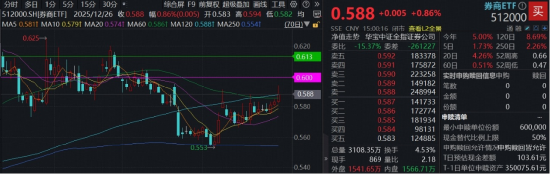
Core Viewpoint - The brokerage sector is experiencing a resurgence, with the top-performing brokerage ETF (512000) showing a price increase and significant trading volume, indicating renewed investor interest despite a lackluster performance throughout the year [1][9]. Group 1: Market Performance - The brokerage ETF (512000) has seen a year-to-date increase of only 3.96%, significantly lagging behind the broader market indices, which have shown much higher gains [3][11]. - The sector's price-to-book ratio (PB) stands at 1.5 times, which is at a low level compared to the historical average over the past decade [3][11]. - Individual stocks within the sector have shown positive movements, with notable gains from companies like China Merchants Securities and Industrial Securities [1][9]. Group 2: Future Growth Drivers - The brokerage industry is entering a new growth cycle driven by three core factors: the service of new productive forces, the influx of long-term capital, and opportunities for internationalization [5][13]. - By 2026, the sector is expected to benefit from four catalysts: increased market activity due to the relocation of household savings, enhanced market resilience leading to improved profitability, opportunities in direct financing for tech enterprises, and ongoing mergers and acquisitions among brokerages [14][15]. - Regulatory support for the development of first-class investment banks is anticipated to further enhance the sector's valuation and growth potential [15]. Group 3: Investment Tools - The brokerage ETF (512000) is a highly efficient investment tool that passively tracks the CSI All Share Securities Companies Index, encompassing 49 listed brokerage stocks [7][15]. - The ETF has a fund size exceeding 400 billion yuan and has maintained a daily trading volume of over 10 billion yuan, making it one of the most liquid ETFs in the A-share market [7][15].
光大证券:多重支撑护航 春季行情行稳致远
Xin Lang Cai Jing· 2025-12-28 08:12
Group 1 - A-shares showed strong performance this week, with major indices generally rising, particularly the CSI 500, ChiNext Index, and the Small and Medium 100, while the Shanghai Composite and CSI 300 had smaller gains [1][6] - The current valuation of the Sci-Tech 50 and Wind All A indices is relatively high, with their PE (TTM) percentile exceeding 85% since 2010, as of December 26, 2025 [1][6] - Small-cap growth style outperformed this week, with significant gains in sectors such as non-ferrous metals and defense, while sectors like beauty care and social services saw declines [1][6] Group 2 - The A-share market is expected to continue its upward trend, supported by favorable policies and increased capital inflows, with historical patterns indicating a "spring rally" [3][8] - The trading volume has increased, surpassing 2 trillion yuan on Friday, with a total weekly turnover of 9.83 trillion yuan, marking a six-week high [3][8] - Policy support is anticipated to boost market confidence and attract various types of capital, with a focus on growth and consumption sectors, particularly TMT and advanced manufacturing during the "spring rally" [4][9] Group 3 - Recent policy developments include the People's Bank of China announcing a one-time credit repair policy, and the housing and urban-rural development meeting outlining real estate priorities for 2026 [2][7] - The issuance of L3 level autonomous driving vehicle licenses in Beijing marks a significant step in the automotive industry, alongside the 2025 Computing Power Internet Conference held in Chengdu [2][7] - The EU has extended economic sanctions against Russia for six months until July 31, 2026, and Japan has finalized its budget for the 2026 fiscal year, setting a new historical high [2][7]
收官之年,券商IT“成色”几何?
Zhong Guo Ji Jin Bao· 2025-12-28 06:05
Core Viewpoint - The securities industry is undergoing a digital transformation driven by technology and AI, with increasing regulatory scrutiny on compliance in IT operations [1][4]. Group 1: Digital Transformation and Investment - The securities industry has significantly increased its investment in information technology, with 44 firms disclosing a total expenditure of 28.11 billion yuan in 2023, where 14 firms invested over 1 billion yuan, accounting for 70.46% of total investments [2]. - The focus of IT investment is shifting from quantity to quality, emphasizing optimization and application rather than mere expansion, with efficiency and output becoming key metrics [2]. - The introduction of domestic AI models like DeepSeek has accelerated the localization of AI deployment in the financial sector, with firms exploring AI applications across various business scenarios [2]. Group 2: Role of Chief Information Officers (CIOs) - The role of Chief Information Officers (CIOs) has become increasingly critical in securities firms, with many firms appointing new CIOs who possess strong backgrounds in both IT and securities management [3]. - CIOs are seen as key figures in driving digital transformation, responsible for coordinating IT strategy, governance, and risk management within the firm [3]. Group 3: Regulatory Environment and Compliance - Regulatory scrutiny in the IT sector has intensified, with several firms receiving penalties for inadequate risk management and compliance failures, highlighting the importance of system security and data compliance [4][5]. - The regulatory focus includes zero tolerance for system failures that affect investor rights, strict penalties for IT-related misconduct, and accountability measures extending to individual CIOs [5]. - The need for enhanced compliance management is emphasized, with firms required to adapt their IT departments from a purely operational role to one that integrates business management and compliance [6][7]. Group 4: Upgrading Compliance Management - The rapid development of financial technology necessitates a stronger emphasis on data permissions and compliance, with regulatory bodies stressing the importance of information isolation and monitoring [6]. - Firms are encouraged to improve their IT governance capabilities, enhance service continuity, and strengthen defenses against information security risks [7].
光大证券:2026年“特朗普房改”呼之欲出 美国房地产能否迎来复苏周期?
智通财经网· 2025-12-28 00:46
Core Viewpoint - The U.S. real estate market is not experiencing a recovery cycle despite significant interest rate cuts by the Federal Reserve in 2024-2025, remaining in a "weak supply and demand" state [1][2][3]. Group 1: Current Market Conditions - The demand side is negatively impacted by high housing prices, elevated mortgage rates, and an affordability crisis, leading to a decline in home buying and mortgage demand, with 2025 new and existing home sales expected to be lower than in 2024 [3][4]. - On the supply side, the existing home market is constrained by a "lock-in effect," resulting in tight inventory, while new home supply is affected by rising material tariffs and interest rate fluctuations, keeping U.S. housing prices elevated [3][4]. Group 2: Future Outlook and Policy Implications - As the 2026 U.S. midterm elections approach, the potential for "Trump housing reform" is anticipated, which may focus on reducing mortgage costs, activating supply markets, and further interest rate cuts, including proposals to extend mortgage terms and make mortgage rates transferable [1][5]. - However, significant interest rate cuts may not effectively translate to lower mortgage rates due to legislative and judicial constraints, along with tariff risk premiums and construction cycle delays, making it difficult for the real estate supply-demand structure to reverse in the short term [2][5]. Group 3: Indicators for Monitoring the Real Estate Cycle - To observe the U.S. real estate cycle, monitoring the spread between current mortgage rates and existing mortgage rates is crucial, with historical data indicating that a spread of 90-100 basis points, corresponding to around 5% mortgage rates, could signal the start of a real estate cycle [6].
剧变之年!券商首席经济学家“大换牌”,高善文、付鹏、何海峰纷纷隐退
券商中国· 2025-12-27 09:59
Core Viewpoint - The restructuring of chief economists in Chinese securities firms in 2025 reflects a significant talent shift driven by industry consolidation, re-evaluation of research value, and evolving competitive dynamics [1]. Group 1: Industry Consolidation - The primary driver of the recent changes in chief economists is the merger and restructuring within the industry, leading to a reshuffling of key research leadership positions [2]. - The merger of Guotai Junan and Haitong Securities has drawn attention to the personnel arrangements of their former chief economists, with notable departures and transitions impacting the new entity [3]. Group 2: Talent Acquisition by Smaller Firms - As major firms focus on consolidation, many smaller securities firms are actively recruiting top research talent to enhance their market influence and achieve competitive advantages [4]. - Notable movements include the return of Yan Xiang to Founder Securities and the recruitment of Sun Binbin and Song Xuetao from Tianfeng Securities to other firms, indicating a strategy to build strong research brands [4]. Group 3: Internal Promotions - Some firms are focusing on internal talent development, as seen with Yuan Chuang and Long Hongliang being promoted within their respective companies, reflecting a commitment to maintaining research continuity and culture [5]. Group 4: Departure of Iconic Figures - The departure of prominent figures like Gao Shanwen and Fu Peng from the securities industry highlights a trend of established economists exploring new career paths, prompting discussions on the value of traditional research models [6][7]. - Gao Rui Dong's transition from a chief economist role to managing a fund exemplifies the shift from sell-side research to buy-side management [7]. Group 5: Impact on Market Competitiveness - The role of chief economists is crucial for securities firms, serving as leaders in research and key figures in building research brands, which can significantly influence market competitiveness [9].



【固收】商业银行大幅增持利率债——2025年11月份债券托管量数据点评(张旭)
光大证券研究· 2025-12-27 00:04
Group 1: Bond Custody Total and Structure - The total bond custody increased month-on-month, reaching 178.25 trillion yuan by the end of November 2025, with a net increase of 1.48 trillion yuan compared to the previous month [4] - By category, the custody of interest rate bonds, credit bonds, and financial bonds increased, while interbank certificates of deposit saw a decrease [4] - The custody of interest rate bonds was 123.94 trillion yuan, with a net increase of 1.46 trillion yuan; credit bonds reached 19.13 trillion yuan, increasing by 0.27 trillion yuan; and financial bonds totaled 12.80 trillion yuan, up by 0.10 trillion yuan [4] Group 2: Bond Holder Structure and Changes - Among major institutions in the bond market, only securities companies and foreign institutions saw a decrease in bond custody, while other institutions reported increases [5] - Policy banks, commercial banks, and non-legal entity products increased their holdings in interest rate bonds and credit bonds, while reducing interbank certificates of deposit [5] - The custody of government bonds continued to increase, with policy banks and commercial banks consistently adding to their holdings, while securities companies significantly reduced theirs [5] Group 3: Bond Market Leverage Observation - The balance of repurchase agreements decreased month-on-month, leading to a decline in the bond market leverage ratio [6] - As of the end of November 2025, the estimated balance of repurchase agreements was 11.05 trillion yuan, down by 360.125 billion yuan, with a leverage ratio of 106.61%, a decrease of 0.29 percentage points month-on-month [6]

深入推进“减量提质” 中小金融机构迎发展新局
Xin Lang Cai Jing· 2025-12-26 19:02
Core Viewpoint - The transformation of small and medium-sized financial institutions in China from "passively managing risks" to "actively improving quality" is a significant development highlighted in the 2025 Central Economic Work Conference, emphasizing the importance of these institutions in supporting the real economy and rural revitalization [1][2]. Group 1: Policy Evolution and Risk Management - The policy focus has shifted from risk prevention to structural optimization and sustainable development for small and medium-sized financial institutions, indicating a significant upgrade in financial reform [2]. - The National Financial Regulatory Administration has prioritized the management of risks in small financial institutions, implementing tailored reform plans for key regions [2][3]. - The number of high-risk institutions and high-risk asset scales has significantly decreased, with many provinces achieving "dynamic zero" for high-risk small institutions [3]. Group 2: Current Challenges and Risks - Small and medium-sized financial institutions face operational pressures due to high asset concentration, unstable liability structures, and weak risk control capabilities [3][4]. - The ongoing economic pressures, such as narrowing interest margins and insufficient credit demand, continue to challenge weaker regional banks [3][4]. - The need for effective risk management is emphasized, focusing on both immediate risk mitigation and long-term capacity building [4]. Group 3: Reform Directions and Strategies - The 2025 Central Economic Work Conference calls for a "reduction in quantity and improvement in quality" for small financial institutions, which includes reducing the number of institutions and enhancing their operational quality [5][6]. - The reduction in the number of institutions is evident, with significant decreases in various types of rural financial institutions over the past year [5]. - The focus on improving quality involves enhancing core functions such as supporting agriculture and small enterprises, thereby avoiding homogenization with larger banks [7]. Group 4: Future Development Paths - Small financial institutions are expected to achieve differentiated development through local engagement, technological empowerment, and improved governance [7]. - Strategies for enhancing quality include deepening local service, leveraging financial technology for better risk management, and optimizing governance structures to ensure long-term stability [7].