宝钢股份

Search documents
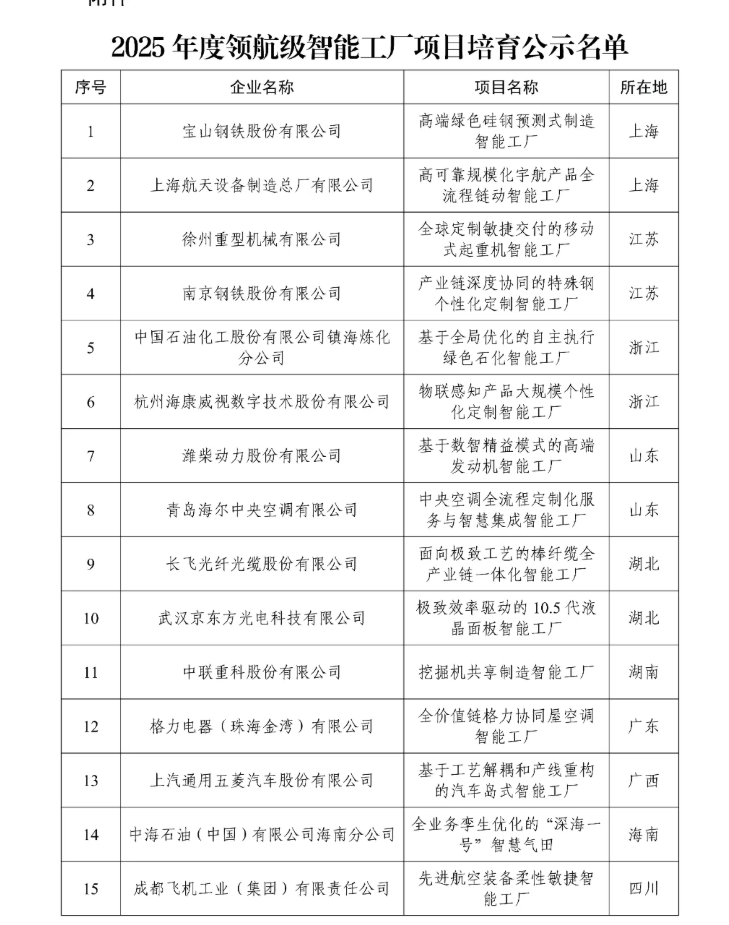
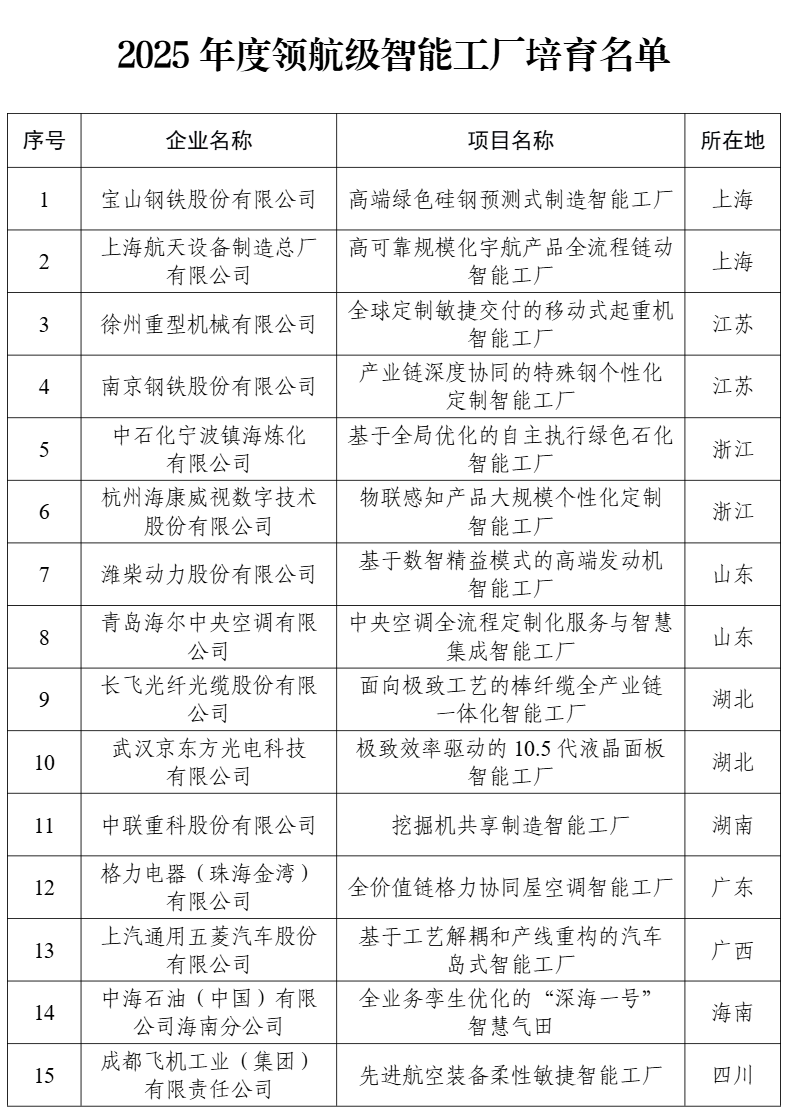
首批15家领航级智能工厂名单公布
Jiang Nan Shi Bao· 2025-11-28 09:41
Group 1 - The Ministry of Industry and Information Technology, along with five other departments, announced the first batch of leading intelligent factories in China, marking a significant leap from digitalization and networking to intelligence in manufacturing [1] - A total of 15 leading intelligent factories were announced, covering key industries such as equipment manufacturing, raw materials, electronic information, and consumer goods [1] - The leading intelligent factories integrate new-generation information technology, advanced manufacturing technology, and lean management concepts, representing the highest standards of intelligent manufacturing in China [1] Group 2 - The 2025 leading intelligent factory cultivation list includes notable projects such as Baoshan Iron & Steel's high-end green silicon steel predictive manufacturing intelligent factory and Shanghai Aerospace Equipment Manufacturing's highly reliable large-scale aerospace product intelligent factory [2] - Other projects on the list include Nanjing Steel's personalized customization intelligent factory for special steel and China Petroleum & Chemical Corporation's green petrochemical intelligent factory based on global optimization [2] - Additional entries include Hikvision's large-scale personalized customization intelligent factory for IoT sensing products and Weichai Power's high-end engine intelligent factory based on digital lean models [2] Group 3 - The 2025 World Intelligent Manufacturing Conference commenced in Nanjing, highlighting the importance of intelligent manufacturing in the current industrial landscape [3]
去世界智能制造大会 看见“未来”
Shang Hai Zheng Quan Bao· 2025-11-28 09:26
Core Insights - The 10th World Intelligent Manufacturing Conference opened in Nanjing, showcasing advancements in intelligent manufacturing and robotics [1][3] - The first batch of 15 "Leading Intelligent Factories" was announced, highlighting the focus on digital transformation and intelligent upgrades in manufacturing [2][4] Group 1: Intelligent Manufacturing Developments - Intelligent manufacturing is significantly reducing order delivery cycles by 55% and new product development cycles by 50% [3] - The "Leading Intelligent Factories" initiative aims to create a global benchmark for manufacturing, focusing on digital transformation and networked collaboration [4][6] Group 2: Leading Intelligent Factories - The 15 selected factories span key industries such as equipment manufacturing, raw materials, electronics, and consumer goods [5] - Notable companies include Baosteel, Shanghai Aerospace Equipment, and Xuzhou Heavy Machinery, each with specific innovative projects [5] Group 3: Robotics Industry Growth - China's industrial robot shipments are projected to reach 294,000 units in 2024, with Nanjing being a leader in production and R&D [7][8] - Nanjing has developed a complete industrial chain for robotics, with over 200 companies contributing to a market that represents 10% of the national scale [8] Group 4: Future of Intelligent Manufacturing - The concept of Intelligent Manufacturing 2.0 is emerging, integrating AI with advanced manufacturing technologies to drive the next industrial revolution [10] - The development of intelligent manufacturing in China is expected to progress in two phases, with significant advancements by 2035 [10]

上海国家级智能工厂入选数量蝉联全国城市第一
Xin Hua Cai Jing· 2025-11-28 09:03
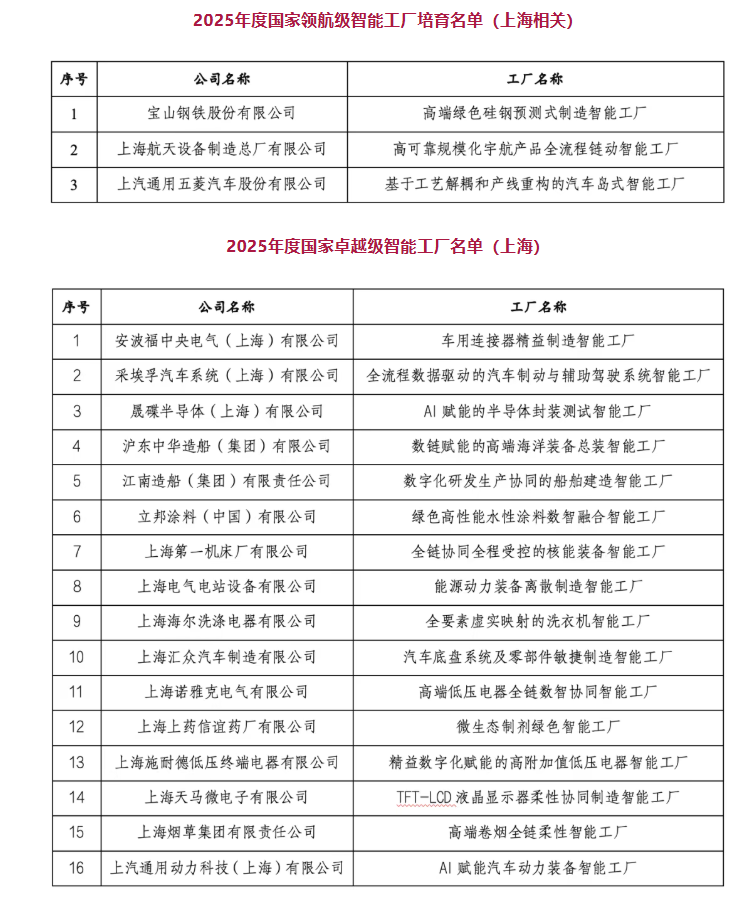
Core Insights - The Ministry of Industry and Information Technology and five other ministries have officially announced the list of pilot-level and excellent-level smart factories for 2025, with Shanghai leading the nation in both categories [1][2] - Shanghai has cultivated 2 pilot-level smart factories and 28 excellent-level smart factories, maintaining the highest number of national-level smart factories in China for several consecutive years [1][2] Group 1: Pilot-Level Smart Factories - Shanghai has 2+ factories included in the pilot-level smart factory cultivation list, representing 13% of the national total of 15 [1] - Notable companies include Baosteel, Shanghai Aerospace Equipment Manufacturing Co., and SAIC-GM Wuling, recognized for their advanced applications in AI integration, system integration, and data-driven manufacturing [1] Group 2: Excellent-Level Smart Factories - A total of 16 factories from Shanghai have been recognized as excellent-level smart factories, the highest number among all cities in China [1] - Key companies include: - Ampof Central Electric (Shanghai) Co., Ltd. - Lean manufacturing smart factory for automotive connectors - ZF Automotive Systems (Shanghai) Co., Ltd. - Data-driven smart factory for automotive braking and assistance systems - Shanghai First Machine Tool Factory Co., Ltd. - Smart factory for nuclear energy equipment with full-chain collaboration [6] Group 3: Future Plans - Shanghai aims to focus on smart factory construction as a primary battlefield, promoting the intelligent transformation and upgrading of the manufacturing industry [2] - The strategy includes a three-pronged approach: cultivating smart factories, providing smart manufacturing system solutions, and building a standard group for smart manufacturing [2]
城市24小时 | 海运大省,发力内河航运
Mei Ri Jing Ji Xin Wen· 2025-11-28 08:29
Core Insights - The "Shipping Zhejiang" initiative aims to reduce logistics costs and promote high-quality development of inland shipping in Zhejiang Province, with a focus on the year 2025 as a starting point for construction [1][3] - The province has developed a comprehensive inland waterway network plan, including 1,400 kilometers of secondary waterways, to support project implementation and funding acquisition [1][3] - The initiative emphasizes the importance of inland shipping in enhancing domestic circulation and supporting international trade, highlighting its cost-effectiveness and lower carbon emissions compared to road and rail transport [3][4] Summary by Sections Shipping Development - A high-level meeting was held on November 27 to promote the "Shipping Zhejiang" initiative, focusing on reducing logistics costs and enhancing inland shipping [1] - The plan includes the construction of a waterway network with a layout of "five verticals, eight horizontals, and ten trunks" [1][3] Economic Impact - Inland water transport costs are significantly lower, at only 1/7 of road transport and 1/3 of rail transport, providing substantial benefits for exports from regions like Yiwu and Shaoxing [3] - The carbon emissions from water transport are also much lower, at 1/6 of road transport and 2/3 of rail transport, contributing to environmental goals [3] Investment and Growth - In the first ten months of the year, Zhejiang's water transport investment reached 33.82 billion yuan, a year-on-year increase of 16.1% [4] - The inland ports handled a total cargo throughput of 360 million tons, up 9.3% year-on-year, with container throughput increasing by 14% [4] Trade Dynamics - Zhejiang's trade with ASEAN has surpassed that with the EU, with a total import-export value of 710.61 billion yuan, marking a 16.2% increase [13] - The province's exports of electric vehicles to ASEAN have surged by 195%, indicating a growing market for Zhejiang's manufacturing [13]




制造业劳动生产率,中美孰高孰低?
Cai Jing Wang· 2025-11-28 08:13
Core Viewpoint - The article presents a paradox where China's manufacturing sector exhibits strong global competitiveness despite academic reports indicating its labor productivity is significantly lower than that of the United States. The author argues that the methodology used in these studies is flawed, leading to incorrect conclusions about China's labor productivity [1][15]. Methodological Issues - Traditional methods of measuring labor productivity through value-added calculations can obscure differences in product quality and types, leading to inaccurate comparisons between countries [2]. - The classification differences between U.S. and Chinese manufacturing statistics contribute to misleading productivity comparisons. U.S. statistics include companies that do not manufacture products, while China only includes actual manufacturers [3][4]. - The use of purchasing power parity (PPP) indices to compare value-added across countries may not accurately reflect price differences, complicating productivity assessments [5]. Industry Comparisons - The research focuses on five key industries: shipbuilding, steel, electric vehicles, solar photovoltaic components, and cement. It finds that Chinese workers' per capita output is 2 to 3 times that of their U.S. counterparts, while nominal value-added is about 20% lower due to price differences [7][8]. - In the cement industry, China's per capita output is slightly higher than that of the U.S., but its nominal value-added is only 28% of the U.S. level, primarily due to significant price disparities [8]. Labor Productivity Metrics - The analysis indicates that in shipbuilding, steel, and electric vehicles, China's labor productivity is superior when measured by physical output. For instance, in shipbuilding, China's per capita output is 2.5 times that of the U.S. [16]. - The average nominal wage for Chinese workers is significantly lower than that of U.S. workers, which is attributed to the overall lower wage levels in China rather than lower productivity [8][15]. Trade Barriers and Their Impact - Trade barriers, such as tariffs, inflate domestic prices in the U.S., leading to higher nominal value-added figures without necessarily improving labor productivity [9][11]. - The structural price differences between the U.S. and China further complicate productivity comparisons, particularly in industries like electric vehicles and pharmaceuticals [12][13]. Global Competitive Advantage - China's manufacturing sector is increasingly moving up the value chain, focusing on high-end manufacturing while outsourcing low-end production to countries with lower wages. This strategy enhances China's global competitiveness [17]. - The article suggests that the U.S. should focus on expanding its advantages in high-tech sectors rather than attempting to regain lost ground in general manufacturing, which may lead to adverse economic outcomes [17].

产业大脑|“江浙沪”龙头企业分布分析
Sou Hu Cai Jing· 2025-11-28 06:54
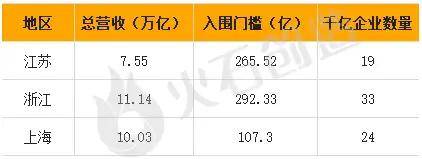
Core Insights - Jiangsu, Zhejiang, and Shanghai form a significant economic triangle in China, housing over 140,000 industrial enterprises, with a clear distribution of top companies emerging from recent rankings [1][12] Group 1: Jiangsu Province - Jiangsu's top 100 enterprises achieved a total revenue of 7.55 trillion yuan in 2024, marking a year-on-year growth of 2.03% [1] - The total asset scale surpassed 14 trillion yuan, with a growth rate of 9.04% [1] - The threshold for entering the list was set at 26.55 billion yuan, an increase of 5.1% from the previous year [1] - 19 companies entered the "billion revenue club," collectively generating 3.9 trillion yuan [1] - State-owned enterprises numbered 27, contributing 2.046 trillion yuan in revenue, a growth of 1.33% [1] - Private enterprises dominated with 73 entries, securing seven of the top ten spots and accounting for the top four positions [1] Group 2: Zhejiang Province - Zhejiang's top 100 enterprises reported total revenue of 11.14 trillion yuan, a 5.22% increase year-on-year, maintaining over 10 trillion yuan for three consecutive years [2] - Total profit reached 511.2 billion yuan, down 2.36% from the previous year [2] - The total asset value was 9.99 trillion yuan, reflecting a 1.78% increase [2] - The entry threshold was 29.233 billion yuan, up 11.09% from last year [2] - 33 companies surpassed the billion revenue mark, contributing 7.8 trillion yuan, which is 70% of the total revenue [2] - Private enterprises accounted for 78 entries, contributing 78.60% of total revenue and 83.77% of total profit [2] Group 3: Shanghai Province - Shanghai's top 100 enterprises generated total revenue of 10.03 trillion yuan, a slight decline of 0.42% year-on-year [2] - The entry threshold was 10.73 billion yuan, an increase of 240 million yuan [2] - Net profit reached 665.57 billion yuan, with a growth rate of 24.84% [2] - There were 24 companies with revenues exceeding 1 billion yuan, collectively generating 7.28 trillion yuan, accounting for 72.58% of total revenue [2] Group 4: Comparative Analysis - Jiangsu, Zhejiang, and Shanghai collectively showcase a robust economic landscape, with Jiangsu at 7.55 trillion yuan, Zhejiang at 11.14 trillion yuan, and Shanghai at 10.03 trillion yuan in total revenue [3] - The top companies in each region include Baowu Steel Group from Shanghai, Hengli Group from Jiangsu, and Alibaba Group from Zhejiang, with Alibaba leading at 996.3 billion yuan [3] - The revenue concentration among the top ten companies varies, with Shanghai having the highest concentration at 46%, followed by Zhejiang at 43.5%, and Jiangsu at 38% [5] Group 5: Regional Distribution - In Shanghai, top enterprises are concentrated in the Pudong New Area, which houses 38 companies, including 6 of the top ten [5][7] - Jiangsu's top companies are primarily located in Wuxi, Suzhou, and Nanjing, with Suzhou leading in revenue [7] - Zhejiang's enterprises are mainly concentrated in Hangzhou and Ningbo, with Hangzhou dominating the top rankings [9]

数智驱动 新质领航 2025世界智能制造大会在宁启幕
Zhong Guo Fa Zhan Wang· 2025-11-28 03:37
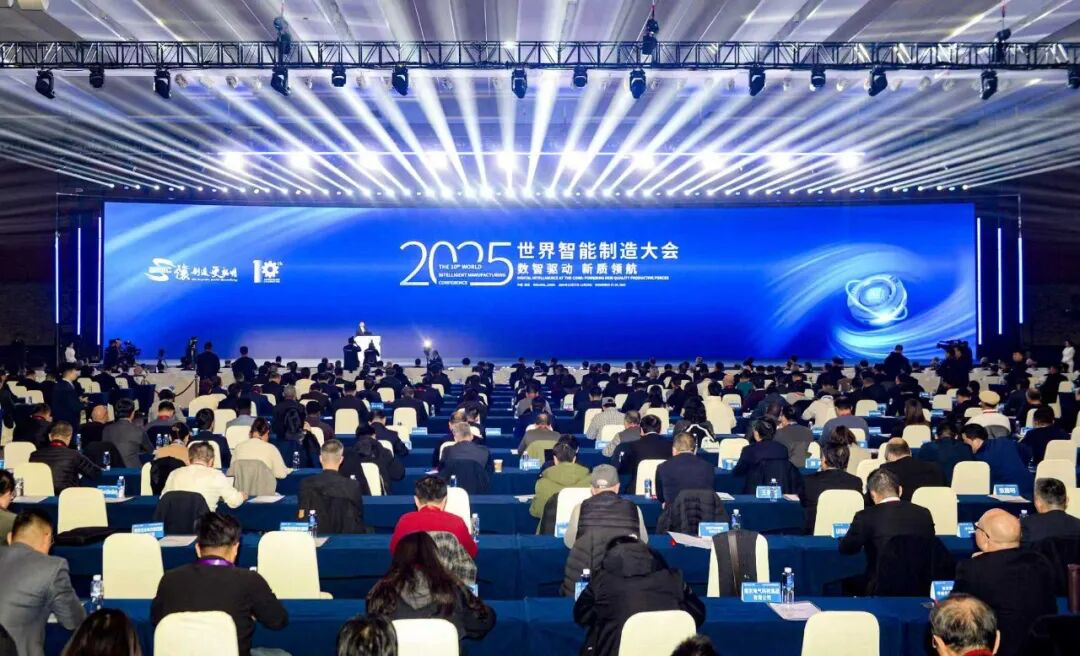
Core Insights - The 2025 World Intelligent Manufacturing Conference opened in Nanjing with the theme "Digital Intelligence Drives New Quality Leadership" [1] - The conference aims to create an international, high-end, and professional platform for global intelligent manufacturing exchange and cooperation, showcasing the latest achievements in the field and exploring the integration of technological breakthroughs and industrial transformation [1] Group 1: Conference Activities - The conference includes one main conference, one market-oriented exhibition, twelve thematic activities, and sixteen concurrent industrial ecosystem activities [1] - The event features the launch of the "Leading Action Plan" by the first batch of fifteen leading intelligent factories, which focuses on digital transformation, network collaboration, and intelligent change [3] Group 2: Key Announcements - A new session of the National Intelligent Manufacturing Committee was appointed, and several significant reports were released, including the 2025 Intelligent Manufacturing Blue Book and the top ten technological advancements in global and Chinese intelligent manufacturing for 2025 [5] - Prominent figures in the field, including academicians and executives from major companies, delivered keynote speeches on cutting-edge trends and strategic directions in intelligent manufacturing [5] Group 3: Exhibition Highlights - The World Intelligent Manufacturing Expo, held concurrently, covers an area of 55,000 square meters and features four main exhibition halls, including robotics and intelligent factories [9] - The expo attracted 456 companies from 21 countries and regions, showcasing international participation and facilitating various activities such as financial roadshows and technology exchanges [9] Group 4: Industry Significance - Intelligent manufacturing is identified as a primary focus for building a strong manufacturing nation, crucial for developing a modern industrial system and strengthening the real economy [9] - The conference has been held annually since 2016, becoming a high-end platform for China's participation in global intelligent manufacturing cooperation and showcasing the achievements of Jiangsu's manufacturing industry [9]

国产大飞机进入放量时期?中国商飞获440亿元巨额增资
Huan Qiu Lao Hu Cai Jing· 2025-11-28 02:53
Core Insights - The recent capital increase of 44 billion RMB for China Commercial Aircraft Corporation (COMAC) signals a critical phase for the C919 aircraft as it prepares for large-scale deliveries [1][2] - The registered capital of COMAC has surged from approximately 50.1 billion RMB to about 94.1 billion RMB, marking an increase of around 88% [1] - The State-owned Assets Supervision and Administration Commission (SASAC) contributed 24.997 billion RMB, raising its stake to 53.08%, achieving absolute control [1] Shareholder Contributions - Eight out of nine shareholders participated in the capital increase, with notable contributions from China Aluminum Group (28.02 billion RMB), China National Building Material Group (26.50 billion RMB), and China Electronics Technology Group (17.28 billion RMB), resulting in increased ownership percentages [1] - Other five companies saw a decrease in their shareholding ratios despite some increasing their investment, such as Shanghai Guosheng Group, which invested 8 billion RMB but saw its stake drop from 20.91% to 19.64% [2] - China National Aviation Industry Group, China Baowu Steel Group, and China Guoxin Holdings also reduced their stakes following their respective investments [2] Company Background and Recent Developments - COMAC, established in March 2008 and headquartered in Shanghai, is the core entity for implementing China's major aircraft projects, including the C919 and C909 aircraft [2] - The C919 has recently entered commercial operations, with the first delivery to China Eastern Airlines in December 2022 and successful commercial flights starting in May 2023 [2] - As of now, 26 C919 aircraft have been delivered, operating over 30 routes and achieving a cumulative passenger volume exceeding 2 million in just over two years of commercial operation [2]
研判2025!中国海底管线用钢行业发展历程、产业链上下游、市场规模、需求量及发展趋势分析:海上油气开发深远化,海底管线用钢需求持续放量[图]
Chan Ye Xin Xi Wang· 2025-11-28 01:23
Core Insights - The underwater pipeline steel industry is crucial for deep-sea oil and gas resource development, with increasing demand driven by the expansion of offshore oil fields into deeper waters [1][10] - The demand for underwater pipeline steel in China is projected to reach 700,000 tons in 2024, a year-on-year increase of 7.69%, and is expected to grow to 750,000 tons in 2025, with a 7.14% increase [1][10] - The market size of the underwater pipeline steel industry in China is anticipated to reach 5.5 billion yuan in 2024, up 10% year-on-year, and 6 billion yuan in 2025, reflecting a 9.09% increase [8] Industry Overview - Underwater pipeline steel is a high-performance steel material used for manufacturing underwater oil and gas transportation pipelines, characterized by high strength, toughness, corrosion resistance, and fatigue resistance [3][4] - The industry has evolved through four stages: reliance on imports, breakthrough in domestic production, full industry chain autonomy, and high-end development [4] Industry Chain - The upstream of the underwater pipeline steel industry includes core raw materials like iron ore, coal, and coke, which directly affect cost control [6] - The midstream is responsible for processing raw materials into various pipeline steel products that meet stringent environmental requirements [6] - The downstream application is primarily focused on major marine engineering projects, mainly in oil and gas development [6] Market Dynamics - The underwater pipeline steel market is dominated by large enterprises such as Baosteel, Hebei Steel, and Ansteel, which possess significant resources and technological advantages [10][11] - Smaller enterprises often focus on niche markets or customized services due to limitations in research and development capabilities [10] Development Trends - The underwater pipeline steel market is expected to continue growing due to increasing global energy demand and marine resource development [13] - Technological innovation will be a key driver, with a focus on new materials and processes to enhance product performance and quality [13] - Environmental sustainability will become increasingly important, with a shift towards eco-friendly production methods and materials [13]





告别死工资?深扒4只月月分红ETF,真的稳赚不赔?小心这3个大坑
Sou Hu Cai Jing· 2025-11-27 22:41
Core Viewpoint - The article discusses the appeal and mechanics of monthly dividend ETFs, highlighting their potential for generating passive income for ordinary investors while emphasizing the importance of understanding their structure and risks [1][3]. Group 1: Monthly Dividend ETFs Overview - Four monthly dividend ETFs have gained attention for their ability to provide regular income, attracting many retail investors [1][3]. - These ETFs rely on either contractual obligations for monthly distributions or the stable cash flows and high dividends of their underlying companies [3][5]. Group 2: Specific ETFs Analysis - The Red Chip Dividend ETF (code 510720) tracks the Shanghai Red Chip Dividend Index, consisting of state-owned enterprises with stable dividend payouts, achieving 19 consecutive months of dividends since May 2024, with monthly payouts typically between 0.3% and 0.4% [5][20]. - The Cash Flow ETF (code 159399) focuses on companies with strong free cash flow, distributing dividends based on the cash flow status of its holdings, with a history of uninterrupted monthly dividends since July 2025 and a payout rate around 0.4% [7][9]. - The Wan Jia CSI Dividend ETF (code 159581) mandates monthly distributions if the fund's net asset value exceeds the benchmark by 0.01%, with a diverse portfolio and a management fee of 0.2%, resulting in monthly payouts between 0.3% and 0.5% [9][11]. - The Hong Kong Stock Connect High Dividend ETF (code 513820) targets high-dividend stocks in the Hong Kong market, achieving a dividend yield of 5.8% in 2025, with monthly payouts ranging from 0.4% to 0.6% [14][16]. Group 3: Investment Characteristics - The ETFs are characterized by low entry barriers, allowing investments starting from around 100 yuan, and are suitable for conservative investors seeking stable monthly income [25][27]. - The average annual yield for these ETFs ranges from 4% to 7%, with A-share ETFs yielding approximately 4% to 5% and Hong Kong ETFs yielding 5% to 7% after tax deductions [23][25]. - Investors are advised to use spare funds for these investments and to hold them for over a year to maximize the benefits of monthly dividends [29][35].