赛力斯

Search documents
华为引望回应“今年下半年上市”传闻:假消息
Xin Lang Cai Jing· 2026-01-12 01:23
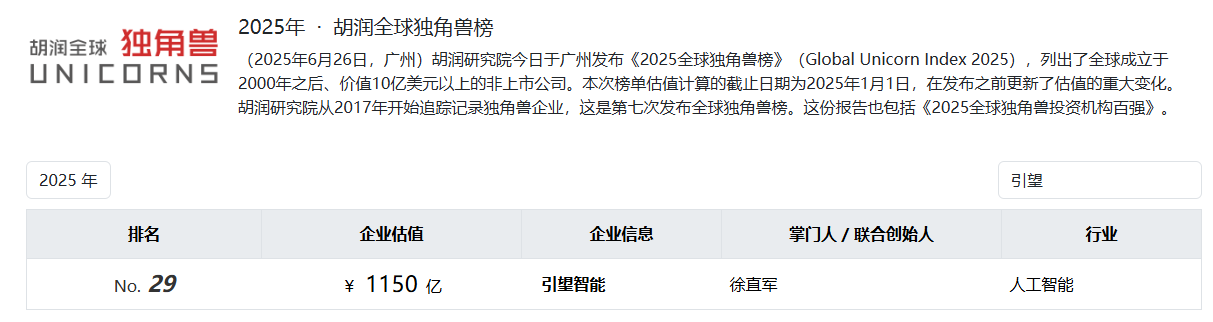
Core Viewpoint - Shenzhen Yingwang Intelligent Technology Co., Ltd., a subsidiary of Huawei, has denied rumors regarding plans for an IPO in the second half of 2026, labeling them as false information [6]. Group 1: Company Overview - Shenzhen Yingwang Intelligent Technology Co., Ltd. was established in January 2024 and focuses on Huawei's advanced driving systems (ADS), vehicle control, vehicle optics, vehicle cloud, and HarmonySpace cockpit solutions [6]. - Huawei holds an 80% stake in Yingwang, while Avita and Seres each invested 11.5 billion yuan to acquire a 10% stake in the company [6]. Group 2: Market Position - Yingwang Intelligent ranked 29th in the "2025 Global Unicorn List" published by Hurun Research Institute in June 2025, with a company valuation of 115 billion yuan [5][8].

天津赛力斯取得易于安装的快速法兰专利,能够大大扩展该法兰的应用范围
Jin Rong Jie· 2026-01-12 01:08
Group 1 - The core point of the article is that Tianjin Sailis Automation Technology Co., Ltd. has obtained a patent for a "quick flange that is easy to install," which enhances the versatility and practicality of flange installation [1] - The patent, with authorization announcement number CN223782304U, was applied for on February 2025 and falls under the field of flange technology [1] - The design includes multiple positioning holes, internal threads, and a sealing component, allowing for two different installation methods: threaded installation and snap-fit positioning [1] Group 2 - Tianjin Sailis Automation Technology Co., Ltd. was established in 2010 and is located in Tianjin, primarily engaged in technology promotion and application services [2] - The company has a registered capital of 5 million RMB and has participated in six bidding projects, holding 16 patent records and one administrative license [2]

2026“国补”首单已于近期陆续送达!关注可选消费板块机会
Mei Ri Jing Ji Xin Wen· 2026-01-12 00:59
Group 1 - The core viewpoint of the news is the launch of a new round of national subsidies for consumer goods, with a total of 62.5 billion yuan allocated to support the "trade-in" policy, aimed at boosting consumption during peak seasons like New Year's and Spring Festival [1] - The 2026 national subsidy program has optimized the range and standards of subsidies compared to 2025, adding smart glasses to the digital product category and focusing on "high-efficiency" appliances in the home appliance category [1] - The "trade-in" policy from 2024 to 2025 led to a significant increase in consumer goods sales, reaching 3.92 trillion yuan and benefiting 494 million consumers [1] Group 2 - The optional consumer ETF (562580.SH) is expected to benefit significantly from the continuation of the national subsidy policy, with a focus on sectors such as automobiles (46%) and home appliances (34%) [2] - The top ten weighted stocks in the optional consumer ETF include major companies like Midea Group, BYD, Gree Electric, and Haier Smart Home, indicating strong potential for growth in these sectors [2] - The index valuation PE-TTM stands at 23.47 times, which is in the 38.04% percentile over the past decade, suggesting a relatively attractive investment opportunity [2]
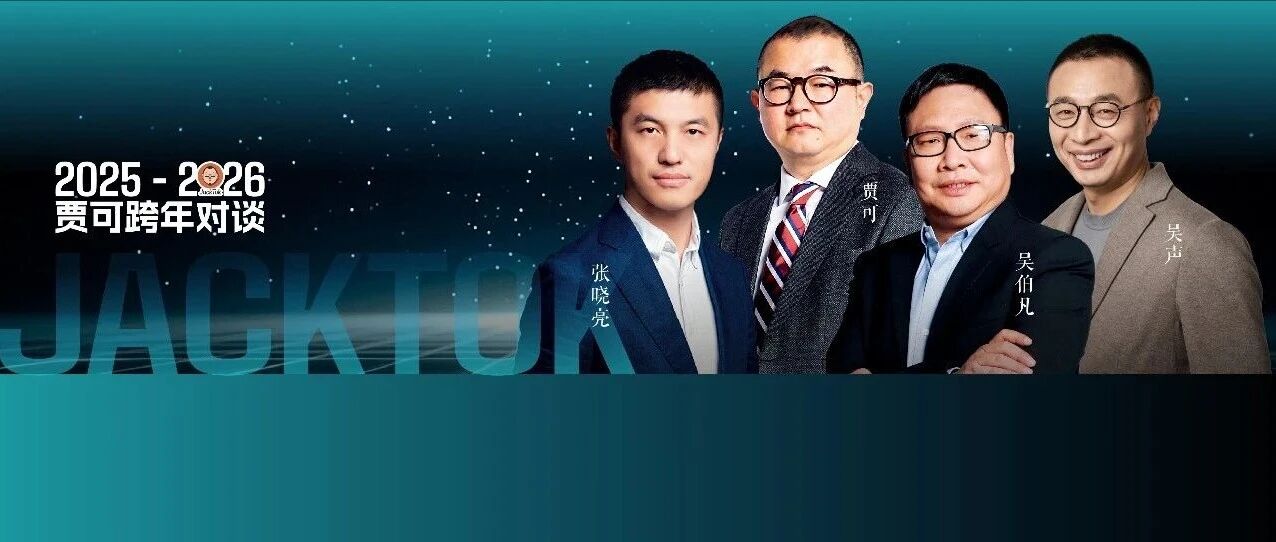
贾可吴伯凡吴声张晓亮,4万字2025-2026跨年对谈全文(下)
汽车商业评论· 2026-01-11 23:06
Core Viewpoint - The article discusses the evolving landscape of the Chinese automotive industry, focusing on the impact of personal branding (IP) of industry leaders, the rise of Huawei in automotive technology, and the trends in global expansion and regulatory changes in autonomous driving [4][5][6]. Group 1: Personal Branding in Automotive Industry - The debate on whether automotive leaders like Lei Jun and Wei Jianjun should develop personal brands (IP) has intensified, with differing opinions on its effectiveness and potential backlash [5][25]. - Lei Jun's recent challenges with Xiaomi's automotive ventures highlight the risks of personal branding, while Wei Jianjun's successful IP development reflects a more grounded approach [26][30]. - The article emphasizes the need for automotive leaders to focus on product quality and strategic management rather than solely on personal branding [31][35]. Group 2: Huawei's Role in Automotive Technology - Huawei's positioning as a service provider rather than a car manufacturer allows it to play a unique role in the automotive industry, focusing on empowering car manufacturers with advanced technologies [7][10]. - The introduction of Huawei's "Jing" and "Jie" series vehicles indicates a strategic expansion into the automotive market, with a focus on high-end segments [9][10]. - Huawei's technology capabilities, including smart cockpit and driving technologies, are seen as critical to its success in the automotive sector, potentially reshaping the competitive landscape [12][15]. Group 3: Trends in Global Expansion - The article notes a significant trend of Chinese automotive companies pursuing IPOs in Hong Kong, reflecting a renewed interest in capital markets and the need for ongoing funding in a capital-intensive industry [38][39]. - The global expansion of Chinese automotive brands is characterized by a shift towards local production and partnerships, moving beyond simple export strategies to more integrated approaches [43][45]. - The necessity for Chinese companies to adapt to local markets and consumer behaviors is emphasized, indicating a more mature approach to globalization [47][49]. Group 4: Regulatory Changes in Autonomous Driving - The Chinese government has implemented stricter regulations on L2 autonomous driving systems, reflecting a growing emphasis on safety following recent incidents [58][60]. - The approval of L3 autonomous driving systems indicates a positive regulatory environment for advanced driving technologies, with companies like Deep Blue and BAIC leading the way [58][61]. - The article suggests that the development of Robotaxi services is gaining momentum, with a focus on subscription-based models as a viable business strategy [61][63].



中国汽车第一城,变了!
商业洞察· 2026-01-11 09:23
Core Viewpoint - The article discusses the significant shifts in China's automotive industry by 2025, highlighting the rise of new cities as automotive powerhouses and the decline of traditional leaders, emphasizing the importance of innovation, government support, and strategic partnerships in shaping the future of the industry [5][6][52]. Group 1: The Rise of New Leaders - In 2025, Chongqing emerged as "China's Automotive Capital" with nearly 2.5 million vehicles produced, marking a 12.1% year-on-year increase, surpassing traditional leaders like Shanghai and Guangzhou [8][15]. - Chongqing's success is attributed to the combination of state-owned enterprises and aggressive private sector strategies, particularly the partnership between Seres and Huawei, which transformed traditional manufacturing into high-end smart vehicle production [16][17]. - Hefei became the "New Energy Capital" with over 1.246 million new energy vehicles produced, showcasing a model of government investment and strategic partnerships with companies like NIO and Volkswagen [21][23]. Group 2: The Decline of Traditional Leaders - Shenzhen, once a leader with nearly 3 million vehicles produced in 2024, saw its data become ambiguous in 2025 due to changes in statistical methods that shifted focus from corporate registration to actual production locations [28][30]. - Guangzhou experienced a 20% decline in traditional vehicle production, primarily due to the slow transition of Japanese automakers to electric vehicles, highlighting the risks of reliance on outdated business models [45]. - Shanghai's production remained strong at 1.6 million vehicles, but without Tesla's contribution, the figures would be significantly lower, indicating challenges in revitalizing the local automotive supply chain [46]. Group 3: Emerging Trends and Insights - The competition in the automotive industry is shifting from "production capacity" to "supply chain integration," with cities like Hefei and Chongqing demonstrating the importance of a comprehensive ecosystem that includes manufacturing and technology [49]. - The future of the automotive sector will increasingly depend on advanced technologies such as AI and automated driving, positioning cities with strong tech capabilities, like Beijing, for potential advantages [50]. - The article emphasizes the growing "Matthew Effect" in urban development, where leading cities attract more resources and talent, while smaller cities face significant challenges, potentially leading to a decline in their automotive industries [51].


2025年汽车以旧换新超1150万辆,全年乘用车零售2374.4万辆
Xinda Securities· 2026-01-10 11:06
Investment Rating - The industry investment rating is "Positive" [2] Core Insights - The report highlights that in 2025, over 11.5 million vehicles will be replaced under the vehicle trade-in program, leading to a total retail of 23.744 million passenger cars, with approximately 54% being new energy vehicles [20][3] - The report indicates a projected growth in the automotive market, with a U-shaped sales trend expected for passenger vehicles in 2026, maintaining overall sales levels similar to 2025 [20] - Key companies to watch include BYD, Geely, Great Wall Motors, and others in the passenger vehicle sector, as well as major players in commercial vehicles and auto parts [3][20] Industry Performance - The A-share automotive sector underperformed the market, with a weekly increase of 2.53% compared to the 2.79% rise in the CSI 300 index, ranking 24th among A-share industries [3][9] - The report notes that the passenger vehicle segment saw a 3.8% year-on-year increase in retail sales, while new energy vehicles experienced a 17.6% growth [20] Key Industry News - The Ministry of Commerce announced that the vehicle trade-in program will exceed 11.5 million vehicles in 2025, contributing to over 1.6 trillion yuan in new car sales [20] - Geely received the largest L3 autonomous driving test license in China, covering an area of 9,224 square kilometers [20] - Baidu's autonomous driving platform, "萝卜快跑," obtained the first full unmanned testing license in Dubai, paving the way for commercial operations [20] Upstream Data Tracking - The report includes tracking of key material prices such as steel, aluminum, and lithium carbonate, which are crucial for automotive manufacturing [23][24]




一周股评|沪指狂飙突破4100点:科技浪潮席卷,万亿成交点燃市场热情
Sou Hu Cai Jing· 2026-01-10 07:43
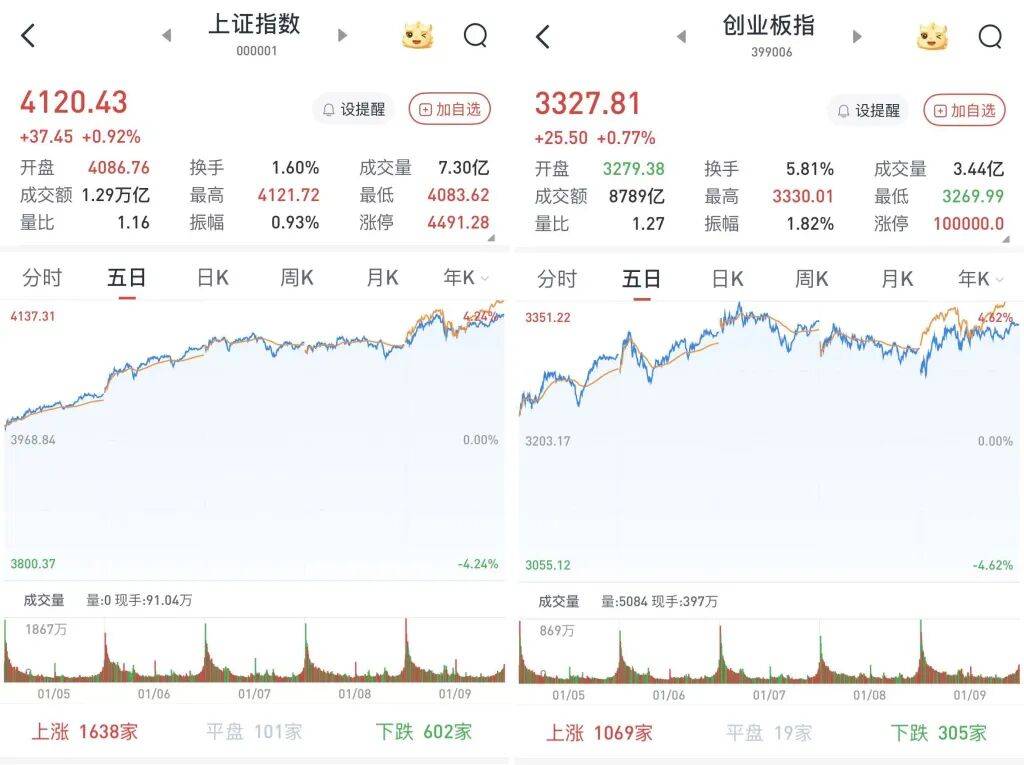
Market Overview - The A-share market experienced a strong start in 2026, with the Shanghai Composite Index breaking the 4100-point barrier and achieving a trading volume exceeding 3 trillion yuan, marking a historical high [1] - The Shanghai Composite Index rose by 0.92%, the Shenzhen Component Index by 1.15%, and the ChiNext Index by 0.77%, with a cumulative increase of 3.82% for the week [1] AI Sector - The AI application sector saw significant gains, with over twenty constituent stocks hitting the daily limit, driven by strong market expectations for the practical application of AI technology [3] - Analysts predict 2026 will be a "golden year" for AI applications, supported by three key factors: technological maturity, ongoing policy support, and resonating market demand [3] Commercial Aerospace - The commercial aerospace sector is attracting substantial investment, with companies like Luxin Venture Capital and China Satellite Communications showing remarkable stock performance [5] - The sector's growth is bolstered by supportive policies and optimistic market expectations regarding the future of commercial aerospace [5] Semiconductor Market - The global memory chip market is experiencing a "price hurricane," with major players like Samsung and SK Hynix planning to raise server DRAM prices by 60%-70% in Q1 2026, impacting cloud computing and AI servers [5][7] - The DRAM market has entered a significant price increase cycle, with prices for many categories rising over 100% since July 2025 [10] - Analysts predict a 144% year-on-year increase in average selling prices for server DRAM in 2026, driven by a structural supply-demand crisis [10][12] Automotive Industry - The penetration rate of new energy vehicles has surpassed 50%, leading to a surge in IPOs within the automotive supply chain, with over 97 companies listed in 2025 [14] - The capital market is witnessing a vibrant atmosphere, with significant participation from various segments of the automotive industry, reflecting the dual drive of electrification and intelligence [16] Economic Outlook - The macroeconomic environment shows signs of stabilization, with CPI rising by 0.8% year-on-year and PPI's decline narrowing, indicating a positive economic trend [16] - Goldman Sachs recommends overweighting Chinese stocks, forecasting a 15%-20% increase in 2026 and 2027, driven by AI, overseas expansion, and supportive policies [18]
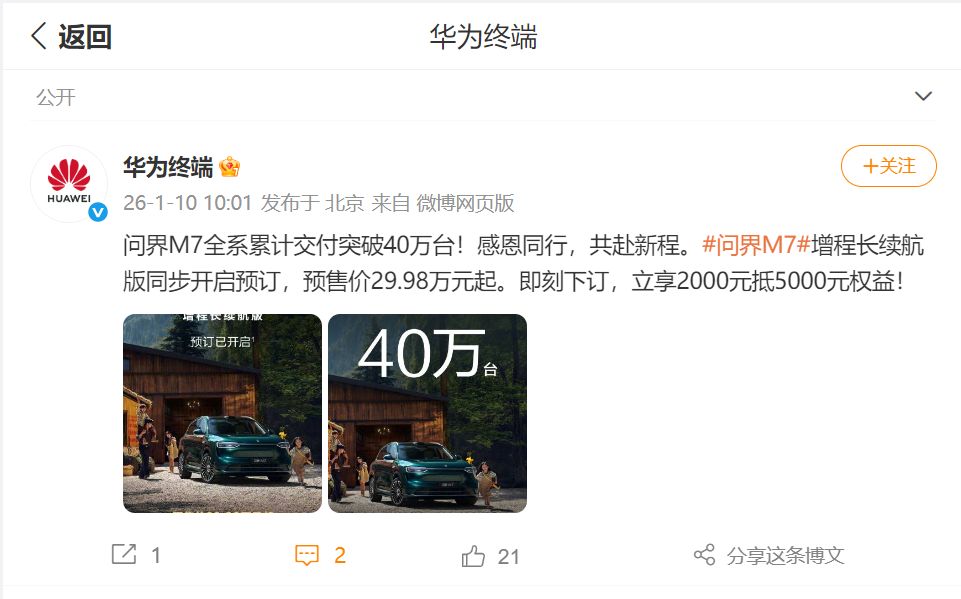
华为官宣!问界M7全系累计交付突破40万台!29.98万元起 这一款车开启预订
Mei Ri Jing Ji Xin Wen· 2026-01-10 03:01
Core Insights - The AITO M7 has achieved cumulative deliveries exceeding 400,000 units, with the extended-range version now available for pre-order starting at 299,800 yuan [1][4] - The AITO M7 is a high-end smart vehicle developed jointly by Seres and Huawei, showcasing a commitment to integrating advanced ICT technologies into manufacturing [4] - In December 2025, AITO set a new monthly delivery record with over 57,000 vehicles delivered, bringing the total for the year to over 420,000 units, leading the high-end new energy vehicle market [5] Company Developments - Huawei and Seres are collaborating to establish a global model for smart manufacturing, integrating AI and various ICT technologies into the Seres Super Factory [4] - The partnership aims to create a safe, efficient, and green smart manufacturing park, enhancing production efficiency and promoting sustainable development [5] - Huawei's ongoing collaboration with GAC Group focuses on building the HarmonyOS ecosystem and enhancing intelligent driving experiences in various vehicle models [5] Industry Trends - In December, the export of new energy passenger vehicles reached 273,000 units, marking a year-on-year increase of 119.8% and accounting for 46.4% of total passenger vehicle exports [6] - Pure electric vehicles constituted 57.9% of new energy exports, with A00 and A0 class pure electric vehicles making up 68% of this category [6]
赛力斯申请车内乘员体质指数检测专利,解决体质指数检测不准确和检测成本较高的技术问题
Jin Rong Jie· 2026-01-10 02:17
Group 1 - The core idea of the news is that Seres Automotive Co., Ltd. has applied for a patent for a method and device to detect the body mass index (BMI) of passengers in vehicles, which aims to improve the accuracy and reduce the cost of BMI detection [1] - The patent application, published as CN121305620A, was filed on November 2025 and includes a method that involves capturing images of the target area containing passengers, detecting faces, and using trained models to predict BMI [1] - The method combines two BMI estimates from facial and upper body detection to produce a fused BMI value, addressing issues of inaccuracy and high costs in existing technologies [1] Group 2 - Seres Automotive Co., Ltd. was established in 2012 and is located in Chongqing, primarily engaged in the automotive manufacturing industry [2] - The company has a registered capital of approximately 1.063 billion RMB and has made investments in 10 enterprises, participated in 26 bidding projects, and holds 4635 patents [2] - Additionally, Seres has 538 trademark registrations and possesses 142 administrative licenses [2]
“今年,港股IPO至少得3000亿起步吧”
Sou Hu Cai Jing· 2026-01-10 00:43
Core Insights - The Hong Kong IPO market is expected to remain robust in 2026, with a projected fundraising amount of 300 billion HKD, reflecting strong market confidence [15] Group 1: 2025 IPO Performance - In 2025, the Hong Kong Stock Exchange (HKEX) saw 114 new listings, a 63% increase year-on-year, raising a total of 286.3 billion HKD (approximately 36 billion USD), marking a 227% increase from the previous year [2][3] - This performance is the strongest since 2021, allowing HKEX to reclaim the top position globally in IPO fundraising, surpassing major exchanges like NASDAQ and NYSE [2][4] - The top ten IPO projects included eight companies that raised over 10 billion HKD, with CATL leading at 41 billion HKD, making it the second-largest global IPO in 2025 [4] Group 2: Notable IPOs and Trends - Zijin Mining International, spun off from A-share Zijin Mining, raised 42.78 billion HKD, highlighting the appeal of large resource companies in the Hong Kong market [5] - Other leading fundraising companies included SANY Heavy Industry, Seres, and Hengrui Medicine, all of which are industry leaders [6] - A significant trend in 2025 was the rise of the "A+H" share listing model, with 19 A-share companies successfully listing in Hong Kong, raising approximately 140 billion HKD, nearly half of the total IPO fundraising for the year [8] Group 3: Global IPO Landscape - In 2025, HKEX not only led in total fundraising but also secured four positions in the global top ten IPOs, showcasing its competitive strength in attracting large projects [11] - Comparatively, the US IPO market had 313 listings, raising about 46.04 billion USD, with the largest IPO being Medline at 6.26 billion USD [16] - The Indian National Stock Exchange had 268 IPOs, raising approximately 21 billion USD, while other exchanges like the NYSE and Tokyo Stock Exchange had significantly lower fundraising totals [16] Group 4: 2026 Outlook - As of early 2026, over 300 companies are queued for IPOs in Hong Kong, indicating a strong pipeline for future listings [13] - The anticipated main themes for 2026 include technology companies in sectors like AI, semiconductors, and biomedicine, as well as a continued trend of A+H listings, which are expected to enhance the market's industry representation and valuation appeal [14]