
古茗

Search documents
9块9成过去时,咖啡价格战卷到2块9
3 6 Ke· 2025-10-12 00:11
Core Viewpoint - The coffee price war continues, with brands like Luckin and Kudi initiating aggressive pricing strategies, leading to a significant drop in coffee prices across the industry, now entering the 4 yuan+ era [1][2][10]. Group 1: Price War Dynamics - The coffee industry has seen a shift from a 9.9 yuan pricing model to a new low of 4.9 yuan initiated by new tea drink brands like Guming [2][3]. - Guming's promotional campaign offers coffee starting at 4.9 yuan, significantly undercutting previous prices and positioning itself as a "price butcher" in the market [2][3]. - The competition has intensified with established brands like Starbucks and Kudi also reducing prices, with Starbucks implementing its first price cuts in 26 years in the Chinese market [1][2]. Group 2: Market Impact and Consumer Behavior - The aggressive pricing strategies have led to a blurring of lines between coffee and tea beverages, with increased order volumes reported by various brands [5][10]. - The introduction of low-priced coffee options has altered consumer expectations, with many now perceiving 4 yuan as a reasonable price for coffee [2][10]. - The rise of brands like Lucky Coffee, offering prices as low as 2.9 yuan, has further intensified the competition, leading to a significant increase in order volumes at certain locations [7][9]. Group 3: Industry Challenges - The ongoing price war has resulted in over 50,000 coffee shops closing in the past year, indicating a challenging environment for many players in the market [10]. - High-end brands are not only participating in the price war but are also facing operational challenges, including layoffs and acquisitions, as seen with Starbucks and Piye Coffee [10]. - The industry is becoming increasingly segmented, with various price points catering to different consumer groups, highlighting the need for long-term strategies in supply chain and investment [10].

国庆中秋假期消费数据如何?
China Post Securities· 2025-10-11 07:34
Industry Investment Rating - The industry investment rating is "Outperform the Market" and is maintained [1] Core Viewpoints - The report highlights a significant increase in domestic travel during the National Day and Mid-Autumn Festival holiday, with 888 million domestic trips taken, an increase of 123 million compared to the previous year. Total spending reached 809 billion, up 108.2 billion from the previous year, indicating a strong recovery in consumer spending [4][5] - The report emphasizes the trend of consumers prioritizing experiences over material goods, reflecting a shift towards "paying for emotions and experiences" in travel choices [14][15] Summary by Relevant Sections Industry Overview - The closing index for the industry is 8596.85, with a 52-week high of 9343.57 and a low of 7320.11 [1] Travel and Tourism Data - Daily average travel volume reached a historical high of 304 million during the holiday, with a year-on-year increase of 6.3%. The report notes that railway, road, waterway, and civil aviation all saw increases in passenger volume [5][6] - The average hotel occupancy rate during the holiday was only 58%, down from 75% the previous year, with average room prices decreasing by 18% [9] Consumer Spending Insights - Retail and catering sales during the holiday increased by 2.7%, with significant growth in organic food sales, which rose by 27.9% [7][8] - The average price of domestic flights remained stable at 849 yuan, showing little change compared to previous years [8] Investment Recommendations - The report suggests focusing on new consumption opportunities in sectors like trendy toys, gold jewelry, and new tea drinks, which align with current consumer trends [17] - It also recommends attention to cyclical sectors such as liquor, hotels, and restaurants, anticipating a recovery in these areas due to policy support [17]
社会服务行业深度报告:现制饮品行业系列报告二:从“规模之战”到“价值之锚”
Wanlian Securities· 2025-10-10 10:00
Investment Rating - The report maintains a rating of "Outperform the Market" for the beverage industry [5] Core Insights - The new tea beverage market is transitioning from rapid growth to a more mature phase, with increasing competition leading to a shift from high-priced, heavily marketed products to a focus on frequency and sustainable operations. The performance of listed tea companies will increasingly depend on their strategic alignment with lower-tier markets [1][2] - The industry is experiencing a slowdown in store expansion, with a shift towards enhancing consumer frequency. The market is expected to grow at a CAGR of 17.59% from 2023 to 2028, indicating a transition from scale expansion to high-quality development [2][11] - The focus for value growth in tea companies will be on product innovation, strengthening supply chains, and expanding into overseas markets, particularly in Southeast Asia [3][53] Summary by Sections Industry Development Trends - The new tea beverage industry has seen rapid growth since 2015, with market size increasing from 1,878 billion yuan in 2018 to 5,175 billion yuan in 2023, reflecting a CAGR of 22.47% [11] - The industry is shifting from price upgrades to frequency enhancements as the main growth driver, with a notable increase in market concentration due to intensified competition [1][15] - The average per capita consumption of ready-to-drink beverages in China is only 22 cups, compared to 323 cups in the US, indicating significant room for growth in consumption frequency [22] Secondary Market Performance - The secondary market for new tea companies has shown significant divergence, with early entrants like Nayuki Tea and Cha Baidao facing stock price declines, while companies like Mixue Group have performed strongly post-IPO [2][28] - The IPO performance of new tea companies has been mixed, with some experiencing severe declines post-listing, highlighting the market's cautious sentiment towards high-end brands [28][30] Corporate Value Growth - Companies are focusing on product innovation by enhancing health attributes through functional ingredients, strengthening supply chains for cost efficiency, and exploring international markets for growth [3][53] - The competitive landscape is evolving, with leading companies like Mixue Group and Gu Ming leveraging their supply chain capabilities and market positioning to achieve superior profitability and cost control [49][50]
港股收盘(10.10) | 恒指收跌1.73% 科技、有色、医药股等下挫 部分新消费逆市走高
智通财经网· 2025-10-10 08:48
Market Overview - The Hong Kong stock market experienced a collective decline, with the Hang Seng Index dropping 1.73% to 26,290.32 points, marking five consecutive days of losses [1] - The Hang Seng Tech Index fell 3.27%, while the Hang Seng China Enterprises Index decreased by 1.8% [1] - For the week, the Hang Seng Index declined by 3.13%, the China Enterprises Index by 3.11%, and the Tech Index by 5.48% [1] Blue-Chip Performance - Hang Lung Properties (00101) rose 2.05% to HKD 8.98, contributing 0.49 points to the Hang Seng Index, driven by a 15% year-on-year increase in tenant sales during the National Day holiday [2] - China Overseas Development (00688) and China Telecom (00728) also saw gains of 2.46% and 2.41%, respectively [2] - Semiconductor company SMIC (00981) fell 7.13%, negatively impacting the index by 42.13 points [2] Sector Performance - Major technology stocks declined, with Alibaba down 4.56% and Tencent down 3.55% [3][6] - The AI sector faced pressure, with warnings from the IMF and the Bank of England regarding potential market corrections similar to the 2000 internet bubble [6] - New consumption concepts saw some stocks rise, such as Gu Ming up 12.21% and Buluco up 8.78%, attributed to increased sales during the recent holiday [3] Commodity and Chip Stocks - The metals sector saw a broad decline, with Ganfeng Lithium (01772) down 10.75% and Shandong Gold (01787) down 7.04%, influenced by a significant rise in the US dollar and a drop in international gold prices [4] - Chip stocks also fell, with SMIC down 7.13% and Shanghai Fudan (01385) down 5.98% [4][5] Notable Stock Movements - Poly Property Group (00119) surged 19.51% following news of a share transfer within its parent company, indicating potential consolidation [7] - Dazhong Public Utilities (01635) rose 8.67%, benefiting from its dual business model in public utilities and financial investments [8] - ZTE Corporation (00763) increased by 4.01%, supported by its position in the AI and telecommunications sectors [10] New Listings - Jinye International Group (08549) saw a remarkable 330% increase on its first trading day, reflecting strong investor interest with an oversubscription rate of 11,464 times [11] - Zhida Technology (02650) rose 192.14%, focusing on electric vehicle charging solutions [12]

港股收评:恒生指数跌1.73%,恒生科技指数跌3.27%
Xin Lang Cai Jing· 2025-10-10 08:17
Core Viewpoint - The Hong Kong stock market experienced a decline, with the Hang Seng Index falling by 1.73% and the Hang Seng Tech Index dropping by 3.27% [1] Market Performance - The Hong Kong stock market closed with the Hang Seng Index down 1.73% and the Hang Seng Tech Index down 3.27% [1] - The Hong Kong Tech ETF (159751) decreased by 3.31%, while the Hang Seng Hong Kong Stock Connect ETF (159318) fell by 1.79% [1] Sector Performance - The construction materials and entertainment sectors showed positive performance, leading in gains [1] - Conversely, the metals and mining, as well as biotechnology sectors, experienced significant declines [1] Individual Stock Performance - Kinyu International Group saw a substantial increase, rising over 330% [1] - Mixue Group increased by 4.44%, and ZTE Corporation rose by 4.01% [1] - Conversely, WanGuo Gold Group fell by 11.81%, and Rongchang Bio declined by 12.1% [1] - Poly Real Estate Group surged by 19.51%, while Gu Ming rose by 12.21% [1]
恒生指数午盘跌1.14%,恒生科技指数跌2.45%,半导体概念股走弱
Mei Ri Jing Ji Xin Wen· 2025-10-10 04:23
Core Viewpoint - The Hong Kong stock market experienced a decline, with the Hang Seng Index falling by 1.14% and the Hang Seng Tech Index dropping by 2.45% on October 10th [1] Group 1: Semiconductor Sector - The semiconductor sector in Hong Kong showed weakness, with notable declines in key stocks: SMIC fell over 5%, Fudan Microelectronics and Hua Hong Semiconductor dropped more than 4%, and InnoCare and ChipMOS fell over 3% [1] Group 2: Beverage Sector - In contrast, the beverage sector performed well, with Gu Ming rising over 13%, Mixue Group increasing nearly 6%, and other companies like Hou Shang Ayi, Cha Ba Dao, Uni-President China, and Nongfu Spring also seeing gains [1]

港股午评:恒生指数跌1.14% 恒生科技指数跌2.45%
Zheng Quan Shi Bao Wang· 2025-10-10 04:18
Core Points - The Hang Seng Index declined by 1.14% during the midday session [1] - The Hang Seng Tech Index experienced a drop of 2.45% [1] - Semiconductor stocks were among the biggest losers, with SMIC falling over 5% [1] - Food stocks showed positive performance, with Gu Ming rising over 13% [1] Industry Summary - The semiconductor sector faced significant declines, indicating potential challenges within the industry [1] - The food sector demonstrated resilience, with notable gains in specific stocks, suggesting a divergence in market performance [1]

港股午评|恒生指数早盘跌1.14% 茶饮股逆势走强
智通财经网· 2025-10-10 04:07
Market Overview - The Hang Seng Index fell by 1.14%, down 304 points, closing at 26,447 points, while the Hang Seng Tech Index dropped by 2.45% [1] - The trading volume in the Hong Kong stock market reached HKD 180.3 billion in the morning session [1] Tea Beverage Sector - Tea beverage stocks performed strongly, with significant sales during the holiday period; companies are accelerating their overseas expansion [1] - Gu Ming (01364) rose by 13.23%, Nayuki (02150) increased by 7.26%, and Mixue Group (02097) gained 5.98% [1] Insurance Sector - Domestic insurance stocks collectively rose, driven by the return of dividend-type health insurance after 22 years, enhancing the attractiveness of insurance products [1] - New China Life Insurance (01336) increased by 3.11%, China Pacific Insurance (02601) rose by 3.02%, and China Life Insurance (02628) also gained 3.02% [1] Retail Sector - Xiao Cai Yuan (00999) saw a rise of over 9%, with impressive operational data during the National Day holiday, reporting a 21% year-on-year increase in customer traffic across its stores [1] New Product Launches - Blokku (00325) surged over 11% after launching new product lines "Building Cars" and "Building People" at the WF2025 exhibition [1] Construction Materials Sector - Jinju Group (02009) rose by over 5%, actively promoting new building materials and securing significant overseas project contracts [1] Graphite Sector - China Graphite (02237) surged by over 24% following export controls imposed by two departments on lithium battery and artificial graphite anode materials [1] Semiconductor Sector - Chip stocks continued to decline, with several brokerages adjusting the margin financing rates for SMIC, leading to a 5.6% drop in SMIC (00981) and a 4% decline in Hua Hong Semiconductor (01347) [1][3] Biotechnology Sector - Innovent Biologics (09969) fell over 9% after announcing a licensing collaboration with Zenas for three self-immune pipeline products [2] Battery Sector - Contemporary Amperex Technology Co. (03750) dropped over 7% as the cornerstone lock-up period is set to expire on the 19th of next month, with major brokerages downgrading the company's H-share rating [3]
603011,9天5板,券商股突现异动
Zheng Quan Shi Bao· 2025-10-10 03:39
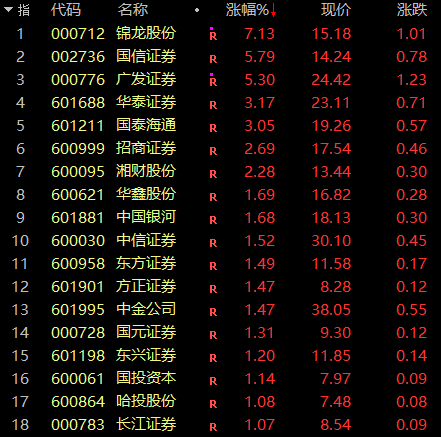
Market Overview - The A-share market opened lower on October 10, with the ChiNext Index down over 2% and the Sci-Tech 50 Index down more than 3% [1] - The Hong Kong market also saw declines, with the Hang Seng Index and Hang Seng Tech Index both opening lower, the latter down nearly 2% [2] Sector Performance - Strong sectors included cultivated diamonds, controllable nuclear fusion concepts, rare earth permanent magnets, and nuclear energy, while semiconductor, non-ferrous metals, real estate, and chemical fiber sectors experienced corrections [1] - The brokerage sector saw a rapid increase, with Jinlong Co. rising over 7%, and Guosen Securities and GF Securities both up over 5% [2] Notable Stocks - Jinlong Co. (000712) increased by 7.13% to 15.18, while Guosen Securities (002736) rose by 5.79% to 14.24 [2] - Other notable gainers included GF Securities (000776) up 5.30% to 24.42, and Huatai Securities (601688) up 3.17% to 23.11 [2] Controllable Nuclear Fusion Sector - The controllable nuclear fusion sector was active, with companies like Hezhong Intelligent (603011) hitting five consecutive trading limits, and Hanhua Welding rising nearly 14% [3] - The construction of China's nuclear fusion device BEST has begun, which is expected to demonstrate nuclear fusion power generation by 2030 [5] Beverage Manufacturing Sector - The beverage manufacturing sector saw gains, with Zhuangyuan Pasture hitting two consecutive trading limits and Yangyuan Beverage reaching the daily limit [6] - During the National Day and Mid-Autumn Festival holiday, key retail and catering enterprises reported a 2.7% year-on-year increase in sales [8] Automotive Parts Sector - The automotive parts sector opened higher, with companies like Landai Technology and Shenda Co. hitting the daily limit [8] Coal Mining Sector - The coal mining sector experienced fluctuations, with companies like Dayou Energy and Baotailong hitting the daily limit [8]

港股异动 | 茶饮股逆势走强 双节假期茶饮门店爆单 茶企出海步伐明显加快
Zhi Tong Cai Jing· 2025-10-10 03:11
Group 1: Market Performance - Tea beverage stocks are performing strongly, with notable increases: Gu Ming up 13.51% to HKD 24.36, Nai Xue's Tea up 6.45% to HKD 1.32, and Mi Xue Group up 6.28% to HKD 426.4 [1] - The surge in sales is attributed to the upcoming "Double Festival" in 2025, which is expected to boost foot traffic in tea beverage stores due to the "holiday economy" and travel trends [1] Group 2: Sales Growth - Cha Bai Dao reported a nearly 2800% increase in sales at scenic area stores, with popular "autumn appreciation" cities like Nanjing and Guilin seeing sales growth exceeding 600% [1] - Ba Wang Tea Ji also experienced significant sales increases in transportation hubs and popular tourist cities, with some stores in Shanghai, Sichuan, and Guangzhou averaging over 2500 cups sold daily [1] Group 3: Nai Xue's Expansion - Nai Xue's Tea has seen a surge in domestic orders, with many stores reporting over 700% growth compared to pre-holiday levels, particularly in tourist cities like Chengdu and Dalian [2] - The company has recently opened its first store in the United States, generating nearly USD 87,000 (approximately RMB 620,000) in sales within three days and selling around 13,000 products, setting a record for new store openings [2] - Nai Xue's second U.S. store is confirmed to be located in the core commercial area of Long Island, New York, and is expected to open soon [2]