腾讯

Search documents
H200芯片放宽出口,云计算ETF(159890)高开涨超3%,石基信息、税友股份开盘涨停!
Sou Hu Cai Jing· 2026-01-14 02:34
Group 1 - The GEO concept has significantly boosted AI applications, with stocks like Shiji Information and Taxfriend both hitting the daily limit up, and others like Yidian Tianxia rising by 14.20% [1] - The cloud computing ETF (159890) opened with a 3.39% increase and saw substantial net inflows, indicating strong investor interest in AI-related stocks [1][6] - The ETF tracks a broad range of sectors, with IT services, horizontal general software, and vertical application software making up approximately 65% of its index, highlighting its deep investment in AI applications [6] Group 2 - The U.S. has relaxed export regulations on Nvidia's H200 chips to China, but the impact on the domestic computing power industry is expected to be limited due to differing application scenarios [3] - Domestic computing power is primarily focused on small to medium models and inference applications, which do not overlap significantly with the H200's training applications [3] - By 2026, domestic computing power is projected to capture over 400 billion yuan of the estimated 600-650 billion yuan allocated for domestic purchases, driven by major companies like ByteDance, Alibaba, and Tencent [3] Group 3 - The AI industry is transitioning from a focus on "computing power competition" to "application landing," with a growing emphasis on commercializing AI applications [4] - Historical trends suggest that hard technology follows a cyclical pattern, while soft technology is more influenced by changes in business models, indicating a potential new wave of software market activity [4] - The AI market is expected to maintain a high configuration cost-performance ratio as it enters its second phase in 2026, with applications becoming the core focus [4]


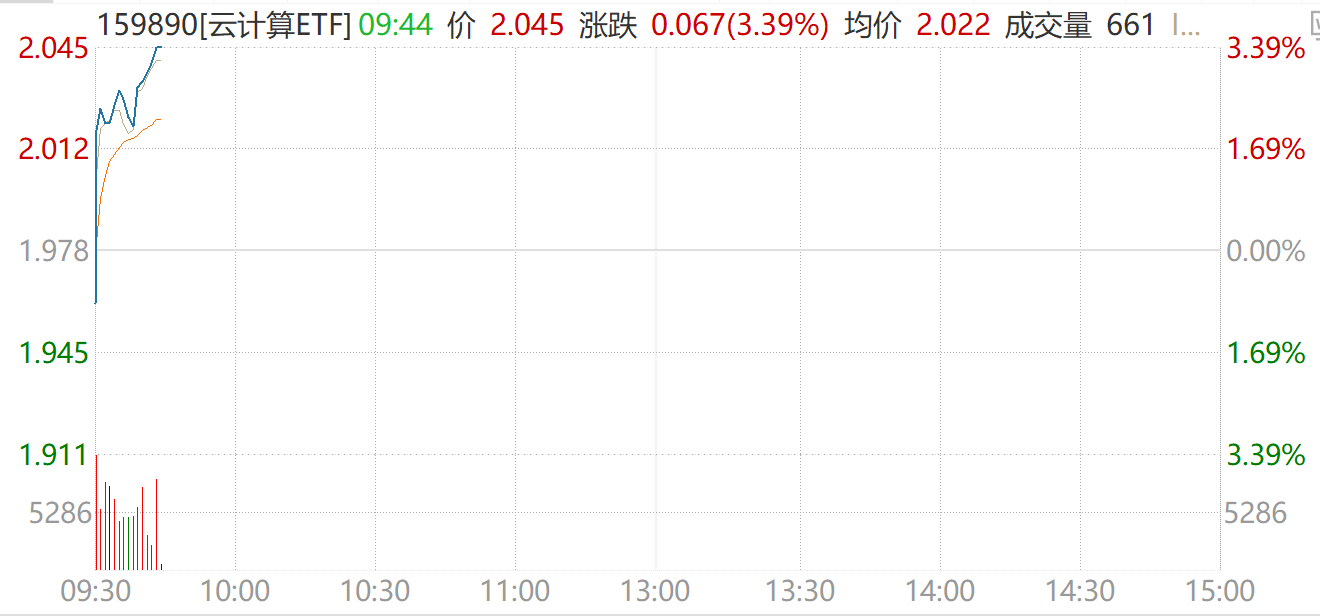
云计算ETF(159890)高开3.39%!机构:从算力竞赛到应用落地,聚焦下半场AI行情
Sou Hu Cai Jing· 2026-01-14 02:33
Group 1 - The GEO concept has significantly boosted AI applications, with stocks like Shiji Information and Taxfriend reaching their daily limit up, and others like Yidian Tianxia increasing by 14.20% [1] - The cloud computing ETF (159890) opened with a 3.39% increase, indicating substantial net inflows, and it tracks a broad index with 65% allocation to IT services, general software, and vertical application software, showing deep engagement in AI applications [1][6] Group 2 - The U.S. has relaxed export regulations on Nvidia's H200 chips to China, but the impact on the domestic computing power industry is expected to be limited due to differing application scenarios [3] - Domestic computing power is projected to capture over 400 billion yuan of the estimated 600-650 billion yuan allocated for domestic purchases by ByteDance by 2026, with significant investments also expected from Alibaba and Tencent [3] - The Chinese intelligent computing power market is anticipated to maintain a compound annual growth rate of 57% from 2020 to 2028, driven by the expansion of intelligent computing centers and accelerated domestic substitution [3] Group 3 - The AI industry is transitioning from a focus on "computing power competition" to "application landing," with a notable increase in confidence regarding the commercial viability of large model applications [4] - Historical trends suggest that hard technology follows a cyclical pattern driven by market conditions, while soft technology is more influenced by changes in business models, indicating a potential new wave of software market activity [4] - The AI market is expected to remain a core focus in 2026, with applications offering high configuration cost-effectiveness despite limited price increases compared to overseas computing power [4]
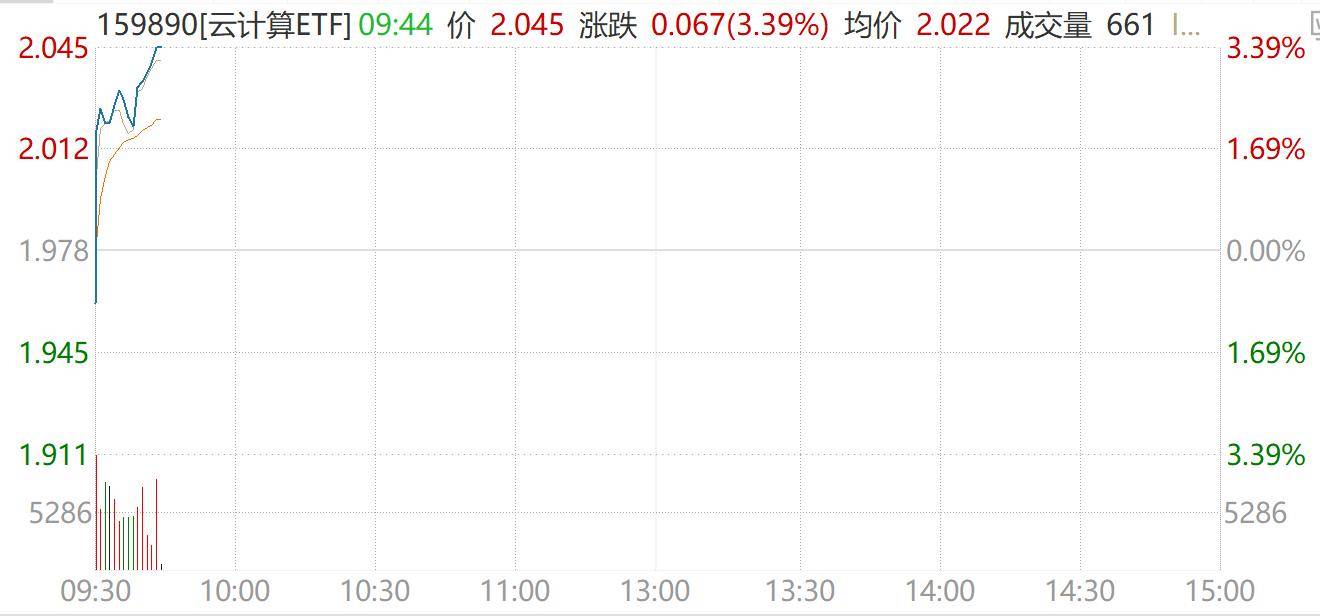
GEO引领AI应用板块狂飙!计算机ETF(159998)标的指数涨超4%,9连“吸金”超7亿,云计算ETF天弘(517390)标的指数涨2.67%
Ge Long Hui A P P· 2026-01-14 02:18
Group 1 - The AI application sector continues to strengthen, with notable stock performances from companies like Zhejiang Wenhui, Shiji Information, and Guangyun Technology, contributing to significant increases in related ETFs [1] - The largest computer industry-themed ETF, Computer ETF (159998), has seen a net inflow of 761 million yuan over nine consecutive days, indicating strong investor interest [1] - The top ten holdings of the Computer ETF include industry leaders such as Hikvision and iFLYTEK, which are well-positioned to capture growth in AI applications and cloud computing [1] Group 2 - The computer industry is expected to reach a turning point by the second half of 2025, with Q3 software revenue reported at 176.52 billion yuan, reflecting a 1.61% increase, and a net profit of 377 million yuan, up 244.56% [2] - Software-defined computing is crucial for determining the cost curve and capability ceiling of AI applications, with performance improvements expected to precede application deployment [2] - AI technology is evolving, with marketing and animated content becoming key commercial applications, particularly through generative search (GEO) [2] Group 3 - 2026 is projected to be a pivotal year for AI applications transitioning from "technology validation" to "commercial promotion" [3] - The Cloud Computing Tianhong ETF (517390) closely tracks the CSI Hong Kong-Shenzhen Cloud Computing Industry Index, capturing opportunities in the cloud computing sector with significant representation from major players like Alibaba and Tencent [3]
美国批准英伟达H200卖给中国,但有条件
Guan Cha Zhe Wang· 2026-01-14 00:32
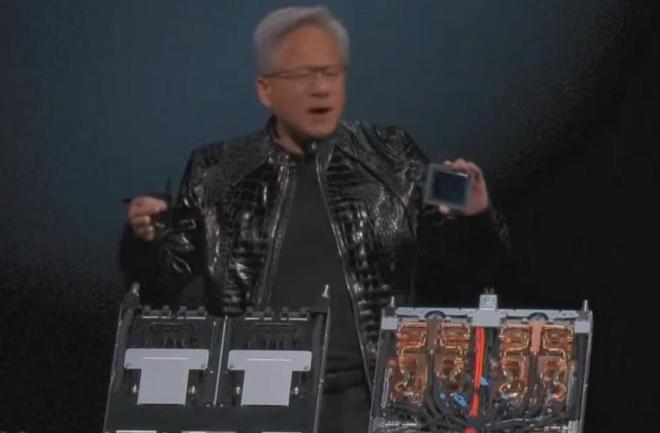
【文/观察者网 齐倩】 当地时间1月13日,美国特朗普政府正式批准英伟达对华出口H200人工智能(AI)芯片。 根据美国商务部发布声明,商务部下属机构工业与安全局(BIS)正在修订对某些半导体向中国出口的 许可审查政策——从推定拒绝改为逐案审查。 彭博社称,这一规定是落实美国总统特朗普上个月决定允许英伟达等芯片制造商向中国销售先进AI芯 片的关键一步。当时,特朗普提出一个条件:美国政府需获得25%的分成。 在最新声明中,美国商务部再次针对英伟达H200等芯片设置了出口限制:其一,该芯片在美国市场上 商业可用;其二,出口商需证明,美国有足够的该产品供应,且接收方已展示"充分的安保程序"。 根据法规,芯片将在发货至中国前,由第三方测试实验室审查其技术AI能力。 这些公司向中国运送的芯片数量将受到限制,不得超过面向美国市场总产量的50%。同时,公司还必 须"采用严格的'了解你的客户'程序",以防止技术被未经授权使用。 彭博社提到,该措施为英伟达及其竞争对手先进微器件公司(AMD)设定了许可要求,后者正在寻求 在中国销售其MI325X芯片的许可。AMD发言人在声明中表示:"我们遵守所有美国出口管制法律和政 策。" 5 ...

谷歌英伟达遥遥领先,亚洲科技股持续看涨,“美股七巨头”统治力面临挑战
Huan Qiu Shi Bao· 2026-01-13 23:07
Core Viewpoint - The dominance of the "Big Seven" tech stocks in the US market is showing signs of weakening, as their performance has diverged, with only Alphabet and Nvidia outperforming the overall market in the past year [1][2][3] Group 1: Performance of the "Big Seven" - The "Big Seven" refers to Tesla, Nvidia, Microsoft, Amazon, Apple, Alphabet, and Meta, which collectively account for about one-third of the S&P 500 index [2] - In 2025, the "Big Seven" index rose by 25%, outperforming the S&P 500's 16% increase, primarily driven by Alphabet's 66% and Nvidia's 39% stock price increases [2] - The expected profit growth for the "Big Seven" stocks is about 18%, the lowest since 2022, only slightly above the 13% expected growth for the remaining 493 companies in the S&P 500 [3] Group 2: Diverging Company Prospects - Nvidia continues to see sales growth due to high demand for AI chips, despite concerns about competition and customer spending sustainability [2] - Microsoft is investing heavily in AI but is perceived to have slower profit growth [2] - Apple's cautious approach to AI investments has stabilized its position, but its high stock price is viewed as overvalued [2][3] Group 3: Shift in Market Focus - Investors are increasingly looking towards other components of the S&P 500 as profit growth slows and doubts about the returns from massive AI investments grow [3] - Year-to-date, the "Big Seven" index has only increased by 0.5%, while the S&P 500 has risen by 1.8% [3] Group 4: Rise of Asian Tech Stocks - Asian tech stocks are experiencing a strong rise, contrasting with the slowdown in US tech stocks, with expectations that they will outperform their US counterparts throughout the year [4] - The MSCI Asia Pacific Information Technology Index has outperformed the Nasdaq 100 Index by 33 percentage points this year [4] - Major players in the Asian tech sector, such as Samsung and various Chinese AI companies, are showing significant growth and market confidence [4][6][7] Group 5: Future Outlook for Chinese Tech Giants - The Chinese tech sector is gaining attention, with predictions that the "Big Eight" Chinese tech companies could surpass the "Big Seven" US tech companies in profit growth by 2026 [6][7] - Recent IPOs of Chinese AI companies have boosted market confidence, with significant stock price increases observed [7]

智谱与MiniMax上市:AI大模型“告别草莽”
Sou Hu Cai Jing· 2026-01-13 13:13
Core Insights - The article discusses the transition of the AI large model industry from a phase of intense competition to a period focused on commercial validation, highlighting the distinct paths taken by two companies, Zhiyu and MiniMax, as they went public in the Hong Kong market [2][17]. Group 1: Business Models and Strategies - Zhiyu adopts a "MaaS" (Model as a Service) approach, focusing on becoming a foundational infrastructure for various industries, emphasizing stability and long-term value [3][5]. - MiniMax, on the other hand, pursues a global C-end strategy, leveraging product innovation and market speed to establish a competitive edge, with a significant portion of its revenue coming from overseas markets [3][5][27]. - Both companies' paths reflect their strategic judgments regarding different stages of AI commercialization, with no absolute superiority between the two approaches [4][6]. Group 2: Financial Performance - Zhiyu's revenue grew from 57.4 million yuan in 2022 to 312.4 million yuan in 2024, with a compound annual growth rate of 130%, and a projected revenue of 738 million yuan in 2025 [7][8]. - MiniMax's revenue surged from 3.5 million USD in 2023 to 30.5 million USD in 2024, marking a year-on-year growth rate of 782.2% [8]. - Both companies face significant losses, with Zhiyu accumulating over 6.2 billion yuan in losses from 2022 to mid-2025, and MiniMax's losses reaching approximately 9.3 billion yuan during the same period [9][10]. Group 3: Industry Trends and Market Dynamics - The successful IPOs of Zhiyu and MiniMax signify a shift in the AI large model industry, moving away from the "parameter competition" era towards a more rational investment landscape [17][21]. - The market is witnessing a clear differentiation among AI companies, with some exiting direct competition in favor of niche markets, while others, like Zhiyu and MiniMax, demonstrate viable business models and growth potential [18][22]. - Major internet companies are entering the AI space, altering the competitive landscape with their resources and strategies, which creates a disparity in competition between established giants and startups [23][24]. Group 4: Future Outlook - The article concludes that the paths of Zhiyu and MiniMax illustrate the diverse possibilities within the AI industry, with both companies facing similar challenges of high operational costs and the need for sustainable profitability [29][30]. - The successful listings of these companies mark a new beginning in the AI competition, emphasizing the importance of technological assets and ecosystem potential in valuation [30][31].
押中AI芯片、大模型IPO,世纪华通、游族等游戏企业图啥
Nan Fang Du Shi Bao· 2026-01-13 11:04
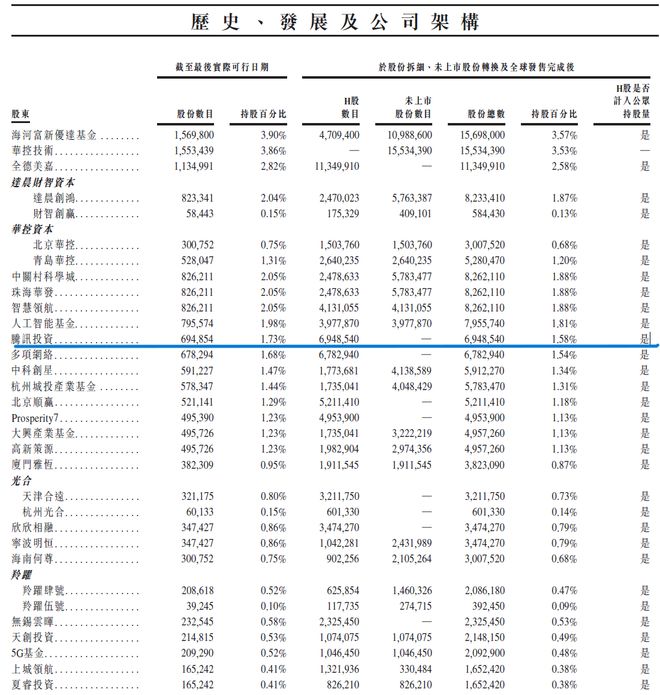
Core Insights - The recent surge in IPOs for AI and semiconductor companies in China has attracted significant market attention, with notable performances from companies like MiniMax and Zhipu [1][2][3] - Major gaming companies such as Tencent, Mihayou, and others are increasingly investing in AI and semiconductor firms, indicating a trend of deep integration between the gaming industry and advanced technologies [1][12][15] Investment Highlights - MiniMax, an AI unicorn, debuted on the Hong Kong Stock Exchange with a first-day increase of 109%, reaching a market capitalization of over HKD 100 billion [1] - Mihayou, an early investor in MiniMax, holds approximately 6.1% of the company, with a current stake valued at around HKD 6.5 billion, reflecting a nearly 70-fold increase in valuation since its initial investment [2] - Zhipu, another AI company, saw its market cap exceed HKD 570 billion upon listing, with significant price increases shortly after [2][3] Strategic Investments by Gaming Companies - Tencent led a USD 250 million Series B funding round for MiniMax and has also invested in Zhipu, holding 1.58% and 2.58% stakes in these companies, respectively [3][12] - Other gaming companies, such as 37 Interactive Entertainment and Youzu Interactive, are also making strategic investments in AI and semiconductor firms, indicating a broader trend within the industry [3][11] Market Dynamics - The gaming industry is increasingly viewed as a significant player in the tech investment landscape, with analysts noting that gaming companies are leveraging their cash flow to support advancements in AI and semiconductor technologies [12][15] - The shift in perception of gaming companies from mere entertainment providers to strategic investors in high-tech sectors reflects a growing recognition of their role in driving technological innovation [15][16] Future Outlook - Analysts suggest that the investments made by gaming companies are not merely opportunistic but are driven by internal needs for enhanced computational power and AI tools to improve game development processes [13][14] - The trend of gaming companies investing in upstream technologies is expected to continue, fostering a symbiotic relationship between gaming and technological advancements [14][15]


机构:2025年大厂扩招涨薪 人工智能相关岗位成集中方向
Zheng Quan Shi Bao Wang· 2026-01-13 08:47
1月13日,脉脉发布的数据显示,新经济行业就业出现回暖信号。从招聘量来看,2025年,万人以上规 模企业新发岗位量同比增长2.33%,成为唯一实现新发岗位量增长的企业规模类型。500人以下、500— 1000人、1000—10000人企业的招聘需求均在收窄。2025年,万人以上的企业贡献了全行业36.55%的新 发岗位量,高于2024年的34.80%。 具体到公司层面,新发岗位量涨幅较高的企业几乎全部为万人以上规模企业。大疆、滴滴、小米的新发 岗位量均取得较高水平增长。字节跳动、蚂蚁集团等知名大厂在脉脉发布多个急招岗位,其中BI数据分 析、海外业务项目经理、数据开发专家等多个岗位年薪超过100万元。 脉脉调研数据显示,2025年,万人以上规模企业涨薪的员工比例显著高于其他规模企业。从不同企业的 新发岗位平均月薪涨幅来看,涨薪较多的企业集中在互联网行业和新能源汽车。据不完全统计,2025 年,比亚迪(002594)新发"AI infra算法工程师"岗位平均月薪上涨超过36%;大疆"工业设计师"岗位平 均月薪上涨20%,腾讯"AI产品经理"岗位平均月薪上涨5.56%。近日,字节跳动启动实习生全面涨薪计 划。在脉脉 ...

MiniMax市值破千亿,上市首日涨幅超100%,AI应用Talkie贡献六成收入
Jin Rong Jie· 2026-01-13 08:42
Core Viewpoint - MiniMax, a general artificial intelligence company, successfully listed on the Hong Kong Stock Exchange on January 9, 2026, with a share price of HKD 165, closing at HKD 345 on the first day, marking a 109.09% increase and a market capitalization exceeding HKD 100 billion [1] Group 1: Company Overview - MiniMax was founded in 2021 by CEO Yan Junjie, who holds a PhD from the Chinese Academy of Sciences and previously held an executive position at SenseTime [1] - The company focuses on consumer-oriented (C-end) and global development paths from its inception [1] - MiniMax has developed multimodal model technologies, including text model MiniMax M2, video model Hailuo 02, and voice model Speech 02 [1] Group 2: Product and Revenue - The company has launched several AI-native products, including the AI companionship application Talkie/Xingye and the visual generation platform Hailuo AI [1] - According to the prospectus, Talkie/Xingye contributed 63.7% of the total revenue in 2024 [1] - As of September 2025, MiniMax's AI native products have served over 212 million individual users globally, with over 70% of revenue coming from overseas markets [1] Group 3: Financial Performance - MiniMax's revenue has grown rapidly, with total revenue of USD 30.52 million in 2024, increasing to USD 53.437 million in the first three quarters of 2025 [2] - The company is currently in a loss position due to high R&D investments, with an adjusted net loss of USD 345 million from 2022 to 2024 [2] Group 4: Investment and Legal Issues - Prior to its IPO, MiniMax secured multiple rounds of investment from major firms including Alibaba, Tencent, MiHoYo, Hillhouse, IDG Capital, and Sequoia China [2] - Alibaba, through Alisoft China, holds a 12.52% stake, making it the second-largest shareholder [2] - In September 2025, MiniMax faced a copyright infringement lawsuit from several U.S. film production companies, including Disney and Universal Pictures, regarding its visual generation platform Hailuo AI [2] - The company believes the allegations lack factual basis and sufficient evidence, and plans to contest the lawsuit [2] Group 5: Market Position - According to ZhiShi Consulting, MiniMax ranks as the tenth largest model technology company globally by revenue based on models in 2024, holding a market share of 0.3% [2] - The global large model market is expected to reach USD 22 billion by 2025, with MiniMax projected to maintain approximately 0.3% market share [2]
智谱跌13%,港股科网股多股下挫,阿里涨超2%
21世纪经济报道· 2026-01-13 07:32
记者丨 张伟泽 编辑丨李莹亮,和佳 继昨日大涨后,今日港股AI股开始回调走弱。1月13日午后,港股AI应用板块午后继续降温。截至发稿, 智谱(02513.HK)跌超13%, MINIMAX-WP(00100.HK)跌10%,商汤(00020.HK)跌超4%,港股科网股多股下挫,快手、华虹半导体、金山软件跌超2%,阿里巴巴、哔哩 哔哩、小鹏汽车飘红,截至发稿涨幅超2%。 | 截至1月13日14:17走势 | | --- | 目前港股AI产业版图正在不断拓展。在AI产业链的上游,有中芯国际、壁仞科技、天数智芯等多家提供算力和数据支撑的硬件服务企业。而在 AI产业链的中游,除了刚刚上市的MiniMax和智谱之外,也有阿里、腾讯和百度等参与AI软件的综合厂商。在AI产业链的下游,则有百度旗下 的AI芯片公司昆仑芯,以及存储芯片公司芯天下技术等企业,均已向港交所提交上市申请。 这股热潮并非偶然。瑞银全球投资银行亚太股票资本市场联席主管胡凌寒在近期接受21世纪经济报道记者专访时指出,AI是当前全球范围内热 度极高的赛道,随着行业发展,这些公司必然产生融资需求,可以预见2026年一定会有更多AI产业链相关的公司登陆香港市场 ...