国信证券

Search documents
移为通信:拟将9455.70万元节余募资永久补流
Xin Lang Cai Jing· 2025-12-22 09:15
移为通信公告称,2025年12月22日公司召开董事会,审议通过募投项目结项及将节余资金永久补充流动 资金的议案。2021年向特定对象发行股票募投项目已基本实施完毕,截至2025年12月19日,节余资金 9455.70万元(含利息和理财收益),拟永久补充流动资金用于经营活动。相关专户将注销,三方/四方 监管协议将终止。该事项尚需股东会审议,保荐机构国信证券无异议。 ...

两融资金未大规模撤离,债券交易沪强深弱
China Post Securities· 2025-12-22 08:01
Investment Rating - The industry investment rating is Neutral, maintained [1] Core Insights - The macro liquidity environment is easing, alleviating funding pressure and providing a stable cost advantage for brokerages' capital-intensive businesses such as proprietary trading and margin financing. The sustained high trading volume in equity funds is expected to support brokerage commission income. The margin financing balance has remained above 2.4 trillion, indicating a transition from "incremental expansion" to "stock optimization" in the use of leverage in the A-share market, suggesting that the previously influxed leveraged funds have not significantly withdrawn but are instead showing a trend of "settling down" [4][6] - The bond market has shown a clear "strong in Shanghai, weak in Shenzhen" pattern, with Shanghai focusing on government bonds and policy financial bonds, which are more attractive for institutional funding due to their pledge financing convenience at year-end. This shift in funding between equity and bond markets may indicate subtle changes in current funding risk preferences [4][7] Industry Fundamentals Tracking - The SHIBOR 3M rate has stabilized at 1.60%, showing a recovery from previous lows and indicating alleviated funding pressure [5][14] - The average daily trading volume of equity funds for the week from December 12 to December 19 was approximately 220.29 billion, reflecting a slight decline from the previous week's average of 238.02 billion, but still indicating that a trillion-level transaction has become the new normal for the A-share market [5][15] - As of December 18, the margin financing balance in the Shanghai, Shenzhen, and Beijing markets was 2,499.366 billion, indicating a consolidation phase at high levels since September 2025, marking a transition in leverage use [6][18] - The China Bond New Comprehensive Index closed at 248.8624 points, currently stabilizing after a decline from November's peak, supported by a stable liquidity environment [6][19] - The brokerage sector's valuation has diverged significantly from the overall market, with the Shenwan brokerage index PE rising 5.63% year-to-date, compared to a 20.25% increase in the Shenwan A index, widening the gap to 14.62 percentage points [6][22] Market Review - Last week, the A-share Shenwan Securities II industry index increased by 1.01%, outperforming the CSI 300 index, which declined by 0.28%, with a relative outperformance of 1.29 percentage points [6][26] - For the year, the CSI 300 index has increased by 15.78%, while the brokerage sector has decreased by 0.11%, underperforming by 15.89 percentage points [6][26] - The A-share securities II sector ranked 14th among 31 Shenwan first-level industries last week, underperforming the non-bank financial sector [6][27]
港股创五年最佳:恒指涨33%创新高,南向资金破纪录,机构看好2026年前景
Jin Rong Jie· 2025-12-22 07:36
Group 1 - The Hong Kong stock market is expected to achieve its best annual performance in five years by 2025, driven by policy support, improved liquidity, and structural investment opportunities [1] - The Hang Seng Index rose by 33.25% in 2025, closing at 25,690.53 points, while the Hang Seng Tech Index increased by 25.74%, closing at 5,479.04 points [1] - Southbound capital inflow exceeded 1.38 trillion HKD, marking a historical high, with its trading volume accounting for an average of 61% of the total market turnover [1] Group 2 - The gold sector led the market, with Zhenfeng Gold achieving a remarkable increase of 1,195.45% during the year [1] - The new energy vehicle sector also performed well, with XPeng Motors rising by 64.46%, linked to the recent approval of L3 autonomous driving models [1] - The technology sector benefited from AI narratives, with significant stock price increases for companies like Alibaba and Kuaishou [2] Group 3 - The insurance and brokerage sectors showed strong performance, with New China Life and China Life increasing by 162.98% and 102.10%, respectively, driven by policy benefits and fundamental improvements [2] - Multiple institutions are optimistic about the Hong Kong stock market's outlook for 2026, with Standard Chartered predicting the Hang Seng Index to trade between 28,000 and 30,000 points [2] - Morgan Stanley forecasts that A-shares and Hong Kong stocks may rise nearly 20% next year [2] Group 4 - Emerging markets are gaining global attention, with analysts indicating a shift in sentiment as pessimism fades [3] - JPMorgan's investment strategy emphasizes holding emerging market local currency bonds, anticipating double-digit returns for hard currency emerging market bonds in 2025 [3]
资配跨年展望:春季躁动,你想知道的一切
Guoxin Securities· 2025-12-22 07:14
Global Assets - The "cross-year red envelope" and "spring market" phenomenon is observed, with Q4 historically showing higher stock index gains due to seasonal effects, dovish signals from central banks, and increased risk appetite during the holiday season [3][8] - In Q1, commodities show strong seasonal performance, with gold averaging a 4% gain, silver at 3.4%, and oil at 4.85%, influenced by OPEC adjustments and seasonal demand [10][14] - Global assets exhibit a strong resonance during China's "spring market," with increased odds of gains across global equity assets during this period [3][18] AH Market Trends - The current trading window is less sensitive to fundamentals, with the spring market expected to be neutral to strong in 2026 [3] - Historical data shows that A-shares have a higher win rate during the period from the Spring Festival to the Two Sessions, while H-shares perform better from New Year to Spring Festival [3][34] - The main upward trend typically covers the period from the Spring Festival to the start of the Two Sessions, with a 94% overlap with actual upward trends [3] Style Patterns - Small-cap stocks outperform large-cap stocks with a 75% win rate, particularly during the spring market [3] - Growth stocks tend to outperform value stocks, with asymmetric potential returns where losing years are limited to a 4% drop, while winning years can exceed 10% [3] - The spring market shows a clear style switch between large-cap value and small-cap growth stocks, particularly around the Spring Festival [3] Industry Patterns - The spring market does not determine the main industry trends for the year, with sectors like non-ferrous metals, computing, and media showing relative strength [3] - Historical data indicates that communication and military industries have a higher probability of positive returns during the Spring Festival to Two Sessions period [3] - The overlap of top-performing industries during the spring market with the previous year's main trends is relatively low, indicating weak guiding effects [3] Technical and Practical Patterns - Entry points for small-cap stocks are recommended within the week before the Spring Festival, while large-cap growth and ChiNext stocks should be positioned early [3] - Important exit conditions include a single-day drop exceeding 2% and a weak MACD signal [3]

估值周观察(12月第3期):风格反转,行业轮动
Guoxin Securities· 2025-12-22 05:08
Group 1 - The report indicates that in the week from December 15 to December 19, 2025, overseas markets experienced more declines than gains, with slight valuation changes. The Asia-Pacific region saw a broad decline, led by South Korea, while the Eurozone and the UK saw increases. Notably, the Nikkei 225 and the Korean Composite Index fell by 2.61% and 3.52%, respectively, but their P/E ratios expanded by 0.92x and 2.57x, indicating downward revisions in earnings expectations [3][8]. - In the same week, A-shares showed narrow fluctuations with slight valuation expansion. The large-cap value stocks outperformed growth stocks, with large-cap value rising by 1.52% while large-cap growth fell by 1.39%. The report highlights that the valuation distribution is asymmetric, with significant P/E contractions in small-cap growth and the National Index 2000 [3][23]. - The report notes that the downstream consumer sector has a favorable valuation attractiveness. The communication sector has the highest valuation percentiles, with rolling 1-year, 3-year, and 5-year averages of 96.80%, 98.93%, and 99.36%, respectively. Other consumer sectors like social services and beauty care also show relatively high valuation attractiveness [3][26]. Group 2 - The report highlights that the new energy sector experienced a broad decline, with photovoltaic stocks leading the drop at -3.91%. However, sectors such as insurance and military industry performed well, indicating a divergence in sector performance. The report also notes that some industries, like artificial intelligence and new energy, saw significant P/E expansions despite falling stock prices, reflecting downward revisions in profit expectations [3][23]. - The report provides a detailed valuation comparison of various indices, indicating that the core broad-based indices (CSI 300, Shanghai Composite, and Wind All A) are all above the 75th percentile level since 2010. In contrast, other indices are positioned between the median and the 75th percentile [3][28]. - The report concludes that large-cap growth stocks have superior valuation attractiveness, with their P/E, P/B, and P/S ratios showing higher percentile rankings compared to small-cap value stocks, which have lower valuation attractiveness across multiple time frames [3][26].
国联民生证券整合再提速!姜晓林出任财富子公司总裁
Xin Lang Cai Jing· 2025-12-22 03:36
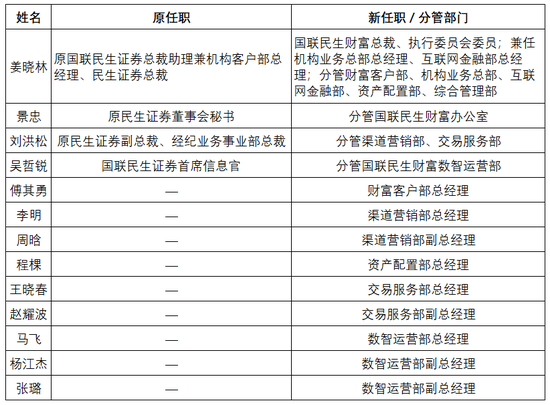
Group 1 - The core development of Guolian Minsheng Securities involves the integration of its wealth management business, transitioning to a new entity named "Guolian Minsheng Wealth" by June 2026 [1][8] - The company aims to consolidate client resources and business layouts from both Guolian Securities and Minsheng Securities in the wealth management sector [1][8] - Key personnel changes have been announced, with Jiang Xiaolin appointed as the president of Guolian Minsheng Wealth, overseeing multiple departments [1][2][8] Group 2 - Jiang Xiaolin has a significant background in the industry, having previously held various leadership roles at CITIC Securities, where he developed extensive experience in market expansion and institutional client services [3][11] - Under Jiang's leadership, Guolian Securities has enhanced its advisory services, achieving recognition in the industry with multiple awards for its fund advisory services [5][11] - The company reported a substantial increase in financial product sales, reaching 870.20 billion yuan, with a 50.01% growth in product holdings compared to the previous year [6][12] Group 3 - The wealth management industry is experiencing a trend of concentration among leading firms, while smaller firms are seeking to differentiate themselves amid challenges in profitability and competition [6][12] - The overall transformation of wealth management in the industry is still in its early stages, with many firms relying heavily on traditional commission-based models [6][12] - Guolian Minsheng Securities has positioned itself as the fastest-growing firm in terms of revenue in the brokerage and wealth management sectors, with a reported revenue growth of 215.76% in the first half of 2025 [6][12]


国信证券:互联网证券行业构建综合服务生态模式 深化财富管理深度转型
Zhi Tong Cai Jing· 2025-12-22 01:48
Group 1 - The core viewpoint of the report is that the internet securities industry is transitioning from a traditional, homogeneous channel service model to a customer-centric model that builds a comprehensive service ecosystem, which will drive industry innovation and iteration [1] - The traditional securities brokerage business is facing challenges due to high homogeneity and a "commission war," leading to a significant decline in average commission rates, resulting in "increased revenue without increased profit" [1] - Internet securities are breaking this dilemma by acquiring customers at low costs through online channels and traffic cooperation, and monetizing traffic by extending from low-commission services to higher-value services like margin trading and fund distribution [1] Group 2 - The goal of deepening wealth management transformation is to establish asset allocation and advisory service capabilities centered on customer interests, achieving a "two-way rush" with customer assets [2] - Five representative models of successful internet brokers are analyzed, highlighting their core capabilities: Dongfang Wealth (traffic ecosystem type), Charles Schwab (platform ecosystem type), Futu Securities (cross-border differentiation type), Jiufang Zhitu (service extension type), and Robinhood (zero-commission transformation type) [2] - Successful internet brokers generally possess core capabilities that form a synergistic system, including traffic acquisition and conversion, exceptional product experience, data asset application, ecosystem construction, and regulatory adaptation [3]
十大券商看后市|A股风险偏好或企稳回升,春季行情启动在即
Sou Hu Cai Jing· 2025-12-22 00:53
Core Viewpoint - The A-share market is expected to stabilize and recover in risk appetite, with a spring rally anticipated in 2026 as the overseas environment becomes more stable and liquidity expectations are clarified [1][4][7]. Group 1: Market Outlook - Multiple brokerages indicate that a classic "cross-year-spring" rally is brewing, with significant institutional investors increasing their holdings in broad-based ETFs, providing stable incremental capital to the market [1][10][11]. - The spring market is characterized by a favorable liquidity environment, with historical patterns suggesting a high probability of a rebound before the Spring Festival [7][10]. - The market is currently experiencing a narrow range of fluctuations, influenced by external factors such as U.S. Federal Reserve policies and Japanese central bank actions, but is expected to resonate upward with global markets [8]. Group 2: Investment Strategies - Investors are advised to adopt a strategy of finding buying points and waiting for opportunities, rather than chasing prices, as the market adjustment appears to be sufficient [2][12]. - Focus areas for investment include sectors benefiting from domestic demand, such as AI applications, commercial aerospace, and tourism, as well as cyclical recovery sectors [4][11][13]. - The spring rally is seen as an opportunity to invest in high-growth sectors, with recommendations to pay attention to industries like industrial metals, non-bank financials, and tourism-related services [11][14]. Group 3: Currency and Asset Allocation - Investors are encouraged to adapt to a continuously appreciating RMB environment, with certain industries expected to benefit from improved profit margins due to currency appreciation [3]. - Approximately 19% of industries may see profit margin improvements due to the RMB's appreciation, which could attract investor attention [3].




并购潮下头部券商筑生态 区域精兵深耕差异化 聚焦功能跃迁 券商竞合开新局
Zhong Guo Zheng Quan Bao· 2025-12-21 21:56
Core Viewpoint - The Chinese securities industry is undergoing a significant wave of integration driven by policies aimed at building a strong financial nation, with major mergers and acquisitions expected to reshape the competitive landscape of the industry [1][2][3]. Group 1: Mergers and Acquisitions - CICC has announced a stock swap merger with Dongxing Securities and Xinda Securities, which is expected to push its total asset scale beyond 1 trillion yuan, marking the emergence of a new "carrier-level" brokerage [1][2]. - By 2025, several significant mergers are anticipated, including the merger of Guotai Junan and Haitong Securities, indicating a trend towards consolidation among leading firms [2][3]. - The motivations for these mergers are diverse, including the creation of internationally competitive investment banks and the integration of specialized brokerages to enhance overall competitiveness [2][4]. Group 2: Policy and Strategic Drivers - This round of mergers is characterized by a top-down, policy-driven approach, aligning with national strategies such as the cultivation of first-class investment banks [3][4]. - The integration is primarily led by state-owned capital, reflecting a high degree of coordination with national strategies, and involves various forms such as stock mergers and controlling acquisitions [3][4]. - The current environment encourages a shift from mere scale expansion to achieving functional synergy and professional capability enhancement, aiming for a leap in quality development [1][4]. Group 3: Industry Trends and Future Outlook - The integration wave is expected to improve the overall competitive landscape, reducing harmful price wars and enhancing the efficiency of resource allocation within the industry [7][8]. - The "14th Five-Year Plan" emphasizes optimizing the financial institution system and enhancing resource integration capabilities, aiming to form several internationally influential leading institutions [6]. - Future mergers are likely to focus on achieving synergistic effects rather than just asset accumulation, with an emphasis on enhancing capital efficiency and resilience against economic cycles [4][8]. Group 4: Strategic Directions for Brokerages - Leading brokerages are encouraged to strengthen their roles in serving the real economy and new productive forces, focusing on sectors like artificial intelligence, biomedicine, and green energy [8][9]. - Smaller brokerages should concentrate on regional specialization and professional differentiation, leveraging local industry resources to build competitive advantages in niche markets [10]. - The future development paths for smaller brokerages include enhancing their wealth management services and utilizing their extensive branch networks to deepen customer engagement [10].



前华尔街投行分析师:用“全球视角”看中概股
Sou Hu Cai Jing· 2025-12-21 18:58
Group 1 - The core viewpoint of the article highlights the transformation of China's capital market under the "dual circulation" strategy, emphasizing the deepening of the "1+6" reform on the Sci-Tech Innovation Board and the adaptation of the Growth Enterprise Market's admission standards to future industries [2] - In 2025, the scale of medium- and long-term capital entering the market is expected to reach a historical high, with foreign capital net increasing its holdings of domestic stocks by over 100 billion yuan within the year [2] - The article announces an online sharing session titled "Technology Empowerment · Capital Breakthrough" scheduled for December 22, 2025, featuring insights on the global macro environment, structural evolution of Chinese concept stocks, and strategic positioning of the Hong Kong market [2][6] Group 2 - Marco Zhang, the director of the Gelonghui China Concept Research Institute, will provide in-depth analysis during the event, drawing from his extensive experience in investment banking and capital markets [4] - The agenda includes presentations from various analysts, focusing on sectors such as electric equipment and new energy, indicating a broad interest in technology and innovation [8] - The event aims to explore the value coordinates of China's capital market in the context of global capital rebalancing, positioning China as a core anchor in this new era [2]