
零跑汽车

Search documents
钢材&铁矿石日报:商品情绪偏暖,钢矿震荡走高-20260112
Bao Cheng Qi Huo· 2026-01-12 10:03
Report Industry Investment Rating No relevant content provided. Core Views - The main contract price of rebar oscillated higher with a daily increase of 0.60%, showing a pattern of decreasing volume and increasing open interest. With supply increasing and demand weak, the fundamental contradiction has accumulated. Although the positive factor is the warm commodity sentiment, the rebar price is expected to continue the oscillatory and stable operation. Attention should be paid to the production situation of steel mills [5]. - The main contract price of hot-rolled coil also oscillated higher with a daily increase of 0.55%, with decreasing volume and increasing open interest. In the current situation of increasing supply and weak demand, the fundamentals of hot-rolled coil are weak, and the price continues to be under pressure. The relatively positive factor is the warm commodity sentiment, and its trend is expected to maintain an oscillatory and stable operation. Attention should be paid to the demand performance [5]. - The main contract price of iron ore oscillated higher with a daily increase of 0.92%, and both volume and open interest expanded. Currently, the supply of iron ore is high while the demand improvement is limited, so the fundamentals of iron ore are weak, and the ore price continues to be under pressure. The relatively positive factors are the warm commodity sentiment and pre - holiday restocking support. Under the game of multiple and short factors, the ore price maintains a high - level operation. Attention should be paid to the restocking situation of steel mills [5]. Summary by Directory 1. Industry Dynamics - In December 2025, 482 projects started across the country with a total investment of about 534.092 billion yuan. The total investment in 2025 was about 27.52 trillion yuan. The top three provinces in terms of start - up investment in December were Guangxi, Jiangxi, and Anhui, with total investments of 121.238 billion yuan, 59.41 billion yuan, and 49.103 billion yuan respectively [7]. - As of January 12, 2026, 21 car companies announced their 2025 production and sales data. These 21 car companies sold a total of 25.0233 million vehicles in 2025. BYD led the domestic market with sales of 4.6024 million vehicles. SAIC Group ranked first in production with 4.602 million vehicles in 2025, followed by BYD with 4.5374 million vehicles. 18 car companies saw their sales increase in 2025. XPeng Motors had the highest growth rate of 125.94%, followed by Leapmotor with 103.10%, and BAIC BluePark with 84.06% [8]. - Since January 12, 2026, Handan has launched a level - II emergency response for heavy pollution weather, which is expected to be lifted around January 17 due to poor atmospheric diffusion conditions [9]. 2. Spot Market - Rebar: The spot price in Shanghai was 3,280 yuan, in Tianjin was 3,200 yuan, and the national average was 3,341 yuan. The price changes were 20 yuan, 0 yuan, and 4 yuan respectively [10]. - Hot - rolled coil: The spot price in Shanghai was 3,290 yuan, in Tianjin was 3,190 yuan, and the national average was 3,311 yuan. The price changes were 20 yuan, 0 yuan, and 5 yuan respectively [10]. - Tangshan billet: The price was 2,970 yuan with a change of - 10 yuan [10]. - Zhangjiagang heavy scrap: The price was 2,090 yuan with no change [10]. - PB powder (Shandong port): The price was 825 yuan with a change of 7 yuan [10]. - Tangshan iron concentrate powder (wet - basis): The price was 777 yuan with no change [10]. - Freight rates: Australian freight was 7.84 yuan with a change of - 0.08 yuan, and Brazilian freight was 21.13 yuan with a change of - 0.46 yuan [10]. - SGX swap (current month): The price was 108.34 yuan with a change of 0.49 yuan [10]. - Platts Index (CFR): The price was 108.50 yuan with a change of 0.30 yuan [10]. 3. Futures Market - Rebar: The closing price of the active contract was 3,165 yuan, with a daily increase of 0.60%. The highest price was 3,174 yuan, the lowest was 3,141 yuan, the trading volume was 957,432 lots (a decrease of 212,075 lots), and the open interest was 1,726,703 lots (an increase of 11,840 lots) [13]. - Hot - rolled coil: The closing price of the active contract was 3,311 yuan, with a daily increase of 0.55%. The highest price was 3,320 yuan, the lowest was 3,289 yuan, the trading volume was 408,729 lots (a decrease of 106,874 lots), and the open interest was 1,427,498 lots (an increase of 10,408 lots) [13]. - Iron ore: The closing price of the active contract was 822.5 yuan, with a daily increase of 0.92%. The highest price was 826.0 yuan, the lowest was 817.0 yuan, the trading volume was 272,044 lots (an increase of 1,717 lots), and the open interest was 654,834 lots (an increase of 14,950 lots) [13]. 4. Related Charts - Steel inventory: Charts show the weekly changes and total inventory (steel mill + social inventory) of rebar and hot - rolled coil from 2022 - 2026 [15][21][25]. - Iron ore inventory: Charts show the inventory of 45 ports in China, including inventory changes, seasonal inventory, inventory of 247 steel mills, and inventory of domestic mine iron concentrate powder [23][24][26]. - Steel mill production: Charts show the blast furnace operating rate and capacity utilization rate of 247 sample steel mills, the profitability ratio of 247 steel mills, the operating rate of 87 independent electric furnaces, and the profit and loss situation of 75 building material independent electric arc furnace steel mills [30][33][35]. 5. Future Outlook - Rebar: The supply - demand pattern has weakened. The weekly output increased by 2.82 tons, and the demand decreased by 25.48 tons. With the accumulation of fundamental contradictions, the rebar price is under pressure in the off - season. Although there is positive commodity sentiment and cost support, it is expected to continue the oscillatory and stable operation. Attention should be paid to the production of steel mills [40]. - Hot - rolled coil: The supply - demand pattern has changed little. The weekly output increased by 1.00 tons, and the demand decreased by 2.43 tons. With high inventory and weakening demand, the price is under pressure. Although the positive factor is the warm commodity sentiment, it is expected to maintain an oscillatory and stable operation. Attention should be paid to the demand performance [40]. - Iron ore: The supply - demand pattern is weak. The inventory is rising, and the demand improvement is limited due to the poor profitability of steel mills and the off - season steel market. The supply is at a relatively high level. Although there is warm commodity sentiment and pre - holiday restocking support, the ore price is expected to maintain a high - level operation. Attention should be paid to the restocking of steel mills [41].
港股汽车股持续疲弱
Cai Jing Wang· 2026-01-12 09:38
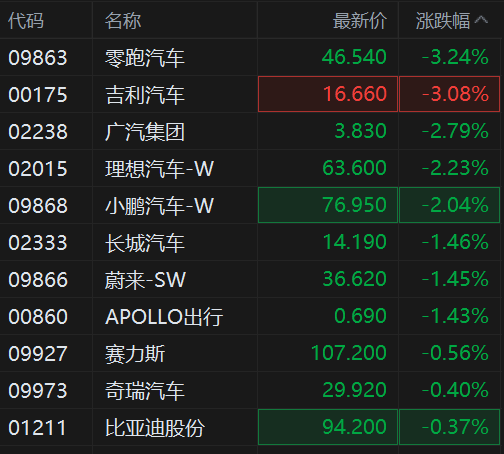
1月12日,港股汽车股持续疲弱,其中,吉利汽车、零跑汽车跌超3%,广汽集团跌2.8%,理想汽车、小 鹏汽车跌超2%,长城汽车、蔚来汽车、赛力斯、奇瑞汽车均有跌幅。(新浪财经) 作者丨彭鑫 编辑丨安安 ...



【月度排名】2025年12月厂商销量排名快报
乘联分会· 2026-01-12 09:28
Core Viewpoint - The article highlights the performance of the Chinese automotive market in December 2025, noting a decline in retail sales for traditional vehicles while emphasizing growth in the new energy vehicle (NEV) sector and exports. The market is expected to transition into 2026 with a focus on new energy vehicles and a recovery in demand [4]. Sales Performance - In December 2025, the domestic narrow passenger car market retail sales reached 2.261 million units, a year-on-year decrease of 14.0% but a month-on-month increase of 1.6%. Cumulative sales for the year totaled 23.744 million units, reflecting a year-on-year growth of 3.8% [2]. - The wholesale sales ranking for December 2025 shows BYD leading with 414,784 units sold, followed by Geely and Chery with 236,817 and 234,736 units, respectively. Notably, BYD's sales decreased by 12.7% month-on-month and 18.6% year-on-year [5]. - For the entire year of 2025, BYD also topped the wholesale sales with 4.545 million units, marking a 6.9% increase year-on-year, while Geely's sales surged by 39.0% to 3.025 million units [6]. New Energy Vehicle Market - In December 2025, the NEV wholesale sales ranking was led by BYD with 414,784 units, despite a month-on-month decline of 12.7% and a year-on-year drop of 18.6%. Geely followed with 154,264 units, showing a year-on-year increase of 38.7% [9]. - The retail sales for NEVs in December 2025 also saw BYD at the forefront with 339,854 units sold, a month-on-month increase of 10.9% but a year-on-year decrease of 15.7% [13]. - For the full year, BYD maintained its dominance in the NEV sector with 3.485 million units sold, although this represented a year-on-year decline of 6.3% [14]. Market Trends and Future Outlook - The article notes that the end of the year typically sees a surge in vehicle purchases, but the depletion of subsidy funds across provinces has tempered this effect, leading to a more stable demand outlook heading into 2026 [4]. - The performance of various manufacturers indicates a competitive landscape, with traditional automakers facing challenges while NEV manufacturers like BYD and Geely continue to show resilience and growth potential [6][9].





整车主线周报:12月新能源批发符合预期,看好26年景气度向上-20260112
Soochow Securities· 2026-01-12 09:10
Investment Rating - The industry investment rating is "Overweight," indicating an expected outperformance of the industry index relative to the benchmark by more than 5% over the next six months [33]. Core Insights - The report highlights a positive outlook for the passenger vehicle sector, anticipating a recovery in demand in Q1 2026 due to the implementation of subsidy policies. Key players include Jianghuai Automobile, Geely, Great Wall Motors, and BYD, focusing on high-end electric vehicles and established export leaders [23][24]. - The heavy truck segment is projected to see a slight increase in domestic sales in 2026, with expectations of 800,000 to 850,000 units sold, reflecting a 3% year-on-year growth. Recommended companies include China National Heavy Duty Truck Group and Weichai Power [28]. - The bus market is expected to benefit from the continuation of subsidy policies, with a conservative estimate of 40,000 units sold in 2026, representing a 5% increase year-on-year. Key recommendations include Yutong Bus and King Long [27]. - The motorcycle sector is forecasted to grow by 14% in total sales in 2026, with a significant increase in large-displacement motorcycles. Recommended companies include Chunfeng Power and Longxin General [24]. Summary by Sections Passenger Vehicles - The report emphasizes a recovery in the passenger vehicle market in Q1 2026, driven by subsidy policies. Key stocks to watch include Jianghuai Automobile and Geely, with a focus on high-end electric vehicles [23][24]. Heavy Trucks - In 2025, heavy truck wholesale sales reached 1.14 million units, a 26% increase year-on-year. The report forecasts 800,000 to 850,000 units for 2026, with a 3% growth expectation. Recommended companies include China National Heavy Duty Truck Group and Weichai Power [28]. Buses - The bus market is projected to see a slight increase in sales due to favorable policies, with an expected 40,000 units sold in 2026. Key recommendations include Yutong Bus and King Long [27]. Motorcycles - The motorcycle industry is expected to grow by 14% in 2026, with large-displacement motorcycles seeing a 31% increase. Recommended companies include Chunfeng Power and Longxin General [24].
2026,卖车更难了
创业邦· 2026-01-12 03:27
Core Viewpoint - The automotive market in 2025 is characterized by intense competition, price wars, and a shift in consumer behavior towards value-driven purchases, leading to significant challenges for manufacturers [5][39]. Group 1: Market Dynamics - BYD, Geely, and Tesla dominated the sales rankings, with BYD maintaining a significant lead in the new energy vehicle sector, selling 4.545 million vehicles in 2025 [7][12]. - The overall sales of new energy vehicles in China reached 14.78 million units, a year-on-year increase of 31.2%, but BYD's growth rate was only 11% [11][12]. - Consumers are increasingly price-sensitive, often comparing prices across cities, which has benefited brands that offer high value for lower prices [7][10]. Group 2: Competitive Landscape - Geely has adopted aggressive pricing strategies, successfully positioning its models against BYD's offerings, resulting in a total of 1.687 million new energy vehicles sold in 2025 [13][14]. - New entrants like Leap Motor have carved out a niche in the budget segment, achieving sales of 596,600 units, and have become profitable, contrasting with many competitors still struggling [16][17]. - Xiaomi's foray into the automotive market has been successful, with its vehicles achieving significant sales and profitability, highlighting the potential for tech companies to disrupt traditional automotive players [21][22]. Group 3: Challenges and Future Outlook - The automotive industry is facing a bottleneck, with many companies struggling to innovate and maintain profitability amid ongoing price wars [39][40]. - The market is expected to become more challenging in 2026, with changes in tax policies and increased competition from established players like Xiaomi and Tesla [45][46]. - Companies are focusing on cost control and operational efficiency as key strategies to survive in a tightening market [41][39].



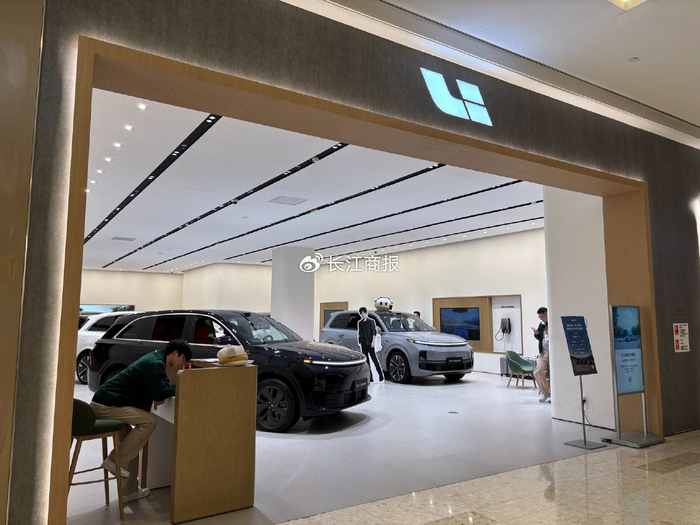
理想汽车失销冠交付量仅完成目标63% 单季归母净利亏6.2亿
Chang Jiang Shang Bao· 2026-01-12 02:47
Core Viewpoint - Li Auto has experienced a significant decline in sales and profitability, leading to a restructuring of its product lines and management approach to regain market competitiveness [2][5][8]. Sales Performance - In 2025, Li Auto delivered a total of 406,300 vehicles, representing an 18.81% year-on-year decline, and only achieved approximately 63% of its revised sales target of 640,000 vehicles [7]. - The company has fallen from the top position in the new energy vehicle sector to fifth place, trailing behind competitors such as Leap Motor, Hongmeng Zhixing, Xiaomi Auto, and XPeng [7]. Financial Performance - In Q3 2025, Li Auto reported a net loss of 624 million yuan, ending a streak of 11 consecutive profitable quarters [8]. - The company's revenue for Q3 2025 was 27.365 billion yuan, a 36.2% decrease compared to the same period last year [8]. Organizational Restructuring - Li Auto is restructuring its product lines into two main categories: the first line, led by Tang Jing, will cover models MEGA, L9, L8, and L7; the second line, led by Li Xinyang, will focus on the i series and L6 [3]. - The restructuring is a response to declining sales and aims to return to a startup management model to enhance value creation and better meet user needs [4][6]. Market Challenges - The company has faced challenges including a recall of 11,411 vehicles due to safety concerns related to cooling system failures, which has negatively impacted consumer confidence [10]. - A recent fire incident involving a Li Auto MEGA vehicle has further raised concerns among consumers and the media [10]. Future Outlook - Despite current challenges, the CEO remains optimistic, highlighting milestones such as surpassing 1.5 million cumulative deliveries and expanding into new international markets [11].
汽车股继续走低,元旦以来超20家车企降价促销
Ge Long Hui· 2026-01-12 02:25
Group 1 - The core viewpoint of the article highlights the ongoing weakness in Hong Kong's automotive stocks, with significant declines observed in companies such as Geely Auto and Li Auto, among others [1] - As of January 12, 2026, over 20 automotive companies have launched promotional activities for more than 75 models, employing various strategies such as cash subsidies and interest-free financing [1] - The Secretary-General of the National Passenger Car Market Information Association, Cui Dongshu, suggests that the current price reductions by car manufacturers are a rational return to pricing rather than a price war, although the trend of price cuts is expected to continue into 2026 [1] Group 2 - Analysts predict that the promotional activities may stimulate sales, potentially leading to a strong start for the automotive market in January 2026, but these promotions are likely to compress profit margins for companies and create significant operational pressure for dealers [1] - It is widely anticipated that the number of automotive companies will decrease by 2026, with market concentration (CR5) expected to rise from 65% to 80%, indicating that brands lacking core competitiveness may face elimination or consolidation [1]
港股异动丨汽车股继续走低 元旦以来超20家车企降价促销
Ge Long Hui· 2026-01-12 02:02
Group 1 - The Hong Kong automotive stocks are experiencing weakness, with companies like Geely Auto and Leap Motor dropping over 3%, and GAC Group down 2.8% [1] - A new round of competition in the Chinese automotive market is set to begin in 2026, with companies launching promotional discounts and new models with added features at no extra cost [1] - Over 20 automotive companies have initiated limited-time promotional activities for more than 75 models since January 1, 2026, employing various strategies such as cash subsidies and interest-free financing [1] Group 2 - The current price reductions by car manufacturers are viewed as a reasonable return to pricing rather than a price war, according to industry experts [1] - While promotions may stimulate sales, they are expected to compress profit margins for companies and create significant operational pressure for dealers [1] - It is anticipated that the number of automotive companies will decrease by 2026, with market concentration (CR5) expected to rise from 65% to 80%, leading to the potential elimination or consolidation of brands lacking core competitiveness [1]
与企业家谈“新”|练好内功,才能把潜力激发出来
Ren Min Ri Bao· 2026-01-12 00:57
Core Viewpoint - The rapid development of China's new energy vehicle (NEV) industry has positioned it as a global leader in production and sales for ten consecutive years, with Leap Motor emerging as a notable player in this sector [1]. Industry Insights - The automotive industry is characterized by long cycles, requiring companies to adopt a long-term perspective to succeed [2]. - The challenges faced by new entrants in the automotive sector include intense market competition, high capital requirements, and the need for advanced technology across various disciplines [2]. - Leap Motor's founder emphasizes the importance of mastering core technologies through self-research and development to compete effectively against established foreign automakers [7][8]. Company Strategy - Leap Motor has adopted a strategy of full self-research and development, which enhances integration, reduces costs, and improves performance [8]. - The company aims to maintain profitability by avoiding loss-making sales and focusing on quality and cost efficiency [5]. - Leap Motor's approach to product development emphasizes the importance of technical excellence and market-driven innovation [9]. Market Outlook - The Chinese NEV market is expected to continue its rapid growth, with projections indicating that sales could account for 80% to 90% of the market within the next 3 to 5 years [10]. - The transition from policy-driven growth to market-driven dynamics is anticipated to accelerate the adoption of NEVs globally, leveraging advantages in economics, user experience, and smart technology [10]. Safety and Quality - Safety remains a top priority for Leap Motor, with advancements in battery technology leading to improved safety standards comparable to traditional fuel vehicles [11]. Talent and Team Dynamics - Leap Motor maintains a high proportion of engineers within its workforce, focusing on efficiency and stability to drive innovation [12]. - The company employs an "end-to-end" management approach to streamline product development and enhance team collaboration [14]. Global Expansion - Leap Motor is pursuing globalization through partnerships with established international automakers, facilitating market entry and brand recognition in overseas markets [16]. - The company plans to achieve significant overseas sales, with a target of approximately 60,000 units by 2025, leveraging a "borrowed boat" strategy for rapid growth [17]. - Leap Motor aims to establish a strong foothold in the Chinese market while gradually expanding its presence internationally [18].
理想汽车失销冠交付量仅完成目标63% 单季归母净利亏6.2亿李想急调管理模式
Chang Jiang Shang Bao· 2026-01-11 23:31
Core Viewpoint - Li Auto has experienced a significant decline in sales and profitability, leading to a restructuring of its product lines and management approach to regain market competitiveness [1][4][6]. Sales Performance - In 2025, Li Auto delivered a total of 406,300 vehicles, representing an 18.81% year-on-year decline, and only achieved approximately 63% of its revised sales target of 640,000 vehicles [6][7]. - The company has fallen from the top position in the new energy vehicle sector to fifth place, trailing behind competitors such as Leap Motor, Hongmeng Zhixing, Xiaomi Auto, and XPeng [7]. Financial Performance - In Q3 2025, Li Auto reported a net loss of 624 million yuan, ending a streak of 11 consecutive profitable quarters [8]. - The company's revenue for 2023 was 123.85 billion yuan, a 173.5% increase year-on-year, but revenue growth slowed to 16.64% in 2024, with a net profit decline of 31.37% [8]. Organizational Restructuring - Li Auto is restructuring its product lines into two main categories: the first line, led by Tang Jing, will cover models MEGA, L9, L8, and L7; the second line, led by Li Xinyang, will focus on the i series and L6 [2]. - The restructuring is a response to declining sales and aims to return to a startup management model to enhance value creation and better meet user needs [2][5]. Market Challenges - The company has faced challenges including a recall of 11,411 vehicles due to safety concerns related to cooling system failures, which may impact consumer confidence [9][10]. - A recent fire incident involving the Li Auto MEGA has raised concerns among consumers and the media, further complicating the company's recovery efforts [10]. Future Outlook - Despite current challenges, the CEO remains optimistic about achieving significant milestones, including surpassing 1.5 million cumulative deliveries and expanding into new international markets [10].
