泸州老窖

Search documents
食品饮料:2026 年行业投资策略报告:破晓启航-20260115
Huafu Securities· 2026-01-15 09:22
Group 1 - The food and beverage sector is showing signs of recovery after a prolonged adjustment period, with macroeconomic indicators stabilizing and the restaurant industry experiencing a rebound in daily operations [2][14][15] - The report suggests that investment opportunities in 2026 should focus on three main directions: capturing the recovery rhythm, identifying growth opportunities within existing markets, and leveraging emotional consumption trends [2][3][4] - The restaurant industry is expected to lead the recovery, with a projected annual revenue of 5.7 trillion yuan in 2025, reflecting a 3.3% year-on-year growth [20][26] Group 2 - The report highlights the importance of focusing on demand-driven scenarios, channels, and product innovations, particularly in the snack and beverage sectors, which are expected to continue their growth trajectories [3][4][66] - The snack retail sector is experiencing significant growth, with a projected GMV of 600 billion yuan by 2029, driven by the expansion of major players like Wanchen Group and Mingming Hen Mang [68][74] - The beverage and low-alcohol sectors are also identified as areas of growth, with companies like Kuaijishan and Nongfu Spring expected to benefit from ongoing market expansion [4][66] Group 3 - The beer sector is anticipated to benefit directly from the recovery of the restaurant industry, with a notable trend towards premiumization and a shift in consumer preferences towards higher-priced products [40][41] - The white wine industry is undergoing a rebalancing, with demand expected to show weak recovery in 2026, characterized by a concentration of high-priced products and minor innovations in mid-priced segments [48][49][64] - The report emphasizes the need for companies to manage supply effectively in response to weak demand, with a focus on optimizing product offerings and enhancing operational efficiency [49][53][64]
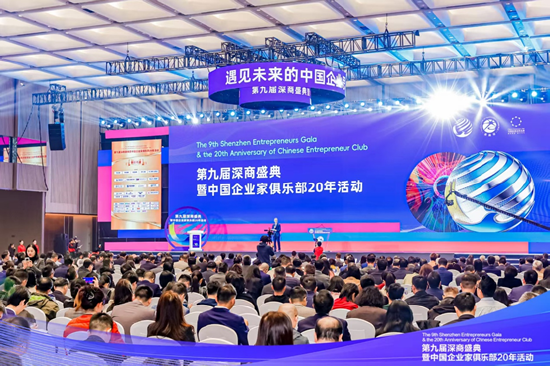
思想领航 共赴新程——第九届深商盛典暨中国企业家俱乐部20年活动书写中国企业高质量发展新篇
Xin Lang Cai Jing· 2026-01-15 09:10
Core Insights - The event, the 9th Shenzhen Business Convention and the 20th Anniversary of the China Entrepreneurs Club, gathered top Chinese entrepreneurs to discuss key topics such as industrial innovation, technological breakthroughs, ecological construction, and social responsibility, aiming to provide a clear path for high-quality economic development in China during the 14th Five-Year Plan period [1][22]. Group 1: Technology Empowerment and Industrial Innovation - TCL's founder, Li Dongsheng, emphasized the importance of AI in driving economic growth and highlighted the application of their Star Intelligence Model 3.0 in the semiconductor display industry, which significantly enhances product development and material research efficiency [4][24]. - iFlytek's founder, Liu Qingfeng, pointed out the accelerating arrival of the general artificial intelligence era, stressing the need for core technology autonomy and the company's focus on AI as a primary business, with over 3 million applications developed on their open AI platform [6][25]. - XPeng Motors' CEO, He Xiaopeng, discussed the transition of the Chinese automotive industry from electrification to intelligent competition, emphasizing breakthroughs in autonomous driving and smart cockpit technologies as key to gaining a global competitive edge [9][27]. Group 2: Financial Support and Industrial Synergy - Ping An Group's General Manager, Xie Yonglin, discussed the role of financial technology in upgrading industrial chain finance, providing targeted financial support for technology innovation and green development, aligning with the trend of steady growth in manufacturing loans [11][29]. - The CEO of Huada Group, Yin Ye, highlighted the importance of core technology in the life and health industry, advocating for the integration of cutting-edge technologies like gene technology into everyday life to enhance public health [17][35]. Group 3: Traditional Industry Transformation and Digitalization - Luzhou Laojiao's General Manager, Lin Feng, shared insights on the transformation of traditional enterprises, emphasizing the need to embrace digitalization while maintaining quality and cultural heritage [13][31]. - Wumart's founder, Zhang Wenzhong, discussed the digital transformation in the retail sector, which enhances operational efficiency and consumer experience through supply chain innovation and the integration of online and offline shopping [15][33]. Group 4: Social Responsibility and Sustainable Development - Lin Li, Chairman of Liyue Group, stressed the importance of balancing economic benefits with social responsibility, advocating for community development through public welfare and employment initiatives [19][37]. - Ma Weihua, former President of China Merchants Bank, highlighted the significance of ESG principles in guiding high-quality development, promoting green investments and social responsibility projects to achieve a win-win scenario for commercial and social values [21][39].





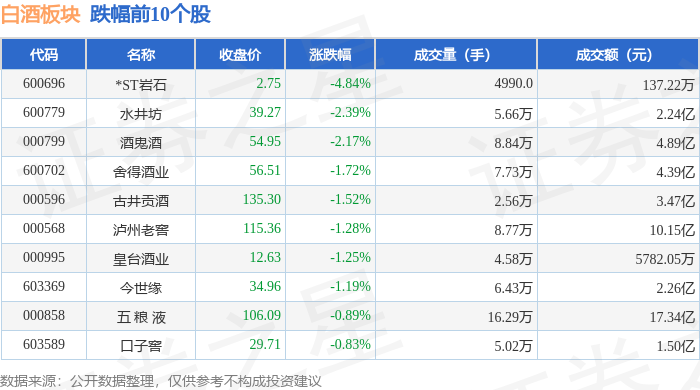
白酒板块1月15日跌0.77%,*ST岩石领跌,主力资金净流出11.52亿元
Zheng Xing Xing Ye Ri Bao· 2026-01-15 08:59
Group 1 - The liquor sector experienced a decline of 0.77% on January 15, with *ST Rock leading the drop [1] - The Shanghai Composite Index closed at 4112.6, down 0.33%, while the Shenzhen Component Index rose by 0.41% to 14306.73 [1] - Major liquor stocks showed varied performance, with *ST Rock down 4.84% to 2.75, and other notable declines including Shui Jing Fang down 2.39% and Moutai down 7.31% in net outflow [1][2] Group 2 - The liquor sector saw a net outflow of 1.152 billion yuan from main funds, while retail investors contributed a net inflow of 528 million yuan [1] - Specific stocks like Moutai and Wuliangye faced significant net outflows of 416 million yuan and 201 million yuan respectively, indicating a shift in investor sentiment [2] - The data indicates that retail investors are increasingly active, with a notable net inflow into stocks like Wuliangye, which saw 157 million yuan from retail investors [2]




中国消费板块 2026 展望:消费信心复苏是否已开启?-China Consumer Sector_ 2026 Outlook_ are we at the beginning of consumer confidence recovery_
2026-01-15 06:33
Summary of the Conference Call Transcript Industry Overview - **Industry**: China Consumer Sector - **Outlook**: The sector is believed to be in the early stage of a multi-year recovery cycle that began in Q3 2024, with expectations for gradual improvement in consumer sentiment and spending through 2026E [2][11][12] Key Insights - **Valuation**: MSCI China Consumer Discretionary and Staples are trading at 17x and 15x 12-month forward PE, approximately one standard deviation below the 10-year averages, indicating that current valuations do not reflect a potential consumption recovery [2][9] - **Consumer Confidence**: The China Consumer Confidence Index has been trending upwards since September 2024, suggesting a gradual restoration of consumer confidence despite ongoing challenges in the property market [12][19] - **K-shaped Recovery**: The recovery is characterized by a K-shaped trend, where mid- to high-income consumers in tier-1 cities are expected to lead spending, while lower-tier city consumers remain focused on value for money [3][48] Consumer Behavior Trends - **Shifting Preferences**: A UBS Evidence Lab survey indicates a divergence in consumer behavior, with over 50% of mid- to high-income consumers reporting investment gains and showing strong spending intentions, particularly in premium and experiential categories [3][37] - **Spending Intentions**: The strongest spending intentions are noted in beauty and skincare (41%) and tourism (37%), reflecting a shift towards experiential and premium spending [51] - **Investment Gains**: 64-74% of mid- to high-income consumers reported increased investment returns, with many planning to reinvest or spend on travel, health services, and consumer electronics [40][41] Stock Implications - **Company Ratings**: - Upgrades to Neutral for Fenjiu due to expected benefits from non-business baijiu consumption - Buy ratings maintained for companies like MIXUE, Guming, China Foods, CR Beer, and YUM China, among others [4] - **Dividend Payouts**: Premium baijiu companies are noted for their >75% dividend payout, which is expected to protect share prices from downside risks [4] Structural Growth Opportunities - **Emerging Themes**: Key investment themes for 2026E include changing consumer preferences, corporate restructuring, and industry consolidation, particularly in sectors like home appliances and mass-market consumption [14][50] - **Corporate Restructuring**: Companies are expected to adapt their business models to align with changing consumer behaviors, which may lead to sustainable long-term earnings growth [4][50] Risks and Challenges - **Property Market Downturn**: The ongoing downturn in the property market is anticipated to weigh on household balance sheets, potentially impacting consumer spending [13][48] - **Policy Support**: The pace of recovery is contingent on stabilizing the property market and effective policy implementation to boost consumption [13][48] Conclusion - The China consumer sector is poised for a recovery, driven by improving consumer confidence and shifting spending patterns. However, the recovery will be uneven across different income groups and city tiers, necessitating a nuanced investment approach to capture emerging opportunities while being mindful of potential risks associated with the property market downturn.



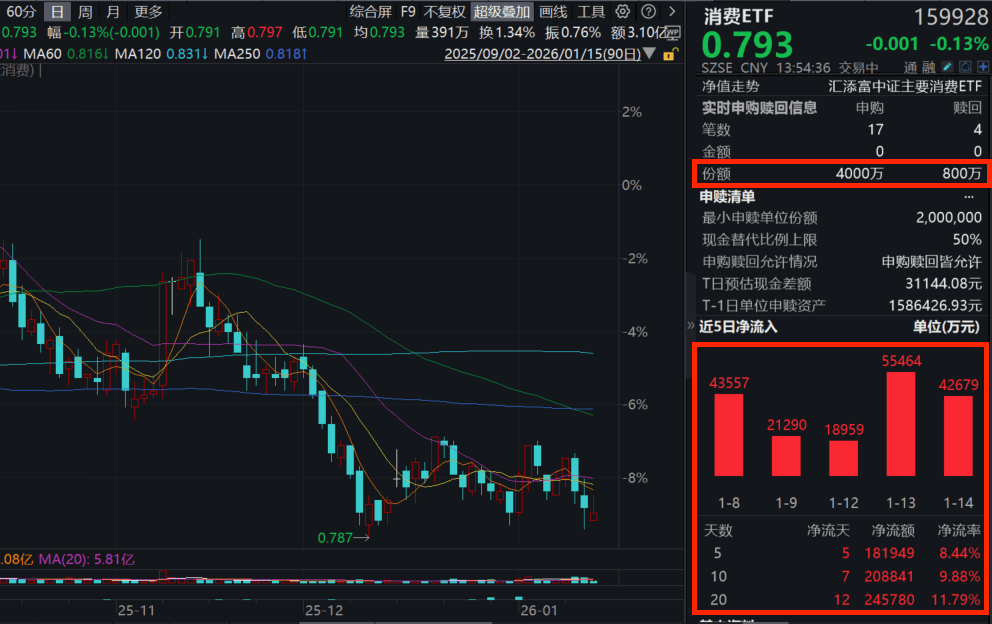
资金高低切换,大消费再受青睐!消费ETF(159928)近5日大举净流入超18亿元!CPI连续三月同比涨幅扩大!
Sou Hu Cai Jing· 2026-01-15 06:19
Group 1: Market Overview - The Shanghai Composite Index experienced fluctuations, with the consumer sector slightly retreating, and the Consumer ETF (159928) declining by 0.13% on January 15, with a trading volume exceeding 315 million yuan [1] - The Consumer ETF has attracted significant capital, accumulating over 1.8 billion yuan in the past five days [1] Group 2: Policy Impact - The policy extending the tax refund for residents switching homes will remain in effect until the end of 2027, providing tax incentives for those selling and repurchasing homes within a year [3] - The valuation of the Consumer ETF is currently attractive, with a TTM P/E ratio of 19.17, placing it in the 2.18% percentile over the past decade, indicating it is cheaper than 98% of historical periods [3] Group 3: Stock Performance - In the Hong Kong market, the Hong Kong Stock Connect Consumer 50 ETF (159268) showed slight gains, with notable stocks like Anta Sports and Mengniu Dairy rising over 1%, while others like Pop Mart and Yum China fell over 1% [5] Group 4: Kweichow Moutai's Strategy - Kweichow Moutai is restructuring its pricing system to promote market-oriented transformation, focusing on a differentiated product structure to meet diverse consumer needs [7] - The company is shifting from a traditional sales model to a multi-channel marketing system, enhancing its distribution channels to include wholesale, offline retail, online retail, dining, and private domain [7] - The new pricing strategy will be market-driven, aiming for a dynamic adjustment mechanism to stabilize retail prices [7] Group 5: Consumer Price Index (CPI) Trends - The CPI has shown a continuous increase for three months, with December's CPI rising by 0.8%, indicating potential improvement in traditional consumer goods [8][10] - The white liquor sector is highlighted as having significant investment value, with expectations for performance recovery as demand improves during the upcoming Spring Festival [8] Group 6: Investment Recommendations - The traditional consumer goods sector is expected to see a fundamental turning point, supported by policy catalysts and improved economic indicators [9] - Focus on sectors such as the restaurant supply chain and dairy industry for recovery opportunities, while also considering innovative product categories and new distribution channels as growth drivers [9]
ETF盘中资讯|“i茅台”多款茅台酒今日开售!吃喝板块震荡盘整,机构高呼板块进入左侧布局阶段
Sou Hu Cai Jing· 2026-01-15 03:25
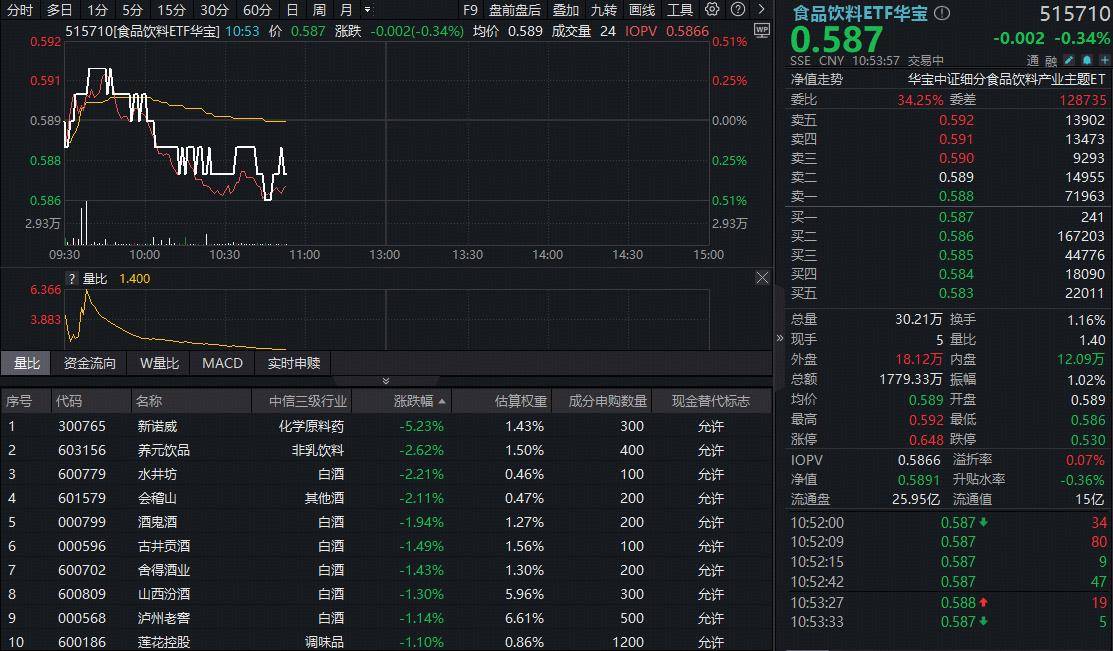
Group 1 - The food and beverage sector is experiencing a pullback, with the Huabao Food and Beverage ETF (515710) showing a decline of 0.34% as of the report time [1] - Major stocks in the liquor segment, such as Shui Jing Fang and Guo Jiu Jiu, are leading the declines, with Shui Jing Fang down over 2% and several others down more than 1% [1] - The valuation of the food and beverage sector is at a historical low, with the food and beverage ETF's price-to-earnings ratio at 20.07, which is in the 5.68% percentile of the last decade, indicating a potential opportunity for long-term investment [2] Group 2 - The market outlook suggests that the current adjustment phase for the liquor industry may be nearing its end, with expectations for a recovery as the Spring Festival approaches [3] - Recent market strategies from major liquor brands like Moutai and Wuliangye are being implemented, which may stabilize prices and reduce pressure on distributors [3] - The Huabao Food and Beverage ETF is heavily invested in leading high-end liquor stocks, with approximately 60% of its portfolio allocated to these stocks, indicating a strategic focus on premium products [4]
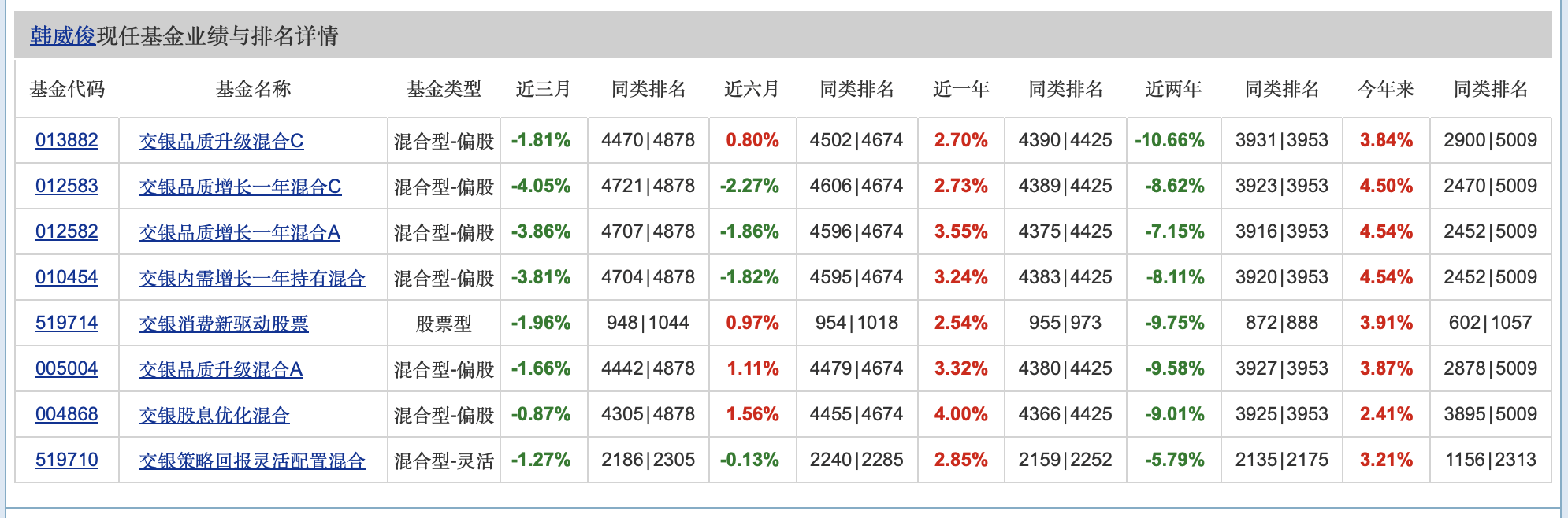
为何“躺平式投资”?交银施罗德“海豹”韩威俊旗下产品全线亏损引争议
Sou Hu Cai Jing· 2026-01-15 03:25
2026年1月,交银施罗德的韩威俊即将迎来担任基金经理的十年关口,但近年来围绕这位"老将"的舆论不再是"爆发"或者"进攻",而是"躺平":不追热点、 换手率低、重仓股高度稳定并且产品之间持仓趋同。 这带来的结果是,虽然2025年股市呈现"硬科技+创新药"双主线行情,带动权益类基金大面积飘红,超2000只权益类基金净值创历史新高,但韩威俊管理的 六只产品在2025年全部录得负收益,其代表性产品交银内需增长一年持有期混合基金已连续五年亏损。截至2025年底,韩威俊管理的6只基金合计规模仅剩 48.71亿元,相较于巅峰期近200亿元的规模,三年内缩水了75%以上。 | | 韩威俊现任基金业绩与排名详情 | | | | | | | --- | --- | --- | --- | --- | --- | --- | | 基金代码 | 基金名称 | 基金类型 | 近三月 | 同类排名 | 近六月 | 同类 | | 013882 | 交银品质升级混合C | 混合型-偏股 | -1.81% | 4470 4878 | 0.80% | 4502 - | | 012583 | 交银品质增长一年混合C | 混合型-偏股 | -4. ...
国盛证券-2026食饮行业年度策略:消费者大时代
Sou Hu Cai Jing· 2026-01-15 03:22
Core Insights - The food and beverage industry is expected to see multi-dimensional improvements in 2026, following a year of stabilization in 2025, characterized by price pressures and structural differentiation [1][2]. Group 1: Industry Overview - The food and beverage sector (CITIC) experienced a cumulative decline of 4% in 2025, underperforming the CSI 300 by 20% [1][16]. - The liquor sector faced significant pressure, with an annual decline of 7%, while segments like health products, frozen foods, and beverages saw increases of 18%, 15%, and 12% respectively [1][16]. - The overall retail sales in China showed moderate growth, with a year-on-year increase of 4.0% from January to November 2025, and service consumption growth outpacing goods consumption [1][27]. Group 2: Liquor Industry Insights - The liquor industry is currently at a triple bottom, with supply clearing continuing into 2025, and leading companies focusing on stabilizing prices and sales [2][6]. - Demand has begun to recover, with improved sales expected during the Spring Festival, and strong demand for mid-range priced liquor brands [2][61]. - The product strategy includes a shift towards lower alcohol content and targeting younger consumers, with a focus on collaborative channel development [2][6]. Group 3: Beer and Beverage Sector - The beer sector is anticipated to benefit from a recovery in dining, with cost advantages expected to maintain stable gross margins in 2026 [2][6]. - The soft drink market is steadily expanding, with segments like functional beverages and bottled water showing strong performance, driven by leading brands leveraging their market position [2][6]. Group 4: Food Sector Developments - The food sector is focusing on recovery and growth, with a rebound in demand for restaurant supply chains and leading companies expected to show profit elasticity [3][6]. - The snack segment is being driven by retail transformation, with health-oriented products and new opportunities emerging [3][6]. - The dairy sector is nearing a turning point, with expectations for supply-demand improvements in the second half of 2026 [3][6]. Group 5: Consumer Trends - High-end consumption is showing signs of recovery, with luxury retail sales improving and experiential consumption rebounding [1][35]. - The trend towards health-conscious consumption is becoming more pronounced, with a shift towards lower sugar and simpler ingredient formulations across various food categories [3][45].


“i茅台”多款茅台酒今日开售!吃喝板块震荡盘整,机构高呼板块进入左侧布局阶段
Xin Lang Cai Jing· 2026-01-15 03:01
Core Viewpoint - The food and beverage sector continues to experience a pullback, with the Huabao Food and Beverage ETF (515710) showing a decline of 0.34% as of the latest update, primarily driven by significant drops in the liquor segment [1][8]. Group 1: Market Performance - The Huabao Food and Beverage ETF opened with a brief rise before turning negative, reflecting a broader downturn in the food and beverage sector [1][8]. - Key stocks in the liquor category, such as Shui Jing Fang and Jiu Gui Jiu, have seen declines exceeding 2%, contributing to the overall negative performance of the sector [1][8]. Group 2: Product Launches - Starting January 15, multiple products from Guizhou Moutai will be available for purchase on the iMoutai app, including various versions of Moutai liquor [3][10]. - Specific products include the 53% vol 500ml Moutai liquor, which will be released on the 15th and subsequently on the 9th, 19th, and 29th of each month [10]. Group 3: Valuation Insights - The food and beverage sector is currently at a historical low in terms of valuation, with the price-to-earnings ratio of the underlying index for the Huabao ETF at 20.07, placing it in the 5.68% percentile of the last decade [3][10]. - This low valuation suggests a potential opportunity for left-side positioning in the sector [3][10]. Group 4: Future Outlook - Analysts from CITIC Securities indicate that the liquor industry may be approaching a turning point, with expectations of a recovery coinciding with the upcoming Spring Festival [4][11]. - The market is expected to stabilize as inventory levels decrease and pricing policies are implemented by liquor companies [4][11]. Group 5: Investment Strategy - The Huabao Food and Beverage ETF is recommended for investors looking to gain exposure to core assets in the food and beverage sector, with approximately 60% of its portfolio allocated to leading high-end and mid-range liquor stocks [12]. - The ETF also includes significant positions in beverage, dairy, and seasoning sectors, with top holdings featuring major brands like Moutai and Yili [12].
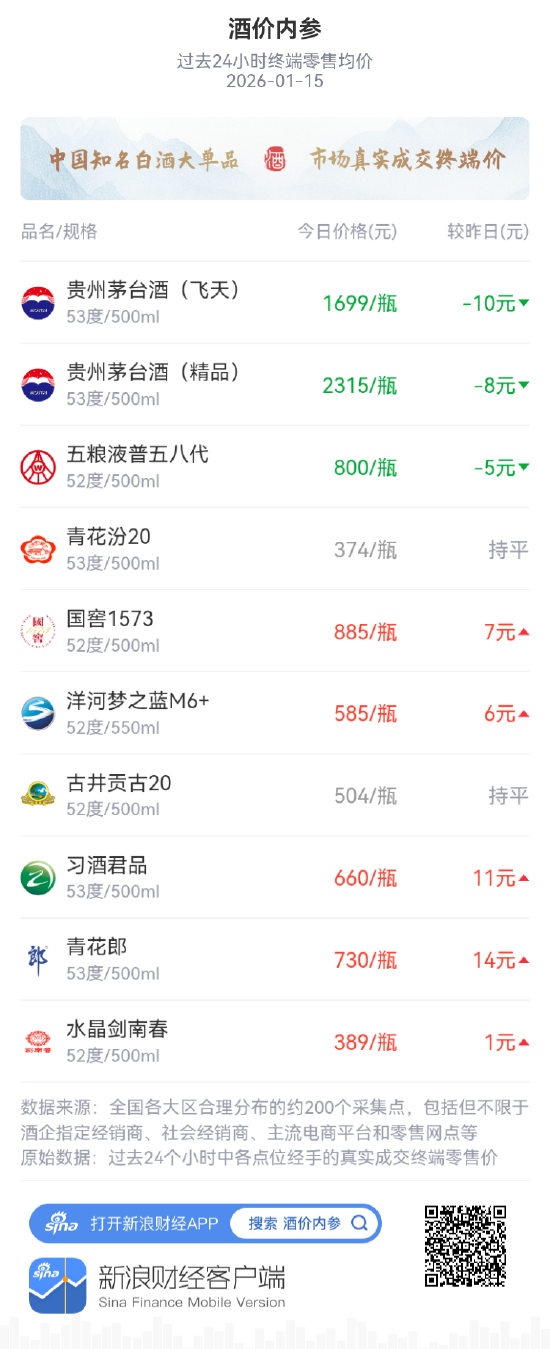
酒价内参1月15日价格发布 青花汾20与昨日持平
Xin Lang Cai Jing· 2026-01-15 01:45
来源:酒业内参 【点击进入酒价内参,查看真实酒价】 | 五粮液普五八代 | 800/瓶 | -570 | | --- | --- | --- | | 52度/500ml | | | | 青花汾20 | 374/瓶 | 持平 | | 53度/500ml | | | | 国窖1573 | 885/瓶 | 7元 | | 52度/500ml | | | | 洋河梦之蓝M6+ | 585/瓶 | 6元 | | 52度/550ml | | | | 古井贡古20 | 504/瓶 | 挂本 | | 52度/500ml | | | | 习酒君品 | 660/瓶 | 11元▲ | | 53度/500ml | | | | 青花郎 | 730/瓶 | 14元- | | 53度/500ml | | | | 水晶剑南春 | 389/瓶 | 1元- | | 52度/500ml | | | 新浪财经"酒价内参"过去24小时收集的数据显示,中国白酒市场十大单品的终端零售均价在1月15日迎 来小幅回升。如果十大单品各取一瓶整体打包售卖,今日总售价为8941元,较昨日上涨16元。市场在短 期整理后向上修复,涨跌分化结构性波动,契合当前的行业调整态 ...