
西门子

Search documents
英伟达豪赌“物理AI”:下一个风口,还是又一个GE Predix?
3 6 Ke· 2025-05-14 09:45
Core Insights - The article discusses the rapid advancement of "Physical AI," particularly through NVIDIA's ambitious strategy to create a platform-level infrastructure that integrates training, simulation, and deployment in physical systems [1][2][11] - It highlights the collaboration between NVIDIA and leading industrial giants like Siemens, BMW, and General Motors to incorporate AI into complex physical systems such as manufacturing and autonomous driving [1][11] Summary by Categories Definition and Differentiation - Physical AI, embodied intelligence, and spatial intelligence represent different pathways for AI to perceive, integrate, and alter the physical world [2][6] - Spatial intelligence focuses on AI's understanding of three-dimensional structures and relationships, while embodied intelligence emphasizes interaction with the environment through physical actions [3][4][9] - Physical AI serves as the central nervous system connecting perception and action, enabling AI to truly enter the physical realm [5][6] Technological Framework - The core of Physical AI is NVIDIA's "three computers" architecture, which includes training with real and synthetic data, creating high-fidelity virtual environments, and deploying trained models in real-world applications [14][16] - Key technologies supporting Physical AI include synthetic data generation, virtual simulation platforms, and model generalization capabilities [9][10][11] Historical Context and Comparison - The article draws parallels between NVIDIA's Physical AI strategy and GE's earlier industrial internet platform, Predix, which ultimately failed due to its closed ecosystem approach [15][19][21] - Unlike GE, NVIDIA's strategy emphasizes an open, developer-first approach, providing a comprehensive toolkit rather than a singular solution [23][24][27] Future Trends and Industry Implications - The integration of AI into physical systems is seen as a long-term evolution rather than a short-term trend, requiring patience and strategic investment in foundational capabilities [37][39] - Companies in the industry are advised to focus on building internal capabilities and understanding the underlying logic of the tools they use, rather than merely adopting them superficially [33][35][36]



锡南科技(301170) - 301170锡南科技投资者关系管理信息20250514
2025-05-14 08:36
Group 1: Business Expansion and Market Strategy - The company is actively expanding its customer base and market presence, particularly in the fuel cell stack sector for energy storage, with a focus on high-quality new clients [2] - Strategic cooperation has been established with key players such as Sijia Tobo in hydrogen fuel cell storage components, and Siemens in the medium and high voltage control sector, enhancing the company's supplier qualifications [2][3] - Thailand is identified as a crucial hub for overseas capacity layout, targeting the Southeast Asian market to boost international competitiveness [3] Group 2: Competitive Response and Market Share - To address intense competition in the automotive parts industry, the company is accelerating overseas capacity construction and expanding its market scale [3] - The company plans to actively explore new business opportunities in the domestic market to increase market share while continuously promoting cost reduction and efficiency improvement [3] Group 3: Investor Relations and Future Plans - The company has not disclosed any significant undisclosed information during the investor relations activity [3] - Future share repurchase plans will be disclosed in accordance with relevant regulations if they arise [3]
中国工业自动化与机器人行业:需求回暖,国产替代加速突围
Zhi Tong Cai Jing· 2025-05-14 01:20
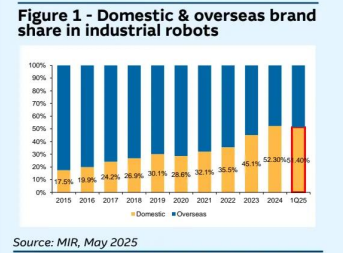
Group 1: Market Overview - In Q1 2025, China's industrial robot and automation market showed significant resilience, with demand recovering in sectors such as automotive, semiconductors, and lithium batteries, leading to a "quantity and quality" upgrade phase [1][11] - Industrial robot sales increased by 11.6% year-on-year, ending a previous inventory destocking cycle, with collaborative robots (cobots) experiencing a remarkable 41.4% growth [1][11] - The automotive sector saw a 45.4% increase in demand, while the lithium battery industry rebounded from a -19.4% decline in 2024 to +10.5% in 2025 [3] Group 2: Competitive Landscape - Domestic manufacturers' market share slightly decreased from 52.3% in 2024 to 51.4% in Q1 2025, but leading companies like Estun (9.9%) and Inovance (8.9%) continued to perform well [1][11] - Foreign brands like Fanuc (10.1%) maintained their lead, while companies like KUKA and ABB adjusted pricing strategies to expand their market share [1] Group 3: Future Outlook - Despite a projected slowdown in industrial robot growth to 6.3% in 2025 due to intensified competition, growth is expected to rebound to 11.2% and 12.2% in 2026 and 2027, respectively [3] - The pressure from price wars is anticipated to ease as foreign brands raise average prices to maintain profits, allowing domestic manufacturers to leverage their advantages in customization and delivery speed [3][12] Group 4: Automation Sector Insights - The industrial automation demand grew by 2.4% year-on-year in Q1 2025, ending a four-quarter decline, driven by the OEM market in packaging machinery and lithium battery equipment [5] - In the servo and inverter markets, Inovance maintained a leading position with a market share of 31.4% in servo systems and 20.8% in inverters, significantly outperforming foreign brands [7] Group 5: Key Component Developments - The domestic market share of RV reducers surpassed 60% for the first time, breaking the long-standing monopoly of Japan's Nabtesco, with a 9.7% year-on-year growth in demand [8][10] - Domestic manufacturers are expected to increase their RV reducer market share to over 70% by 2028, driven by cost advantages and technological advancements [10] Group 6: Investment Opportunities - Companies like Inovance and Shuanghuan are positioned to benefit from the industry's recovery and the trend of domestic substitution, with collaborative robots and new energy equipment identified as future growth engines [11] - The overall trend of intelligent upgrades in China's manufacturing sector is seen as irreversible, with domestic firms transitioning from "substitution" to "leadership," presenting long-term investment value [11]



江南奕帆(301023):深度报告:微特减速电机隐形冠军,持续拓展下游应用场景
ZHESHANG SECURITIES· 2025-05-13 13:44
Investment Rating - The report initiates coverage with a "Buy" rating for the company [5] Core Insights - The company specializes in the research, manufacturing, and sales of customized micro and special reduction motors, with a diverse product line exceeding 3,000 specifications [1][14] - The company has shown significant revenue growth, achieving 282 million yuan in 2024, a year-on-year increase of 61.69%, and a net profit of 95 million yuan, up 98.51% [1][16] - The reduction motor market in China is projected to grow from 884 billion yuan in 2023 to 1,156 billion yuan by 2030, with a CAGR of 5.12% from 2024 to 2030 [2][33] Summary by Sections Company Overview - The company has a strong focus on the micro and special reduction motor sector, continuously expanding its downstream application scenarios [1][14] - It has established long-term partnerships with renowned companies such as Siemens, Schneider Electric, and Eaton, enhancing its market position [3][56] Market Potential - The reduction motor market is vast, with applications in various industries including power distribution, RVs, and renewable energy [2][33] - The company is actively expanding into new fields such as electric bicycles and humanoid robots, aiming to create new growth curves [4][61] Financial Performance - The company forecasts revenues of 364 million yuan in 2025, 451 million yuan in 2026, and 543 million yuan in 2027, with respective growth rates of 29%, 24%, and 20% [5][6] - The net profit is expected to reach 114 million yuan in 2025, 135 million yuan in 2026, and 159 million yuan in 2027, with growth rates of 20%, 19%, and 18% respectively [5][6] Research and Development - The company maintains a high R&D expense ratio of over 4.5%, with significant investments in technology and product quality [3][51] - It holds 82 patents, including 22 invention patents, showcasing its commitment to innovation [51][52] Customer Base - The company has a strong customer base, including major players in the power distribution and solar industries, which enhances its competitive edge [3][56] - It has established strategic partnerships with key clients, ensuring a stable supply chain and long-term collaboration [56][57]

关税缓和双机遇:CXO估值修复与医疗器械全球突围
Xiangcai Securities· 2025-05-13 11:34
Investment Rating - The report maintains a "Buy" rating for the healthcare services industry [6]. Core Insights - The easing of tariffs between China and the U.S. is expected to lead to a valuation recovery for the CXO sector, which has been under pressure due to previous tariff escalations [2]. - The tariff relief is anticipated to lower production costs for medical devices, enhancing competitiveness in overseas markets, particularly in the U.S. [3]. - The report suggests that domestic companies in the medical device sector are well-positioned to capture market opportunities in the U.S. due to increased demand for cost-effective products [3]. Summary by Sections CXO Sector - The impact of U.S.-China tariffs on the CXO sector is complex, with CRO services not directly affected by tariffs but facing uncertainty regarding future tariff increases [2]. - CDMO companies are also navigating complex influences, as their clients are often multinational firms with production bases outside the U.S., allowing them to mitigate tariff impacts [2]. Medical Devices - Domestic companies have made significant advancements in high-end medical equipment and diagnostics, gradually replacing imports [3]. - The tariff easing is expected to stabilize supply chain costs and improve the global market competitiveness of Chinese medical device manufacturers [3]. - There are specific opportunities in the U.S. market, particularly in price-sensitive segments and high-end equipment, where reduced tariffs could facilitate market entry [3]. Investment Recommendations - The report recommends focusing on companies with significant exposure to overseas CRO and CDMO markets, such as WuXi AppTec, and those with substantial U.S. sales in medical devices, like Yihua Jaye [4]. - Companies with strong international expansion capabilities, such as Aihua Long and Shengxiang Biology, are also highlighted as potential investment opportunities [4].
健信超导IPO:“左手分红、右手募资” 研发费用率仅个位数
Xin Lang Zheng Quan· 2025-05-13 06:00
Core Viewpoint - Ningbo Jianxin Superconductor Technology Co., Ltd. (referred to as "Jianxin Superconductor") faces multiple potential risks in its pursuit of an IPO on the Sci-Tech Innovation Board, raising concerns about its "hard technology" credibility and listing motivations [1] Group 1: Supply Chain and Customer Dependency - Jianxin Superconductor is in a weak position within the industry chain, with high customer and supplier concentration. The top five customers contributed nearly 80% of revenue, with the largest customer, Fujifilm Group, accounting for over 40% [1] - The company relies significantly on its top five raw material suppliers, which account for about 60% of purchases, leading to weak bargaining power and a gross margin of only 19.56%-24.94%, less than half the industry average of approximately 45% [1] Group 2: Lack of Technological Moat - The company has insufficient R&D investment, with R&D expense ratios of only 5.66%, 5.42%, and 6.50% from 2022 to 2024, which is less than one-third of comparable peers (14%-18%) [2] - Jianxin Superconductor holds only 42 invention patents, while competitors like United Imaging Healthcare have 3,475 patents, indicating a significant technological gap [2] - The core technology is protected by only 42 patents and confidentiality agreements, posing a risk of losing competitive advantage if key personnel are poached or if there is a leak [2] Group 3: Inventory Backlog and Liquidity Risk - The company's inventory surged from 182 million to 319 million yuan, accounting for over 30% of current assets, with inventory turnover days exceeding 200 [3] - The rapid iteration of superconducting magnet technology raises the risk of existing inventory becoming obsolete, yet the company has only recognized a write-down of 7.18 million yuan for inventory depreciation [3] - Accounts receivable have consistently exceeded 20% of revenue, which could exacerbate liquidity issues if downstream customers face financial difficulties [3] Group 4: Dividend Payouts and Fundraising Contradictions - Despite claiming a need to raise 90 million yuan for liquidity, the company distributed 59.99 million yuan in dividends over the past three years, with the chairman personally receiving 24.91 million yuan [4] - This "left hand dividend, right hand fundraising" approach raises questions about the rationality of its capital operation logic, especially given the average working capital ratio of 58.13% of revenue [4] Group 5: Policy Dependence and International Competitive Pressure - The company relies on a 15% income tax incentive for high-tech enterprises, with tax benefits accounting for 18% of total profits in 2024, making it vulnerable to policy changes [5] - With over 90% dependence on imported liquid helium, fluctuations in the international supply chain could disrupt production [5] - Although the company holds a 4.2% global market share, it faces significant pressure from international giants like Siemens and GE, which could squeeze its market position [5] Conclusion - The risk profile of Jianxin Superconductor's IPO journey includes both visible operational crises and hidden long-term concerns related to technological iteration and industry transformation [6]
中国制造业数字化转型行业发展研究报告
艾瑞咨询· 2025-05-10 09:05
尽管制造业的数字化已经进行了几年,但市场竞争格局尚未出现任何改变,未来在行业层面、市场打法层 面、产品及服务层面还有巨大的潜力,一切都是未知,一切也都有可能。 1)市场机会层面: 行业层面上, 离散制造业中的高技术产业是高潜力行业;打法层面上,垂直行业攻坚和信创/国产替代行业相对容易出现 领头企业。 2)产品层面: 大模型具有非常强的可探索性,但还处于非常早期的阶段,供需双方都在尝 试。大模型短期对市场竞争格局影响不大,但长期看,当大模型对实际应用场景具有支撑作用能力时,会加 速市场变化,故企业需把握大模型机会。 3)数据层面: 目前市场上数据交易、数据开放的声音出现比较 多,但企业无需纠结是否跟随,重要的是要基于数据(无论是自身数据还是外部数据)构建自己的行业认知 壁垒,即内化数据,完成数据-显性知识-隐性知识构建的完整链条。 需求市 场1 -具有强烈的地域特色 广东、江苏、浙江、山东等是制造业企业数TOP4省份,也是积极打造产业 集 群、 积极试行数字化转型的省份 制造业数字化转型丨 研究报告 核心摘要: 需求端的核心需求没有变,生产制造管理相关、供应链相关等是重点,也是离散制造业的核心诉求 。 只不 过 ...

我国又一产品被全球抢购?出口额暴增900%,为何只有我国订单暴增
Sou Hu Cai Jing· 2025-05-10 03:50
Core Insights - The article highlights the significant increase in China's exports despite the challenges posed by U.S. tariffs, showcasing the resilience and competitiveness of Chinese manufacturing in the global market [1][17]. Trade Performance - In Q1, mechanical and electrical products accounted for 53% of China's export value, with 72,000 new energy vehicles sold primarily to Mexico and the UAE [3]. - Urea fertilizer sales in Henan surged by 947.8% quarter-on-quarter, with costs dropping by 700 yuan per ton, disrupting international pricing [3]. Manufacturing Efficiency - China's supply chain efficiency is emphasized, particularly in the electric vehicle sector, where all components can be sourced within a 50-kilometer radius, significantly outperforming traditional manufacturing hubs like Detroit [5]. - The global shipbuilding industry is dominated by China, holding 70% of new ship orders, with some companies like Hudong-Zhonghua having orders extending to 2030 [5]. Technological Advancements - The export of industrial robots increased by 81.9%, with Polish factories replacing German equipment with "Chinese smart manufacturing" [6]. - Innovative products, such as AI-integrated cleaning robots and advanced cameras, are gaining popularity in international markets, indicating a shift in consumer perception towards Chinese goods [6]. E-commerce Growth - Cross-border e-commerce is thriving, with platforms like Dunhuang.com utilizing smart systems to circumvent U.S. tariffs by splitting orders into smaller, tax-exempt packages [8]. - The volume of cross-border e-commerce at Hangzhou Xiaoshan Airport grew by 30%, driven by high demand for mobile accessories and clothing [8]. Policy Support - The Chinese government has implemented reforms, such as batch inspection reforms by Lanzhou Customs, which have expedited the export process and reduced clearance times by 30% [12]. - The China-Europe Railway Express saw a 15% increase in trips this year, with freight costs decreasing by 30%, facilitating trade from various regions in China to Europe [12]. Competitive Response - In response to U.S. tariffs, companies are innovating, such as a shoe factory in Quanzhou developing its own "air suspension technology" to compete with major brands like Nike [15]. - The Ministry of Commerce has initiated actions to improve product quality and reduce counterfeit goods, with significant enforcement against trademark infringements [15].
苏宁易购“618”大促即将开启 线上线下齐发力冲刺年中消费
Zheng Quan Ri Bao Wang· 2025-05-09 13:11
Core Insights - Suning.com is launching a major promotional event called "618" aimed at boosting sales in the home appliance sector, with a focus on both online and offline channels [1][2] - The company plans to collaborate with leading brands to introduce over 1,000 new home appliance products during the event, with many items being offered at industry-low prices [1] - Suning.com is implementing various subsidy strategies to lower consumer purchasing barriers, including government, factory, bank, and platform subsidies [1] Group 1 - The "618" event will kick off offline on May 13, with online promotions starting at 8 PM on the same day, featuring a significant subsidy of 10 billion yuan [1] - Suning.com will enhance its promotional efforts by offering multiple benefits such as double pre-stored value for appliances, cross-category discounts, and trade-in subsidies [2] - The company is set to open over 100 newly renovated stores in major cities to provide comprehensive home appliance services [2] Group 2 - The promotional strategy includes a focus on trending products like washing and drying sets, dishwashers, and foldable screen smartphones [1] - Suning.com aims to improve product strength, pricing power, scenario capability, and service quality to enhance consumer experience [1] - The event is expected to accelerate the release of mid-year consumption potential [1]


助力国产MRI核心部件破局 健信超导科创板IPO申请获受理
Zheng Quan Ri Bao Wang· 2025-05-09 11:17
Group 1 - The core viewpoint of the articles highlights the ongoing effects of the policies introduced by the China Securities Regulatory Commission to deepen the reform of the Sci-Tech Innovation Board, which is aimed at supporting technological innovation and new productivity development [1] - The Sci-Tech Innovation Board has seen an increase in IPO applications, with companies like Ningbo Jianxin Superconducting Technology Co., Ltd. and others being accepted for listing, indicating a clear trend towards "hard technology" in the A-share market [1] - Jianxin Superconducting is recognized as the largest independent supplier of superconducting magnets globally, focusing on the core components of MRI equipment, and has achieved self-designed and large-scale production of mainstream zero-evaporation superconducting magnets [1] Group 2 - Jianxin Superconducting plans to raise 865 million yuan through its IPO, with the funds allocated for projects including the annual production of 600 sets of liquid helium-free superconducting magnets and technological upgrades for high-field medical superconducting magnets [2] - The company has developed the world's first "1.5T liquid helium-free superconducting magnet system," establishing a leading position for China in this next-generation technology [1]