
嘉能可

Search documents
有色和贵金属每日早盘观察-20251009
Yin He Qi Huo· 2025-10-09 14:51
Report Overview - Report Date: October 9, 2025 - Report Type: Daily Morning Observation of Non - ferrous and Precious Metals - Report Sector: Non - ferrous metals and precious metals 1. Report Industry Investment Rating There is no information about the industry investment rating in the report. 2. Report's Core View The report analyzes the market conditions, important information, logical reasoning, and provides trading strategies for various non - ferrous metals and precious metals. Overall, the precious metals market is in an upward trend, while different non - ferrous metals have different market trends and challenges, such as supply shortages, demand fluctuations, and policy impacts [2][4][7]. 3. Summary by Metal Type Precious Metals - **Market Review**: London gold broke through the $4000/oz mark, closing up 1.4% at $4040.745/oz; London silver rose 2.36% to $48.88/oz. The US dollar index rose 0.15% to 98.767, and the 10 - year US Treasury yield weakened to 4.11% [2]. - **Important Information**: The US Senate rejected the bipartisan appropriation bill, the Fed is divided on interest rate cuts, and the probability of interest rate cuts is high. Trump announced a peace plan between Israel and Hamas [2]. - **Logic Analysis**: Uncertainties such as the US government shutdown, global political turmoil, and China's increase in gold reserves have increased investors' demand for gold as a hedge, pushing up gold prices. Silver prices have also risen due to expectations of interest rate cuts [4]. - **Trading Strategy**: Wait for opportunities to go long on the dips for single - sided trading; wait and see for arbitrage; take profit on out - of - the - money call options and collar call options bought before the holiday [4]. Copper - **Market Review**: LME copper closed at $10701/ton, down 0.23%. LME inventory decreased by 225 tons to 139,200 tons, and COMEX inventory increased by 1947 tons to 335,500 tons [6]. - **Important Information**: The US government shutdown continued, QB mine cut copper production guidance, Aurubis raised the price of refined copper, and Australia provided financial support to copper smelters [6][7]. - **Logic Analysis**: Copper mine supply is tight, and the transfer from the mine end to the smelting end may be faster. Consumption is weak, and downstream demand is mainly for rigid needs [7]. - **Trading Strategy**: Adopt a long - on - dips strategy for single - sided trading; hold cross - market positive spreads and arrange cross - period positive spreads after domestic inventory decreases; wait and see for options [8]. Alumina - **Market Review**: The alumina 2601 contract fell to 2868 yuan/ton. Spot prices in different regions showed a narrow - range decline [10][11]. - **Important Information**: Overseas alumina was traded at different prices, Inalum planned to expand production, and the supply of alumina was estimated to be in surplus in September [11][12]. - **Logic Analysis**: Alumina supply is in an excess pattern, and prices are expected to be in a low - level oscillating pattern before large - scale production cuts [13]. - **Trading Strategy**: Expect alumina to maintain a weak trend for single - sided trading; wait and see for arbitrage and options [18]. Cast Aluminum Alloy - **Market Review**: The casting aluminum alloy 2511 contract fell to 20160 yuan/ton, and the spot price was stable [16]. - **Important Information**: The Shanghai Futures Exchange's aluminum alloy warehouse receipts increased, and most aluminum die - casting enterprises extended their holidays [16]. - **Logic Analysis**: The demand for raw material inventory in recycled aluminum plants is restricted, and the holiday of downstream die - casting enterprises is extended. The spot price is expected to be firm, and attention should be paid to the opportunity of cash - and - carry arbitrage [16]. - **Trading Strategy**: Expect the aluminum alloy futures price to open higher and then weaken slightly for single - sided trading; pay attention to cash - and - carry arbitrage if the futures price opens higher; wait and see for options [17]. Electrolytic Aluminum - **Market Review**: The SHFE aluminum 2511 contract fell to 20680 yuan/ton, and the LME aluminum price rose 3.22% during the holiday. The spot price increased [20]. - **Important Information**: The US government shutdown and the Fed's internal differences in interest rate cuts. The domestic aluminum rod production capacity expanded, and some enterprises increased production during the holiday [20][21]. - **Logic Analysis**: Affected by interest rate cut expectations and the resonance of the non - ferrous metal sector, the LME aluminum price rose during the holiday. The domestic demand is slowly recovering, and there may be short - term inventory accumulation after the holiday [21][22]. - **Trading Strategy**: Be cautious about chasing high prices and wait and see for single - sided trading; wait and see for arbitrage and options [23]. Zinc - **Market Review**: The LME zinc price fell 1.53% to $2995/ton, and the spot price was stable. The LME zinc inventory decreased [25][26]. - **Important Information**: Kipushi mine increased production, Golden Grove mine postponed high - grade zinc ore mining, and the LME zinc inventory decreased [25][26]. - **Logic Analysis**: The non - ferrous metal sector was strong during the holiday, and the LME zinc inventory decreased to a two - year low. The domestic market is in surplus, and the pattern of strong overseas and weak domestic is expected to continue [26][28]. - **Trading Strategy**: Expect the SHFE zinc price to be strong in the short term and go short on the high for single - sided trading; wait and see for arbitrage; sell out - of - the - money call options for options [28]. Lead - **Market Review**: The LME lead price fell 0.02% to $2005.5/ton, and the spot price was stable. The LME lead inventory was high [30]. - **Important Information**: A lead - zinc mine in Fujian postponed production [30]. - **Logic Analysis**: The demand for lead concentrate is large, and the supply is in a tight balance. The primary lead smelter is in a small loss, and the secondary lead smelter may increase production. The consumption season is not as expected [32]. - **Trading Strategy**: Expect the lead price to fall; wait and see for arbitrage; sell out - of - the - money call options for options [33]. Nickel - **Market Review**: The LME nickel price fell to $15390/ton, and the inventory increased. The spot premium decreased [34]. - **Important Information**: Global nickel demand and production are expected to increase in 2026, and Indonesia adjusted the RKAB approval system [34][36]. - **Logic Analysis**: The global primary nickel supply is expected to be in excess, and the nickel price is expected to fluctuate within a range [36]. - **Trading Strategy**: Wait and see for options [37]. Stainless Steel - **Market Review**: The stainless steel SS2511 contract closed at 12730 yuan/ton, and the spot price was stable [39]. - **Important Information**: The EU tightened steel import policies, and a South Korean buyer cancelled an order from a Taiwanese supplier [40]. - **Logic Analysis**: The terminal demand for stainless steel is differentiated, and the supply is high. Without production - capacity reduction policies, the trend is weak [42]. - **Trading Strategy**: Expect a weak oscillation for single - sided trading; wait and see for arbitrage [42]. Industrial Silicon - **Market Review**: The industrial silicon futures price fell before the holiday, and the spot price was at a premium [44][45]. - **Important Information**: Industrial silicon exports increased in August, and imports decreased [45]. - **Logic Analysis**: The output increased, and the demand was strong in the short term. It is recommended to buy on the dips [45]. - **Trading Strategy**: Buy on the dips for single - sided trading; buy out - of - the - money put options for options; no strategy for arbitrage [46]. Polysilicon - **Market Review**: The polysilicon futures price oscillated narrowly before the holiday, and the spot price was stable [48]. - **Important Information**: India imposed anti - dumping duties on Chinese polysilicon products [48]. - **Logic Analysis**: Supply is expected to increase in October, demand is weakening, and there may be a callback in November. It is recommended to buy on the dips after the callback [48]. - **Trading Strategy**: Buy on the dips after a full callback for single - sided trading; conduct reverse spreads for the 2511 and 2512 contracts for arbitrage; buy deep out - of - the - money call and put options for options [49]. Lithium Carbonate - **Market Review**: The lithium carbonate 2511 contract closed at 72800 yuan/ton, and the spot price decreased [52]. - **Important Information**: Chile's lithium exports increased in September, the US terminated energy projects, and a Chinese research team made a breakthrough in solid - state lithium batteries [53]. - **Logic Analysis**: The supply and demand of lithium carbonate are tight in October and may return to balance in November. October may be a turning point [54]. - **Trading Strategy**: Expect a wide - range oscillation for single - sided trading; wait and see for arbitrage and options [56]. Tin - **Market Review**: The LME tin price fell to $36250/ton, and the spot price rose. The LME tin inventory increased [57][58]. - **Important Information**: The US government shutdown continued, and the global AI infrastructure expenditure is expected to reach $2 trillion in 2026 [57][58]. - **Logic Analysis**: The supply of tin ore is tight, and the demand is weak. Pay attention to the resumption of production in Myanmar and the recovery of electronic consumption [58]. - **Trading Strategy**: Expect a short - term weak oscillation and pay attention to the resumption of production in Myanmar for single - sided trading; wait and see for options [58][61].
How economic development ambitions and a global tech war are shaping the rise of resource nationalism
Yahoo Finance· 2025-10-09 10:00
Core Insights - The rise of resource nationalism is characterized by increased government control over natural resources, with a shift towards policies that require local processing and value addition rather than mere extraction [1][2][4] Group 1: Government Policies and Resource Nationalism - Governments are increasingly implementing measures such as foreign equity restrictions and tighter permit requirements to gain control over extractive industries [1] - The resource nationalism index has risen, indicating greater government involvement in mining and energy sectors across 47 developing countries since Q1 2020 [3] - Traditional resource nationalism methods like tax hikes are being replaced by more nuanced policy changes aimed at local processing and value addition [2][4] Group 2: Economic Implications and Historical Context - The historical context of extraction from resource-rich countries has led to a push for local value addition to prevent the loss of economic benefits from unprocessed exports [10][12] - Countries like Zimbabwe and Mali are enacting laws to increase state equity stakes in mining projects, reflecting a broader trend across Africa [9][11] - The demand for critical minerals, such as lithium and nickel, is driving this shift, with production expected to grow significantly in the coming years [14] Group 3: Challenges and Opportunities - The lack of infrastructure and high operational costs in mineral-rich countries pose challenges for local processing initiatives [19] - Local content laws are being developed to encourage domestic participation in the mining sector, with Tanzania leading the way in amending its mining code [23] - The rise of recycling legislation in Europe, such as the Critical Raw Materials Act, is expected to influence the market for certain minerals and promote local economies [25][26] Group 4: Global Trade Dynamics - The EU's trade policies and disputes, such as the case against Indonesia, highlight the tension between local processing goals and free trade principles [6][7][20] - Countries with significant mineral reserves but limited global supply chain importance face risks in implementing protectionist policies, as they may deter foreign investment [22] - The interplay between environmental legislation, economic development, and global supply chains will continue to shape the landscape of resource nationalism [27]
Audit reveals DRC mining companies under-reported $16.8bn
Yahoo Finance· 2025-10-09 09:35
A state audit has found that mining companies operating in the Democratic Republic of Congo (DRC) under-reported $16.8bn in revenue between 2018 and 2023, reported Reuters, which has seen the audit report. This discrepancy may have reduced funds meant for government and local communities. As per the 2018 mining code, companies are required to contribute 0.3% of annual revenue to community development funds. The June financial audit, which was carried out by the Court of Auditors, found that the mining co ...
异动点评:商品及金融属性共振,铜价大涨
Guang Fa Qi Huo· 2025-10-09 08:11
异动点评:商品及金融属性共振,铜价大涨 投资咨询业务资格:证监许可【2011】1292 号 周敏波 投资咨询: Z0010559 2025 年 10 月 9 日星期四 今日行情: 国庆后第一个交易日,沪铜高开大涨,盘中最高触及 87000 元/吨,截至今日收盘,主力 CU2511 合约报 86750 元/吨,涨幅 4.19%。 驱动因素 1:铜矿供应收紧担忧 2025 年 9 月,自由港麦克莫兰(Freeport-McMoRan)公司旗下的印尼 Grasberg 矿区超预期停产, 引发市场对全球铜供应收紧的担忧。自由港公司表示 Grasberg 矿区 2025 年第四季度产量骤减约 20 万 吨(约占全球矿端供给 0.9%),2026 年产量或减少 27 万吨铜(约占全球矿端供给 1.2%)。当前全球铜 矿供应呈现显著的刚性特征与脆弱性,除上述 Grasberg 铜矿停产事件外,2025 年年内已出现多起大 型铜矿供给扰动事项:5 月艾芬豪矿业公司旗下 Kamoa-Kakula 铜矿因地震活动中断采矿作业,7 月嘉 能可公司旗下 El Teniente 矿区因地震活动暂停地下作业,矿端扰动进一步加剧了全球铜供 ...
海内外24家半年报全扫描:2025H2全球铜矿供给更为紧俏
Minmetals Securities· 2025-10-09 07:14
Investment Rating - The investment rating for the industry is "Positive" [3] Core Viewpoints - The global copper supply is expected to remain tight in the second half of 2025, with a projected production of 570 million tons from major mining companies, reflecting a year-on-year decrease of 1.9% [2][24] - The average C1 cash cost for major copper companies decreased to $1.72 per pound in the first half of 2025, down 8.7% year-on-year, with most companies experiencing a decline in costs due to increased copper production and strong by-product prices [3][21] - The merger of Anglo American and Teck Resources is anticipated to create a top five global copper producer, with an annual output exceeding 1.2 million tons [3][36] Summary by Sections Section 1: Supply and Demand - In the first half of 2025, the production of the top 24 copper companies reached 7.41 million tons, a year-on-year increase of 20,000 tons, with a growth rate of 2.8% [1][11] - The production guidance for 2025 has been revised downwards to a year-on-year increase of 1.7%, compared to an initial forecast of 2.8% [2][13] Section 2: Cost Analysis - The average C1 cash cost for 15 copper companies was $1.72 per pound in the first half of 2025, with only four companies reporting an increase in costs [3][21] - The decline in costs is attributed to higher copper output and favorable by-product prices, particularly for companies like Minmetals Resources and Antofagasta [25][21] Section 3: Financial Performance - Chinese copper companies showed an increase in net profit margins and free cash flow, while overseas companies experienced declines in these metrics [29][30] - The free cash flow for overseas copper companies dropped by an average of 54%, contrasting with a 432% increase for Chinese companies [29][30] Section 4: Strategic Developments - Freeport-McMoRan is advocating for U.S. policies to boost refined copper production and is exploring copper scrap as a potential source [36] - The Cobre Panama mine is under consideration for a restart in early 2026, with ongoing negotiations between Panama and First Quantum Minerals [36]
钴专家交流20251008
2025-10-09 02:00
Summary of Cobalt Industry Conference Call Industry Overview - The Democratic Republic of Congo (DRC) is implementing a cobalt export quota system to strengthen resource sovereignty, which is expected to systematically increase the market value of cobalt [2][3] - The DRC government has extended the cobalt export ban until October 15, 2025, and plans to implement the export quota system thereafter, marking a shift from a surplus to a shortage cycle in the cobalt market [3] Key Points Cobalt Supply and Demand - The announced export quota for 2026 is insufficient to meet 70%-80% of the production capacity needs of Chinese cobalt companies, which consume over 30,000 tons annually [4][5] - China's total cobalt consumption is approximately 110,000 tons, with an additional export demand of around 20,000 tons, leading to a total demand of 170,000 tons [4] - Cobalt prices have surged from $5.4 per pound at the end of last year to $15.5-$16 per pound, nearly tripling, which has driven up the prices of cobalt sulfate and metal cobalt significantly [4][11] Regulatory Changes - The DRC government may impose regulatory and prepayment fees, and 27 out of 33 cobalt mining companies will need export licenses to obtain quotas [6] - Quotas will be adjusted quarterly to address market imbalances, with a higher likelihood of supply shortages rather than smuggling [6][10] Local vs. Foreign Companies - Local Congolese companies have received special permits for small-scale mining and processing into end products, with specific policies to be announced [8] - The DRC government is balancing local and foreign interests, indicating a potential shift in how resources are allocated [8] Transportation and Logistics - The transportation cycle from the DRC to China takes 90-120 days, meaning any relief from supply pressures will not be felt until early next year, even if quotas are approved [7] Market Dynamics - The cobalt industry is currently experiencing a global raw material supply tightness, with the DRC's official production last year reported at 198,000 tons, but actual production likely exceeding 220,000 tons [11] - The high prices of cobalt materials may impact the consumption of ternary materials in batteries, as insufficient cobalt content can severely affect battery performance [12] Future Outlook - Cobalt prices are expected to fluctuate between 350,000 to 400,000 yuan in the next three months due to ongoing supply shortages [24] - The geopolitical landscape and technological advancements will further complicate the competition between the DRC and other cobalt sources [24] Recycling and Recovery - China recycles approximately 20,000 to 25,000 tons of cobalt annually, which provides some supply relief, but the high cost of recycled products limits their overall impact on demand [28][29] Conclusion - The DRC's new export quota system and regulatory changes are set to create significant shifts in the cobalt market, particularly affecting supply dynamics for Chinese companies. The ongoing high prices and potential supply shortages will likely continue to influence the industry in the near future.
金、银、铜、钴,动态扫描及观点更新
2025-10-09 02:00
Summary of Key Points from Conference Call Records Industry Overview - The conference call discusses the dynamics of precious metals (gold, silver) and industrial metals (copper, cobalt) in the context of recent market changes and geopolitical factors [1][3][4]. Core Insights and Arguments - **Monetary Policy Impact**: The new Japanese Prime Minister's loose monetary policy contrasts with market expectations, alleviating the strength of the dollar and stimulating precious metal trading. This has led to increased expectations of currency devaluation globally, positively impacting commodity prices [1][4]. - **Copper Price Drivers**: Changes in the Central African copper mining assets and the Lobiito Corridor plan enhance companies like Glencore's pricing power. The reduction in output from Grasberg exacerbates supply tightness, driving copper prices upward [1][5]. - **Future Demand for Copper**: By 2030, investments in the power grid in China and the U.S. are expected to significantly boost industrial metal demand. Even without considering monetary easing, the trends of supply tightening and demand expansion indicate a bullish outlook for copper prices [1][6]. - **Valuation of Domestic Mining Companies**: Domestic mining companies are maturing in their valuation systems and are currently undervalued compared to international peers. They exhibit leading advantages in capital expenditure, resource capture, and cost reduction, positioning them favorably for future growth [1][7][8]. - **Precious Metals Performance**: From October 1 to 8, 2023, London spot gold and silver prices rose by 4.62% and 4.84%, respectively, driven by factors such as the U.S. government shutdown and Japan's monetary policy [1][9]. Additional Important Insights - **Cobalt Market Dynamics**: The cobalt price in China has surged to over 340,000 yuan per ton due to quota policies from the Democratic Republic of Congo, which are insufficient to meet global supply and demand, leading to a bullish sentiment in the market [2][14]. - **Impact of U.S. Tech Stocks on Gold**: Poor performance of U.S. tech stocks may increase the allocation of gold in personal asset portfolios. Notably, Oracle's cloud business gross margin fell short of expectations, raising concerns about the sustainability of AI profitability [10]. - **Central Bank Gold Purchases**: Continuous gold purchases by central banks, particularly by China, support gold prices. As of September, China's reserves reached 2,303.5 tons, although monthly purchases have shown a slight decline [15]. - **Stock Recommendations**: The call recommends several stocks in the precious metals and cobalt sectors, including Shandong Gold, Zijin Mining, and Luoyang Molybdenum, which are expected to benefit from current market conditions [16]. This summary encapsulates the key points discussed in the conference call, highlighting the interplay between monetary policy, market dynamics, and investment opportunities in the precious and industrial metals sectors.


AI投资风向即将上演“超级切换”? 美银押注资源股与中国四巨头“BATX”领衔AI新主线
智通财经网· 2025-10-03 14:28
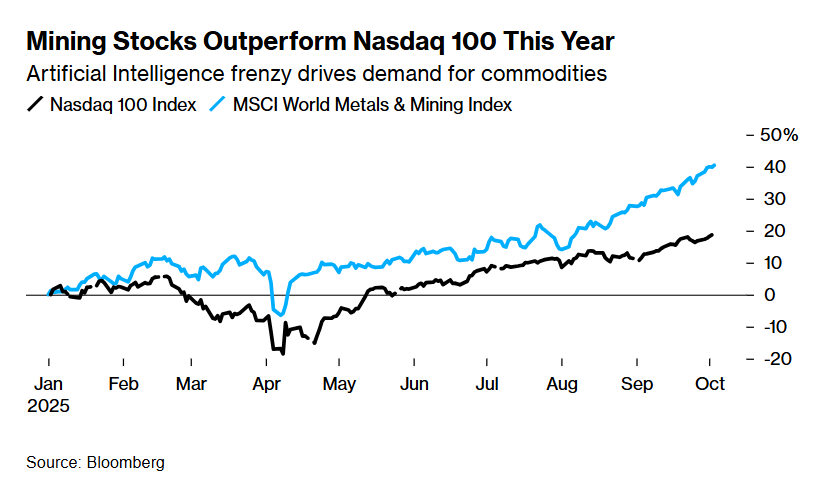
Core Viewpoint - Investors can better allocate and participate in the AI investment boom by combining AI-related stocks with those closely linked to global economic growth, such as resource stocks, which are significantly cheaper compared to major US tech giants [1] Group 1: AI Investment Strategy - The Bank of America (BofA) suggests that investors should focus on resource stocks and the UK stock market instead of the crowded US tech sector to capitalize on the AI boom [3] - The rapid construction of AI data centers is driving strong demand for energy and commodities like copper, which is essential across various tech sectors [4][7] - BofA's AI-focused stock basket has surged over 450% since the beginning of 2023, outperforming the Nasdaq 100 index by three times [7][8] Group 2: Market Trends and Shifts - The market is expected to favor China's four major tech giants (BATX: Baidu, Alibaba, Tencent, Xiaomi) over the US tech giants (Magnificent Seven) in the latter half of this decade [1][8] - The UK stock market offers significant exposure to defensive investment sectors, which can hedge against the risks of an overheated tech market [7] - There are early signs of a "bubble" market pattern, with inflation indicators trending upwards, yet no major interest rate hikes have occurred globally in the past two months [7] Group 3: Foreign Investment in China - After a period of withdrawal, foreign investors are returning to the Chinese stock market, driven by advancements in AI, robotics, and innovative pharmaceuticals [10][11] - Major Wall Street firms have upgraded their ratings on Chinese stocks, particularly in the semiconductor and AI-related sectors, reflecting a renewed interest [11] - Over 90% of US investors expressed a willingness to increase their allocation to Chinese stocks, marking the highest level of interest since early 2021 [11] Group 4: Alibaba and Tencent's Potential - There is strong bullish sentiment towards Alibaba, with significant target price increases from major financial institutions [12] - Alibaba and Tencent are positioned to leverage their AI capabilities, potentially rivaling the market scale of North American cloud giants like Amazon and Microsoft [13]


Glencore's Lomas Bayas mine in Chile working to control fire at waste yard
Reuters· 2025-09-30 20:39
Core Points - Glencore's Lomas Bayas copper mine in Chile is currently managing a fire that erupted at a waste yard [1] - The fire began at midday on Tuesday and has resulted in a significant column of smoke being emitted [1] Company Summary - Glencore is actively working to control the fire situation at its Lomas Bayas copper mine [1] - The incident highlights potential operational challenges for the company in managing environmental risks [1] Industry Summary - The event underscores the importance of safety and environmental management in the mining industry [1] - Fires at mining sites can lead to regulatory scrutiny and impact operational efficiency [1]


Glencore promotes head of LNG to lead oil and gas trading, memo shows
Reuters· 2025-09-30 11:48
Core Viewpoint - Glencore has appointed Maxim Kolupaev as the new head of its oil and gas trading division, effective after the current head Alex Sanna steps down at the end of 2025 [1] Group 1 - Maxim Kolupaev is currently the top gas and power trader at Glencore [1] - The transition in leadership is part of Glencore's strategic planning for its oil and gas trading division [1] - The memo regarding this promotion was seen by Reuters, indicating internal communication within the company [1]