
万华化学

Search documents
“反内卷”政策引导下化工行业景气度或将止跌回升,化工ETF嘉实(159129)有望持续受益
Xin Lang Cai Jing· 2026-01-12 05:51
Group 1 - The chemical sector experienced a reversal in early trading on January 12, 2026, with the CSI Chemical Industry Theme Index (000813) down by 0.63% as of 11:25 AM [1] - Key stocks in the sector showed mixed performance, with Guangwei Composite leading gains at 8.12%, followed by Bluestar Technology at 4.77% and Zhongjian Technology at 4.52%. Hebang Bio led the declines, with Sanmei Co. and Juhua Co. also falling [1] - The Ministry of Industry and Information Technology emphasized four key areas for 2026: "stability," "expansion," "innovation," and "growth," focusing on stabilizing growth in key industries such as steel, non-ferrous metals, and petrochemicals [1] Group 2 - CITIC Construction pointed out that despite rising short-term technical correction risks in the chemical sector, investment opportunities still exist. The outlook remains positive for the cross-year market, focusing on future industry hotspots, AI, semiconductors, and the resource price increase chain [1] - Guohai Securities noted that under the "anti-involution" policy, supply-side expansion in China's chemical industry is expected to slow significantly, potentially leading to a recovery in industry prosperity. The curtailment of disorderly capacity expansion may benefit leading companies with cost and efficiency advantages, marking a long-term upward trend in performance [1] - As of December 31, 2025, the top ten weighted stocks in the CSI Chemical Industry Theme Index included Wanhua Chemical, Salt Lake Industry, and Cangge Mining, accounting for a total of 45.31% of the index [2] Group 3 - Investors can also explore investment opportunities in the chemical sector through the Chemical ETF Link Fund (013527) [3]
长江期货聚烯烃周报-20260112
Chang Jiang Qi Huo· 2026-01-12 03:54
1. Report Industry Investment Rating - No relevant information provided 2. Core Viewpoints - Polyolefins are expected to have limited upward range and are likely to experience weak oscillations. Key factors to watch include downstream demand, the situation in Venezuela, and crude oil price fluctuations [8][9] - Plastics still face supply - demand contradictions and are expected to trade in a range [10] - Polypropylene (PP) faces significant upward pressure and is expected to oscillate weakly in the short term [53] 3. Summary by Directory 3.1 Plastic 3.1.1 Weekly Market Review - On January 9, the closing price of the plastic main contract was 6,674 yuan/ton, a week - on - week increase of 3.12%. The average price of LDPE was 8,933.33 yuan/ton, up 2.88% from the previous week. The average price of HDPE was 7,022.50 yuan/ton, up 2.52%. The average price of LLDPE (7042) in South China was 6,848.89 yuan/ton, up 3.37%. The LLDPE South China basis was 174.89 yuan/ton, down 0.94% week - on - week, and the 1 - 5 month spread was - 249 yuan/ton (- 47) [12] 3.1.2 Key Data Tracking - **Month - spreads**: On January 9, 2026, the 1 - 5 month spread was - 249 yuan/ton (- 47), the 5 - 9 month spread was - 41 yuan/ton (- 4), and the 9 - 1 month spread was 290 yuan/ton (+ 51) [17] - **Spot Prices**: Provided detailed spot price data for different varieties (HDPE, LDPE, LLDPE) in various regions, including minimum, maximum, and mainstream prices, as well as their price changes [20][21] - **Cost**: Last week, WTI crude oil closed at $58.78 per barrel, up $1.45 from the previous week, and Brent crude oil closed at $63.05 per barrel, up $2.25. The price of anthracite at the Yangtze River port was 1,070 yuan/ton (unchanged) [23] - **Profit**: The profit of oil - based PE was - 472 yuan/ton, up 158 yuan/ton from the previous week, and the profit of coal - based PE was 34 yuan/ton, up 98 yuan/ton [28] - **Supply**: This week, the operating rate of Chinese polyethylene production was 83.67%, up 0.43 percentage points from the previous week. The weekly polyethylene output was 68.68 tons, up 0.51% week - on - week. The maintenance loss this week was 9.87 tons, down 0.36 tons from the previous week [34] - **2026 Production Plan**: Multiple companies have planned new production capacity in 2026, with a total planned capacity of 550 tons [37] - **Maintenance Statistics**: Many enterprises' polyethylene production lines have been shut down for maintenance, and some of the restart times are undetermined [38] - **Demand**: This week, the overall domestic agricultural film operating rate was 37.89%, down 1.06% from the previous week; the PE packaging film operating rate was 48.96%, up 0.55%, and the PE pipe operating rate was 29.50%, down 0.50% [40] - **Downstream Production Ratio**: Currently, the production ratio of linear film is the highest, accounting for 31.5%, with a 2% difference from the annual average. The production ratio of low - pressure film is significantly different from the annual average, currently accounting for 6.9%, with a 3% difference [44] - **Inventory**: This week, the social inventory of plastic enterprises was 48.48 tons, down 0.16 tons from the previous week, a week - on - week decrease of 0.33% [46] - **Warehouse Receipts**: The number of polyethylene warehouse receipts was 11,365 lots, an increase of 12 lots from the previous week [50] 3.2 PP 3.2.1 Weekly Market Review - On January 9, the closing price of the polypropylene main contract was 6,514 yuan/ton, up 166 yuan/ton from the previous weekend, a week - on - week increase of 2.61% [54] 3.2.2 Key Data Tracking - **Downstream Spot Prices**: Provided price data for PP granules, PP powder, and other related products on January 9, 2026, as well as their price changes compared with the previous day, week, month, and year [59] - **Basis**: On January 9, the spot price of polypropylene reported by Business Society was 6,376.67 yuan/ton (+ 3.35%). The PP basis was - 137 yuan/ton (+ 41), and the 1 - 5 month spread was - 40 yuan/ton (- 19) [61] - **Month - spreads**: On January 9, 2026, the 1 - 5 month spread was - 212 yuan/ton (- 54), the 5 - 9 month spread was - 49 yuan/ton (- 29), and the 9 - 1 month spread was 261 yuan/ton (+ 83) [69] - **Cost**: Same as the plastic cost data, WTI crude oil and Brent crude oil prices increased, and the anthracite price remained unchanged [73] - **Profit**: The profit of oil - based PP was - 516.36 yuan/ton, up 110.86 yuan/ton from the previous week, and the profit of coal - based PP was - 428.77 yuan/ton, up 141.48 yuan/ton [78] - **Supply**: This week, the operating rate of Chinese PP petrochemical enterprises was 75.47%, down 1.27 percentage points from the previous week. The weekly output of PP granules was 77.92 tons, down 1.69% week - on - week, and the weekly output of PP powder was 6.75 tons, down 2.88% [82] - **Maintenance Statistics**: Many PP production lines of enterprises have been shut down for maintenance, and some of the restart times are undetermined [86] - **Demand**: This week, the average downstream operating rate was 52.58% (- 0.18). The operating rate of plastic weaving was 42.92% (- 0.22%), the operating rate of BOPP was 63.24% (unchanged), the operating rate of injection molding was 58.04% (- 0.08%), and the operating rate of pipes was 38.13% (- 0.34%) [88] - **Import and Export Profits**: This week, the polypropylene import profit was - 349.72 US dollars/ton, down 19.02 US dollars/ton from the previous week, and the export profit was - 8.91 US dollars/ton, down 5.17 US dollars/ton [94] - **Inventory**: This week, the domestic polypropylene inventory was 46.77 tons (- 4.69%); the inventory of the two major state - owned oil companies decreased by 16.14% week - on - week, the inventory of traders increased by 15.52%, and the port inventory increased by 7.24% [96] - **Finished Product and Raw Material Inventory**: The finished product inventory of large - scale plastic weaving enterprises was 941.95 tons, down 2.15% week - on - week, and the BOPP raw material inventory was 10.64 days, up 2.11% [100] - **Warehouse Receipts**: The number of polypropylene warehouse receipts was 15,445 lots, unchanged from the previous week [104]
ETF盘中资讯|倒车接人?热门板块突然熄火,化工ETF(516020)跌超1%!机构看好中长期修复逻辑
Sou Hu Cai Jing· 2026-01-12 03:36
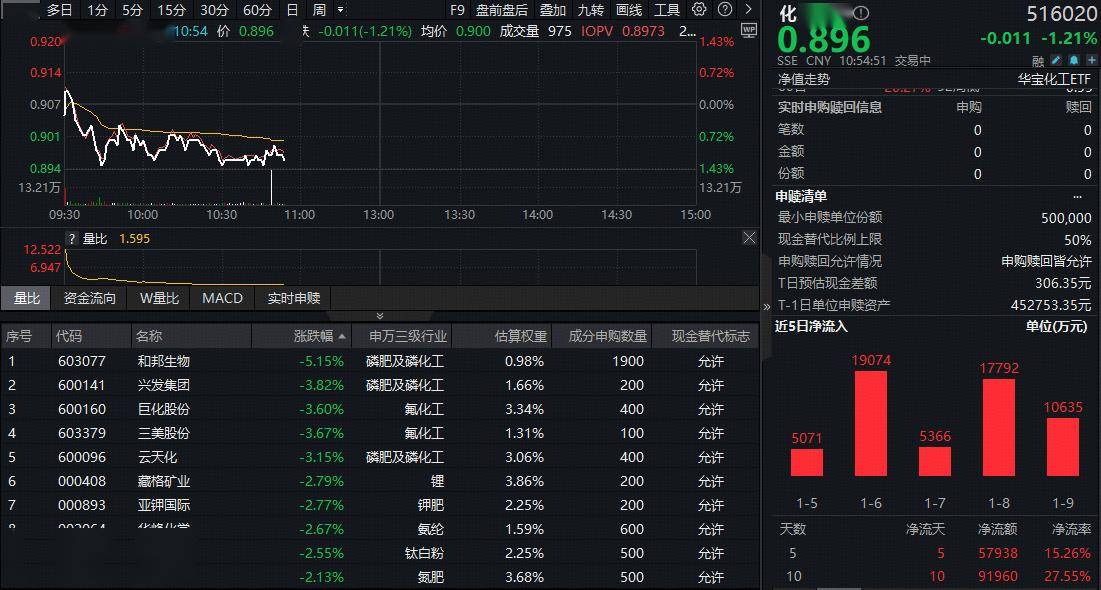
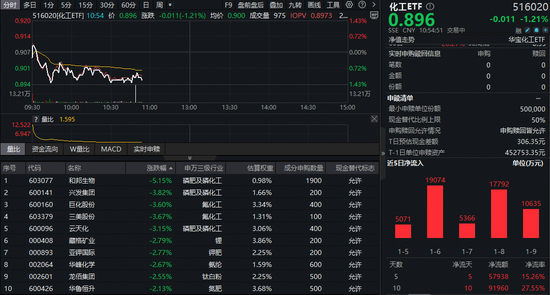
化工板块今日(1月12日)深度回调,反映化工板块整体走势的化工ETF(516020)开盘后迅速走弱,而后持续低位震荡,截至发稿,场内价格跌1.21%。 成份股方面,磷化工、氟化工、锂电等板块部分个股跌幅居前。截至发稿,和邦生物大跌超5%,兴发集团、巨化股份、三美股份等多股跌超3%,拖累板块 走势。 尽管今日突发回调,但从2025年以来,或受益于政策重大利好,化工板块表现持续强势。数据显示,截至上个交易日(1月9日)收盘,自2025年年初,化工 ETF(516020)标的指数细分化工指数累计涨幅已达到46.18%,显著跑赢同期上证指数(22.93%)、沪深300指数(20.94%)等A股主要指数。 | | 证券简称 序号 证券代码 | 区间涨跌幅 | | | --- | --- | --- | --- | | | | [区间首日] 2025-01-01 | | | | | [区间居日] 2026-01-09 | | | | | [单位] % | | | | 1 000813.CSI 细分化工 | | 46.1822 | | :: | 2 000001.SH 上证指数 | | 22.9331 | | :: | 3 ...

化工ETF(159870)盘中净申购1.37亿份,冲刺连续8天净流入
Sou Hu Cai Jing· 2026-01-12 03:13
Group 1 - The chemical sector is experiencing a capital inflow, with the chemical ETF (159870) seeing a net subscription of 137 million units, marking eight consecutive days of net inflow [1] - The core logic of the chemical industry is that capital expenditure has ended, with operating rates still at 80% to 90%. The trend remains positive despite internal competition, as only the chemical sector can achieve a healthy reduction in competition [1] Group 2 - Chemical stocks are currently in the first phase of a three-phase cycle, where EPS and commodity prices have bottomed out, indicating significant potential for future price increases [2] - Seasonal demand in the chemical industry is pronounced, with low inventory levels and strong spot market performance, suggesting that profitability will recover significantly during peak seasons [2] Group 3 - The chemical sector's leading companies are expected to see profit margins improve due to increased industry concentration and capital expansion from 2022 to 2025, which could lead to record high profits [3] - The current price-to-book (PB) ratios for leading companies differ from previous cycles, indicating potential for higher returns on equity (ROE) if leverage ratios return to historical levels [3] Group 4 - As of January 12, 2026, the CSI sub-industry chemical theme index (000813) shows mixed performance among its constituent stocks, with notable gains from companies like Guangwei Composite and Lanxiao Technology [3] - The top ten weighted stocks in the CSI sub-industry chemical theme index account for 45.31% of the index, including major players like Wanhua Chemical and Yanhua Co. [4]
倒车接人?热门板块突然熄火,化工ETF(516020)跌超1%!机构看好中长期修复逻辑
Xin Lang Cai Jing· 2026-01-12 03:09
化工板块今日(1月12日)深度回调,反映化工板块整体走势的化工ETF(516020)开盘后迅速走弱, 而后持续低位震荡,截至发稿,场内价格跌1.21%。 成份股方面,磷化工、氟化工、锂电等板块部分个股跌幅居前。截至发稿,和邦生物大跌超5%,兴发 集团、巨化股份、三美股份等多股跌超3%,拖累板块走势。 | | | 分时 多日 1分 5分 15分 30分 60分 日 周 ▼ | | | | | | F9 盘前盘玩 图加 九转 测试 工具 (6 2 > | | 化工ETF O | | | 516020 | | --- | --- | --- | --- | --- | --- | --- | --- | --- | --- | --- | --- | --- | --- | | 0.92 | | | | | 516020(化工ETF) 10:54 价 0.896 源跌 -0.011(-1.21%) 均价 0.900 成交量 975 IOPV 0.8973 | | | | | 0.896 | | | -0.011 -1.21% | | 0.914 | | | | | | | | | | SSE CNY 10:54:5 ...


石化化工行业景气度有望实现复苏,石化ETF(159731)连续3天净流入
Sou Hu Cai Jing· 2026-01-12 02:27
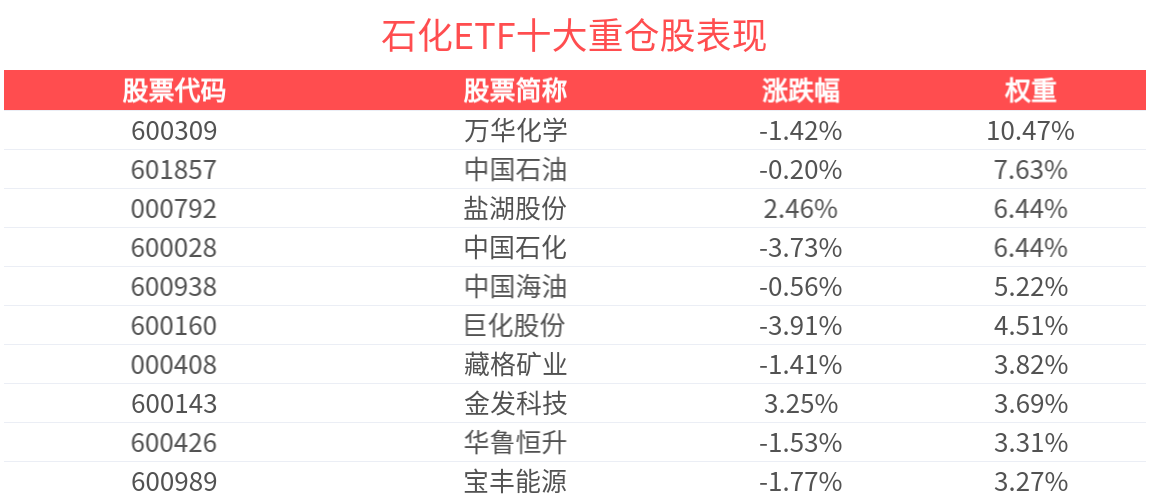
| 股票代码 | 股票简称 | 涨跌幅 | 权重 | | --- | --- | --- | --- | | 600309 | 万华化学 | -1.42% | 10.47% | | 601857 | 中国石油 | -0.20% | 7.63% | | 000792 | 盐湖股份 | 2.46% | 6.44% | | 600028 | 中国石化 | -3.73% | 6.44% | | 600938 | 甲国海海 | -0.56% | 5.22% | | 600160 | 巨化股份 | -3.91% | 4.51% | | 000408 | 藏格矿业 | -1.41% | 3.82% | | 600143 | 金发科技 | 3.25% | 3.69% | | 600426 | 华鲁恒升 | -1.53% | 3.31% | | 600989 | 宝幸能源 | -1.77% | 3.27% | 截至1月9日,石化ETF近2年净值上涨49.64%。从收益能力看,截至2026年1月9日,石化ETF自成立以来,最高单月回报为15.86%,最长连涨月数为8个月, 最长连涨涨幅为41.60%,上涨月份平均收益率为5.25 ...





氯碱周报:SH:供应预期增加,价格重回弱势震荡,V:PVC出口退税取消,短期消极情绪拖累盘面-20260112
Guang Fa Qi Huo· 2026-01-12 02:11
Report Industry Investment Rating - Not provided in the content Core Viewpoints - **Caustic Soda**: Affected by macro - sentiment, the post - holiday caustic soda futures market fluctuated greatly, and the spot market price was generally weak. Supply increased slightly, demand lacked substantial improvement, and the price was expected to remain stable with a weakening trend [3]. - **PVC**: The domestic PVC market continued to be strong after the holiday, but the fundamentals were weak. With expected increase in domestic production and weakening demand, along with the cancellation of export tax rebates, the short - term pessimistic sentiment might drag down the PVC trend [4]. Summary by Relevant Catalogs Caustic Soda - **Price and Market Situation**: The price of 32% liquid caustic soda decreased in most regions, except in Inner Mongolia. The market was affected by macro factors, and the downstream and traders' enthusiasm for purchasing was average [3]. - **Supply**: The industry's operating rate increased slightly this week, and the inventory of caustic soda increased. The national weighted average operating rate was 88.91%, up 0.39 percentage points from last week. The inventory of 32% liquid caustic soda in East China and Shandong increased [21][27]. - **Demand**: The demand from the main downstream industries remained stable at the rigid - demand level. Some areas had an expected decline in alumina prices, which put pressure on caustic soda prices [3]. - **Device Dynamics**: This week, there were fewer maintenance enterprises, and the total maintenance loss was 1.42 tons. Hubei Xingrui planned semi - load maintenance from January 15th to February 5th [28][30]. - **Alumina**: The planned production capacity from the end of 2024 to 2025 was 12.3 million tons, with an estimated annual output of over 88 million tons in 2025. The demand for caustic soda increased by about 800,000 tons. The short - term domestic alumina price was expected to decline, ranging from 2,500 - 2,700 yuan/ton [34][38]. - **Bauxite**: The price was stable, and the inventory was somewhat depleted [41]. - **Electrolytic Aluminum**: The production remained high, and the in - plant inventory decreased [47]. - **Non - Aluminum Downstream**: The operating rate declined, and the off - season was approaching [52]. - **Caustic Soda Export**: In November, exports weakened, and the estimated export profit increased slightly [57]. Polyvinyl Chloride (PVC) - **Price and Market Situation**: The PVC spot price rebounded slightly this week, affected by overseas device disturbances. The industry's profit was slightly repaired [65][70]. - **Profit**: The price increase led to a slight repair of the industry's profit [70]. - **Supply**: The operating rate of the domestic PVC powder industry increased this week. The overall operating rate was 78.85%, up 1.51 percentage points from last week [80][86]. - **Device Dynamics**: This week, there were fewer maintenance enterprises, and the total maintenance loss was 36,300 tons, a decrease from last week. Next week, the maintenance loss was expected to change little [87][89]. - **Downstream Demand**: The two main downstream industries of PVC, profiles and pipes, faced great pressure. Domestic demand did not improve significantly, and downstream orders were lower than the same period in the past five years [94]. - **Real Estate Data**: The real estate industry was still in the bottom - building cycle [95]. - **Inventory**: The total inventory was still at the highest level in recent years [102]. - **External Market and Export**: Some external market prices weakened. In November 2025, the PVC export volume was 275,300 tons, and the import volume was 15,700 tons [109][120].
能源成本下行-看好商品周期与科技主线需求共振-能源及有色行业2026年度投资策略
2026-01-12 01:41
Summary of Key Points from Conference Call Records Industry Overview - The conference call discusses the energy and non-ferrous metal industries, focusing on commodity cycles and market dynamics in 2026 [1][2]. Core Insights and Arguments - **Commodity Cycle Dynamics**: The acceleration of commodity cycle rotation is influenced by global economic recovery and pandemic impacts, similar to the commodity volatility seen after the collapse of the Bretton Woods system in the 1970s. It is challenging to determine the current cycle position, necessitating a comprehensive analysis of various commodities to identify patterns [1][2]. - **Oil Prices and Commodity Volatility**: Oil prices are highly correlated with overall commodity volatility, serving as a benchmark for energy costs. Gold has started to rise as a leading indicator, but other commodities have not followed suit significantly, likely due to the lack of a clear upward trend in oil prices [1][4]. - **Gold Price Influences**: The price of gold is affected by the transition between the old and new world orders. Currently, gold is viewed as a safe-haven asset amid the remnants of the old world wealth. Historical trends show that after the decoupling of the dollar from gold in 1971, significant price increases in gold and other commodities occurred due to excessive dollar issuance [5]. - **U.S. Treasury Credit and Precious Metals**: The loosening of U.S. Treasury credit post-2009 financial crisis has led to increased market preference for precious metals as a hedge. Despite multiple interest rate cuts by the Federal Reserve, Treasury yields have not significantly decreased, indicating a weakening preference for Treasury securities [6]. - **Future Gold Price Trends**: A long-term downward expectation for the U.S. dollar index, driven by an expanding trade deficit and potential appreciation of the Renminbi, suggests that gold prices may have room to rise [7]. - **Oil Supply and Demand**: Short-term oil supply and demand are heavily influenced by political factors, while long-term demand changes will have a more significant impact on price volatility. Current U.S. inventory increases and stable Chinese supply contribute to short-term price stability, but long-term demand fluctuations could lead to potential volatility [8]. - **U.S. Oil Production and Price Forecast**: U.S. oil production has seen a year-on-year increase of approximately 300,000 barrels, but the number of drilling rigs is declining. The forecast for oil prices in 2026 is expected to fluctuate between $40 and $70 per barrel, with a more stable range of $50 to $70 per barrel if political factors are excluded [9][10]. Additional Important Insights - **Energy Costs in China**: Domestic energy costs are stable, with sufficient supply in coal and natural gas, leading to no significant price increases. Electricity prices are expected to have limited rebound potential due to overall cost constraints [11]. - **Non-Ferrous Metals Market**: The aluminum market is expected to remain in a supply-demand imbalance due to limited domestic production capacity and stable demand growth. Copper prices are projected to range between $11,000 and $15,000 per ton in 2026, driven by increasing demand in power construction and unstable production in major copper mining regions [12][13]. - **Domestic Economic Impact on Metal Demand**: The demand for non-ferrous metals is closely tied to domestic economic development, particularly in sectors like real estate and automotive. A positive GDP outlook suggests continued growth in aluminum demand [14]. - **Global Copper Inventory and Consumption**: As of September 2025, global electrolytic copper inventory was 1.451 million tons, with a consumption increase of 3% year-on-year, indicating a stable demand environment [15]. - **Challenges in the Copper Market**: The domestic copper market faces challenges such as resource scarcity and price increases affecting downstream procurement. Additionally, cyclical patterns in the manufacturing sector impact demand [16][17]. - **Cable Demand in China**: There is strong demand for cables driven by investments in power generation and infrastructure, with a rebound in terminal electrical equipment demand noted [18]. - **Silver Market Dynamics**: The silver market is influenced by financial attributes, with increased speculative demand as gold prices rise. Industrial demand, particularly from photovoltaic and electronics sectors, is expected to support silver prices [19]. - **Rare Earth Industry Development**: The rare earth industry in China is positioned as a competitive sector, benefiting from trends in high-end manufacturing and energy equipment [20]. - **Commodity Market Trends**: The commodity market is experiencing structural demand resonance rather than short-term volatility, with significant implications from U.S. monetary policy and inflation on commodity prices [21]. - **Investment Recommendations**: Suggested investments include resource companies like PetroChina and CNOOC, integrated firms such as Hengli and Rongsheng, and non-ferrous metal companies like Yun Aluminum and Huadong Cable. Additionally, companies in the rare earth sector are noted for their potential [22].
涨价潮要来了
Xin Lang Cai Jing· 2026-01-12 01:19
Group 1 - The core viewpoint of the article is that a chemical price surge is imminent, presenting significant investment opportunities, particularly in the chemical ETF sector, which has seen a remarkable increase of over 30% recently [1][34] - The chemical price increase is primarily driven by global supply issues, with major chemical companies like Wanhua Chemical, BASF, Huntsman, and Dow announcing price hikes for MDI and TDI products in December 2025 [3][37] - The supply constraints are attributed to permanent capacity reductions in Europe and Asia, with ExxonMobil and other multinational companies planning to close several production facilities, resulting in a total capacity loss of 4 million tons per year [9][43] Group 2 - In Europe, the chemical industry faces three main challenges: rising energy costs due to the loss of cheap Russian gas, stringent carbon emission policies, and aging production facilities, leading to a structural cost disadvantage [10][44][45] - Japan and South Korea are also experiencing capacity reductions, with predictions that South Korea's chemical production capacity could decrease by 18% to 25% by 2027 due to similar issues [13][47] - Short-term supply disruptions, including unexpected plant shutdowns and maintenance, are exacerbating the supply tightness, further driving up prices [16][50] Group 3 - The article suggests that the price increase is not a short-term fluctuation but a medium to long-term trend supported by three factors: the depreciation of the US dollar increasing raw material costs, a shift in policy towards promoting reasonable price increases, and signs that the chemical industry cycle has bottomed out [17][51][54][56] - The overall price surge is part of a broader trend affecting various sectors, including upstream commodities and electronic components, indicating a widespread inflationary environment [25][59] - The chemical industry is foundational to modern life, with price increases in chemicals likely to impact consumer goods, construction materials, and electronics, ultimately leading to higher prices for end products [26][60][62] Group 4 - The article concludes that the current price increases in the chemical sector are just the beginning, with a multi-layered logic explaining the trend: permanent global capacity reductions, dollar depreciation, policy shifts towards inflation, and a recovering industry cycle [29][63] - The expectation is that chemical prices will continue to rise into 2026 and possibly 2027, which is viewed as a positive sign for economic health and a necessary step out of low inflation traps [68]
化工行业周报20260111:国际原油、环氧丙烷价格上涨,聚合MDI价格下跌-20260112
Bank of China Securities· 2026-01-12 01:05
Investment Rating - The industry investment rating is "Outperform the Market," indicating that the industry index is expected to perform better than the benchmark index over the next 6-12 months [49]. Core Insights - The report suggests focusing on undervalued leading companies in the industry, the impact of "anti-involution" on the supply side of related sub-industries, and the importance of self-sufficiency in electronic materials companies amid strong downstream demand and price increases in certain new energy materials [3][12]. - The report highlights a mid-to-long-term investment theme where policy support is expected to lead to demand recovery, continuous optimization of the supply side, and potential dual improvements in performance and valuation for excellent leading enterprises [3][12]. - Emerging fields such as semiconductor materials, OLED materials, and new energy materials are identified as having significant growth potential due to rapid development in downstream industries [3][12]. Summary by Sections Industry Dynamics - As of January 9, the TTM price-to-earnings ratio for the SW basic chemical sector is 27.07, at the 80.09 percentile historically, while the price-to-book ratio is 2.45, at the 67.22 percentile historically [3][12]. - The SW oil and petrochemical sector has a TTM price-to-earnings ratio of 13.49, at the 40.05 percentile historically, and a price-to-book ratio of 1.31, at the 42.27 percentile historically [3][12]. Price Changes and Market Performance - During the week of January 5-11, 34 out of 100 tracked chemical products saw price increases, while 31 experienced declines, and 35 remained stable. Overall, 49% of products had month-over-month price increases, while 41% saw decreases [9][30]. - The average price of WTI crude oil rose to $59.12 per barrel, with a weekly increase of 3.14%, while Brent crude oil reached $63.34 per barrel, up 4.26% [31][30]. Key Recommendations - Recommended stocks include Wanhua Chemical, Hualu Hengsheng, Satellite Chemical, and others, with a focus on companies benefiting from policy support and strong demand in emerging sectors [3][12]. - The report identifies "golden stocks" for January as Wanhua Chemical and Yake Technology, emphasizing their potential for growth [3][12].
