
奇瑞汽车

Search documents
11月国内乘用车零售销量同比下降8.1% 乘联分会预测:2026年车市增长面临压力
Mei Ri Jing Ji Xin Wen· 2025-12-09 06:13
Core Viewpoint - In November, the domestic passenger car market experienced a year-on-year decline in retail sales by 8.1%, contrasting with the typical year-end sales surge seen in previous years. The total retail sales for the year reached approximately 21.48 million units, reflecting a 6.1% increase year-on-year [1][10]. Group 1: Market Performance - The retail sales volume in November was about 2.225 million units, showing a month-on-month decrease of 1.1% [1]. - The cumulative growth rate of retail sales for the year showed fluctuations, with a 1.2% increase from January to February, a 15% increase from March to June, and a decline in growth to around 6% from July to September [3]. - The decline in November sales is attributed to a high base effect from previous quarters, aligning with earlier predictions of a "low-middle-high-flat" trend for the year [3]. Group 2: Policy Impact - The "old-for-new" vehicle replacement policy has been a significant factor in regulating market growth, with over 11.2 million applications for subsidies by October 22, 2023 [3]. - The average daily subsidy scale dropped to 30,000 units in November due to the suspension of subsidies in various regions, indicating a clear effect on growth adjustment [3]. Group 3: New Energy Vehicles (NEVs) - In November, the number of manufacturers with monthly sales exceeding 10,000 units for NEVs rose to 22, accounting for 94.2% of total NEV sales for the month [4]. - The total sales of NEVs reached 1.321 million units in November, marking a year-on-year increase of 4.2%, with a penetration rate of 59.3% in the overall passenger car market, up 7 percentage points from the previous year [4]. - The penetration rate for domestic brands' NEVs was 79.6%, while luxury brands and mainstream joint ventures had penetration rates of 38.8% and 8%, respectively [4]. Group 4: Export Trends - NEV exports reached 284,000 units in November, representing a year-on-year increase of 243.3%, making up 47.3% of the total export market [7]. - The share of pure electric vehicles in NEV exports decreased to 57%, while plug-in hybrid models increased to 42% [7]. - The export of complete vehicles has also driven growth in battery exports, with a total of 7.039 million kWh of electricity used for NEV exports and wholesale in November [8]. Group 5: Future Outlook - The retail share of new forces in the market reached 22.1% in November, an increase of 5.9 percentage points year-on-year, with pure electric models accounting for 72.8% of new force sales [9]. - Predictions for December suggest a relatively stable market, with potential for slight negative growth, influenced by consumer urgency due to upcoming changes in vehicle purchase tax policies [9]. - Looking ahead to 2026, the market is expected to face significant pressure due to changes in tax incentives, with a projected reduction in tax benefits leading to a potential decline in growth [9].




鸿蒙智行全面深化战略合作——共建统一服务体系、共享充电网络,打造智能汽车生态联盟
Guan Cha Zhe Wang· 2025-12-09 05:25
共建充电网络:五界品牌将联合投资建设"鸿蒙智行充电站",整合现有充电资源,构建覆盖全国的超级 补能网络。通过统一的账号体系和充电地图,为用户提供无缝的补能体验。 12月8日,鸿蒙智行问界、智界、享界、尊界、尚界在上海共同宣布全面深化战略合作。 华为常务董事、产品投资委员会主任、终端BG董事长余承东,赛力斯(601127)集团董事长(创始 人)张兴海,奇瑞汽车股份有限公司董事长尹同跃,北京汽车集团有限公司党委书记、董事长张建勇, 江汽集团党委书记、董事长项兴初,上海汽车集团股份有限公司党委书记、董事长王晓秋,共同见证鸿 蒙智行合作的升级。 此次合作升级将围绕"统一标准、资源共建"的核心理念展开,意味着鸿蒙智行全方位生态联盟的合作再 升级。联盟将重点推进以下五大领域合作: 归一化、平台化解决方案:推动鸿蒙座舱、智能驾驶、云服务等核心技术和部件的标准化,统一质量管 控、统一生态接口,让车辆品质更稳定,助力中国智能汽车标准体系创新。 标准化服务体系:联盟将打造行业内首个跨品牌共享售后服务中心网络,实现售前、交付、售后等全流 程高质量服务标准化。 创新技术落地:设立联盟创新中心,共同研发下一代智能汽车技术,加速创新成果 ...
港股速报 | 港股窄幅震荡 利好刺激 歌礼制药涨超23%
Mei Ri Jing Ji Xin Wen· 2025-12-09 02:57
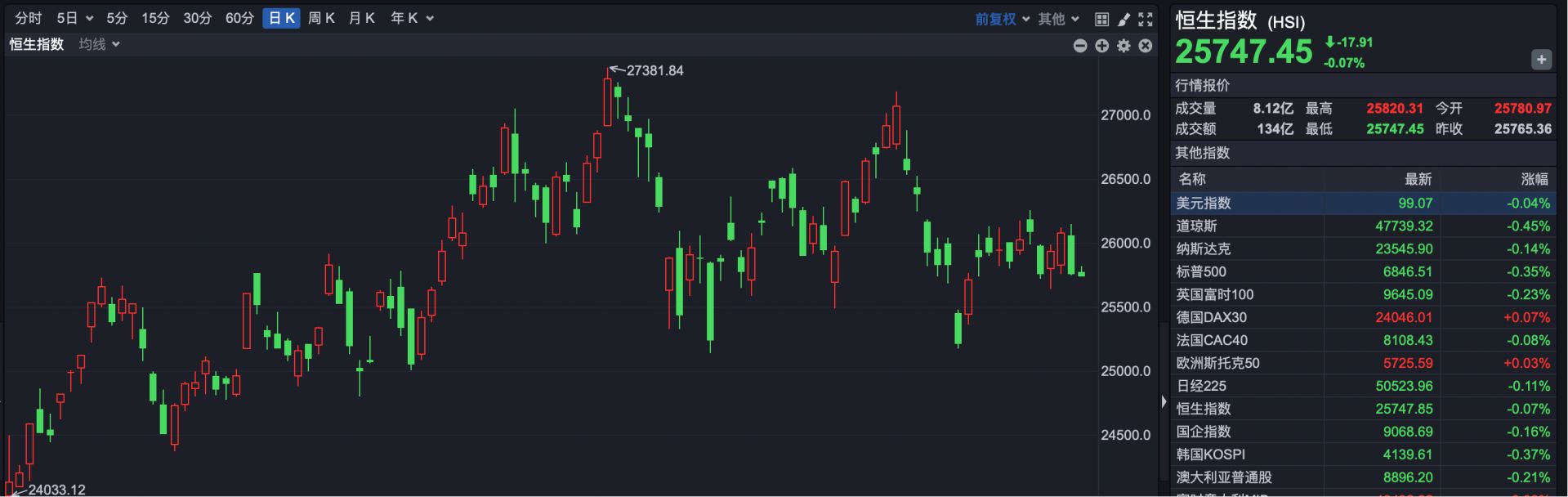
每经记者|曾子建 每经编辑|袁东 12月9日早盘,港股市场小幅高开后窄幅震荡。 截至发稿,恒生指数报25747.45点,下跌17.31点,跌幅0.07%。 恒生科技指数报5640.40点,下跌22.15点,跌幅0.39%。 焦点公司方面,歌礼制药(HK01672)高开高走,截至发稿涨超23%。 消息面,歌礼制药公告称,评估口服小分子GLP-1受体(GLP-1R)激动剂ASC30治疗肥胖症的13周II期研究(NCT07002905)取得积极的顶线结果。 东吴证券表示,港股短期还处在左侧阶段,反弹还需等待。从中长期配置来看,当前位置有吸引力。其一,市场预计12月美联储会降息,但如果采取鹰派降 息,港股反弹力度可能不及预期。其二,市场已对中央经济工作会议进行前瞻,当前投资者态度相对中性。若会议内容超预期,市场会反弹。其三,从中长 期看恒生科技当前具有配置意义,AI科技龙头估值处在合理区间,一旦有新催化,资金启动,恒生科技会有明显反弹。 封面图片来源:图片来源:每经记者 李星 摄 曲少杰指出,2026年港股上涨的核心驱动力将来自上市公司业绩的向好。具体来看:科技股中,具备强AI能力与技术门槛的企业业绩确定性最高;消费 ...
港股开盘:恒指微涨0.06%、科指跌0.11%,券商股及创新药概念股走高,汽车股活跃
Jin Rong Jie· 2025-12-09 01:32
12月9日,港股开盘走势分化,其中恒生指数上涨15.61点,涨幅0.06%报25780.97点;恒生科技指数下 跌6.48点,跌幅0.11%报5656.07点;国企指数上涨0.42点报9083.11点;红筹指数下跌4.27点,跌幅0.1% 报4214.01点。 盘面上,科网股涨跌不一,阿里巴巴涨超1%,快手跌超1%;中资券商股高开,国联民生涨超1%;创新 药概念部分上涨,歌礼制药涨超14%;汽车股活跃,奇瑞汽车涨超2%。生物医药股、汽车股、海运股 普涨,万国黄金集团涨3.6%。半导体股、煤炭股多数走低,中国中冶大跌近6%。 企业新闻 东风集团股份(00489.HK):前11月累计销量169.7万辆,同比下降约0.3%。其中新能源汽车销量为 489,203辆,同比增长约39.1%。 新天绿色能源(00956.HK):前11月累计完成发电量1336.89万兆瓦时,同比增加8.04%。其中11月完成发 电量166.2万兆瓦时,同比增加24.45%。 龙源电力(00916.HK):前11个月累计完成发电量约6909.64万兆瓦时,同比增长0.41%。 绿地香港(00337.HK):前11个月合约销售约68.23亿元, ...
剥离非战略性资产 零部件巨头佛瑞亚被曝出售内饰业务
Zhong Guo Jing Ying Bao· 2025-12-09 00:50
中经记者 方超 石英婧 上海报道 合并仅三年多时间后,全球汽车零部件巨头佛瑞亚(FORVIA)近期被曝或出售核心板块汽车内饰业 务。 公开信息显示,佛瑞亚可能出售旗下的汽车内饰业务,而对于市场传闻,佛瑞亚此后也发布公告 称:"集团已启动某些程序,以出售其稳健业务组合中的部分资产,其中包括其内饰业务集团的资产。" 《中国经营报》记者注意到,尽管佛瑞亚方面对相关业务出售未释放出更多讯息,但市场对于其出售动 作早已不再陌生。佛瑞亚集团首席执行官Martin FISCHER此前就表示:"剥离非战略性资产将加速去杠 杆化进程,同时使我们能够把握增长机遇、持续巩固在创新与可持续发展方面的领导地位。" 对于包括佛瑞亚在内的行业巨头开启的出售动作,中国汽车流通协会专家委员会委员章弘向记者表示, 此举或与相关企业面临的债务压力、战略转型需要及市场竞争加剧等因素有关,在其看来:"剥离部分 业务可精简组织架构,提高运营效率,降低管理成本,同时避免资源分散导致的核心竞争力不足。" 内饰业务三季度营收下滑 对于旗下核心板块之一的汽车内饰业务,佛瑞亚或已启动出售程序。 日前,多家媒体报道,佛瑞亚正寻求出售部分汽车内饰业务,同时继续缩减投 ...
智驾国产芯片格局变化
2025-12-08 15:36
Summary of Conference Call Records Industry Overview - The records focus on the autonomous driving chip landscape in the Chinese automotive industry, highlighting various companies' strategies and developments in self-driving technology and chip utilization. Key Points by Company NIO - NIO's self-driving solution utilizes fully self-developed technology, primarily promoting a world model, but currently lags in effectiveness. The main task for next year is to improve the connectivity rate of the parking-to-parking function and handle complex cases. The Lido and Firefly series are expected to continue using NVIDIA solutions [1][3]. Xpeng Motors - Xpeng's mid-to-high-end models will feature the self-developed Turing chip with a computing power exceeding 1,000 TOPS. The focus is on the iteration of VLA and world models, deeply integrating the BL module. The Turing chip will also be used in the Robotic business line to optimize Robot Taxi efficiency and safety [1][5]. Li Auto - Li Auto's self-developed M100 Schumacher chip is expected to enter mass production in Q2 2026, debuting in high-end models. The AD Max system will feature a mix of M100 and Horizon solutions, while the AD Pro system will continue with Horizon but may upgrade to the G6H version. The algorithm will firmly follow the VOL route [1][5]. Xiaomi - Xiaomi plans to use NVIDIA's 42 series chips in high-end models, while the self-developed Xuanjie O2 chip will be temporarily shelved due to regulatory challenges. The algorithm will be upgraded to address key issues, adopting a structure similar to Tesla's, focusing on world models and language models to solve parking and urban commuting challenges [1][6]. BYD - BYD will upgrade its high-end solutions to NVIDIA's Orin solution, debuting in the Yangwang U8 model. The terminal solution, Tianyi Cloud B1, will have two versions, one continuing with the Orin 3OX low-cost solution and another possibly using Horizon's G6P. BYD plans to significantly adopt the Orin solution and phase out Horizon [1][7]. Chery - Chery's 2026 autonomous driving plan includes multiple tiers. The Falcon 500 series will primarily use Horizon and Qualcomm platforms, while the Falcon 700 series will adopt a dual Orin X platform. The Falcon 900 series will utilize the Sora Ultra platform [1][4][9]. Geely - Geely's autonomous driving layout spans low, mid, and high-end models. Low-end models will mix Black Sesame 1,000 and Horizon Orin chips, while mid-range models will use single and dual Orin X chips. High-end models will feature Soar and dual Soar chips, debuting in flagship models like Zeekr 001 [1][10]. Great Wall Motors - Great Wall's autonomous driving solutions are categorized into low, mid, and high computing power platforms. The low computing power platform will use TI TDA 4VH and Horizon GLM chips, while the mid computing power platform will collaborate with Momenta. The high computing power platform will include dual Orin X and Soar, with Soar expected to replace dual Orin X in 2026 [1][11]. Market Trends - By 2026, companies like BYD, Chery, Geely, and Great Wall, along with joint ventures like Toyota and Volkswagen, are expected to become significant third-party chip purchasers. Volkswagen plans to accelerate its smart vehicle process, heavily adopting Horizon's G6P and G6M solutions [1][12]. Cost Trends - The cost of mid-range platforms, such as BYD's Tianlian B1, is projected to decrease by about 10% in 2026, dropping to around 7,000 yuan. Low-end solutions like Horizon GO6M will see annual hardware cost reductions of 5%-7%. High-end solutions like Orin and Sol are expected to have limited cost reductions, primarily relying on software supplier price drops and increased shipment volumes [1][14][16]. Chip Development - The records indicate a growing trend towards self-developed chips in high-end vehicles to enhance profit margins and optimize resource allocation. In contrast, low-end vehicles will continue to utilize third-party solutions for cost efficiency and quality assurance [1][26]. Conclusion - The autonomous driving sector in China is rapidly evolving, with various companies adopting different strategies for chip development and algorithm integration. The competition is intensifying, particularly in the high-end market, where self-developed solutions are becoming more prevalent.



少见!11月国内乘用车零售销量同比下降8.1%
Mei Ri Jing Ji Xin Wen· 2025-12-08 13:54
每日经济新闻消息,12月8日,乘联分会发布的数据显示,11月国内乘用车销量同比下滑8.1%,环比下降1.1%, 符合"前低中高后平"走势,"以旧换新"政策调节效果明显。新能源车市场表现突出,月销破万车企达22家,零售 渗透率逼近60%。乘联分会预测2025年车市或超预期增长,但2026年因购置税政策调整,车市增长将面临压力, 建议减免政策惠及首购群体和小微型电动车。 与往年年底车市翘尾走势不同的是,今年11月国内乘用车市场销量同比出现下滑。 12月8日,乘联分会公布的最新数据显示,11月,全国乘用车市场零售销量约222.5万辆,同比下降8.1%,环比下 降1.1%;今年以来累计零售销量约2148.3万辆,同比增长6.1%。 "11月乘用车市场销量环比出现下降,是比较少见的。"乘联分会秘书长崔东树认为,今年上半年,我国乘用车市 场销量实现了13%的较快增长,下半年车市增长需要回到合理、稳定的状态。 复盘来看,今年国内乘用车市场零售累计增速从1~2月增长1.2%,3~6月增长15%,7~9月增速徘徊在6%左右, 10~11月回落到偏低状态,呈现四季度高基数的减速特征,基本符合乘联分会在今年年初所判断的"前低中高后 ...

最后一个月!16家车企全年目标完成度大盘点!
Zhong Guo Qi Che Bao Wang· 2025-12-08 12:24
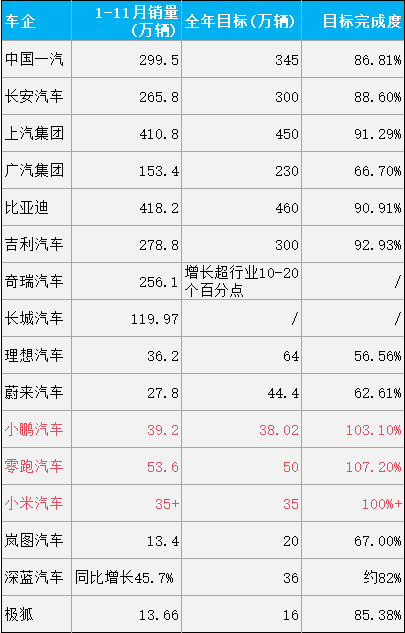
Summary of Key Points Core Viewpoint - The automotive industry in China is nearing the end of 2025, with various companies reporting their sales performance against annual targets, revealing a mix of successes and challenges across the sector. Group 1: Company Performance - China FAW Group achieved a cumulative sales of 2.995 million units from January to November, with a target completion rate of 86.81% against an annual goal of 3.45 million units, showing a year-on-year growth of 4.8% [3][4] - Changan Automobile reported cumulative sales of 2.658 million units, achieving 88.6% of its 3 million unit target, with a notable 54.66% year-on-year growth in its new energy vehicle sales [6] - SAIC Motor Corporation reached 4.108 million units in cumulative sales, completing 91.29% of its 4.5 million target, with a 16.4% year-on-year growth [8] - GAC Group's cumulative sales were 1.534 million units, achieving only 66.7% of its 2.3 million target, reflecting a 10.8% year-on-year decline [10] - BYD's cumulative sales stood at 4.182 million units, completing 90.9% of its revised target of 4.6 million units, with significant contributions from overseas markets [12] - Geely Automobile achieved 2.788 million units in sales, with a completion rate of 92.93%, reflecting a strong 42% year-on-year growth [14] - Chery Group's cumulative sales were 2.561 million units, with a year-on-year growth of 11.1%, aiming to exceed industry growth by 10-20 percentage points [16] - Li Auto reported 362,000 units sold, achieving only 56.56% of its 640,000 target, facing challenges in product cycles and market competition [18] - NIO's cumulative sales were 278,000 units, achieving 62.61% of its 444,000 target, with a year-on-year growth of 45.6% [20] - XPeng Motors exceeded its target with 392,000 units sold, achieving 103.1% of its goal [22][23] - Leap Motor surpassed its target with 536,000 units sold, achieving 107.2% of its goal [25] - Xiaomi's automotive division exceeded its target of 350,000 units, with expectations to surpass 400,000 units [27] - Lantu's cumulative sales were 134,000 units, achieving 67% of its 200,000 target, with a year-on-year growth of 82% [29] - Deep Blue reported a year-on-year growth of 45.7%, with a target of 360,000 units [31][32] - Arcfox aimed for significant growth, achieving 85.38% of its target with 136,600 units sold [34] Group 2: Industry Insights - The performance metrics of these companies reflect their strategic positioning in technology, market strategy, and organizational resilience, indicating a transition in the Chinese automotive industry from quantity accumulation to quality improvement [34]




11月国内乘用车零售销量同比下降8.1%,2026年车市增长面临压力
Mei Ri Jing Ji Xin Wen· 2025-12-08 11:51
Core Insights - In November, the domestic passenger car market in China experienced a year-on-year decline in sales, contrasting with the typical year-end surge seen in previous years [1] - The total retail sales for the year reached approximately 21.48 million units, reflecting a year-on-year growth of 6.1% [1] Group 1: Market Performance - November retail sales of passenger cars were about 2.225 million units, down 8.1% year-on-year and 1.1% month-on-month [1] - The cumulative growth rate for retail sales fluctuated throughout the year, with a notable increase of 13% in the first half, followed by a slowdown in the latter half [3] - The "old-for-new" policy has been a significant factor in adjusting market growth, with over 11.2 million applications for subsidies by October 22 [3] Group 2: New Energy Vehicles (NEVs) - In November, the number of manufacturers with monthly wholesale sales of NEVs exceeding 10,000 units rose to 22, accounting for 94.2% of total NEV sales [4] - NEV sales reached 1.321 million units in November, marking a year-on-year increase of 4.2%, with a penetration rate of 59.3% in the overall passenger car market [4] - The penetration rate for NEVs among domestic brands was 79.6%, while luxury brands and mainstream joint ventures had rates of 38.8% and 8%, respectively [4] Group 3: Export Trends - In November, NEV exports reached 284,000 units, a significant year-on-year increase of 243.3%, representing 47.3% of the total export market [7] - The export of pure electric vehicles accounted for 57% of NEV exports, while plug-in hybrid models made up 42% [7] - The export of complete vehicles has also driven growth in battery exports, with a total of 7.039 million kWh of electricity used for NEV exports and wholesale in November [7] Group 4: Future Outlook - The market is expected to stabilize in December, with potential for slight negative growth due to current market conditions [10] - Predictions for 2025 indicate that the "old-for-new" subsidy program could exceed 180 billion yuan, with a 10% tax exemption for NEVs expected to boost sales [10] - However, the transition to a reduced tax rate in 2026 may pose significant challenges for market growth, with a projected loss of over 100 billion yuan in tax incentives [10]

乘联分会:11月全国乘用车市场零售222.5万辆,同比下降8.1%
Xin Lang Cai Jing· 2025-12-08 08:19
Group 1 - In November, the national passenger car market retail reached 2.225 million units, a year-on-year decrease of 8.1% and a month-on-month decrease of 1.1% [1][4] - Cumulative retail for the year reached 21.483 million units, showing a year-on-year growth of 6.1% [1][4] - The retail growth rate for the domestic car market fluctuated throughout the year, with a notable decline in the fourth quarter, aligning with the initial forecast of a "low in the front, high in the middle, and flat at the end" trend [1][4] Group 2 - Seven key characteristics of the passenger car market in November include record highs in production, exports, and wholesale, with exports reaching historical peaks [2][5] - State-owned major groups' self-owned brands showed strong growth, with a combined year-on-year increase of 3% in November [2][5] - The new car launches this year, along with measures to curb disorderly price reductions, resulted in stable overall trends, with November's new energy vehicle promotions maintained at 10% [2][5] Group 3 - In November, domestic retail of fuel vehicles decreased by 22%, while pure electric vehicle retail grew by 9.2% [2][5] - The penetration rate of new energy vehicles in November reached 59.3%, supported by policies such as tax exemptions for new energy vehicles [2][5] - From January to November, self-owned fuel passenger car exports totaled 2.61 million units, down 8%, while self-owned new energy exports reached 1.78 million units, up 139% [2][5] Group 4 - In November, self-owned brand retail was 1.49 million units, a year-on-year decrease of 4% and a month-on-month decrease of 3.5% [3][6] - The domestic retail market share of self-owned brands was 67%, an increase of 3 percentage points year-on-year [3][6] - The market share of self-owned brands for the year-to-date reached 65%, up 5 percentage points compared to the same period last year, with significant gains in the new energy and export markets [3][6]