天弘基金

Search documents
当估值锚遭遇景气度: “老登小登”正面交锋
Zhong Guo Zheng Quan Bao· 2025-11-09 22:17
Core Viewpoint - The discussion of "Old Deng" and "Young Deng" has evolved into a new narrative in the investment community, reflecting a clash of investment styles and market cycles, with a focus on whether to adhere to value investing or embrace growth trends [1][3]. Group 1: Investment Styles - "Old Deng" refers to investors favoring mature industry leaders with less focus on short-term volatility, while "Young Deng" represents those chasing emerging technologies and market trends [3][5]. - The performance gap between these investment styles has widened significantly in the current market environment, with "Young Deng" stocks, such as those in AI and robotics, outperforming traditional sectors like real estate and banking [3][4]. Group 2: Market Dynamics - The recent market has seen a stark divide, with some funds experiencing significant gains in technology sectors, while others, adhering to traditional value investing, have faced performance pressures [4][6]. - Fund managers are increasingly recognizing the need to balance their investment strategies between maintaining a focus on value and adapting to growth opportunities in emerging sectors [5][7]. Group 3: Future Outlook - The ongoing transformation in investment philosophies is tied to broader industry shifts and the evolution of investor demographics, indicating a potential long-term change in market dynamics [5][8]. - There is a consensus among fund managers that understanding the cyclical nature of markets and being adaptable in investment strategies will be crucial for future success [6][9].
业绩与规模携手向上 ETF联接产品收益领先
Sou Hu Cai Jing· 2025-11-09 22:16
Core Insights - The personal pension system in China has officially launched and evolved over three years, marking a significant transition from pilot programs to nationwide implementation [1][4] - The system has diversified its product offerings, including funds, savings, insurance, and wealth management products, which are increasingly recognized for their tax benefits and long-term investment potential [1][5] Product Performance - As of November 8, over 300 personal pension Y-share products have achieved positive returns this year, with only one product showing a loss, indicating strong market performance [2] - ETF-linked products have emerged as the top performers, with several achieving returns exceeding 50% this year, particularly those tracking broad indices focused on the STAR Market and ChiNext [2][3] - Target date FOF products have also performed well, with returns over 30% for several offerings, benefiting from diversified asset allocation strategies [2] Fund Flows and Growth - The management scale of high-performing pension Y-share products has shown steady growth, with notable increases in assets under management for leading ETF-linked products [3] - Over 70 million individuals have opened personal pension accounts, reflecting a significant expansion in participation and recognition of the system's value [4][5] Product Expansion - The personal pension product range has expanded from four initial categories to over 1,100 products, including government bonds and specific pension savings, enhancing flexibility and choice for participants [5][6] - Fund products have seen the most significant growth, with total assets increasing from 2.005 billion to 12.409 billion yuan, indicating a growing acceptance of long-term fund allocation for retirement [6]
个人养老金三周年成绩单出炉: 业绩与规模携手向上 ETF联接产品收益领先
Zheng Quan Shi Bao· 2025-11-09 19:53
Core Insights - The personal pension system in China has officially launched, marking the establishment of the third pillar of the country's pension security system [1] - The system has evolved from pilot programs to nationwide implementation over three years, with a diverse range of products including funds, savings, insurance, and wealth management [1] - The personal pension system is becoming a crucial tool for residents' retirement savings and wealth management, injecting stable long-term funds into the capital market [1] Product Performance - Over 300 personal pension Y-share products have achieved positive returns this year, with only one product showing a loss [2] - ETF-linked products have emerged as the standout performers, with several achieving returns exceeding 50% [2] - Target date FOF products have also performed well, with returns over 30% for several offerings [2] Fund Flows and Growth - The management scale of high-performing pension Y-share products is steadily increasing, reflecting growing investor confidence in long-term returns [3] - For instance, the Tianhong CSI Science and Technology Innovation 50 ETF-linked Y-share grew from 2.257 billion to 2.903 billion yuan in the second and third quarters [3] Participation and Expansion - More than 70 million personal pension accounts have been opened, indicating significant public engagement with the system [5] - The expansion of the personal pension system is supported by favorable tax policies, enhancing its appeal [6] Product Diversification - The product range has expanded significantly, now exceeding 1,100 options, including government bonds and specific pension savings [7] - The total scale of pension fund Y-shares has grown from 2.005 billion yuan at the end of 2022 to 12.409 billion yuan by mid-2025 [7][8] - The diverse product matrix allows participants with varying risk preferences to find suitable investment options for retirement [8]
今日金价914克!不出意外的话,黄金或将迎来熟悉的行情
Sou Hu Cai Jing· 2025-11-08 16:51
Core Viewpoint - The new gold tax policy implemented on November 1 has significantly disrupted the gold market, leading to increased prices and a shift in trading dynamics, with a notable rise in demand for gold ETFs as physical gold becomes scarce [1][3][12]. Group 1: Market Reaction - On the first day of the new tax policy, trading volume in the Shui Bei market surged by 300%, with gold bar prices skyrocketing from 948 yuan/gram to 1134 yuan/gram, and the buy-sell price spread widening from 27 yuan to over 100 yuan [3]. - Some merchants introduced a "tax-free quota" at 930 yuan/gram, which sold out quickly, while major jewelry brands raised their prices significantly, with Chow Tai Fook's gold jewelry exceeding 1259 yuan/gram, marking a daily increase of 61 yuan [5]. - The tax burden has led to a clear division in the market, with essential buyers turning to rental markets and investors flocking to gold ETFs, which saw a growth of 32.4 billion yuan in the first quarter [5][12]. Group 2: Financial Channels and Investment Trends - As physical gold trading becomes more challenging, financial channels like gold ETFs are gaining traction, with an average net asset value growth of about 20% in the first quarter of 2025, and some ETFs achieving over 40% returns in the past year [7][8]. - The Tianhong Shanghai Gold ETF saw its assets increase more than tenfold in 2024, with a net asset growth of 1305% [7]. - The low management fee of 0.15% for the Huaxia Gold ETF has attracted significant institutional investment, with institutional holdings reaching 80% [7]. Group 3: Global Economic Context - The global demand for gold reached a record high of 1313 tons in the third quarter of 2025, with domestic demand for gold bars and coins increasing by 46% year-on-year in the first quarter [3]. - The World Gold Council noted that trade disputes, U.S. policy uncertainty, and recession fears have made gold a core asset for risk aversion, with historical data showing that gold prices typically rise following interest rate cuts [8]. - The divergence between domestic and international gold prices reflects deeper monetary dynamics, with the average price difference between Shanghai and London gold reaching 15 USD/ounce due to currency fluctuations and local supply-demand factors [10]. Group 4: Market Dynamics and Future Outlook - The new tax policy has highlighted fundamental contradictions in the gold market, where supply constraints affect physical gold while monetary policies drive its financial instrument status [12]. - Current gold prices are at historical highs, with significant daily fluctuations, prompting discussions on whether the market is experiencing a bubble or entering a new cycle [14]. - The increasing scarcity of physical gold and the rapid growth of digital gold ETFs suggest a potential shift in investment logic, indicating a historical return of gold as a "ultimate currency" [12][14].


权益基金月度观察(2025/11):价值风格占优,持仓逐渐多元-20251108
Huafu Securities· 2025-11-08 14:13
- The report introduces a quantitative model for evaluating equity funds' performance. The model uses 22 benchmark indices as independent variables and fund returns as dependent variables. A univariate linear regression is conducted for each index, and the rolling window regression is applied with a 6-month window to calculate the R² matrix for each fund. The index with the highest average R² over the last six periods is selected as the performance reference index. The corresponding regression equation result is used as the performance outcome [16][17] - The report evaluates the overall strategy of public equity funds by analyzing the goodness-of-fit (R²) of funds relative to single indices. In October 2025, the average R² value was 0.7357, with 4.73% of funds exceeding 0.9 and 34.44% below 0.7. This indicates a loss of market concentration and a trend toward diversified holdings among public funds [35] - The report categorizes equity funds into five styles: large-cap, mid-small-cap, value, growth, and sector themes. In October 2025, value funds performed the best with a median return of 3.7%, while growth funds showed the most significant polarization, with the best return at 8.2% and the worst at -10.5% [22][23] - The report highlights the performance of sector-themed funds, with cyclical funds achieving an average return of 3.1% in October 2025. Among cyclical funds, the best performer was the "Coal Equal Weight LOF" with a return of 9.9%. In the technology sector, the best performer was "Caitong Growth Preferred A," with a return of 13.6% [25][28] - The report identifies high-rated funds that demonstrate excellent performance, risk control, and investment strategy. For example, in the mid-small-cap category, "Huitianfu Balanced Selection Six-Month Holding" achieved a recent score of 10 with an R² of 0.74, while "Hongde Zhixuan Qiyuan A" scored 10 with an R² of 0.95 [55][56] - The report also tracks newly rated funds, defined as those receiving their first rating in the current month and managed by fund managers with less than three years of experience. In October 2025, seven such funds were identified, with most benchmarked against the CSI 500 index [61][63][64] - The report highlights funds with significant rating upgrades, reflecting improved performance and management optimization. For instance, "泉果思源三年持有 A" (Quanguo Siyuan Three-Year Holding A) was upgraded and benchmarked against the "New Energy Vehicle" index [65][66]
福建舰入列!含航量最高的航空航天ETF天弘(159241)遭资金疯抢,最新规模较上市以来暴增166%
Ge Long Hui· 2025-11-07 11:06
Group 1 - The core viewpoint of the news highlights the significant increase in investment and interest in the aerospace sector, particularly following the commissioning of China's first electromagnetic catapult aircraft carrier, Fujian [1] - The aerospace ETF Tianhong (159241) has seen a substantial inflow of funds, attracting 61.59 million yuan in the past 10 days, with its latest scale reaching 516 million yuan, marking a 166% increase since its listing on May 29 this year [1] - The Tianhong ETF covers various sub-sectors including aerospace equipment, space equipment, and military electronics, with a combined weight of over 68% in "aerospace + space equipment," aligning with popular themes such as low-altitude economy, large aircraft, and satellite internet [1] Group 2 - Zhongtai Securities notes that the "14th Five-Year Plan" has established "building a strong aerospace nation" as an independent goal, indicating a policy-driven market worth trillions, transitioning the aerospace industry from technological breakthroughs to systematic national strength construction [2] - The aerospace industry is positioned as a core support for the modernization of the national industrial system and technological self-reliance [2]
农业ETF天弘(512620)今日圆满结募,农业农村部:大力培育农业科技领军企业,强化农业企业科技创新主体地位
2 1 Shi Ji Jing Ji Bao Dao· 2025-11-07 07:33
Core Viewpoint - The market experienced fluctuations on November 7, with all three major indices retreating after an initial rise, while the agriculture sector showed resilience [1]. Group 1: ETF and Index Performance - The Tianhong ETF (512620) concluded its fundraising today, tracking the China Securities Agricultural Index, which selects 50 stocks across sectors like breeding and agricultural chemicals [2]. - The index includes leading companies such as Muyuan and Haida, indicating a diversified investment approach [2]. Group 2: Policy and Industry Outlook - The Ministry of Agriculture and Rural Affairs held a meeting in Wuhan on November 6 to promote the cultivation of leading agricultural technology enterprises and enhance the role of agricultural companies in technological innovation [2]. - Dongxing Securities highlighted that the revitalization of the seed industry and the industrialization of biological breeding are crucial for improving planting quality and yield, with a steady advancement expected [2]. - Under policy guidance, leading enterprises in the breeding and planting sectors are anticipated to extend their operations into downstream processing, which could stabilize price fluctuations and enhance profitability [2]. Group 3: Investment Recommendations - Guosheng Securities noted that the overall allocation to the agriculture, forestry, animal husbandry, and fishery sectors is currently low, below standard allocation ratios [2]. - For the breeding sector, there is optimism regarding low-cost leading companies as the industry shifts towards high-quality development [2]. - In the breeding support sector (feed, veterinary), there are opportunities for reshaping the market landscape among leading companies post-scale expansion [2]. - The planting sector is expected to maintain stable profitability, while the seed sector, despite lower attention, is entering a critical investment period in Q4, indicating potential for growth [2].

“落袋为安”?130亿,跑了......
Zhong Guo Ji Jin Bao· 2025-11-07 06:23
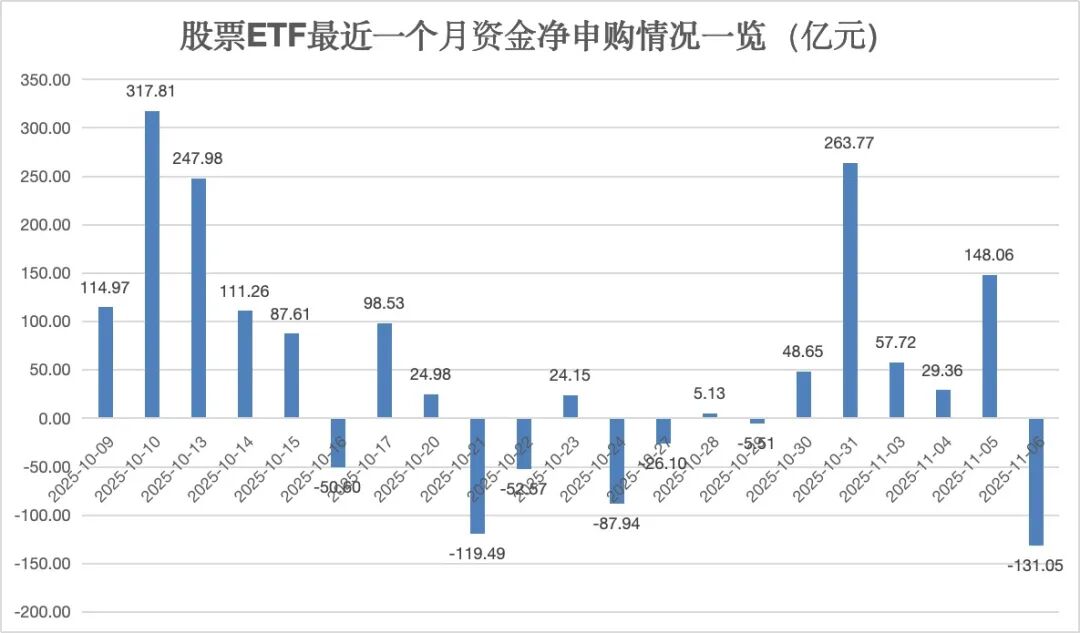
Core Viewpoint - The stock ETF market experienced a significant net outflow of over 130 billion yuan on November 6, indicating a trend of profit-taking among investors despite a rebound in the A-share market, which saw the Shanghai Composite Index recover above the 4000-point mark [1][3]. Fund Flow Summary - On November 6, the overall net outflow from the stock ETF market exceeded 131 billion yuan, with a total of 1241 stock ETFs (including cross-border ETFs) having a total scale of 4.45 trillion yuan [2][3]. - The market saw a reduction of 75.64 billion units in total ETF shares, translating to a net outflow of approximately 131.05 billion yuan based on average transaction prices [3]. - This marked the first occurrence of a net outflow exceeding 100 billion yuan after several days of continuous inflow, reflecting the characteristics of wave operations by market participants [5]. Sector Performance - The sectors with the highest net inflows included pharmaceuticals, Hang Seng Technology, food and beverage, and non-bank financials, with net inflow amounts of 8.1 billion yuan, 3.5 billion yuan, 2.4 billion yuan, 1.7 billion yuan, and 1.5 billion yuan respectively [7]. - The top three ETFs with net inflows were the Huaxia Electric Grid Equipment ETF, Southern CSI A500 ETF, and GF Hong Kong Innovative Medicine ETF, with net inflows of 3.81 billion yuan, 3.25 billion yuan, and 2.16 billion yuan respectively [7]. Notable ETFs - The Huaxia Electric Grid Equipment ETF saw a significant increase in scale, rising from 5.32 billion yuan to 15.78 billion yuan, marking a 197% increase [6]. - The top ten ETFs by net inflow on November 6 included the Electric Grid Equipment ETF, Company Bond ETF, and A500 ETF, with respective net inflows of 3.81 billion yuan, 3.55 billion yuan, and 3.25 billion yuan [8]. Outflow Analysis - The sectors with the highest net outflows included semiconductors, the Sci-Tech Innovation Board, the ChiNext, CSI 300, and securities, with net outflow amounts of 35.7 billion yuan, 26.3 billion yuan, 18.8 billion yuan, 13.3 billion yuan, and 9.6 billion yuan respectively [9]. - The top ten ETFs by net outflow included the Sci-Tech Innovation 50 ETF, Robot ETF, and Securities ETF, with respective outflows of 3.57 billion yuan, 3.65 billion yuan, and 5.89 billion yuan [10].
“落袋为安”?130亿,跑了
Zhong Guo Ji Jin Bao· 2025-11-07 06:09
Core Viewpoint - The stock ETF market experienced a significant net outflow of over 131 billion yuan on November 6, marking the first occurrence of such a large outflow after several days of inflows, indicating a trend of profit-taking among investors [2][5]. Fund Flow Summary - As of November 6, the total scale of all stock ETFs (including cross-border ETFs) reached 4.45 trillion yuan, with a reduction of 75.64 million units in total market share, leading to a net outflow of approximately 131.05 billion yuan based on average transaction prices [3][5]. - The outflow reflects a typical behavior of ETF investors, who tend to buy more during market declines and take profits during upswings, acting as a stabilizing force in the market [5]. Sector Performance - The sectors with the highest net inflows included pharmaceuticals, Hang Seng Technology, food and beverage, and non-bank financials, with net inflow amounts of 8.1 billion yuan, 3.5 billion yuan, 2.4 billion yuan, 1.7 billion yuan, and 1.5 billion yuan respectively [7]. - Conversely, the sectors experiencing the largest net outflows were semiconductors, the Sci-Tech Innovation Board, the ChiNext, CSI 300, and securities, with outflows of 35.7 billion yuan, 26.3 billion yuan, 18.8 billion yuan, 13.3 billion yuan, and 9.6 billion yuan respectively [7]. Notable ETF Performance - Certain ETFs from leading fund companies continued to attract capital, with E Fund's ETFs reaching a total scale of 831.19 billion yuan, increasing by 12.64 billion yuan on the same day [6]. - The top three ETFs with net inflows were the Huaxia Electric Grid Equipment ETF, Southern CSI A500 ETF, and GF Hong Kong Innovative Medicine ETF, with net inflows of 3.81 billion yuan, 3.25 billion yuan, and 2.16 billion yuan respectively [7].
“落袋为安”?130亿,跑了......
中国基金报· 2025-11-07 06:07
Core Viewpoint - The stock ETF market experienced a significant net outflow of over 131 billion yuan on November 6, marking a shift from previous inflows, indicating a trend of profit-taking among investors as the A-share market rebounded above the 4000-point mark [2][3][5]. Fund Flow Analysis - On November 6, the overall stock ETF market, including cross-border ETFs, saw a net outflow of approximately 131.05 billion yuan, with a total of 1241 stock ETFs having a combined scale of 4.45 trillion yuan [3][5]. - The ETFs tracking electric grid equipment, the CSI A500, and Hong Kong innovative pharmaceuticals saw the largest inflows, while those tracking the STAR Market, ChiNext, and semiconductor indices faced significant redemptions [3][10]. Sector Performance - The sectors with the highest net inflows included pharmaceuticals (8.1 billion yuan), Hang Seng Technology (3.5 billion yuan), food and beverage (2.4 billion yuan), and non-bank financials (1.7 billion yuan) [10]. - Conversely, the sectors with the largest net outflows were semiconductors (35.7 billion yuan), the STAR Market (26.3 billion yuan), and ChiNext (18.8 billion yuan) [12]. Notable ETFs - The top three ETFs by net inflow on November 6 were: - Huaxia Electric Grid Equipment ETF: 3.81 billion yuan - Southern CSI A500 ETF: 3.25 billion yuan - GF Hong Kong Innovative Pharmaceuticals ETF: 2.16 billion yuan [10][11]. - The Huaxia Electric Grid Equipment ETF saw a significant increase in scale, growing from 5.32 billion yuan to 15.78 billion yuan, a rise of 1.97 times [8]. Outflow Trends - The ETFs with the highest net outflows included: - STAR Market 50 ETF: -3.57 billion yuan - Robotics ETF: -3.65 billion yuan - Securities ETF: -5.89 billion yuan [13]. - Multiple ETFs tracking the STAR Market, ChiNext, and semiconductor indices were among those experiencing the most significant outflows [13].