
软通动力

Search documents
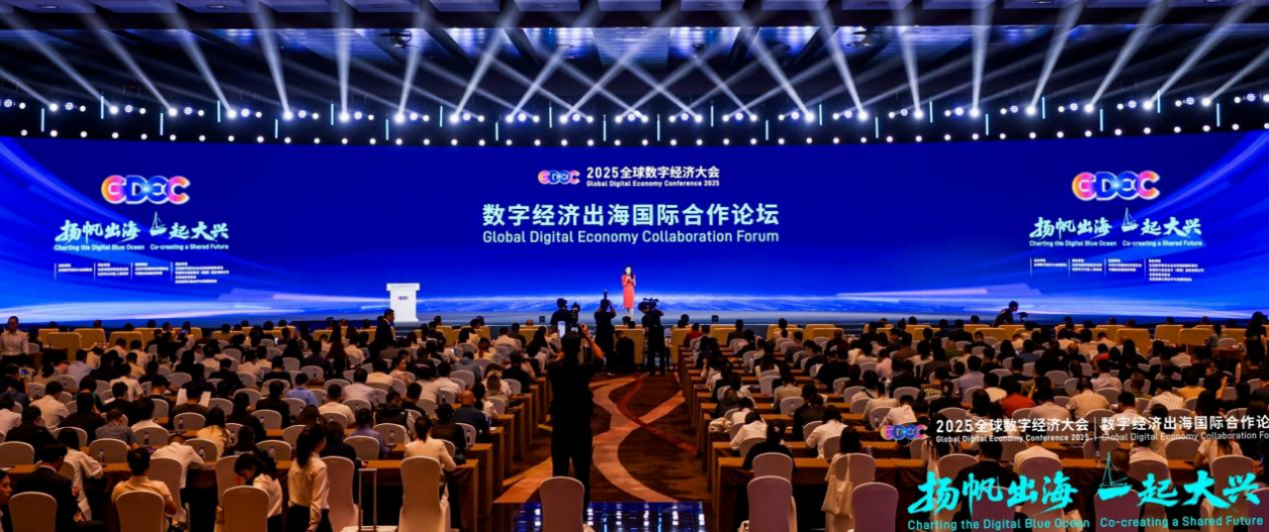
超百亿签约、落地创新实验室…… 北京共建数字经济出海高地
Bei Ke Cai Jing· 2025-07-05 04:57
Group 1 - The forum focused on international cooperation in the digital economy, aiming to create a platform for project innovation and collaboration among digital economy enterprises [4][5][6] - Over 800 representatives from digital economy companies, including IBM and Thales, attended the forum, highlighting the significance of international collaboration [3][4] - The event attracted over 3 million online viewers, indicating a strong interest in the topics discussed [4] Group 2 - The Beijing Outbound Base has signed agreements with 16 companies, with a total contract value exceeding 10 billion, emphasizing its role in facilitating global expansion for enterprises [16][18] - The forum introduced the "Digital Economy Outbound Service International Alliance," with 24 members from various sectors, showcasing a collaborative approach to support outbound digital economy initiatives [19] - The establishment of a "one-stop" outbound service system was announced, covering key elements such as management, data, technology, and talent [21] Group 3 - The forum discussed the "Digital Friendly City" concept, aiming to create a supportive environment for digital economy development and international cooperation [11][12] - Various speakers emphasized the importance of open attitudes and international collaboration for domestic enterprises to achieve global integration [8][10] - The forum featured specialized sessions focusing on artificial intelligence, cross-border e-commerce, and smart tourism, reflecting the diverse opportunities in the digital economy [24]

稳定币产业生态加速构建,重视国产替代新机遇
Yin He Zheng Quan· 2025-07-04 14:36
Investment Rating - The report maintains a "Recommended" rating for the computer industry [1] Core Insights - The stablecoin industry ecosystem is accelerating its construction, with significant opportunities for domestic alternatives. The recent passage of the "Stablecoin Regulation" in Hong Kong is expected to boost the adoption of stablecoins, with major e-commerce platforms like Shopify and retail giants like Amazon and Walmart exploring stablecoin issuance [2][3] - The AI sector is experiencing structural investment opportunities, particularly in domestic alternatives, financial IT, and cross-border payments. The AI sector index saw a 7.6% increase in June, outperforming major indices [2][6] - Huawei's recent developer conference showcased advancements in HarmonyOS and AI cloud services, indicating a strong potential for domestic AI computing infrastructure [2][3] Market Overview - The AI index closed at 9481.88 with a monthly increase of 7.6%, while the computer industry index rose by 7.11% [6] - The AI sector's total market capitalization reached 23666.38 billion, with 84 constituent stocks [8] AI Industry Dynamics - The report highlights the latest developments in data elements and data exchanges, emphasizing the importance of data asset development and high-quality growth in the sector [19][20] - Major AI models are being developed and released, with Huawei announcing the open-sourcing of its Pangu models, which is expected to enhance AI applications across various industries [25] Investment Recommendations - The report suggests focusing on specific segments and companies, including: 1. Domestic computing industry chain: Industrial Fulian, Zhongke Shuguang, etc. 2. IDC service providers and computing leasing: Runze Technology, Guanghuan New Network, etc. 3. Domestic software vendors: China Software, Softcom Power, etc. 4. AI applications: iFlytek, Kingsoft Office, etc. 5. Cloud computing vendors: Kingdee International, Kingsoft Cloud, etc. 6. Data element industry chain companies: Tuolisi, Shensanda A, etc. 7. Stablecoin and RWA: Hengsheng Electronics, Sifang Jichuang, etc. [2][3]
近千家A股公司涉足机器人业务,“虚火”知多少?
证券时报· 2025-07-04 04:21
近千只机器人 概念股的"众生相" 今年以来,机器人成为资本市场的热门概念板块之一。但在这股充满想象空间的新兴产业浪潮之下,资本套利的暗流却在时时涌动。 同花顺数据显示,截至7月2日收盘,A股机器人概念一共有947家上市公司,相当于每6家A股公司就有一家涉及机器人业务,人形机器人概念公司则一共有 252家。但是,机器人板块持续扩容的同时,其"含金量"却值得商榷。证券时报记者多方采访了解到,近千只机器人概念股背后,虽然有部分是真正从事机器 人研发、制造的企业,但也有不少是仅具备边缘关联的公司,通过各种途径"蹭概念"抢占人形机器人风口,浑水摸鱼推升股价。非理性炒作不仅潜藏着资本套 利的陷阱,亦可能透支行业信用,加剧这个年轻赛道的泡沫化。 人形机器人产业仍处于"从0到1"的研发阶段,距离真正的产业落地还有颇长距离。因此,A股目前没有主业是人形机器人本体研发及制造的公司。记者调查发 现,机器人概念股进入这一概念池,最常见的是以下两种途径。 一种是作为核心零部件供应商,切入人形机器人供应链。"很多公司本身从事的是工业机器人或者汽车行业,具备一定的基础。从产业链角度来说,的 确可以进入人形机器人领域。"华南某券商资深投行人 ...

从“人力输出”到“方案出海、数字护航” 中国企业以技术方案与合规运营竞逐全球市场
Shang Hai Zheng Quan Bao· 2025-07-03 18:58
Group 1 - The core viewpoint is that Chinese companies are undergoing a significant transformation in their overseas expansion strategies, shifting from "labor export" to "solution export and digital support" driven by artificial intelligence and global cooperation [1][2] - The "Beijing Digital Economy Enterprise Overseas Innovation Service Base" has integrated eight core services and has supported over 150 companies in market selection, significantly enhancing cross-border compliance efficiency [2][4] - The global digital transformation is creating new demands and opportunities for Chinese companies, particularly in emerging markets, with sectors like cloud computing and artificial intelligence seeing rapid growth [3][4] Group 2 - Leading listed companies are transitioning from "labor output" to "solution export," with Softcom Power focusing on mature digital solutions and establishing international headquarters in Singapore [4][5] - Trust and compliance are essential for successful overseas operations, with companies needing to respect local regulations and cultural nuances to build credibility [5][6] - A new international cooperation platform, including the "Digital Economy Overseas International Cooperation Alliance," has been established to support companies in navigating overseas challenges and opportunities [5][6]
近千家A股公司涉足机器人业务,“虚火”知多少? 业界呼吁进一步完善信息披露制度,提高信息披露的标准和透明度,遏制蹭概念炒作
Zheng Quan Shi Bao· 2025-07-03 18:49
Core Viewpoint - The robot sector has become a popular concept in the capital market, but there are concerns about the authenticity and value of many companies involved, leading to potential capital arbitrage and market distortion [1][4]. Group 1: Market Overview - As of July 2, there are 947 listed companies in the A-share robot concept sector, meaning one in every six A-share companies is involved in robotics [1]. - Among these, 252 companies are specifically focused on humanoid robots, but the actual number of companies genuinely engaged in robot R&D and manufacturing is limited [2][4]. Group 2: Company Involvement - Companies often enter the humanoid robot space as core component suppliers, leveraging their existing capabilities in industrial robotics or the automotive sector [2]. - Notable companies like Lingyi iTech have announced strategic initiatives to become leading manufacturers in embodied intelligent hardware, indicating a cross-industry collaboration [2]. Group 3: Investment and Collaboration - Many companies are forming strategic partnerships or joint ventures with emerging humanoid robot firms, which can enhance their market visibility and attract capital [3]. - Traditional companies such as Midea, Haier, and Gree are also entering the humanoid robot field, either through partnerships or by establishing their own R&D teams [3]. Group 4: Market Manipulation Concerns - There are significant concerns regarding the authenticity of many robot concept stocks, with some companies engaging in vague disclosures or exaggerated claims to inflate stock prices [4][5]. - The lack of clear standards for information disclosure allows companies to operate in a "gray area," leading to potential capital arbitrage opportunities [5][6]. Group 5: Regulatory Recommendations - Experts suggest that improving information disclosure standards and increasing regulatory scrutiny could help mitigate the risks associated with concept stock speculation [7][8]. - There is a call for more specific legal frameworks to address the unique challenges posed by emerging industries like robotics, ensuring that companies provide timely and accurate information [8][9].

软通动力深度参与2025全球数字经济大会
Zheng Quan Ri Bao Zhi Sheng· 2025-07-03 14:12
Group 1 - The core viewpoint of the article highlights the participation of Softstone Technology in the 2025 Global Digital Economy Conference, emphasizing the company's role in the digital economy's development and its strategies for international cooperation [1][2] - Liu Tianwen, the Chairman and CEO of Softstone Technology, delivered a keynote speech on the achievements and new opportunities in China's digital economy over the past 20 years, advocating for technology and industry innovation to tackle complex challenges [1] - The company reported a steady revenue growth, surpassing 30 billion yuan, and established a presence in four major overseas markets, serving over 230 Fortune 500 and Chinese 500 companies [1] Group 2 - Softstone Technology showcased its overseas brand iSoftStone Digital and the "Beijing Brand" under Softstone Huafang during the conference, highlighting its full-stack intelligent products and services [2] - The company presented its "Four Transformations" strategy and six major product and service capabilities in the international exchange and cooperation experience area, aiming to promote project cooperation [2]
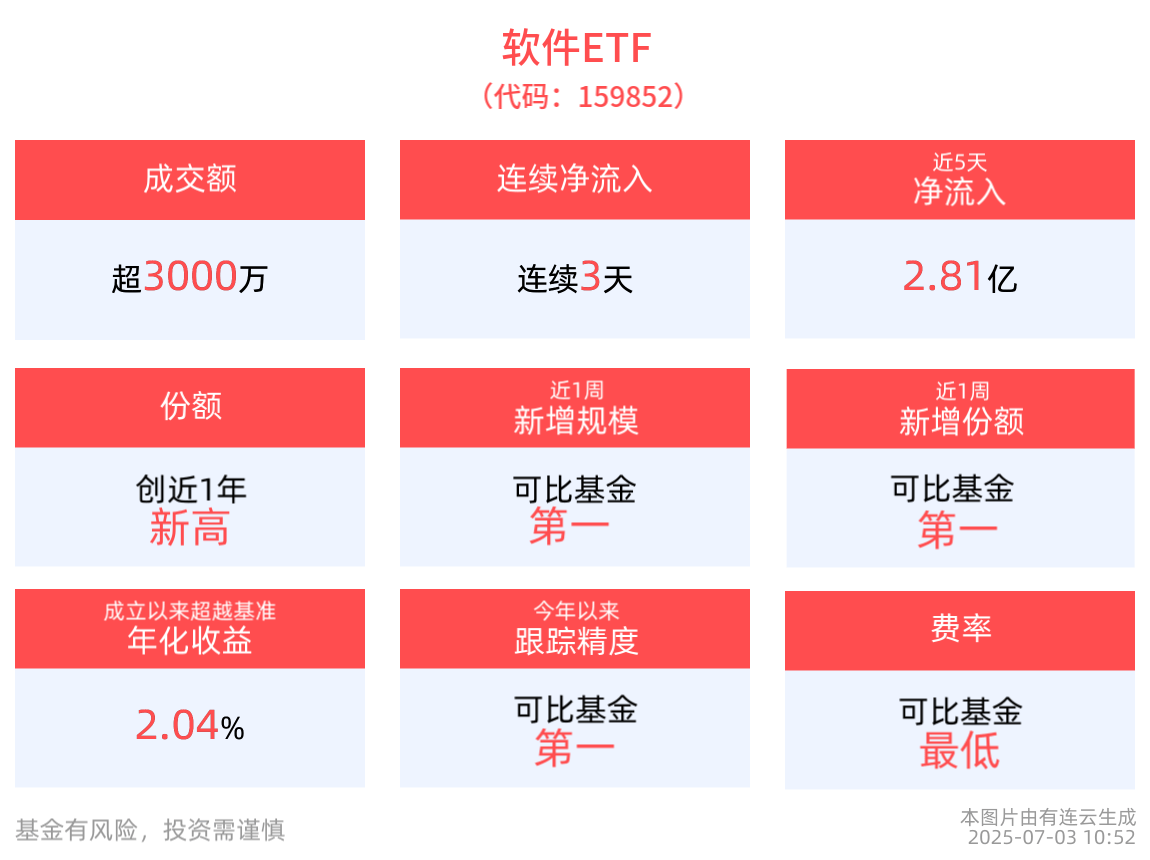
近一周新增规模同类居首,软件ETF(159852)连续3天净流入超亿元
Sou Hu Cai Jing· 2025-07-03 03:21
Group 1: ETF Performance and Liquidity - The software ETF had an intraday turnover of 1.18%, with a transaction volume of 37.91 million yuan [1] - As of July 2, the software ETF's average daily trading volume over the past week was 206 million yuan, ranking first among comparable funds [1] - The software ETF's scale increased by 17.07 million yuan in the past week, also ranking first among comparable funds [1] - The latest share count for the software ETF reached 4.063 billion shares, a one-year high, placing it first among comparable funds [1] - Over the past three days, the software ETF experienced continuous net inflows, with a maximum single-day net inflow of 48.96 million yuan, totaling 113 million yuan [1] - The financing net purchase amount for the software ETF on the previous trading day was 11.37 million yuan, with the latest financing balance at 126 million yuan [1] Group 2: Performance Metrics - As of July 2, the software ETF's net value increased by 45.17% over the past year, ranking 219 out of 2897 index equity funds, placing it in the top 7.56% [1] - The highest monthly return since inception for the software ETF was 39.35%, with the longest consecutive monthly gains being three months and the longest cumulative gain being 69.40% [1] - The average return during the rising months was 9.98% [1] Group 3: AI and Software Industry Insights - Generative AI is transforming the business model of the computer and software development industry from a traditional "licensed software model" to a "results-based service model," with AI applications becoming labor substitutes [1] - The overseas software giants have a first-mover advantage in AI application development, directly collaborating with leading large model manufacturers, while China's general large models are still in a catch-up phase [2] - The manufacturing sector is a stronghold for China, providing quality scenarios for AI technology implementation, with significant potential for AI applications in manufacturing [2] - The rapid development of C-end AIGC applications in China is led by major tech companies with large model capabilities, resulting in superior user experiences [2] - 82% of enterprises plan to integrate AI Agents into their workflows over the next three years, indicating a strong demand for enterprise service software [2] Group 4: Top Weighted Stocks - As of June 30, 2025, the top ten weighted stocks in the CSI Software Service Index include iFLYTEK, Kingsoft Office, Tonghuashun, Hang Seng Electronics, Runhe Software, 360, Softcom Power, Tuo Wei Information, Compass, and China Software, collectively accounting for 60.56% of the index [2]


★A股主要股指"含科量"提升 更有效表征企业转型升级
Shang Hai Zheng Quan Bao· 2025-07-03 01:56
Group 1 - The core viewpoint of the news is the recent adjustments in index sample stocks by major exchanges, which aim to enhance the representation and investment value of indices, particularly in the context of increasing long-term capital inflows into the market [1][2] - The adjustments have led to a significant increase in the scale of ETFs linked to major indices, with an estimated total scale of approximately 1.7 trillion yuan by April 2025, representing a nearly fourfold increase since the end of 2021 [1] - The adjustments are expected to optimize index representation, trigger structural capital flows, and potentially have a positive impact on the stock prices of newly included stocks, especially those in mainstream indices [1][3] Group 2 - The recent index adjustments have increased the weight of technology stocks, reflecting a trend towards high-tech and advanced manufacturing in listed companies [2] - The adjustments in the CSI 300 index included an increase of 2 technology stocks, raising its weight by 0.18%, while the CSI 500 index saw an increase of 12 technology stocks, raising its weight by 1.82% [2] - The adjustments are likely to enhance the investment value of the North Exchange's indices, aligning with its focus on specialized and innovative companies [2][3] Group 3 - The selection criteria for index adjustments typically emphasize market capitalization and liquidity, with newly included stocks often experiencing increased buying pressure post-adjustment [3] - The recent adjustment of the CSI 300 index involved the removal of stocks from sectors like power equipment and construction materials, while adding stocks from banking, artificial intelligence, and military sectors, consistent with the current market style [3] - Historical data indicates that index adjustments lead to positive price impacts for included stocks, particularly in larger indices where passive trading can significantly influence stock prices [3][4] Group 4 - The adjustments by international index providers like MSCI are also noteworthy, with recent changes including the addition of five A-shares to the MSCI China Index, which saw immediate price increases for the newly included stocks [4]




★国际金融展书写数字化转型新注脚
Shang Hai Zheng Quan Bao· 2025-07-03 01:55
Group 1 - The 2025 China International Financial Expo was held from June 18 to 20, showcasing nearly 300 exhibitors, including both mainstream financial institutions and emerging tech companies [1] - Fast Warehouse, a tech company specializing in smart warehousing, has transitioned from being a service provider for banking technology to directly serving bank clients with advanced technologies like AI and big data [1] - The expo highlighted the integration of traditional financial institutions with tech companies, indicating a trend towards collaboration in the digital transformation of the financial sector [1] Group 2 - The "role model effect" is accelerating the digital transformation of finance, with larger banks replicating their intelligent business experiences in smaller banks [2] - OceanBase, a self-developed distributed database, has set a record by switching 133 systems in 48 hours, demonstrating its capability to support over 100 banks with critical systems [2] - The acceptance of autonomous innovation in core trading systems is increasing among users, presenting significant opportunities for companies in the industry chain [2] Group 3 - The expo served as a platform for collaboration between financial institutions and tech companies, focusing on innovations in data, technology, management, and compliance [3] - Attendees were not only interested in new intelligent service experiences but also in capturing the future direction of China's financial industry [3] - The vibrant atmosphere of financial innovation was evident as professionals engaged in discussions and formed project groups on-site [3]
2025年中期电子行业投资策略报告:芯声澎湃,精彩纷呈-20250702
Wanlian Securities· 2025-07-02 13:10
Core Insights - The report indicates that the SW electronics industry has outperformed the CSI 300 index since the beginning of 2025, with a slight increase in valuation compared to recent years [1] - The performance in Q1 2025 shows record highs in revenue and net profit for the SW electronics sector, suggesting a positive outlook for the second half of 2025, particularly in semiconductor self-sufficiency, AI computing power construction, and terminal innovation [1][2] Semiconductor Self-Sufficiency - The intensifying US-China tech friction is accelerating the domestic substitution process in semiconductors, with China being the largest semiconductor equipment market globally [2] - The report highlights that the domestic market still has significant room for improvement in the localization of advanced process equipment, components, and materials, particularly in areas like photolithography machines and high-end photoresists [2][40] - The expansion of wafer fabs is expected to boost demand for semiconductor equipment, indicating a strong growth momentum in advanced processes [2] AI Computing Power Construction - The report notes that AI computing power construction has entered a competitive phase, with key segments including AI chips, advanced packaging, storage chips, and PCBs being critical to the computing power foundation [3] - Domestic internet companies are increasing their AI spending, supported by favorable policies for domestic AI innovation, leading to a gradual increase in the market share of domestic AI chips [3][39] - The storage chip market is expected to benefit from price increases due to adjustments in production plans by overseas manufacturers, with domestic storage companies likely to gain from this trend [3] Terminal Innovation - The report emphasizes that the combination of national subsidies and the AI innovation wave is driving growth in consumer terminals, with AI smartphones and AIPC expected to penetrate the market rapidly [4] - AI smartphones are projected to exceed a penetration rate of 30% in the smartphone market by 2025, with major brands like Apple, Huawei, and Xiaomi actively innovating in AI terminal products [4][39] - The report also mentions that the user base for AI applications is accelerating, with the potential for several billion-level AI application opportunities in the future [4][8] Investment Recommendations - The report suggests focusing on investment opportunities in semiconductor self-sufficiency, AI computing power construction, and terminal innovation [9] - Specific recommendations include investing in advanced process semiconductor industry chains, domestic AI chip leaders, and companies involved in advanced packaging and storage chips [9] - The report also highlights the importance of monitoring leading companies in the PCB sector and those involved in AI smartphone and AIPC developments [9]