
上海瀚讯

Search documents
宏观对话行业-科技叙事还能走多远
2026-01-22 02:43
Summary of Key Points from Conference Call Records Industry Overview - **Macro Industry**: The discussion centers around the technology sector, particularly the impact of AI on the macroeconomic landscape in the U.S. and China, as well as investment opportunities in various sub-sectors like commercial aerospace and humanoid robotics [1][3][17][19]. Core Insights and Arguments AI and Economic Growth - AI capital expenditures are projected to drive U.S. economic growth, with major tech companies expected to spend approximately $350 billion to $360 billion by 2025, accounting for about 1% of GDP and growing at a rate of 60%-70% [1][3]. - The contribution of AI to macroeconomic growth is estimated to be around 0.6%-0.7% [1][3]. - By 2026, capital expenditures from the top five U.S. tech companies are expected to reach $500 billion to $510 billion, indicating sustained investment-driven growth, albeit at a potentially slower pace [3][5]. AI's Impact on Various Industries - AI technology is having a comprehensive impact on the semiconductor industry, leading to price increases in mature processes and the rise of domestic computing power [1][12][14]. - The storage sector is also benefiting from AI, with new technologies driving demand for NAND and DRAM [11][12]. - In the commercial aerospace sector, investment opportunities are concentrated in rocket assembly, core aerospace engines, and satellite payloads, with companies like BoLite and Zhenlei Technology highlighted as key players [1][17]. Concerns and Risks - There are growing concerns about a potential bubble in the AI sector, particularly as discussions around the transition from short-term to long-term economic benefits intensify [6][9][13]. - The stability of macroeconomic policies is crucial to ensure a smooth transition and to mitigate risks associated with the AI narrative [5][6]. China's Technological Landscape - China has surpassed Japan in R&D spending, becoming the second-largest globally, and leads in PCT patent applications, indicating significant advancements in technology [8][7]. - However, the impact of these advancements on labor productivity remains limited, primarily reflecting in capital markets rather than the real economy [7][8]. Additional Important Insights - The humanoid robotics industry is transitioning from component manufacturing to key assembly stages, with companies in Tesla's supply chain, such as Sanhua and Topband, being noteworthy [2][20][21]. - Investment opportunities in the commercial aviation sector are expected to rise due to increased domestic production capabilities, particularly in engine manufacturing [18]. - AI applications in retail are opening new growth avenues, with companies leveraging AI tools to enhance operational efficiency and consumer engagement [25]. - The development of AI glasses is anticipated to grow significantly, with a projected increase in global shipments and sales exceeding 50% over the next five years [26]. Conclusion - The overall sentiment is cautiously optimistic regarding the future of AI and its integration into various industries, with a focus on the importance of stable macroeconomic policies and the potential for significant technological advancements to drive productivity and economic growth [15][16].



商业航天:以第一性原理推演中国商业航天降本革命(附报告)
材料汇· 2026-01-21 15:30
Core Conclusion - By 2026, China's commercial aerospace industry is expected to reach a turning point in cost reduction for launch capacity, driven by the concentrated deployment of low Earth orbit (LEO) constellations and the normalization of high-frequency launches, with reusable rockets nearing breakthroughs in reducing unit launch costs. The industry's business model will shift from state-driven tasks to market-driven profitability, with a valuation logic transitioning towards "space infrastructure" as application scenarios and business models are restructured [3]. Market Outlook - 2026 is anticipated to be a prosperous year for China's commercial aerospace sector, with an accelerated pace of multi-constellation launches transitioning to large-scale deployment, leading to a rapid increase in rocket launch frequency. The commercial rocket launch service market in China is projected to grow from 10.26 billion yuan in 2025 to 47.39 billion yuan by 2030, corresponding to a CAGR of approximately 35.8%, primarily driven by high-frequency launch demand from dense deployment of LEO constellations [4][11]. - The industry is expected to maintain medium to long-term growth, with over 237,000 satellites needing to be deployed in accordance with ITU regulations by 2039. Starlink currently has over 9,000 satellites in orbit, and the demand for subsequent launches remains robust due to tightening frequency resources [4][11]. Cost Reduction Pathways - The essence of commercial rockets is a "space logistics" business, where core variables include efficiency improvements and cost reductions in launch capacity. Key pathways for cost reduction include breakthroughs in full-flow engine technology, high-frequency reuse capabilities, and industrialization in manufacturing [5]. - The unit cost of launching rockets is expected to decrease significantly through various stages: 1. Initial launch cost is approximately 55,000 yuan/kg 2. By around 2026, after achieving first-stage reuse, costs may drop to about 25,000 yuan/kg 3. Upgrading from aluminum to stainless steel structures could further reduce costs to approximately 19,000 yuan/kg 4. With the maturation of recovery methods, costs may decline to around 13,000 yuan/kg 5. Long-term, achieving second-stage reuse could bring costs close to 5,000 yuan/kg [5]. Industry Structure and Investment Opportunities - The commercial rocket industry is still in its early growth and valuation evolution phase. Key catalysts for valuation uplift in China's commercial aerospace sector include the realization of reusable rockets for large-scale LEO satellite networking and the transition from customized to standardized launches through long-term batch tasks [7][8]. - The valuation logic for commercial aerospace companies is shifting from manufacturing-oriented to platform and infrastructure-oriented technology enterprises, covering diverse long-term space mission needs such as manned flights and deep space exploration [8]. Key Players and Market Segments - The core technical barriers in rocket engines are concentrated in critical components such as thrust chambers and turbine pumps. The value in satellite manufacturing is primarily found in communication payloads [9]. - Key companies involved in the aerospace supply chain include: - Power Systems: Yingliu Co., Srey New Materials, Guoji Precision Engineering - Satellite Communication Systems: Shanghai Hantong, Aerospace Electronics, Guobo Electronics - Materials and Structural Components: Western Materials, Parker New Materials, Guoji Heavy Industry, Huazhuo High-Tech - Testing and Verification: Xicai Testing, Su Testing [9][10].





商业航天行业深度系列(一):以第一性原理推演中国商业航天降本革命
Shanghai Aijian Securities· 2026-01-21 10:19
Investment Rating - The report rates the industry as "stronger than the market" [1] Core Insights - The report concludes that 2026 will mark a turning point for China's commercial aerospace industry, with a shift from state-driven missions to market-driven profitability, driven by the deployment of low-orbit satellite constellations and advancements in reusable rocket technology [1][6] - The commercial rocket launch service market in China is projected to grow from 10.26 billion yuan in 2025 to 47.39 billion yuan by 2030, with a CAGR of approximately 35.8% [1][12] - The report emphasizes that the core components of rocket launch services are engines (54%) and structural components (24%), which together account for 78% of the value in the launch service segment [1][12] Summary by Sections Industry Overview - The commercial aerospace industry is defined as activities that provide aerospace products and services through social capital investment under national policy guidance, including the R&D, manufacturing, launch, and operation of spacecraft and rockets [6][7] - The global aerospace economy is expected to reach $612 billion by 2024, with commercial aerospace revenues accounting for approximately $480 billion, representing about 78% of the total [6][7] Market Dynamics - The demand for satellite launches is expected to surge as China enters a concentrated deployment phase for low-orbit satellite constellations, with over 200,000 satellites planned for deployment [18][19] - The report highlights that the competition for low-orbit frequency resources is intensifying, necessitating faster deployment of satellite constellations [19][21] Cost Structure and Efficiency - The report breaks down the cost structure of rockets, indicating that engines and structural components dominate the value chain [1][12] - It outlines a pathway for reducing launch costs, projecting that the unit cost of launching payloads could decrease significantly as technology advances [1][12] Investment Recommendations - The report suggests focusing on companies involved in key segments such as propulsion systems, satellite communication systems, materials and structural components, and testing and validation services [2][4] - Specific companies to watch include 应流股份 (603308), 斯瑞新材 (688102), and 上海瀚讯 (300762), among others [2][4]

机构:商业航天有望迎来“政策+技术+资本”三重共振
Zheng Quan Shi Bao Wang· 2026-01-21 08:59
Group 1 - The core viewpoint is that China's commercial space industry is experiencing rapid development, with projections for 2025 indicating 50 launches, accounting for 54% of the total national space launches [1] - In 2025, commercial rockets are expected to complete 25 launches, and the Hainan commercial space launch site will have conducted 9 launches, totaling 10 since its establishment [1] - A total of 311 commercial satellites are projected to be placed into orbit, representing 84% of the total satellites launched in China [1] Group 2 - The commercial space industry is entering a golden era driven by both demand and supply, with recommendations to focus on structural component suppliers such as Aerospace Power, Srey New Materials, and others [1] - In satellite manufacturing, the focus is on low Earth orbit satellites and related infrastructure, with suggested companies including China Satellite and Aerospace Electronics [1] - The upstream and midstream sectors, particularly subsystems and materials supporting satellite mass production, are expected to benefit first, with companies like Zhenlei Technology and Guangwei Composites highlighted [1] Group 3 - In 2026, the domestic commercial space sector is anticipated to experience a "triple resonance" of policy, technology, and capital, making it highly promising [2] - Beneficiary companies in the rocket industry chain include Aerospace Power, Western Materials, and others [2] - In the satellite industry and space computing, recommended companies include Zhongke Xingtou, Aerospace Hongtu, and several others [2]




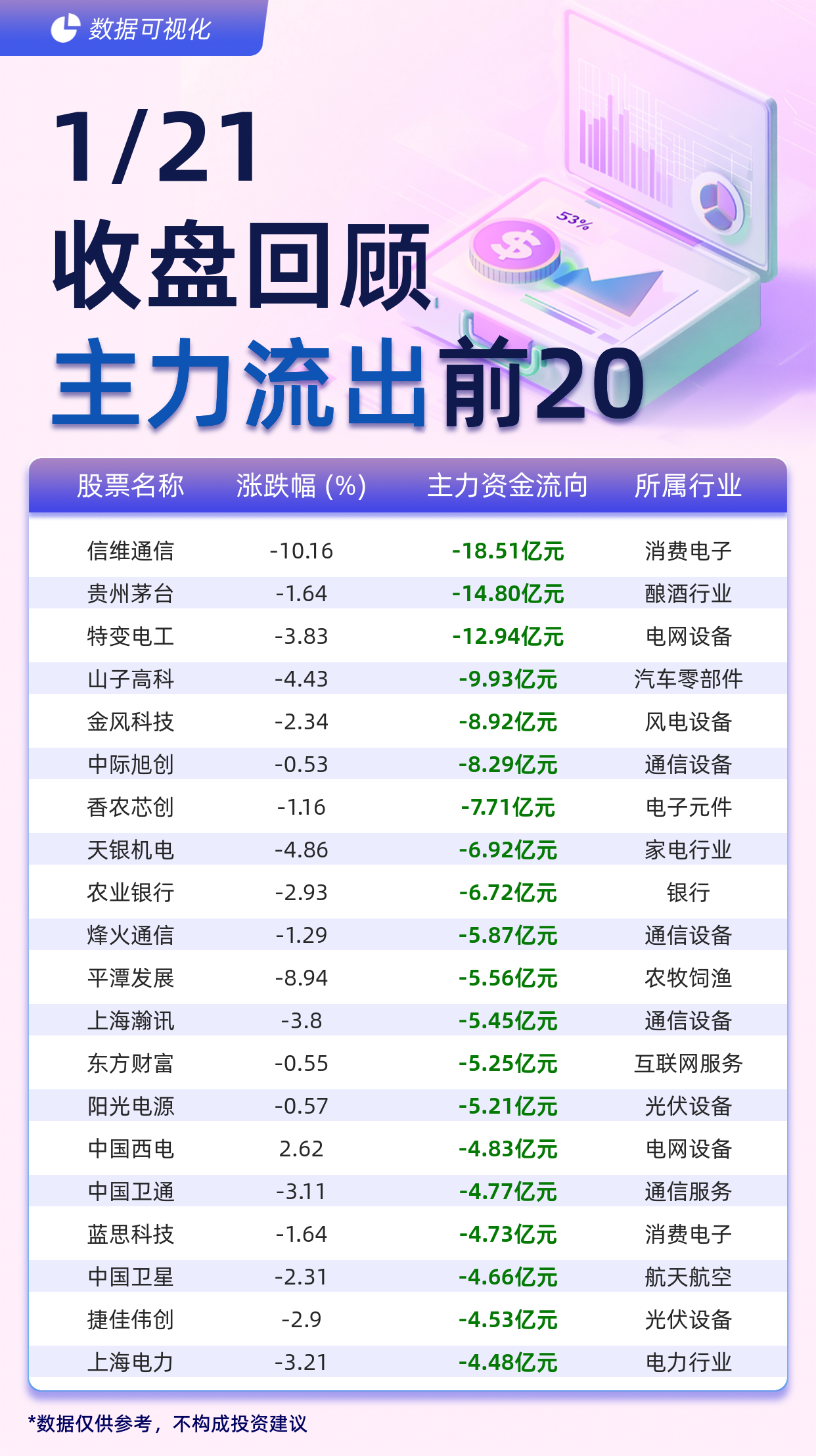
主力个股资金流出前20:信维通信流出18.51亿元、贵州茅台流出14.80亿元
Jin Rong Jie· 2026-01-21 07:11
Core Viewpoint - The data indicates significant outflows of main funds from various stocks, with notable amounts withdrawn from companies across different sectors, suggesting a potential shift in investor sentiment and market dynamics [1][2][3] Group 1: Stock Performance and Fund Outflows - The top stock with the largest fund outflow is XW Communication, with a withdrawal of 1.851 billion yuan and a decline of 10.16% in its stock price [2] - Guizhou Moutai follows with a fund outflow of 1.480 billion yuan and a decrease of 1.64% [2] - TBEA Co., Ltd. experienced a fund outflow of 1.294 billion yuan and a drop of 3.83% [2] - Other notable companies with significant outflows include: - Sanzi Gaoke: -0.993 billion yuan, -4.43% [2] - Goldwind Technology: -0.892 billion yuan, -2.34% [2] - Zhongji Xuchuang: -0.829 billion yuan, -0.53% [2] Group 2: Sector Analysis - The consumer electronics sector is represented by XW Communication and Lens Technology, both experiencing substantial fund outflows [2][3] - The beverage industry, highlighted by Guizhou Moutai, shows a minor decline in stock price despite significant fund outflow [2] - The power equipment sector, including TBEA Co., Ltd. and China Western Power, reflects mixed performance with varying fund outflows [2][3] - The telecommunications sector, represented by companies like Zhongji Xuchuang and Fenghuo Communication, also shows notable fund withdrawals [2][3]





中美竞逐万亿美元新赛道,五层解构下的投资蓝图
Tebon Securities· 2026-01-21 04:07
Investment Rating - The report maintains an "Outperform" rating for the commercial aerospace industry [1] Core Insights - The aerospace sector is transitioning from being viewed as a "cost center" driven by national will to a "growth engine" driven by commercial demand, with significant investments and strategic planning from both the US and China [6][9] - The global aerospace economy is projected to reach $613 billion in 2024, with commercial aerospace contributing 78%, and is expected to exceed $1 trillion by 2032 [6][9] - The value chain of commercial aerospace is divided into five core levels: "space, ground, terminal, rocket, and application," each presenting unique market opportunities and technical challenges from 2026 to 2030 [10][29] Summary by Sections 1. Space: Satellite Manufacturing - The satellite manufacturing market in China is expected to grow from approximately 7.1 billion yuan in 2025 to about 39.4 billion yuan by 2030, reflecting a shift from sporadic research models to continuous, batch engineering deliveries [16][18] 2. Ground: Ground Systems - The ground systems market is projected to increase from around 1.2 billion yuan in 2025 to approximately 39.1 billion yuan by 2030, evolving from a supporting role to a core infrastructure essential for stable satellite constellation operations [21][22] 3. Terminal: Key Variable for Commercial Aerospace - The terminal market is anticipated to grow from 500 million yuan in 2025 to about 141.9 billion yuan by 2030, driven by multiple vertical industries and potential consumer scenarios [23][24] 4. Rocket: Core Constraint - The cost of rocket launches is a critical constraint, with reusable technology expected to reduce costs by 80%-90% compared to traditional expendable rockets. The market for rocket launch services is projected to grow from approximately 10.7 billion yuan in 2025 to about 34.3 billion yuan by 2030 [25][26] 5. Application: Final Value Realization - The application market is expected to expand from 200 million yuan in 2025 to 525 billion yuan by 2030, with the revenue share from applications projected to rise from single digits to over 67% by around 2030 [27][28] 6. Investment Opportunities - Investment opportunities in commercial aerospace can be categorized into three main tracks: 1. Launch and manufacturing segments, which are expected to benefit directly from increased orders and visibility 2. Core components and systems, characterized by high technical barriers and critical for long-term competitiveness 3. Downstream applications and operational services, which, while currently limited in scale, hold the greatest long-term potential for value realization [29][30]


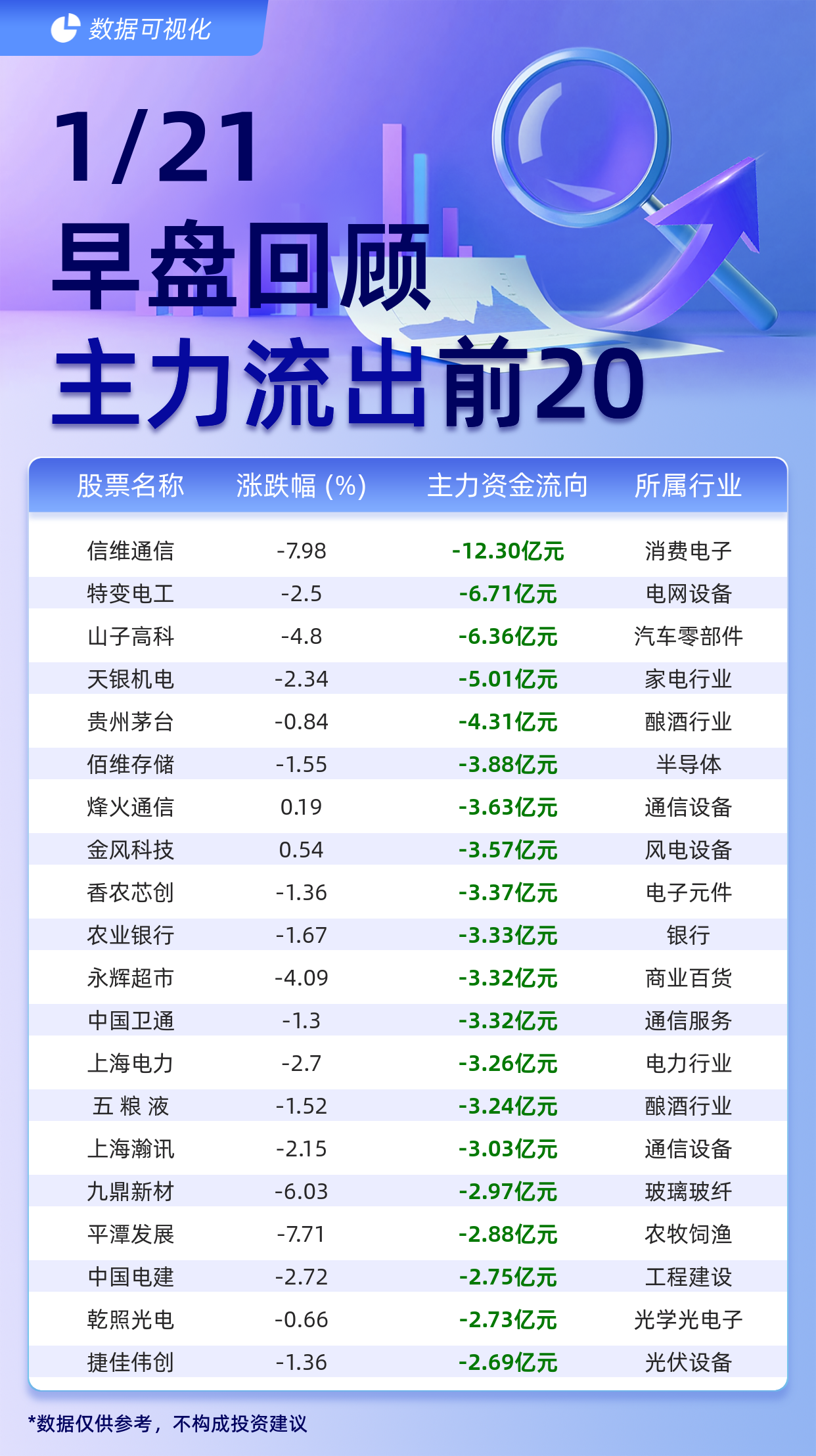
主力个股资金流出前20:信维通信流出12.30亿元、特变电工流出6.71亿元
Jin Rong Jie· 2026-01-21 04:04
Core Viewpoint - The data indicates significant outflows of capital from various stocks, with notable declines in share prices across multiple sectors, suggesting a bearish sentiment in the market. Group 1: Major Stocks with Capital Outflows - Xinyi Communication experienced a capital outflow of 1.23 billion, with a price drop of 7.98% [1][2] - Tebian Electric witnessed a capital outflow of 671 million, with a price decline of 2.5% [1][2] - Shanzi Gaoke had a capital outflow of 636 million, with a decrease of 4.8% [1][2] - Tianyin Electromechanical saw an outflow of 501 million, with a drop of 2.34% [1][2] - Kweichow Moutai experienced a capital outflow of 431 million, with a decline of 0.84% [1][2] Group 2: Additional Stocks with Notable Outflows - Baiwei Storage had a capital outflow of 388 million, with a price drop of 1.55% [1][2] - Fenghuo Communication saw an outflow of 363 million, with a slight increase of 0.19% [1][2] - Goldwind Technology experienced a capital outflow of 357 million, with a price increase of 0.54% [1][2] - Shannon Chip Creation had an outflow of 337 million, with a decline of 1.36% [1][2] - Agricultural Bank saw a capital outflow of 333 million, with a drop of 1.67% [1][2] Group 3: Further Stocks with Capital Outflows - China Satellite Communications experienced a capital outflow of 332 million, with a decline of 1.3% [3] - Shanghai Electric saw an outflow of 326 million, with a price drop of 2.7% [3] - Wuliangye experienced a capital outflow of 324 million, with a decline of 1.52% [3] - Shanghai Hanxun had an outflow of 303 million, with a drop of 2.15% [3] - Jiuding New Materials saw a capital outflow of 297 million, with a significant decline of 6.03% [3]


超300份预告折射产业冷暖,业绩驱动取代概念博弈成市场主线
第一财经· 2026-01-19 12:59
2026.01. 19 本文字数:3133,阅读时长大约5分钟 作者 | 第一财经 魏中原 景气度较差的地产行业,相关上市公司业绩也普遍承压。华夏幸福(600340.SH)预计去年归母净利润亏损160亿元至240亿元;绿地控股 (600606.SH)预亏160亿元至190亿元。就业绩亏损的原因,上述两家企业均表示市场有效需求不足、社会预期偏弱,房地产业的结转规模、基建产 业的营收规模同比均有较大幅度下降。 A股市场已有超过350家公司发布2025年度业绩预告,一幅清晰的产业景气度"分野图"就此展开。 业绩预告数据显示,在全球科技浪潮与商品周期驱动下, 半导体、有色金属 行业业绩耀眼,龙头公司普遍实现高增长;而曾备受瞩目的 光伏 产业则因 产能过剩、价格内卷深陷亏损,多家龙头预亏合计超300亿元。更为引人深思的是, 商业航天、AI应用 等此前遭资金热捧的赛道,多数公司业绩预告 亏损,凸显概念炒作后基本面与估值的严重脱节。 综观已披露的业绩预告,A股市场正在经历一场从"预期叙事"到"报表验证"的切换,市场资金正基于业绩真实成色进行博弈与调仓,业绩确定性已成为 当前市场的核心锚点。 半导体业绩实现高增长,光伏龙头陷 ...

超300份预告折射产业冷暖,业绩驱动取代概念博弈成市场主线
第一财经网· 2026-01-19 10:13
Core Viewpoint - The A-share market is experiencing a clear divergence in industry performance as over 350 companies have released their 2025 earnings forecasts, highlighting strong growth in the semiconductor and non-ferrous metals sectors, while the photovoltaic industry faces significant losses due to overcapacity and price competition [1] Semiconductor Industry - The semiconductor sector is benefiting from the global AI infrastructure wave and rising storage chip prices, with leading companies like 澜起科技 (Lianqi Technology) forecasting a net profit of 2.15 billion to 2.35 billion yuan for 2025, representing a year-on-year growth of 52.29% to 66.46% [2] - 佰维存储 (Baiwei Storage) expects to achieve record revenue of 10 billion to 12 billion yuan, with a net profit forecast of 850 million to 1 billion yuan, reflecting a staggering year-on-year growth of 427.19% to 520.22% [2] Photovoltaic Industry - The photovoltaic sector is struggling with overcapacity, low prices, and rising raw material costs, leading to significant losses among leading companies. 通威股份 (Tongwei Co.) anticipates a net loss of 9 billion to 10 billion yuan, while TCL中环 (TCL Zhonghuan) expects a loss of 8.2 billion to 9.6 billion yuan [3] - The total projected losses for major photovoltaic companies have exceeded 32 billion yuan, with several firms reporting substantial deficits [3] Real Estate Industry - The real estate sector is also under pressure, with companies like 华夏幸福 (China Fortune Land Development) forecasting a net loss of 16 billion to 24 billion yuan, attributed to insufficient market demand and weak social expectations [4] Non-Ferrous Metals Industry - The non-ferrous metals sector has seen significant price increases, benefiting from global monetary easing and fiscal expansion, with companies reporting strong earnings growth. For instance, 紫金矿业 (Zijin Mining) expects a net profit of 51 billion to 52 billion yuan, a year-on-year increase of 59% to 62% [5][6] - The performance of the rare earth sector is also notable, with 北方稀土 (Northern Rare Earth) projecting a net profit of 2.176 billion to 2.356 billion yuan, reflecting a year-on-year growth of 116.67% to 134.60% [7] Concept Stocks and Emerging Industries - Emerging sectors like commercial aerospace and AI applications are facing challenges, with many companies reporting losses despite previous market enthusiasm. For example, 上海瀚讯 (Shanghai Hanxun) and 三维通信 (Sanwei Communication) are expected to incur losses in 2025 [8][9] - 中文在线 (Zhongwen Online) anticipates a net loss of 580 million to 700 million yuan, driven by high promotional costs in its overseas short drama business [9]





上海瀚讯(300762) - 关于上海瀚讯2025年度向特定对象发行股票并在创业板上市之发行保荐书
2026-01-19 08:18
国泰海通证券股份有限公司 关于 上海瀚讯信息技术股份有限公司 2025 年度向特定对象发行股票并在创业板 上市 之 发行保荐书 保荐机构(主承销商) (中国(上海)自由贸易试验区商城路 618 号) 二零二六年一月 上海瀚讯信息技术股份有限公司 向特定对象发行股票并在创业板上市之发行保荐书 国泰海通证券股份有限公司 关于上海瀚讯信息技术股份有限公司 2025 年度向特定对象发行股票之发行保荐书 深圳证券交易所: 国泰海通证券股份有限公司(以下简称"国泰海通"、"保荐人"或"本保 荐人")接受上海瀚讯信息技术股份有限公司(以下简称"上海瀚讯"、"公司" 或"发行人")的委托,担任上海瀚讯本次向特定对象发行 A 股股票的保荐人。 国泰海通及其保荐代表人根据《中华人民共和国公司法》(以下简称"《公司 法》")、《中华人民共和国证券法》(以下简称"《证券法》")、《上市公 司证券发行注册管理办法》(以下简称"《注册管理办法》")、《证券发行上 市保荐业务管理办法》(以下简称"《保荐管理办法》")等法律法规和中国证 券监督管理委员会(以下简称"中国证监会")、深圳证券交易所(以下简称"深 交所")的有关规定,诚实守信, ...