零跑汽车

Search documents
港股科技股继续走弱



Jin Rong Jie· 2026-01-07 06:17
Group 1 - The Hang Seng Tech Index has declined by 2.3%, indicating a broader downturn in the technology sector in Hong Kong [1] - Tencent Music has dropped over 5%, while Alibaba and BYD have seen declines exceeding 4% [1] - Other companies such as NIO, Bilibili, Xiaopeng Motors, Kuaishou, and Li Auto have all fallen by more than 3%, with Tencent, Meituan, NetEase, and SMIC experiencing declines of over 2% [1]
港股科技股继续走弱,阿里巴巴、比亚迪股份跌超4%

Ge Long Hui· 2026-01-07 06:07
Core Viewpoint - The Hong Kong technology sector is experiencing a significant decline, with the Hang Seng Technology Index dropping by 2.3% [1] Group 1: Stock Performance - Tencent Music has seen a decline of over 5% [1] - Alibaba and BYD have both dropped by more than 4% [1] - NIO, Bilibili, Xpeng Motors, Kuaishou, and Li Auto have all decreased by over 3% [1] - Tencent, Meituan, NetEase, and SMIC have fallen by more than 2% [1]
复盘2025新能源汽车下半场:在喧嚣、焦虑与体验升级中打响淘汰赛
Xin Lang Cai Jing· 2026-01-07 05:57
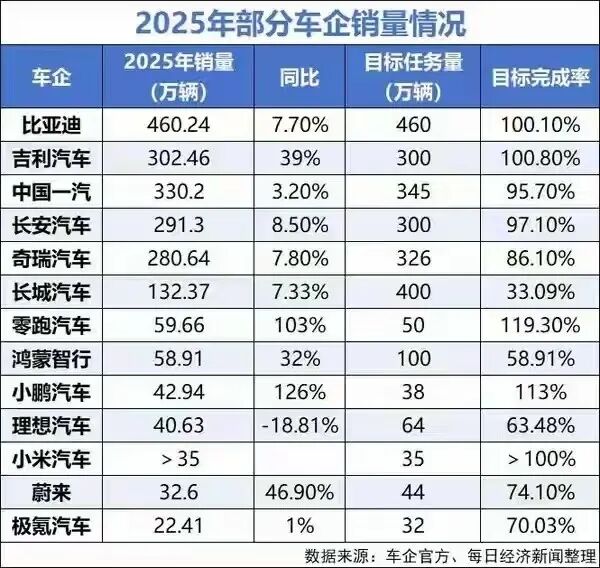
Core Insights - The 2025 year for the electric vehicle (EV) industry is characterized by aggressive growth, a backlash against internal competition, and uncertainty heading into 2026 [2][17][19] Group 1: Aggressive Growth - The EV industry is projected to sell 12.852 million units in 2025, with a market penetration rate surpassing 50% [3] - BYD leads the market with 4.6024 million units sold, achieving a 7.7% year-on-year growth [6] - New players like Leap Motor and Xiaomi are also showing significant growth, with Leap Motor achieving a 103% year-on-year increase [4][6] Group 2: Backlash Against Internal Competition - The industry has faced issues of malicious competition, with average price reductions of 9.2% leading to a decline in profit margins from 6.2% in 2020 to 4.3% in 2025 [17][18] - Regulatory bodies are advocating for a shift towards innovation and service differentiation rather than price wars [18] - The backlash aims to guide companies towards better product definitions and fair competition practices [18] Group 3: Uncertainty in 2026 - The competition in the EV sector is expected to intensify, with a slowdown in growth rates and increased pressure on product iteration [19][20] - Key factors influencing competition will be autonomous driving capabilities and expansion strategies [20][25] - The industry may face a dilemma regarding price wars as average vehicle prices have decreased from 184,000 yuan in 2024 to 178,000 yuan in 2025 [27]



市场最前沿|从车企年报透视中国汽车产业突围密码
Xin Hua Wang· 2026-01-07 05:56
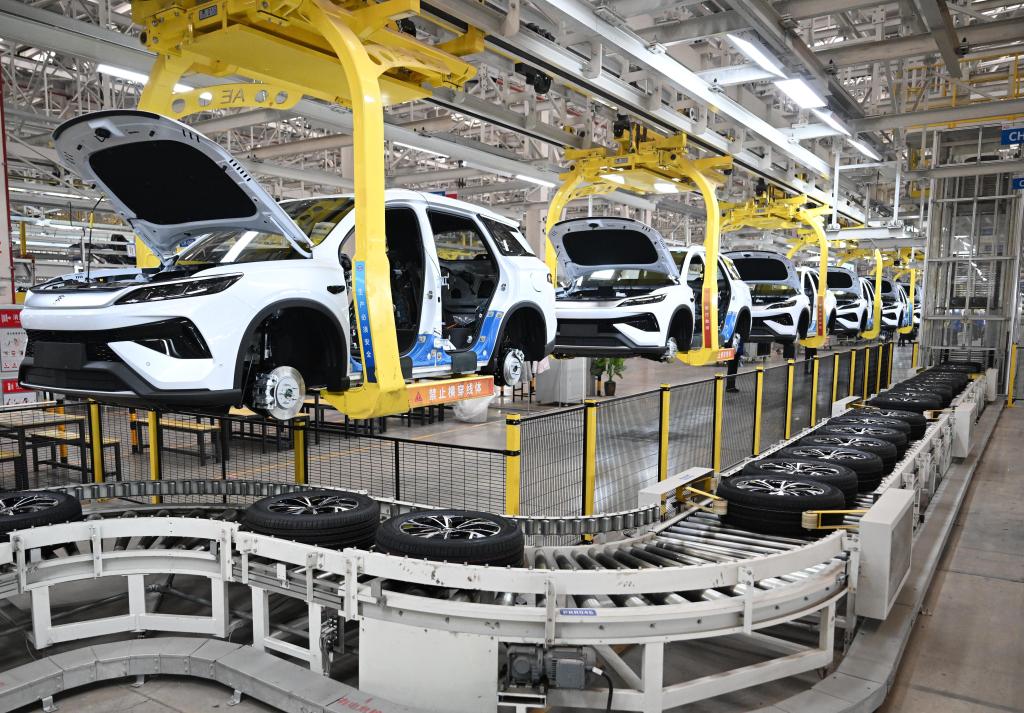
Group 1 - BYD has topped the global sales chart for pure electric vehicles, with a total sales exceeding 4.6 million units in 2025, maintaining its position as the annual sales champion in China [3] - China FAW Group achieved over 3.3 million vehicle sales in 2025, marking a 3.2% year-on-year increase, with its joint venture FAW-Volkswagen leading in sales among joint venture brands [3] - Geely Automobile surpassed 3.02 million units in sales, exceeding its annual target and setting a historical record [3] Group 2 - Leap Motor emerged as the biggest "dark horse" in the new energy vehicle sector, delivering nearly 600,000 units in 2025, representing a 103% year-on-year growth and achieving over 119% of its annual target [4] - NIO reported a record delivery of over 320,000 vehicles in 2025, with a significant increase in delivery volume in the latter half of the year [6] - Multiple automakers indicated that the Chinese new energy vehicle industry is entering a new phase of technological iteration and global development, aiming to lead in both quantity and quality [6] Group 3 - The establishment of new state-owned enterprise China Changan Automobile Group aims to accelerate breakthroughs in new energy, intelligence, and globalization, contributing to a total sales of 2.91 million units in 2025, the highest in nearly nine years [3] - Chery Group's sales exceeded 2.8 million units in 2025, focusing on innovation to enhance product service for global users [3] - Huawei's collaboration with automakers like Seres and BAIC has led to the successful launch of popular models, with a total delivery of nearly 590,000 units in 2025 [4]

零跑汽车(9863.HK):一汽溢价入股助力零跑新征程
Ge Long Hui· 2026-01-07 04:34
Core Insights - Leap Motor celebrated its 10th anniversary on December 28, 2025, and announced a strategic partnership with FAW, acquiring a 5% stake for approximately 3.74 billion yuan, aiming to become a world-class automaker [1][2] - The company reported a total sales volume of 597,000 units for 2025, marking a significant milestone with expectations for its first annual profit [1][2] - Leap Motor's long-term goals include achieving sales of 1 million units by 2026 and 4 million units in the future, supported by a new vehicle cycle and strategic collaborations [1][3] Company Development - From 2015 to 2025, Leap Motor transitioned from an IT cross-border player to a leading new energy vehicle manufacturer, with cumulative deliveries exceeding 1.2 million units and a peak monthly sales of over 70,000 units [2] - The company has established 17 major component factories, achieving a 65% self-manufacturing ratio for core components, which provides a cost advantage of approximately 10% compared to external procurement [2] - The LEAP platform allows for high component commonality, significantly reducing R&D and manufacturing costs for models like C10 and C16 [2] Strategic Partnerships - FAW's investment highlights strategic recognition of Leap Motor, with funds allocated for R&D, operational capital, and brand development [2] - A collaboration agreement was signed between FAW and Leap Motor for joint development of powertrains, with the first model expected to be produced in 2026 [3] Future Outlook - Leap Motor aims to transition from a follower to a leader in the automotive industry, with a focus on technology leadership, product matrix expansion, and a cooperative ecosystem [3] - The company plans to host annual technology days starting in 2026 to enhance supply chain integration and factory construction [3] Financial Projections - Adjusted sales forecasts for 2025-2027 are 600,000, 1,040,000, and 1,420,000 units respectively, with revenue projections of 68.3 billion, 123.5 billion, and 168.8 billion yuan [3] - The net profit estimates for the same period are 660 million, 5.11 billion, and 8.25 billion yuan, reflecting a significant adjustment in expectations [3] - The target price for Leap Motor is set at 83.69 HKD, reflecting a 30% premium on the estimated valuation due to anticipated growth and profitability [3]
通讯|在葡萄牙,中国电动汽车吸引力持续上升
Xin Hua She· 2026-01-07 04:00
Core Insights - The attractiveness of Chinese electric vehicles (EVs) in Portugal is on the rise, with increasing market acceptance among consumers [1] Market Trends - In the first 11 months of 2025, pure electric vehicles accounted for 22.9% of new car registrations in Portugal, nearing the 25% share of gasoline vehicles and significantly higher than the 5.7% share of diesel vehicles, indicating a rapid shift towards electric mobility [1] - BYD led the Portuguese electric vehicle market with 645 registrations in November 2025, representing a substantial year-on-year growth of 119.4% [1] - The total registration of BYD electric vehicles in Portugal reached 4,477 units in the first 11 months of 2025, marking a 90.5% increase compared to the same period in 2024 [1] Competitive Landscape - Tesla remains the leader in annual cumulative registrations in Portugal, but the gap with Chinese electric vehicle brands is narrowing, indicating a shift from being an alternative option to becoming a significant force in the Portuguese automotive market [1] - A senior executive from the Salvador Caetano Group, one of Portugal's largest dealership groups and a representative of several Chinese EV brands, highlighted that Chinese electric vehicles excel in quality, technology, design, and cost-effectiveness [1] Consumer Preferences - Portuguese consumers are increasingly choosing Chinese electric vehicles due to their appealing design, competitive ownership costs, and high value-for-money configurations [1] - The growing acceptance of Chinese electric vehicles is also enhancing the attractiveness of other emerging brands in the Portuguese market [1] Industry Impact - The performance of Chinese electric vehicle brands reflects their technological competitiveness and their growing role in shaping sustainable mobility in Portugal, providing more choices, innovation, and affordability for consumers [1]
通讯丨在葡萄牙,中国电动汽车吸引力持续上升
Xin Hua Wang· 2026-01-07 04:00
Group 1 - The core viewpoint of the articles highlights the increasing attractiveness of Chinese electric vehicles (EVs) in Portugal, with a notable shift in consumer preferences towards these brands due to their quality, technology, design, and cost-effectiveness [1][2][3] - In the first eleven months of 2025, pure electric vehicles accounted for 22.9% of new car registrations in Portugal, nearing the 25% mark for gasoline vehicles, indicating a rapid transition towards electric mobility [1] - BYD led the Portuguese electric vehicle market with 645 registrations in November 2025, reflecting a significant year-on-year growth of 119.4%, and a total of 4,477 registrations in the first eleven months of 2025, up 90.5% from the same period in 2024 [1][2] Group 2 - Tesla remains the leader in annual cumulative registrations in Portugal, but the gap with Chinese brands is narrowing, indicating a shift from being an alternative option to becoming a significant force in the Portuguese automotive market [1][2] - The increasing acceptance of Chinese electric vehicles among Portuguese consumers is also benefiting other emerging brands, with Leap Motor registering 210 vehicles, Xpeng 785 vehicles, and Polestar 484 vehicles in the same period [2] - The performance of Chinese electric vehicle brands reflects their technological competitiveness and their growing role in shaping sustainable mobility in Portugal, providing more choices and affordability for consumers [3]
港股异动丨汽车股普跌 机构预计2026年车市销量下滑+车圈开年狂打价格战
Ge Long Hui· 2026-01-07 03:04
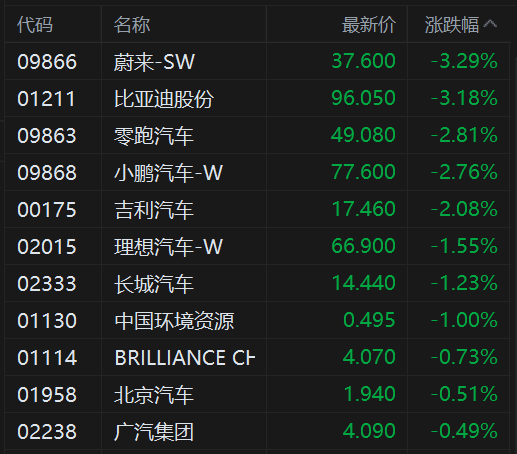
Group 1 - The core viewpoint of the news is that Hong Kong automotive stocks have experienced a significant decline, with major players like NIO and BYD dropping over 3% due to reduced subsidies and a weak outlook for the Chinese auto market in Q4 [1] - Multiple institutions predict a 7% decline in China's auto sales by 2026, marking the first anticipated annual drop since 2020 [1] - A price war has commenced in the Chinese auto market, with over 76 models from various brands, including both domestic and foreign manufacturers, launching promotional policies at the start of the year [1] Group 2 - Specific stock performance shows NIO down 3.29% at 37.600, BYD down 3.18% at 96.050, and other companies like Leap Motor and Xpeng also experiencing declines of around 2.8% [2] - The decline in stock prices is widespread among major automotive companies, including Geely down 2.08%, Li Auto down 1.55%, and Great Wall Motors down 1.23% [2] - The overall sentiment in the market reflects concerns over the sustainability of growth in the automotive sector, influenced by changing subsidy policies and market conditions [1][2]


本土化与生态“出海”将是破局关键
Zhong Guo Qi Che Bao Wang· 2026-01-07 01:35
Core Insights - In 2025, China's automobile exports reached 6.343 million units, a year-on-year increase of 18.7%, with new energy vehicle (NEV) exports at 2.315 million units, growing by 102.9% [2] - The growth momentum is expected to continue into 2026, with a transition towards "stable quantity and improved quality" as the industry expands export scale and deepens localization [2] Group 1: Export Predictions - Multiple organizations predict optimistic growth for China's automobile exports in 2026, with estimates ranging from 680,000 to 800,000 units, and NEV exports projected at 350,000 units [3] - The China Automobile Industry Association anticipates continued growth in exports but with a slowing growth rate, while Morgan Stanley forecasts 6.97 million passenger car exports, focusing on Europe, Southeast Asia, and Latin America as key markets [3] - The export strategy has evolved into a dual-driven model of "emerging market expansion + developed market breakthroughs," with countries like Mexico, UAE, Brazil, and the UK becoming significant growth contributors [3] Group 2: Localization Efforts - The localization process for Chinese automakers is accelerating, with companies increasing investments in overseas factories, such as BYD's plant in Hungary and Chery's joint venture in Spain [4] - Key components supply chains are also being localized, with companies like CATL and Fuyao Glass establishing production bases abroad to enhance local manufacturing capabilities and reduce supply chain risks [4] - The deepening of localization is crucial for building a collaborative manufacturing system that integrates vehicle and component production [4] Group 3: Market Adaptation and Challenges - Chinese automakers are optimizing product configurations to meet diverse market demands and are developing comprehensive service ecosystems, including sales, after-sales, and charging networks [5] - The EU's stringent localization requirements pose challenges, necessitating deep local R&D and production capabilities rather than simple assembly [5] - Trade protectionism, particularly Mexico's increased tariffs on imports from non-free trade agreement countries, threatens to undermine the competitive advantage of Chinese brands [5] Group 4: Supply Chain Risks - Supply chain risks, particularly in automotive-grade chips and power semiconductors, are significant challenges for global automakers, including Chinese companies [6] - Variations in technical standards and consumer habits across different markets, along with geopolitical policy fluctuations, demand higher operational standards from Chinese automakers [6] - The year 2026 is characterized by both growth and challenges, requiring Chinese automakers to focus on technological innovation and diversified ecosystems to achieve high-quality development [6]
智驾战场来到CES2026:英伟达硬刚特斯拉,中国车企集体突围,AI成唯一答案!
Xin Lang Cai Jing· 2026-01-07 01:29
Core Insights - CES 2026 has officially opened, showcasing significant advancements in autonomous driving technology, with major companies like Nvidia, Geely, and Great Wall Motors presenting their latest innovations [4][28] - Nvidia introduced its open-source physical AI reasoning model, Alpamayo, aimed at addressing the "long tail problem" in autonomous driving, which has been a major barrier to the technology's deployment [5][7][11] Group 1: Nvidia's Innovations - Nvidia's CEO Jensen Huang emphasized that CES 2026 would not feature new GPU products, marking a shift in focus towards autonomous driving and AI software capabilities [5][30] - The Alpamayo model is designed to process complex driving scenarios and provide reasoning behind decisions, moving beyond traditional object detection and path planning [7][32] - Nvidia aims to create an open ecosystem for autonomous driving, contrasting with Tesla's closed system that relies on proprietary data [11][35] Group 2: Tesla's Response - Tesla's CEO Elon Musk responded to Nvidia's announcements, highlighting the challenges of solving the long tail problem, which involves rare but critical driving scenarios [10][35] - Tesla's Full Self-Driving (FSD) system utilizes extensive real-world driving data to train its neural networks, maintaining a closed-loop system for its vehicle iterations [10][35] Group 3: Chinese Automakers' Developments - Geely has upgraded its AI technology system to version 2.0, enhancing its core driving system, "Qianli Haohan G-ASD," to support capabilities from Level 2 to Level 4 autonomous driving [12][37] - Geely plans to introduce L3 and L4 autonomous driving features by 2026, alongside launching Robotaxi services [13][37] - Great Wall Motors and Leap Motor are also showcasing advanced AI-driven solutions, indicating a strong push from Chinese automakers in the autonomous driving sector [41][42] Group 4: Industry Trends and Future Outlook - AI is recognized as the essential driver of advancements in autonomous driving, with various companies leveraging AI to meet diverse consumer needs [20][44] - The emergence of AI large models is expected to lower development barriers and accelerate the adoption of high-level autonomous driving features across different vehicle segments [20][44] - The competitive landscape at CES 2026 highlights a significant shift towards practical applications of autonomous driving technology, moving from theoretical concepts to real-world implementations [19][42]