今世缘

Search documents
【开源食饮】食品饮料仓位新低,建议布局白酒与新消费潜力股——行业点评报告
Sou Hu Cai Jing· 2025-07-25 20:24
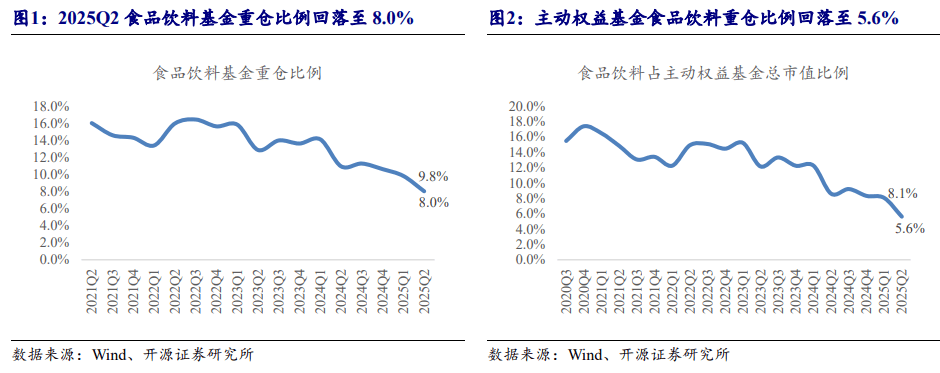
Group 1 - The core viewpoint of the articles indicates a significant decline in the allocation of food and beverage sectors by funds, reaching a new low since 2020, with the allocation ratio dropping from 9.8% in Q1 2025 to 8.0% in Q2 2025 [1][5][6] - Active equity funds have notably reduced their allocation to the food and beverage sector, with a decrease from 8.1% in Q1 2025 to 5.6% in Q2 2025, reflecting a 2.5 percentage point drop [1][5][6] - The decline in the food and beverage sector is attributed to the impact of the alcohol ban, which has further contracted consumption scenarios, particularly affecting traditional sectors like liquor [1][3][5] Group 2 - The proportion of active equity funds heavily invested in liquor has decreased from 6.57% in Q1 2025 to 3.97% in Q2 2025, a decline of 2.6 percentage points, indicating a widespread reduction in liquor holdings [2][11] - The overall market fund allocation to liquor has also fallen from 8.5% in Q1 2025 to 6.8% in Q2 2025, showing a similar trend of reduced investment in liquor [2][11] - Major liquor companies such as Luzhou Laojiao, Wuliangye, and Shanxi Fenjiu have seen significant reductions in fund holdings, while only a few companies like Kuaijishan and Shede Liquor experienced slight increases [2][11][20] Group 3 - The investment recommendation suggests strategically positioning in the liquor sector, as the current low expectations and valuations present potential opportunities for gradual accumulation [3][25][27] - The report anticipates that the liquor industry will find a bottom in the second half of the year, with expectations of a recovery in demand as the market adjusts to the impacts of the alcohol ban [3][27] - For new consumption targets, the focus should be on companies that can leverage channel expansion opportunities and emerging product categories, with recommendations including Ximai Food and Bai Run Shares [3][28]






消费行业2025年中期策略解读
2025-07-25 00:52
Summary of Key Points from Conference Call Records Industry Overview: Home Appliances - Emerging markets have a low penetration rate in home appliances, driving demand growth due to economic development. These markets account for 32% of global home appliance sales and 67% of the population, indicating significant future growth potential [1][2][4] - The export growth rate for white goods is notably high, with Southeast Asia and Latin America experiencing compound annual growth rates of over 13% and 20%, respectively, over the past five years [1][2] Core Insights and Arguments - Short-term fluctuations in exports to the U.S. are influenced by tariff policies, but stable end-user demand is expected to lead to a gradual recovery in exports in the third and fourth quarters once tariff policies are clarified [1][5] - Domestic market growth has been stimulated by national subsidy policies, with air conditioner, refrigerator, and washing machine sales increasing in the first half of the year. However, the sustainability of these subsidy policies is uncertain, and their potential cessation could disrupt the industry, though the impact is expected to be less than anticipated [1][6][7] - The national subsidy policy has significantly boosted sales of emerging appliance categories like robotic vacuum cleaners, which saw sales growth exceeding 40%. Even if subsidies are withdrawn in the future, these categories are expected to maintain high growth potential due to short replacement cycles [1][8] Investment Opportunities - The white goods industry primarily relies on replacement demand, with limited oversupply. Companies with high dividend yields and payout ratios above 50%, such as Gree Electric, Midea Group, Haier, and Hisense, are recommended for investment [1][9][10] - Companies with strong overseas advantages and notable performance reversals, such as Ecovacs, Roborock, Anker Innovations, TCL Electronics, and Hisense Visual, are also highlighted as worthy of attention [1][10] Additional Important Insights - The national subsidy policy has had a limited impact on overall market sales, primarily affecting pricing and product structure rather than significantly increasing total sales volumes [1][7] - Emerging markets, particularly in Asia, are expected to see rapid increases in penetration rates as GDP per capita rises, further driving industry growth [4] - The home appliance sector is characterized by a focus on replacement demand domestically, with emerging categories showing significant growth potential even in the absence of subsidies [1][9]
开源晨会-20250724
KAIYUAN SECURITIES· 2025-07-24 14:59
Group 1 - The report highlights the ongoing "anti-involution" market phase, driven by high-level policies and clean industry chips, which are expected to support a rebound in certain sectors [8][10][11] - The chemical industry, particularly polyester filament, is identified as a leader in the "anti-involution" movement, with production capacity expansion reaching its peak and profit margins expected to improve [12][14] - The organic silicon industry is also noted for its recovery potential due to improved supply-demand dynamics and industry self-discipline, with limited new capacity expected in the near future [18][21] Group 2 - The report discusses Google's cloud services, which exceeded revenue expectations, indicating strong growth driven by AI investments, and an increase in capital expenditure for 2025 [24][25] - The food and beverage sector is experiencing a decline in fund allocation, with a significant reduction in holdings in traditional sectors like liquor, suggesting a cautious market outlook [29][30] - The medical sector, particularly the Chinese medicine chain Solidarity Hall, is positioned for growth due to favorable policies and increasing demand, with projected profit growth in the coming years [36][38] Group 3 - The home appliance sector, represented by companies like TCL and Zhao Chi, is expected to see profit improvements driven by high-value Mini LED products and production efficiency enhancements in Vietnam [40][46] - The non-ferrous metals industry, particularly Zhongfu Industrial, is anticipated to benefit from cost optimization and increased production capacity, leading to improved profitability [42][43] - The overseas market, particularly for Quan Feng Holdings, is showing resilience with expected profit growth due to strategic production relocation and favorable market conditions [51][52]
东吴证券分析基金持仓,白酒明显减配;青花汾酒30复兴版新品发布丨酒业早参
Mei Ri Jing Ji Xin Wen· 2025-07-24 09:52
Group 1 - The core viewpoint of the news highlights the ongoing crackdown on counterfeit "special supply liquor" by law enforcement, resulting in the seizure of 260,000 bottles and an involved amount of 3.7 billion yuan [1] - The police have reported a total of 64,000 criminal cases related to food safety, with 540 cases specifically concerning counterfeit "special supply liquor" [1] - The operation aims to protect consumers and legitimate businesses by disrupting the illegal supply chain in the production, transportation, and sales of counterfeit liquor [1] Group 2 - According to Dongwu Securities, active funds have reduced their holdings in the liquor sector, with significant decreases in high-end liquor stocks such as Kweichow Moutai (14.9%), Wuliangye (30.1%), and Luzhou Laojiao (34.7%) [2] - The report indicates a shift in market preference towards sectors with higher growth potential, such as innovative pharmaceuticals and technology, leading to a capital outflow from the liquor sector [2] - Despite the overall negative sentiment towards the liquor sector, some long-term investors believe that the pessimistic expectations have been over-reflected in stock prices, suggesting potential value recovery for the liquor industry [2] Group 3 - Shanxi Fenjiu launched the "Qinghua Fenjiu 30 Revival Edition," emphasizing cultural innovation and internationalization in the liquor industry [3] - The event serves as a model for other liquor companies to enhance their cultural significance and adapt to modern consumer demands, thereby enriching the cultural ecosystem of the liquor industry [3] - The internationalization efforts of Fenjiu, through cultural exchanges and product upgrades, provide valuable insights for other liquor companies facing challenges in global markets [3]

开源证券:食品饮料仓位新低 建议布局白酒与新消费潜力股
Zhi Tong Cai Jing· 2025-07-24 06:57
开源证券发布研报称,当前行业仍在寻底,考虑到禁酒令同时打击餐饮,影响范围较广,判断纠偏动作 应不会太久,下半年白酒应能看到阶段性底部位置。从报表角度,考虑到二季度白酒需求受影响较大, 中报后市场大概率普遍下修盈利预测。综合判断下半年白酒板块应有布局机会,建议加大关注。新消费 标的短期由于中报预期变化而出现波动。该行建议在新消费标的中寻找符合产业发展趋势的优质公司并 长期持有。 开源证券主要观点如下: 2025Q2食品饮料仓位降至新低 从基金重仓持股情况来看(中全部市场基金,一级子行业),2025Q2食品饮料配置比例由2025Q1的9.8% 回落至8.0%水平,环比回落1.8pct,处于2020年以来新低位置。该行选取主动权益基金(普通股票、偏股 混合、灵活配置三类基金),从基金重仓持股情况来看,2025Q2食品饮料配置比例为5.6%,和2025Q1的 8.1%相比,下降2.5pct,说明二季度主动权益基金大幅减少食品饮料配置。二季度由于禁酒令的影响, 餐饮等消费场景进一步收缩,以白酒为代表的传统板块基本面情绪仍偏悲观,资金持续流出。7月份市 场风格切换,板块基本面探底叠加资金避险需求,该行预计会有部分资金回流 ...
行业点评报告:食品饮料仓位新低,建议布局白酒与新消费潜力股
KAIYUAN SECURITIES· 2025-07-24 05:43
Investment Rating - The industry investment rating is "Positive" (maintained) [1] Core Viewpoints - The food and beverage sector has seen a significant decline in fund allocation, with the configuration ratio dropping from 9.8% in Q1 2025 to 8.0% in Q2 2025, marking a new low since 2020 [3][12] - The decline in fund allocation is primarily attributed to the impact of the alcohol ban, which has further contracted consumption scenarios, particularly in the traditional liquor sector [5][6] - Despite the current pessimism, there is an expectation of a market style switch in July, which may lead to some capital returning to the sector [5][13] Summary by Sections Fund Allocation Trends - In Q2 2025, the allocation ratio for food and beverage in active equity funds decreased to 5.6%, down from 8.1% in Q1 2025, indicating a significant reduction in food and beverage investments [5][12] - The proportion of funds heavily invested in liquor dropped from 6.57% in Q1 2025 to 3.97% in Q2 2025, reflecting a broad reduction in liquor company holdings [4][20] - The overall market fund allocation for liquor also fell from 8.5% to 6.8% during the same period [20] Investment Recommendations - The report suggests a strategic focus on the liquor sector, particularly as the market is expected to find a bottom in the second half of the year [6][33] - It is recommended to gradually build positions in leading liquor companies such as Kweichow Moutai, Luzhou Laojiao, and Shanxi Fenjiu, which maintain high dividend yields [6][33] - For new consumption stocks, the report advises identifying high-quality companies that align with industry trends and holding them long-term, focusing on opportunities in new channels and product categories [6][34] Performance Metrics - The food and beverage sector's market value declined by 3.4% in Q2 2025, ranking 31 out of 32 sectors [13][18] - The sector's transaction amount ratio increased to 2.70%, indicating a slight recovery in trading activity despite the overall decline [13][18] - The report highlights that the majority of liquor companies experienced a decrease in fund holdings, while some consumer goods companies saw an increase in their market value [5][32]
茅台重磅公告!吃喝板块重拾升势,白酒、大众品携手上涨!机构:食饮板块整体景气度或有所回升
Xin Lang Ji Jin· 2025-07-24 03:14
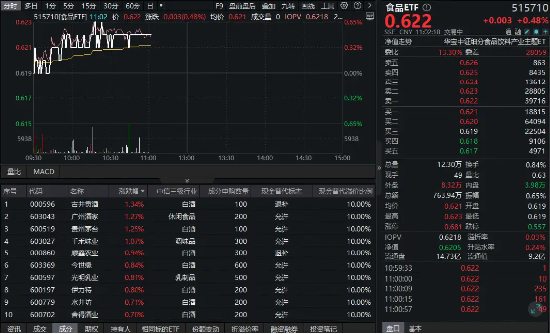
Group 1 - The food and beverage sector has regained upward momentum, with the food ETF (515710) showing a price increase of 0.48% as of the latest report [1] - Key stocks in the sector, such as Kweichow Moutai, Gujing Distillery, and Guangzhou Restaurant, have seen gains exceeding 1% [1] - Kweichow Moutai announced plans to establish a research institute in collaboration with its controlling shareholder, aimed at enhancing technological capabilities and maintaining market position [3] Group 2 - The food ETF (515710) has a significant holding in Kweichow Moutai, accounting for 14.61% of its portfolio as of the second quarter of 2025 [3][4] - The current price-to-earnings ratio of the food ETF's underlying index is 20.58, indicating a favorable valuation for long-term investment [4] - Analysts expect the food and beverage sector to benefit from economic recovery policies, with a potential increase in demand in the second half of the year [5] Group 3 - The food ETF (515710) primarily invests in leading high-end and mid-range liquor stocks, with a diversified portfolio that includes dairy, seasoning, and beer sectors [6] - The ETF's top holdings include major brands like Moutai, Wuliangye, and Yili, reflecting a strategic focus on core assets in the food and beverage industry [6]
A股震荡走强 三大指数均创年内新高
Mei Ri Shang Bao· 2025-07-23 08:15
Group 1: A-Share Market Performance - A-share market showed strong performance driven by infrastructure, resources, and liquor sectors, with all three major indices reaching new highs for the year [1] - The Shanghai Composite Index rose by 0.62%, Shenzhen Component Index increased by 0.84%, and the ChiNext Index gained 0.61% [1] - Total market turnover was approximately 1.93 trillion yuan, an increase of 201.5 billion yuan compared to the previous trading day [1] Group 2: Infrastructure and Machinery Sector - The infrastructure sector, particularly the engineering machinery segment, led the market rally, with significant gains in stocks like Sany Heavy Industry and Zoomlion [2] - The engineering machinery sector saw an overall increase of over 6%, with several stocks hitting the daily limit up [2] - The China Engineering Machinery Industry Association reported a 16.8% year-on-year increase in excavator sales for the first half of 2025, with exports rising by 10.2% [2][3] Group 3: Resource Sector Performance - The coal sector experienced a significant rise, with stocks like Shanxi Coking Coal and Huahua Energy hitting the daily limit up [4] - The main contract for coking coal futures reached 1,048.5 yuan/ton, while the main contract for coke futures was at 1,697 yuan/ton [4] - Market rumors regarding a government notice on coal mine production checks contributed to the bullish sentiment in the coal sector [4] Group 4: Steel Sector Insights - The steel sector also showed strength, with stocks like Fangda Special Steel and Xining Special Steel hitting the daily limit up [6] - The upcoming supply-side reforms in the steel industry are expected to improve the supply-demand balance, benefiting leading companies in the long term [6] Group 5: Liquor Sector Recovery - The liquor sector rebounded, with the overall liquor concept index rising by 1.52%, and 42 out of 51 component stocks showing gains [7] - Leading liquor stocks like Shanxi Fenjiu and Jiangsu Yanghe saw significant increases, driven by attractive dividend yields and positive market sentiment [7] - Despite the recovery, demand pressures remain, and companies are focusing on inventory reduction and market health [7]


食品饮料行业 2025 年中报前瞻:白酒出清探底,食品亮点频现
Huachuang Securities· 2025-07-22 09:25
Investment Rating - The report maintains a "Recommended" rating for the food and beverage industry, particularly highlighting opportunities in the liquor sector and food products [1] Core Insights - The liquor industry is undergoing extreme pressure testing, with a significant focus on inventory clearance and bottoming out of financial reports. The second quarter has shown weak demand due to seasonal factors and regulatory impacts, leading to a notable decline in sales and pricing pressures [5][10] - High-end liquor brands like Moutai are expected to maintain growth, while mid-tier brands face challenges with declining revenues and profits. The overall industry is in a deep clearance phase, with potential for recovery as regulations stabilize [5][12] - The consumer goods sector shows mixed performance, with snacks and beverages remaining strong, while other segments like frozen foods and chain restaurants face ongoing demand pressures [20][25] Summary by Sections 1. Liquor Sector - The liquor industry is experiencing extreme pressure, with weak demand in the second quarter and significant inventory levels. Major brands like Moutai and Wuliangye are expected to show modest growth, while others like Yanghe and Luzhou Laojiao are facing declines [5][11][12] - Moutai's revenue is projected to grow by 7% in Q2, while Wuliangye is expected to see a 1% increase. In contrast, brands like Yanghe and Luzhou Laojiao are forecasted to decline by 35% and 8% respectively [11][12] 2. Consumer Goods - The overall demand for consumer goods remains weak, but segments like snacks and beverages are performing well. For instance, East Peak is expected to see a 33% increase in revenue, while other snack brands are also showing positive trends [20][25] - The beverage sector is projected to see positive growth, with major brands like Qingdao Beer and Yanjing expected to report increases in revenue and profit [25][26] 3. Investment Recommendations - The report suggests focusing on high-performing stocks in the short term while considering long-term investments in liquor brands that are currently at their bottom. Brands like Moutai and Gujing are recommended for their lower risk profiles [7][8] - For consumer goods, companies like Anqi and East Peak are highlighted for their growth potential, while traditional dairy brands like Yili and Mengniu are suggested for a bundled investment approach [7][8]



超级工程带来爆涨潮!超百股涨停!三大指数年内新高!最热板块一票难求!一度落寞的传统板块也悄悄发力...
雪球· 2025-07-22 08:30
Group 1 - The A-share market saw all three major indices rise, with the Shanghai Composite Index up 0.62%, the Shenzhen Component Index up 0.84%, and the ChiNext Index up 0.61%, all reaching new highs for the year [1] - The total trading volume in the Shanghai and Shenzhen markets was 19,286 billion yuan, an increase of 2,015 billion yuan from the previous day, with over 2,500 stocks rising and more than 100 stocks hitting the daily limit for the second consecutive day [1] Group 2 - The focus of the market remains on the Yarlung Tsangpo River downstream hydropower station concept, which has continued to see strong reactions in the second trading day [2][4] - Stocks related to the Yarlung Tsangpo hydropower project have experienced significant surges, particularly in sectors such as cement, civil explosives, water conservancy equipment, and engineering construction, leading to a wave of limit-up stocks [4] - China Power Construction Corporation also hit the daily limit, with a limit-up order volume reaching 12.34 million hands, the highest in A-shares [5] Group 3 - Zhonglian Heavy Industry's stock surged over 9% after the company indicated potential positive impacts on performance from the Yarlung Tsangpo project [7] - The Yarlung Tsangpo hydropower project is the largest planned hydropower project globally, with an investment of 1.2 trillion yuan and a demand for equipment exceeding 100 billion yuan, expected to provide stable orders for the engineering machinery industry over its 10-year construction period [7] Group 4 - The liquor sector has shown volatility, with stocks like Shanxi Fenjiu and Yingjia Gongjiu rising over 5%, while Luzhou Laojiao increased by over 4% [9] - The liquor sector has faced challenges, with a year-to-date decline exceeding 10%, prompting fund managers to adjust their holdings, with some increasing positions in leading brands while reducing exposure to others [13] - Fund manager Zhang Kun emphasized that current valuations reflect pessimistic expectations, suggesting that long-term investors may find attractive opportunities [13] Group 5 - Coal stocks experienced a significant rally, with companies like Shanxi Coking Coal and Haohua Energy hitting the daily limit [15] - The surge in coal prices was anticipated, as the Dalian Commodity Exchange's coking coal futures showed strong activity, leading to a limit-up in the afternoon [15] - Analysts noted that the recent focus on stabilizing growth in key industries by the Ministry of Industry and Information Technology has boosted market confidence in coking coal [17]