台积电

Search documents
两年暴涨261%,博通一路狂飙
半导体行业观察· 2025-09-05 01:07
Core Viewpoint - Broadcom has experienced significant stock price growth, increasing over 100% since April, with a market capitalization of approximately $1.4 trillion, making it the second-largest semiconductor company globally, trailing only Nvidia [2][8]. Financial Performance - Broadcom's Q3 earnings per share were $1.69, slightly above Wall Street's expectation of $1.65, with revenue reaching $15.96 billion, a 22% increase year-over-year [8]. - The company reported a net profit of $4.14 billion for the quarter, a significant recovery from a loss of $1.88 billion in the same period last year, which was attributed to a one-time tax provision [8]. - AI revenue grew by 63% year-over-year, reaching $5.2 billion, exceeding previous forecasts [10]. Market Position and Strategy - Broadcom is positioned as a major beneficiary of the generative AI trend, providing customized chips for large-scale data center clients seeking alternatives to Nvidia's products [4][6]. - The company has launched new AI-focused networking chips, such as the Tomahawk Ultra and Jericho, to compete with Nvidia in the AI semiconductor market [6][12]. - Broadcom's semiconductor solutions business saw a 57% revenue increase, reaching $9.17 billion, while its infrastructure solutions business grew by 43% to $6.79 billion [9]. Future Outlook - Broadcom has secured a $10 billion order for custom AI chips from a major client, leading to an upward revision of its AI revenue forecast for fiscal year 2026 [10]. - The company anticipates Q4 sales to reach $17.4 billion, surpassing Wall Street's expectation of $17.02 billion [8]. - Analysts express optimism about Broadcom's potential to capture market share in the AI chip sector, especially as cloud operators increasingly adopt its solutions [9][16]. Competitive Landscape - Broadcom faces the challenge of competing against Nvidia, which has a stronghold in the AI GPU market, and must navigate the complexities of the AI ASIC design market [12][14]. - Nvidia's proprietary technologies, such as NVLink, are seen as significant competitive advantages, complicating Broadcom's efforts to penetrate the market [14]. - Despite the competitive landscape, Broadcom's recent performance and strategic initiatives position it as a strong contender in the AI semiconductor space [17].

中微公司董事长重磅发声:芯片设备业存在15种内卷形式 产业链过分垂直整合是一种不公平竞争
Mei Ri Jing Ji Xin Wen· 2025-09-04 14:13
Core Viewpoint - The article discusses the challenges and implications of vertical integration in the semiconductor industry, highlighting the risks of unfair competition and the need for collaboration rather than internal competition [1][5]. Industry Overview - The semiconductor manufacturing and equipment sectors are characterized by a high degree of specialization, with major manufacturers like TSMC, Samsung, and GlobalFoundries representing chip makers, while ASML, Applied Materials, and Lam Research represent equipment suppliers [2]. - In China, leading semiconductor manufacturers include SMIC, Hua Hong Semiconductor, and JCET, while equipment suppliers include AMEC, North Huachuang, and Shanghai Semei [2]. Competition and Collaboration - Vertical integration is seen as a source of unfair competition, as it can lead to the leakage of proprietary knowledge and trade secrets between chip manufacturers and equipment suppliers [3]. - The historical failures of vertically integrated companies in the semiconductor space underscore the importance of maintaining a clear division between manufacturing and equipment supply [3]. Domestic Semiconductor Equipment Development - The domestic semiconductor equipment industry has made progress in localization, with the highest domestic production rate of 90% achieved in the photoresist stripping equipment [6]. - Other equipment categories, such as thermal processing, etching, and cleaning, have a domestic production rate of around 20%, while CMP and PVD equipment are at approximately 10% [6]. - The development of semiconductor equipment requires significant funding and time, with R&D costs potentially exceeding the sale price of the equipment by multiples [6]. Industry Challenges - The semiconductor micro-processing equipment industry faces ten major challenges, including severe competition and various forms of internal competition [5]. - Encouragement for collaboration between smaller equipment companies and larger firms is suggested to reduce internal friction and promote healthy industry development [6]. Product Launches - At the recent semiconductor equipment exhibition, the company launched six new semiconductor equipment products, showcasing its technological capabilities in critical processes such as plasma etching, atomic layer deposition, and epitaxy [7].

美国关税手段为何失灵?专家说
Sou Hu Cai Jing· 2025-09-03 15:46
自2017年特朗普政府推行以"美国优先"为核心的贸易政策以来,关税手段成为其实现所谓"制造业回 流"与"经济复兴"的关键工具。八年过去,多项分析显示,这一贸易保护主义政策并未带来预期的长期 繁荣,反而对美国经济结构和全球贸易体系造成持续性影响。青岛银行首席经济学家刘晓曙在接受《金 融时报》专访时指出,美国正为短期利益付出长期代价,全球多边贸易秩序也在这一过程中面临重构。 实际数据表明,多个经济体正在调整贸易合作方向,以降低对美国市场的依赖。欧盟对华贸易比重有所 上升,而对美贸易占比呈下降趋势;加拿大、东盟等国也出现类似的结构性变化。这类调整意味着,全 球贸易网络正在持续多元化。 "在关键技术领域,欧洲通过《芯片法案》明确要求提升自主产能,以减少对美技术的依赖。"刘晓曙表 示,美国虽然拥有市场和技术的显著优势,但单边保护主义政策可能加速削弱其在全球价值链中的传统 核心地位。 货币政策的两难:就业与通胀的平衡挑战 美联储当前面临"最大就业"与"稳定物价"这两重使命之间的艰难权衡。 刘晓曙 青岛银行首席经济学家。清华大学理学博士、厦门大学经济学博士、中国人民大学金融学博士 后。2008年获"中国卓越研究奖"。 短期 ...

《国企要参》海外视点丨美国撤销台积电向中国主要芯片制造厂运送关键设备的授权
Sou Hu Cai Jing· 2025-09-03 13:46
Core Viewpoint - TSMC faces increased operational challenges in China as the U.S. revokes its authorization for the company to freely ship key equipment to its major chip manufacturing base in Nanjing, effective December 31 [2][3]. Group 1: Impact on TSMC - The U.S. government has notified TSMC that its validated end user status for the Nanjing factory has been revoked, which previously allowed the import of U.S. chip manufacturing equipment without additional approvals [2]. - TSMC is assessing the situation and will communicate with the U.S. government while ensuring uninterrupted operations at its Nanjing facility [2]. - TSMC's stock experienced a decline of 2.3% during trading, closing down 1.1% in the U.S. and down 1.3% in Taiwan before recovering [3]. Group 2: Broader Industry Implications - The U.S. Department of Commerce stated that former participants in the VEU program will need to obtain licenses to export their technology, leveling the playing field with competitors [3]. - The removal of Samsung and SK Hynix from the VEU program is expected to result in an additional 1,000 license applications annually, complicating operations for these companies in China [3]. - Analysts suggest that the restrictions will further limit China's access to foreign semiconductor suppliers, potentially benefiting local memory chip manufacturers [4]. Group 3: Strategic Responses - TSMC may redirect equipment orders originally intended for Japan to its Nanjing facility to stockpile spare parts before the deadline [4]. - The ongoing restrictions are pushing China to enhance its self-sufficiency in semiconductor production, which could accelerate the competition for chip independence [4].
9月3日主题复盘 | 指数继续回调,储能板块爆发,国产芯片、黄金持续活跃
Xuan Gu Bao· 2025-09-03 08:32
Market Overview - The market experienced fluctuations with mixed performance across the three major indices, resulting in over 4,600 stocks declining in the Shanghai and Shenzhen markets [1] - Gold stocks continued to show strength, with Western Gold hitting the daily limit, while the military industry sector faced collective adjustments, with several stocks dropping over 10% [1] Daily Highlights Energy Storage - The energy storage sector saw significant gains, with multiple stocks such as Baoxin Technology and Tongrun Equipment hitting the daily limit, and Sunshine Power rising over 15% [3] - Reports indicate that Haitian Energy's factories have been operating at full capacity since March, with orders extending into October [3] - The energy cell market is experiencing a sudden shift from oversupply to a situation where orders cannot be fulfilled even with price increases [3] Domestic Chips - The domestic chip sector remained active, with Tianpu Co. achieving nine consecutive trading limits, and other companies like Taihe Technology and Shenghui Integration also hitting the daily limit [6] - TSMC announced that starting next year, the U.S. government will revoke the exemption for shipping critical equipment to its factories in mainland China [7] Gold - The gold sector continued to perform well, with Western Gold achieving three consecutive trading limits and spot gold reaching a historical high of $3,546.96 per ounce [9] - Morgan Stanley set a target price of $3,800 per ounce for gold in Q4 2025, while Bridgewater's founder noted a shift from U.S. Treasury bonds to gold among international investors [9] Sector Performance - The energy storage sector is expected to see a substantial increase in demand due to power shortages in emerging markets, with significant government support policies anticipated [5] - The global battery energy storage system installation reached 86.7 GWh in the first half of 2025, marking a 54% year-on-year increase, with expectations for continued growth [5] - The domestic chip sector is likely to accelerate as chip design companies shift towards local foundries, and domestic semiconductor equipment continues to improve [8]



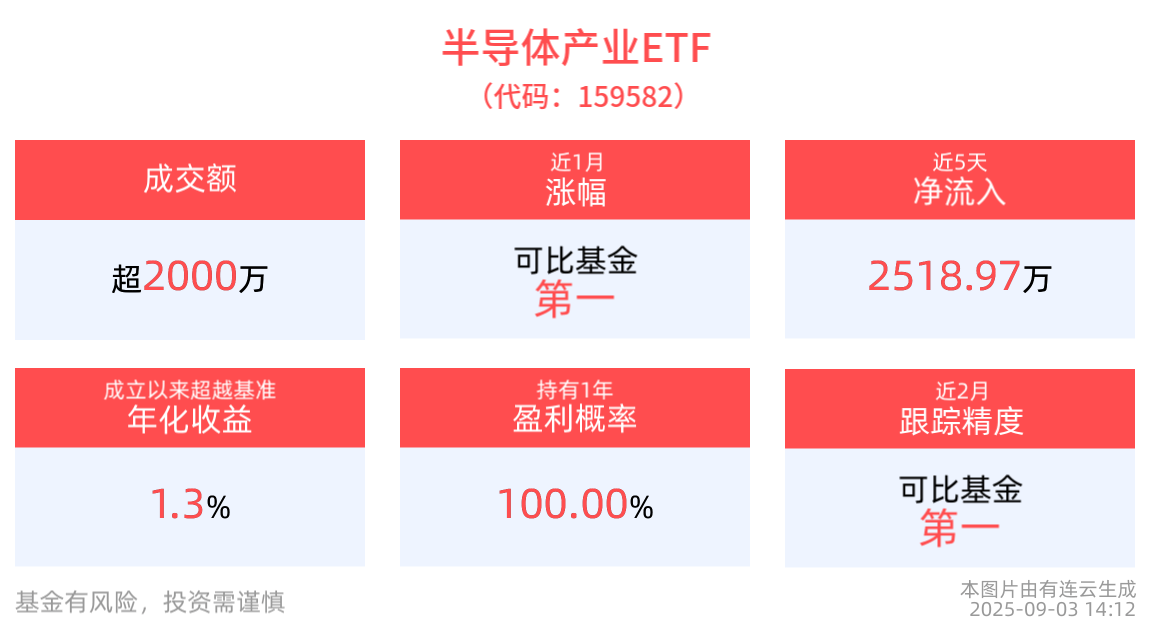
又一半导体产业盛会将至,半导体产业ETF(159582)盘中交投活跃,科创芯片ETF博时(588990)近1周份额增长2.52亿份
Sou Hu Cai Jing· 2025-09-03 06:49
Market Performance - As of September 3, 2025, the China Securities Semiconductor Industry Index decreased by 0.46%, with mixed performance among constituent stocks [2] - The Semiconductor Industry ETF (159582) fell by 0.92%, with a latest price of 1.84 yuan, but showed a 2.82% increase over the past week [2] - The STAR Market Chip Index dropped by 0.52%, while the STAR Chip ETF (588990) decreased by 0.85%, priced at 2.22 yuan, but had a 4.14% increase over the past week [2] Liquidity and Trading Activity - The Semiconductor Industry ETF had a turnover rate of 12.14% with a trading volume of 28.55 million yuan, indicating active market participation [2] - The STAR Chip ETF recorded a turnover rate of 13.05% with a trading volume of 112 million yuan, reflecting strong market activity [3] - The STAR New Materials ETF had a turnover rate of 5.38% and a trading volume of 16.29 million yuan, with a weekly average trading volume of 29.73 million yuan, ranking first among comparable funds [8] Key Events and Developments - Yushutech plans to submit an IPO application in Q4 2025, with quadruped robots making up 65% of its 2024 sales structure [9] - The U.S. government has notified TSMC about the cancellation of its VEU status for the Nanjing plant, which may further restrict production operations for domestic and foreign wafer fabs in China [9][10] - The 13th Semiconductor Equipment and Core Components and Materials Exhibition (CSEAC 2025) will be held in Wuxi from September 4 to 6, showcasing domestic manufacturers [9][10] Institutional Insights - The semiconductor sector is experiencing multiple event-driven dynamics, including the U.S. decision to terminate TSMC's VEU status, which raises concerns about production stability in China [10] - The upcoming CSEAC 2025 exhibition may catalyze interest in domestic equipment and materials, while NVIDIA has clarified that supply constraints for H100/H200 chips are unfounded, supporting industry stability [10] Related ETFs - The Semiconductor Industry ETF (159582) closely tracks the China Securities Semiconductor Industry Index, covering key sectors in semiconductor materials, equipment, and applications [11] - The STAR Chip ETF (588990) tracks the STAR Market Chip Index, focusing on semiconductor-related companies in design, manufacturing, and testing [11] - The STAR New Materials ETF (588010) follows the STAR Market New Materials Index, concentrating on advanced materials relevant to the semiconductor industry [11]
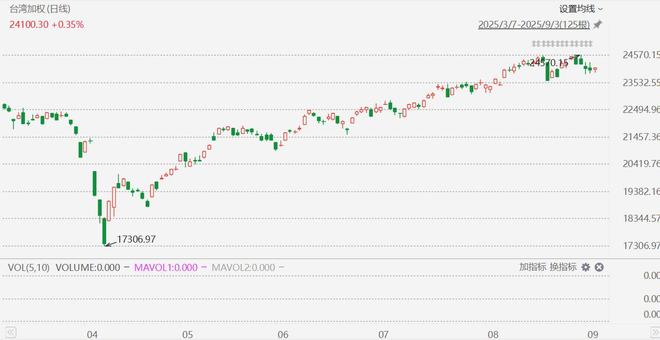
台股收涨0.35%
Xin Lang Cai Jing· 2025-09-03 05:49
来源:格隆汇APP 格隆汇9月3日|台湾加权指数收盘上涨83.52点,涨幅0.35%,报24100.3点。台积电(2330.TW)收跌 0.43%报1155元新台币。 ...
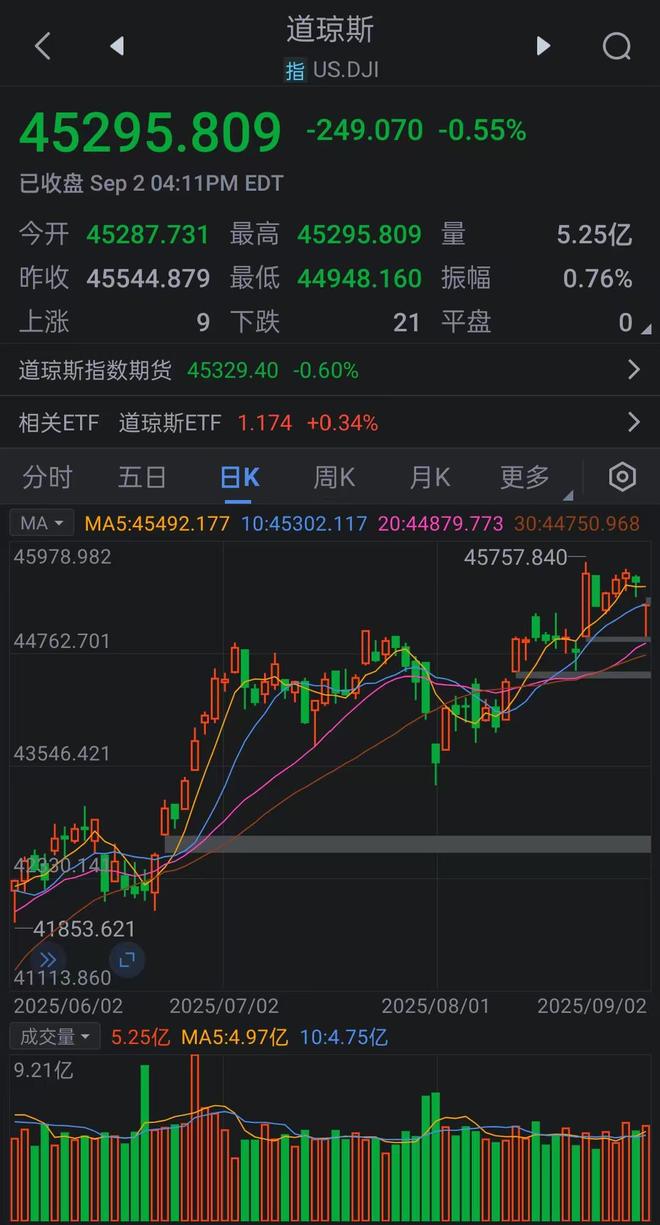
美股三大股指收跌 英伟达跌近2%
Xin Lang Cai Jing· 2025-09-02 20:19
Market Performance - The three major U.S. stock indices closed lower, with the Dow Jones down 0.55%, the Nasdaq down 0.82%, and the S&P 500 down 0.69% [1] - The Dow Jones index closed at 45,295.809, reflecting a decrease of 249.070 points [2] Regulatory Impact - A U.S. appeals court ruled that most of Trump's global tariffs are illegal, leading to increased uncertainty regarding tariffs, which has put pressure on the U.S. stock market [1] Technology Sector - Major technology stocks experienced declines, with Nvidia, Apple, Amazon, TSMC, and Tesla all dropping over 1%, while Microsoft, Google, and Meta saw slight decreases [1]

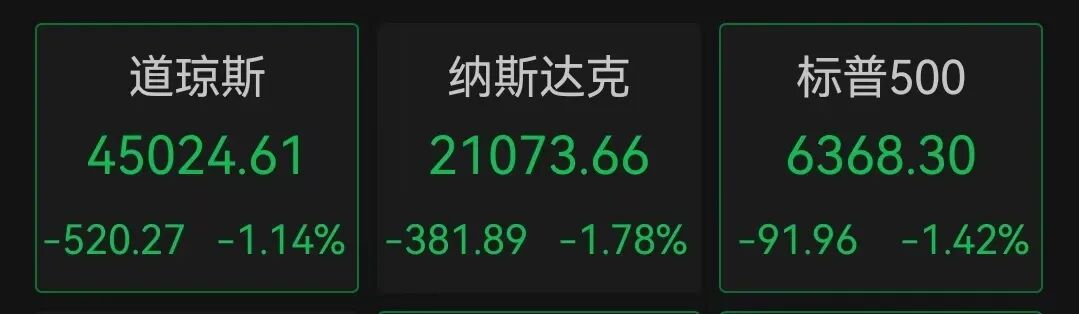
深夜 美股重挫 特朗普家族“核心代币”一度暴跌34%!达利欧警告
Mei Ri Jing Ji Xin Wen· 2025-09-02 17:17
Group 1: Technology Stocks Performance - Major technology stocks experienced a decline, with NVIDIA down 3.48%, Google down 3.06%, Amazon down 2.87%, Apple down 2.06%, Tesla down 1.88%, Facebook down 1.52%, and Microsoft down 1.18% [2][3] - The Philadelphia Semiconductor Index fell by 2.68%, with ARM dropping over 5% and other semiconductor companies like ON Semiconductor, ASML, and Qualcomm declining over 3% [2][3] Group 2: Commodity Market Trends - In the commodities market, both gold and oil prices increased, with international gold prices reaching a new historical high [2][3] Group 3: Cryptocurrency Developments - The Nasdaq China Golden Dragon Index rose slightly by 0.05%, with Li Auto increasing by 3.9% and Alibaba by 1.39% [5] - The Trump family's core token WLFI saw a significant drop of 34%, trading at $0.2243 after a 24-hour decline of 6.54% [7][8] - WLFI was launched by the Trump family and their business partners, with trading initiated on several cryptocurrency exchanges [9] Group 4: Economic Concerns - Ray Dalio, founder of Bridgewater Associates, warned of an impending national debt crisis in the U.S., attributing it partly to policies from Trump's second term [10][11] - Dalio highlighted that excessive spending from new budgets could lead to a debt-induced crisis within a timeframe of approximately three years [11] - He expressed concerns about the current political and social climate in the U.S., comparing it to historical economic challenges faced in the 1930s and 1940s [12][13]
深夜突发,美股重挫,特朗普家族“核心代币”一度暴跌34%!达利欧警告
Mei Ri Jing Ji Xin Wen· 2025-09-02 17:07
Group 1: Technology Stocks Performance - Major technology stocks experienced a decline, with NVIDIA down 3.48%, Google down 3.06%, Amazon down 2.87%, Apple down 2.06%, Tesla down 1.88%, Facebook down 1.52%, and Microsoft down 1.18% [2][3] - The Philadelphia Semiconductor Index fell by 2.68%, with ARM dropping over 5%, and other semiconductor companies like ON Semiconductor, ASML, and Qualcomm also declining by more than 3% [2][3] Group 2: Market Overview - The Nasdaq China Golden Dragon Index rose slightly by 0.05%, closing at 7916.46 points, with Li Auto increasing by 3.9% and Alibaba by 1.39% [7] - In the commodities market, gold and oil prices increased, with international gold prices reaching a new historical high [5] Group 3: Cryptocurrency Developments - The Trump family's "core token" WLFI saw a decline of 6.54% in the past 24 hours, trading at $0.2243, after opening at $0.32 and experiencing a drop of 34% to $0.21 [9][10] - The World Liberty Financial company, which supports the Trump family's cryptocurrency project, launched trading for WLFI, which was previously voted to have trading attributes by investors [11] Group 4: Economic Concerns - Ray Dalio, founder of Bridgewater Associates, warned of an impending national debt crisis in the U.S., attributing it partly to policies from Trump's second term, predicting a potential crisis within three years [12][13] - Dalio expressed concerns about the current political and social climate in the U.S., likening it to the global situation in the 1930s and 1940s, and highlighted the risks of rising interest payments squeezing other necessary expenditures [14][15]