包钢股份

Search documents
普钢板块10月22日跌0%,包钢股份领跌,主力资金净流出2.32亿元
Zheng Xing Xing Ye Ri Bao· 2025-10-22 08:19
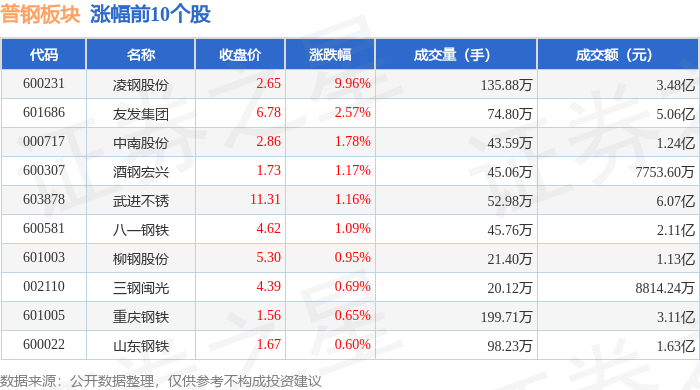
Market Overview - On October 22, the steel sector experienced a slight decline of 0.0%, with Baogang Co. leading the drop [1] - The Shanghai Composite Index closed at 3913.76, down 0.07%, while the Shenzhen Component Index closed at 12996.61, down 0.62% [1] Individual Stock Performance - Lingang Co. saw a significant increase of 9.96%, closing at 2.65, with a trading volume of 1.3588 million shares and a turnover of 348 million yuan [1] - Other notable performers included Youfa Group (+2.57%), Zhongnan Co. (+1.78%), and Jiugang Hongxing (+1.17%) [1] - Baogang Co. led the declines with a drop of 1.50%, closing at 2.63, with a trading volume of 9.0024 million shares and a turnover of 2.366 billion yuan [2] Capital Flow Analysis - The steel sector saw a net outflow of 232 million yuan from main funds, while retail investors contributed a net inflow of 333 million yuan [2] - The capital flow for individual stocks indicated that Lingang Co. had a net inflow of 84.85 million yuan from main funds, while Youfa Group experienced a net outflow of 31.99 million yuan [3] - The overall trend showed that retail investors were more active, with significant inflows into several stocks despite the outflows from institutional and speculative funds [3]


中国稀土战略地位进一步强化,稀土ETF嘉实(516150)近5日“吸金”22.51亿元,机构:稀土价格有望进一步上涨
Xin Lang Cai Jing· 2025-10-22 02:23
Core Insights - The China Rare Earth Industry Index has decreased by 1.58% as of October 22, 2025, with mixed performance among constituent stocks, led by Shengxin Lithium Energy with a rise of 1.81% [1] - The recent tightening of rare earth export controls by the Ministry of Commerce is expected to strengthen China's strategic position in the rare earth market, potentially leading to increased prices [3] Group 1: Market Performance - The rare earth ETF, Jiashi, has seen a turnover of 1.52% and a transaction volume of 1.61 billion yuan, with its latest scale reaching 10.875 billion yuan, marking a new high since its inception [2] - Over the past week, Jiashi's shares increased by 5.76 million, leading the comparable funds in terms of new share growth [2] - In the last five trading days, Jiashi has experienced net inflows on four occasions, totaling 2.251 billion yuan [2] Group 2: Fund Performance - As of October 21, 2025, Jiashi's net value has increased by 91.40% over the past two years, ranking 79th out of 2,358 index equity funds, placing it in the top 3.35% [2] - The highest monthly return since inception for Jiashi was 41.25%, with the longest consecutive monthly gain being four months and a maximum increase of 83.89% [2] Group 3: Industry Dynamics - The recent policy changes include increased export controls on five categories of medium and heavy rare earths, as well as restrictions on equipment, technology, and raw materials across the entire industry chain [3] - These measures are expected to complicate the establishment of independent rare earth supply chains overseas, thereby enhancing China's competitive advantage in the long term [3] - The limitations on overseas supply of rare earth magnetic materials are anticipated to boost demand for high-performance ferrite permanent magnets, leading to a significant increase in orders [3] Group 4: Key Stocks - The top ten weighted stocks in the China Rare Earth Industry Index account for 61.96% of the index, with notable performers including Northern Rare Earth and China Rare Earth, which saw declines of 2.69% and 1.81% respectively [2][5]


普钢板块10月21日涨0.78%,武进不锈领涨,主力资金净流入909.38万元
Zheng Xing Xing Ye Ri Bao· 2025-10-21 08:21
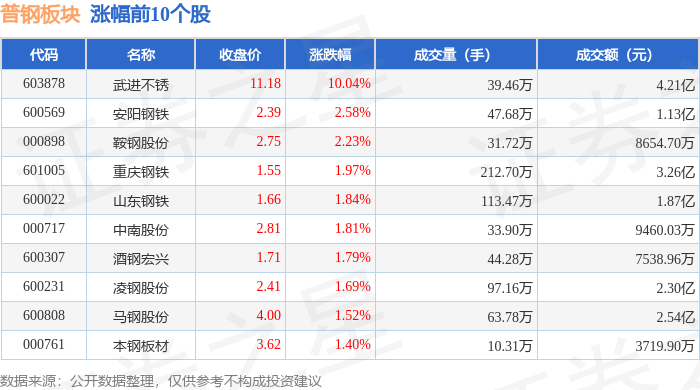
Market Performance - The steel sector saw an increase of 0.78% on October 21, with Wujin Stainless Steel leading the gains [1] - The Shanghai Composite Index closed at 3916.33, up 1.36%, while the Shenzhen Component Index closed at 13077.32, up 2.06% [1] Individual Stock Performance - Wujin Stainless Steel (603878) closed at 11.18, with a significant increase of 10.04% and a trading volume of 394,600 shares, amounting to a transaction value of 421 million yuan [1] - Anyang Iron & Steel (600569) rose by 2.58% to close at 2.39, with a trading volume of 476,800 shares and a transaction value of 113 million yuan [1] - Other notable performers include Ansteel (000898) with a 2.23% increase, Chongqing Steel (601005) up 1.97%, and Shandong Steel (600022) up 1.84% [1] Capital Flow Analysis - The steel sector experienced a net inflow of 9.09 million yuan from institutional investors, while retail investors contributed a net inflow of 19.3 million yuan [2] - However, there was a net outflow of 202 million yuan from speculative funds [2] Detailed Capital Flow for Selected Stocks - Wujin Stainless Steel had a net inflow of 66.62 million yuan from institutional investors, but a net outflow of 43.74 million yuan from speculative funds [3] - Nanjing Steel (600282) saw a net inflow of 23.69 million yuan from institutional investors, with a net outflow of 12.29 million yuan from speculative funds [3] - Baosteel (600019) had a net inflow of 12.40 million yuan from institutional investors, while retail investors showed a net outflow of 22.58 million yuan [3]


国泰海通:节后钢铁需求恢复增长 库存重回下降趋势
智通财经网· 2025-10-21 06:55
Core Insights - The steel industry is experiencing a gradual recovery in demand, with a notable increase in apparent consumption and a decrease in inventory levels, indicating a potential stabilization in the market [1][3] - Despite the positive demand trends, profitability in the steel sector has declined, with significant drops in gross margins for key products, suggesting ongoing cost pressures [2] - The supply side is expected to continue its contraction, supported by government policies aimed at reducing production and promoting a balance between supply and demand [3] Demand and Supply Analysis - Apparent consumption of the five major steel products reached 8.7541 million tons, up by 1.2398 million tons week-on-week, with construction materials and sheet products also showing increases [1] - Total steel production was 8.5695 million tons, down by 0.0636 million tons, while total inventory decreased to 15.8226 million tons, down by 0.1846 million tons, maintaining a low level [1] - The operating rate of blast furnaces remained stable at 84.27%, while electric furnace operating rates increased slightly, indicating a mixed response in production capabilities [1] Profitability Trends - The average gross profit for rebar fell to 111.6 CNY per ton, down by 34.3 CNY per ton, and for hot-rolled coils, it dropped to 21.6 CNY per ton, down by 67.6 CNY per ton [2] - The profitability rate for 247 steel companies decreased to 55.41%, down by 0.87% week-on-week, reflecting the challenges faced by the industry [2] Future Outlook - The demand from the real estate sector is expected to weaken, but stable growth is anticipated in infrastructure and manufacturing, which may support overall steel demand [3] - The government has introduced policies to control production, aiming to phase out inefficient capacities and support advanced enterprises, which may lead to a quicker recovery in the steel industry's fundamentals [3] Investment Recommendations - Companies with leading technology and product structures, such as Baosteel (600019.SH) and Hualing Steel (000932.SZ), are recommended for their competitive advantages [5] - Low-valuation, high-dividend steel companies like CITIC Special Steel (000708.SZ) and Yongjin Shares (603995.SH) are also highlighted as attractive investment opportunities [5] - The report suggests a positive outlook for upstream resource companies, recommending firms like Hebei Steel Resources (000923.SZ) and Erdos (600295.SH) due to their long-term advantages [5]



稀土狂飙,不只是因为“反制”
投中网· 2025-10-21 06:51
Core Viewpoint - The strategic value of rare earth elements is being highlighted due to China's export controls and policy upgrades, leading to a significant increase in stock prices and overall market performance in the rare earth sector [6][10][12]. Group 1: Market Performance - Shenghe Resources (600392.SH) saw its stock price rise by 5.04% to 26.26 yuan, with a year-to-date increase of 155.45% [6]. - The rare earth index (8841089.WI) has increased by 118.86% year-to-date, with five out of seven stocks in the sector doubling in value [6][10]. - On October 9, the rare earth sector surged by 7.97%, followed by a 9.49% increase on October 13, with several stocks recording over 110% gains [10][11]. Group 2: Supply and Demand Dynamics - China's rare earth reserves account for approximately 48% of the global total, with a production capacity of about 27,000 tons, representing nearly 70% of global output [8][9]. - The recent export controls by China, which include restrictions on key technologies and production lines, have tightened global supply and increased the strategic importance of rare earths [9][13]. - The demand for rare earths is expected to grow significantly, particularly in sectors like electric vehicles and renewable energy, with projections indicating a need for 3-5 kg of rare earth permanent magnets per electric vehicle [14][15]. Group 3: Price Trends - The price index for rare earths has been on an upward trend, with light rare earths like praseodymium and neodymium increasing from approximately 440,000 yuan/ton to 562,000 yuan/ton, a rise of about 27.7% [15]. - Heavy rare earths, such as dysprosium oxide, have seen even more dramatic increases, with prices soaring from around 830,000 yuan/ton to 2.6 million yuan/ton, marking a 212% increase [15]. - Recent announcements from companies like Northern Rare Earth and Baotou Steel have indicated continuous price increases for rare earth concentrates, reflecting ongoing supply constraints [17][19]. Group 4: Company Performance - In 2023, several rare earth companies are showing signs of recovery, with five out of seven companies reporting revenue growth in the first half of the year [21]. - Northern Rare Earth reported a revenue of 188.66 billion yuan in the first half of the year, with a net profit increase of 45.24% [22]. - Shenghe Resources anticipates a net profit of 740 million to 820 million yuan for the first nine months of the year, representing a growth of 696.82% to 782.96% [23]. Group 5: Future Outlook - Industry experts predict that while short-term fluctuations may occur, the mid-term price center for rare earths is likely to rise due to tightening supply and increasing strategic value [26]. - Analysts suggest that the recent export control measures will likely lead to price increases, particularly for light rare earth products, while cautioning about potential overvaluation of stocks in the sector [25][27].



稀土暴涨37%!北方稀土打响“翻身仗”,人形机器人再添一把火。
Sou Hu Cai Jing· 2025-10-21 06:23
Core Viewpoint - The announcement of a significant price increase for rare earth minerals by Northern Rare Earth on October 11, 2025, signals the beginning of a new upward cycle in rare earth prices, highlighting the company's strong recovery and strategic importance in the industry [2][3]. Financial Performance - In the first half of 2025, Northern Rare Earth reported a staggering net profit increase of 1951%, with a non-GAAP net profit growth of 5645%, marking a significant turnaround from the previous years' performance [5]. - The company's financial recovery is attributed to the increase in rare earth quotas and the rebound in prices, which had previously caused a downturn in performance [5]. Industry Position - Northern Rare Earth is recognized as a leader in the rare earth industry, with a clear revenue structure that includes raw materials, functional materials, and end-use products [7]. - The company holds nearly 70% of the national quota for light rare earth mining, with a production capacity of approximately 189,000 tons, providing a stable and low-cost raw material supply for its functional materials business [7][10]. Competitive Advantages - The company benefits from exclusive access to the Baiyun Obo mine, the world's largest iron and rare earth co-mining site, ensuring a continuous resource supply [9]. - A transparent pricing mechanism established with its parent company, Baogang Group, allows for stable raw material costs and shared profits, enhancing the company's competitive edge [9]. - The rare earth industry in China has formed a concentrated supply structure, with Northern Rare Earth dominating the light rare earth market, which strengthens its market pricing power [10]. Market Drivers - The demand for rare earth materials is driven by the growth of the electric vehicle market and the emerging humanoid robot industry, both of which require significant amounts of rare earth elements [12][13]. - The estimated rare earth usage for a single humanoid robot is about 4 kilograms, potentially surpassing the demand from electric vehicles, indicating a substantial future market for rare earths [17]. Long-term Outlook - The company is positioned for sustained growth due to the dual demand from electric vehicles and humanoid robots, suggesting a long-term growth period of 5-10 years for the rare earth market [17][18]. - Northern Rare Earth's strategic resource control and comprehensive industry chain layout are expected to enhance its long-term value in the context of the energy and intelligent revolutions [18][19].

国泰海通晨会早报-20251021
GUOTAI HAITONG SECURITIES· 2025-10-21 03:30
Group 1: Policy Research - The "14th Five-Year Plan" period is a critical phase for China to achieve its 2035 vision, focusing on high-quality development driven by new productive forces through technological innovation and industrial upgrades [2][4] - The core development line during the "15th Five-Year Plan" period emphasizes high-quality development driven by new productive forces, with a focus on advanced fields such as artificial intelligence, quantum technology, and low-altitude economy [4][5] - The report outlines a strategic goal system for the "15th Five-Year Plan," aiming for an average annual economic growth of approximately 4.73% to double the economy or per capita income by 2035 [5][6] Group 2: Overseas Technology Research - OpenAI has signed a 10GW computing power order with Broadcom, focusing on building foundational hardware capabilities [7][8] - OpenAI plans to deploy a total of 26GW of computing power through partnerships with NVIDIA and AMD, indicating a significant investment in AI accelerator technology [8][9] - OpenAI is exploring new business models, including integrating shopping features into ChatGPT and launching consumer hardware products, aiming to support a $1 trillion capital investment over five years [9][10] Group 3: Industry Insights - TSMC has reported stronger-than-expected AI demand, with Q4 revenue guidance exceeding market expectations, indicating a positive outlook for the AI sector [10] - The semiconductor market is experiencing significant price increases, with DRAM prices rising by 91% since early September and 510% since March 2025, benefiting semiconductor material demand [19] - The steel industry is witnessing a recovery in demand post-holiday, with inventory levels decreasing, suggesting a potential stabilization in the market [31][34]
稀土板块催化不断,稀土ETF嘉实(516150)近7天获得连续资金净流入,规模再创新高!
Sou Hu Cai Jing· 2025-10-21 02:38
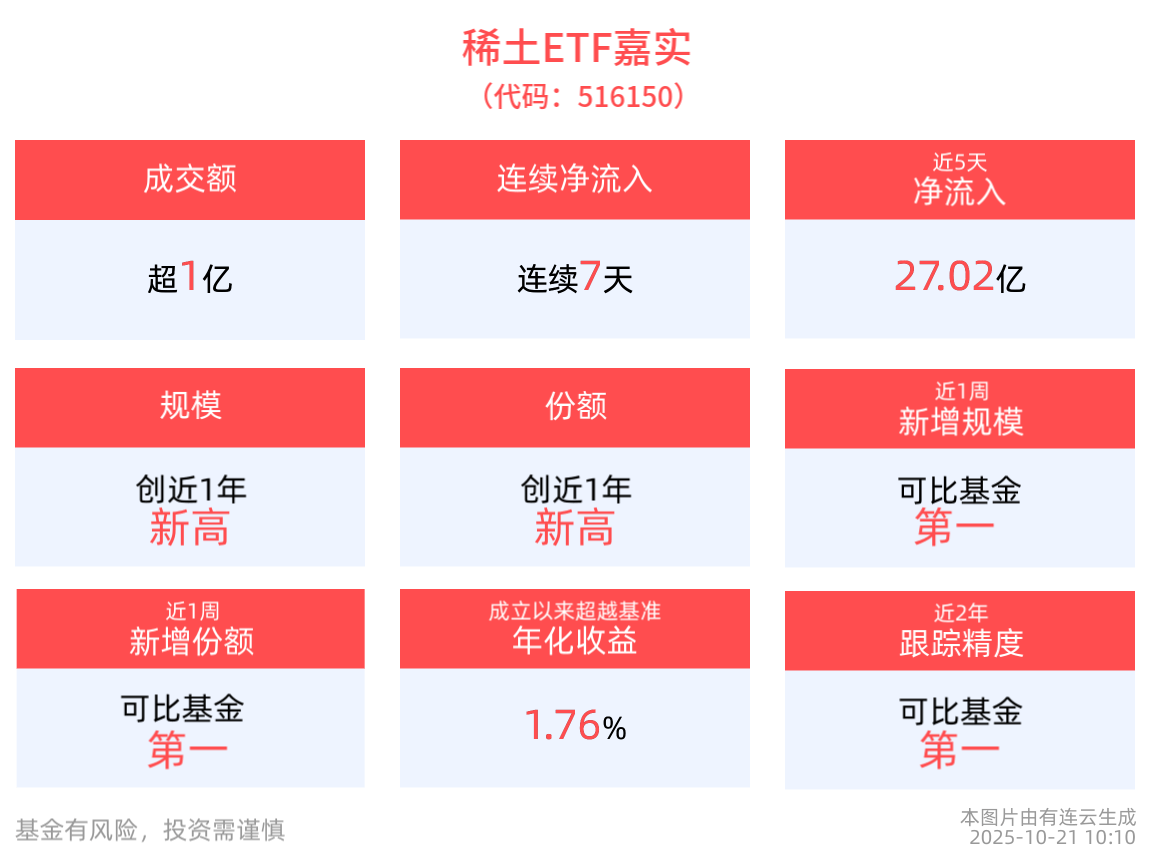
Group 1: Market Performance - The liquidity of the Rare Earth ETF managed by Jiashi has a turnover rate of 1.61%, with a transaction volume of 1.74 billion yuan [2] - The latest scale of the Rare Earth ETF reached 108.04 billion yuan, marking a new high since its establishment and ranking first among comparable funds [2] - The latest share count of the Rare Earth ETF is 6.034 billion shares, also a new high since its inception, and ranks first among comparable funds [2] - Over the past 7 days, the Rare Earth ETF has seen continuous net inflows, with a maximum single-day net inflow of 1.184 billion yuan, totaling 3.405 billion yuan [2] - As of October 20, the net value of the Rare Earth ETF has increased by 88.93% over the past two years, ranking 59th out of 2358 index equity funds, placing it in the top 2.50% [2] - The highest monthly return since the establishment of the Rare Earth ETF is 41.25%, with the longest consecutive monthly increase being 4 months and the longest increase percentage being 83.89% [2] Group 2: Industry Developments - On October 19, Tianhe Magnetic Materials announced plans to invest 850 million yuan in a project for high-performance rare earth permanent magnets and related equipment in Baotou City [3] - Northern Rare Earth and Baotou Steel announced an increase in rare earth prices for the fourth quarter of 2025 [3] - In September, the export of rare earths and related products reached 10,538 tons, a year-on-year increase of 7.6%, with a cumulative export of 95,875 tons from January to September, up 3.1% year-on-year [3] - The Ministry of Commerce of China issued two announcements on October 9 regarding rare earth export controls, indicating that products containing Chinese-origin rare earths valued at 0.1% or more may be subject to export restrictions [3] - The new regulations on rare earths are seen as a necessary response in the context of global supply chain competition, following similar measures for gallium and germanium [3] - It is recommended to focus on investment opportunities along the "resources + growth" dual lines, considering the potential impact of regional politics and export policies from major resource countries [3]



建信期货钢材日评-20251021
Jian Xin Qi Huo· 2025-10-21 01:49
Report Summary 1. Report Type and Date - Report type: Steel Daily Review [1] - Date: October 21, 2025 [2] 2. Research Team - Black Metal Research Team: Researchers include Zhai Hepan, Nie Jiayi, and Feng Zeren [3] 3. Market Conditions on October 20 3.1 Futures Market - **Prices and Trading Volume**: RB2601 closed at 3045 yuan/ton with a -0.03% change, trading 1,232,540 lots; HC2601 closed at 3215 yuan/ton with a -0.12% change, trading 539,570 lots; SS2512 closed at 12595 yuan/ton with a -0.16% change, trading 124,780 lots [5] - **Position Changes**: RB2601's open interest increased by 1,609 lots; HC2601's increased by 7,152 lots [5] - **Fund Flows**: RB2601 had a 0.15 - billion - yuan inflow; HC2601 had a 0.28 - billion - yuan inflow [5] 3.2 Spot Market - **Price Changes**: Some rebar and hot - rolled coil spot prices declined. Rebar prices in Nanjing and Hefei dropped 30 yuan/ton, and in other cities, 10 - 20 yuan/ton; hot - rolled coil prices in Zhengzhou dropped 30 yuan/ton, and in other cities, 10 - 20 yuan/ton [8] 3.3 Technical Indicators - Rebar 2601 contract's daily KDJ indicator showed a golden cross, and hot - rolled coil 2601's was close to a golden cross. Both contracts' daily MACD green bars narrowed [8] 4. Market Outlook 4.1 News and Policy - Trump's attitude towards China - US trade tariffs softened, which eased market concerns. He will meet with China in about two weeks and is optimistic about the negotiation. The US Treasury Secretary also said the meeting may lead to a broader trade agreement [9][10] 4.2 Fundamentals - **Supply and Demand**: In the past 6 weeks, the weekly output of five major steel products decreased slightly but remained high; weekly demand rebounded from the lowest since late February but was lower than the end - September level; social inventory of five major steel products decreased slightly from the highest since mid - April [10] - **Raw Materials**: In the past 2 weeks, iron ore inventories of 247 steel mills and imported sintered powder ore inventories of 64 sample steel mills dropped significantly; in the past 4 weeks, Australian and Brazilian iron ore shipments increased by 2.2% on top of a 3.7% increase in the previous 4 weeks, and arrivals increased by 11.9% after a 1.4% decrease in the previous 4 weeks; coke profit was briefly positive and then turned negative, and the first round of coke price increase was implemented on October 1; steel mills reduced coke inventories after the holiday; coking coal prices remained firm [11] 4.3 Forecast - Steel demand has seasonal improvement, but trade conflicts remain uncertain. Steel futures prices are expected to be more volatile, with a possible first - decline - then - rebound trend. Attention should be paid to market expectations before China - US trade negotiations, raw material prices after most steel mills' profits turn negative, and the impact of low temperatures on terminal demand [11] 5. Industry News - **Economic Growth**: The National Bureau of Statistics attributed the Q3 GDP growth slowdown to international trade protectionism and domestic economic structural adjustment [12] - **Policy Adjustment**: The Ministry of Finance, General Administration of Customs, and State Taxation Administration adjusted the VAT policy for wind power generation and nuclear power [13] - **Production Data**: From January to September 2025, national coke production was 377.16 million tons (up 3.5% YoY), pig iron production was 645.86 million tons (down 1.1% YoY), crude steel production was 746.25 million tons (down 2.9% YoY), and steel production was 1.10385 billion tons (up 5.4% YoY). In September, national coal production was 411.51 million tons (down 1.8% YoY), and industrial power generation was 826.2 billion kWh (up 1.5% YoY) [13] - **Real Estate**: From January to September 2025, national real estate development investment was 6.7706 trillion yuan (down 13.9% YoY), construction area was 6.4858 billion square meters (down 9.4% YoY), new commercial housing sales area was 658.35 million square meters (down 5.5% YoY), and sales volume was 6.304 trillion yuan (down 7.9% YoY) [13] - **Railway Transport**: In the first three quarters of 2025, national railway freight volume was 3.912 billion tons (up 2.8% YoY) [14] - **Corporate Performance**: Baotou Steel's semi - annual asset - liability ratio in 2025 decreased by 0.42 percentage points from the beginning of the year, and financial expenses decreased by 6.29% YoY [14] - **International Trade**: In September 2025, China exported 6.4 million tons of steel plates (down 6.1% YoY) and 1.68 million tons of steel bars (up 25.0% YoY). In September, the iron ore export volume of Port Hedland in Australia was 48.5673 million tons (down 0.48% YoY, up 9.58% MoM) [14] 6. Data Overview - The report presents various steel - related data charts, including prices, production, inventory, and capacity utilization, with data sources from Mysteel and the research and development department of CCB Futures [16][17][20]
净利增超160%,金力永磁首发三季报,新能源汽车业务领跑
Di Yi Cai Jing· 2025-10-20 13:17
Core Viewpoint - Jinli Permanent Magnet (300748.SZ) reported a significant increase in revenue and net profit for the first three quarters, indicating strong performance in the rare earth permanent magnet sector driven by rising demand and effective inventory management [1][2]. Company Performance - For the first three quarters, Jinli Permanent Magnet achieved a revenue of 5.373 billion yuan, a year-on-year increase of 7.16%, and a net profit attributable to shareholders of 515 million yuan, up 161.8% [1]. - The company attributed its performance to the rising prices of rare earth raw materials and effective inventory strategies, alongside the gradual release of new production capacity [1]. Product Sales and Market Demand - Sales of products related to new energy vehicles and automotive components increased by 23.46%, generating revenue of 2.615 billion yuan, accounting for nearly half of the total revenue [2]. - Sales in the energy-saving variable frequency air conditioning sector grew by over 18%, with revenue reaching 1.446 billion yuan [2]. - The company's overseas sales amounted to 942 million yuan, with exports to the United States reaching 354 million yuan, a nearly 44% increase year-on-year [2]. Industry Trends - The overall demand for rare earth materials is improving, with a favorable supply-demand dynamic emerging in the market [2]. - The Chinese government is enhancing its strategic control over the rare earth industry through quota management and export restrictions, ensuring resources are directed towards high-end applications [2]. - Global green transformation is driving demand for key rare earth elements, leading to rapid expansion in emerging applications such as permanent magnet materials [2]. Competitor Performance - Other leading companies in the rare earth sector, such as Northern Rare Earth (600111.SH) and Shenghe Resources (600392.SH), are also reporting significant profit increases, indicating a broader industry recovery [3].