上海家化

Search documents
3230.19万元资金今日流出美容护理股
Zheng Quan Shi Bao Wang· 2025-05-09 15:45
Market Overview - The Shanghai Composite Index fell by 0.30% on May 9, with seven industries experiencing gains, led by the beauty and personal care sector, which rose by 1.41% [1] - The electronic and computer sectors faced the largest declines, with drops of 2.07% and 1.96% respectively [1] Capital Flow Analysis - The main capital outflow from the two markets totaled 47.4 billion yuan, with only four industries seeing net inflows [1] - The textile and apparel industry had the highest net inflow, amounting to 226 million yuan, while the coal industry saw a modest increase of 0.10% with a net inflow of 18.6 million yuan [1] Beauty and Personal Care Sector - The beauty and personal care industry saw a rise of 1.41%, despite a net outflow of 32.3 million yuan in main capital [2] - Out of 31 stocks in this sector, 18 experienced gains, including one stock that hit the daily limit [2] - The top three stocks with net inflows were Beitaini (35.1 million yuan), Proya (23.1 million yuan), and Shuiyang (13.7 million yuan) [2][3] Notable Stocks in Beauty and Personal Care - Qingdao Kingking had the largest net outflow at 40.9 million yuan, followed by Runben (8.7 million yuan) and Kesi (8.4 million yuan) [2] - Other notable stocks with significant net outflows included Marubi (8.0 million yuan) and Aimeike (7.5 million yuan) [2] - The stock performance varied, with some stocks like Beitaini and Shuiyang showing strong gains, while others faced significant outflows [2][3]





美护、纺织服装25Q1板块表现总结:25Q1消费需求整体平稳,建议关注后续国家消费刺激政策
Hua Yuan Zheng Quan· 2025-05-09 13:16
Investment Rating - The industry investment rating is "Positive" (maintained) [4] Core Viewpoints - Overall consumer demand remains stable in Q1 2025, with a recommendation to pay attention to subsequent national consumption stimulus policies [4] - The beauty and personal care sector showed a mixed performance, with the personal care segment performing the best [9][10] - The textile and apparel sector maintained stable growth, with outdoor brands performing well [18][21] Summary by Relevant Sections Beauty and Personal Care Sector - In Q1 2025, the retail sales of cosmetics in China grew by 3.2% year-on-year, lower than the overall consumer goods retail sales growth of 4.6% [5][6] - The beauty sector's revenue and net profit reached 13.5 billion and 1.89 billion respectively, with year-on-year changes of +0.2% and -12.3% [9][10] - The cosmetics segment saw a revenue of 9.62 billion, down 3% year-on-year, and a net profit of 1.06 billion, down 20.7% [10] - The medical beauty segment's revenue was 2.43 billion, down 0.2%, with a net profit of 0.71 billion, down 0.5% [10] - The personal care segment achieved a revenue of 1.45 billion, up 29.4%, and a net profit of 0.13 billion, up 12.6% [10] Textile and Apparel Sector - The retail sales of clothing, shoes, hats, and textiles grew by 3.4% year-on-year in Q1 2025, below the overall consumer goods retail sales growth of 4.6% [13][18] - The textile and apparel sector's revenue and net profit saw year-on-year changes of +1.66% and -10.72% respectively [18] - The OEM segment's revenue grew by 13.02% year-on-year, while the brand segment's revenue decreased by 3.90% [19][21] - The home textile segment's revenue decreased by 3.98% year-on-year, with a net profit decline of 12.35% [21]
谷雨冲刺“美白第一股”,国产美妆品牌加速IPO是“求生存”还是“谋增长”?
3 6 Ke· 2025-05-09 12:34
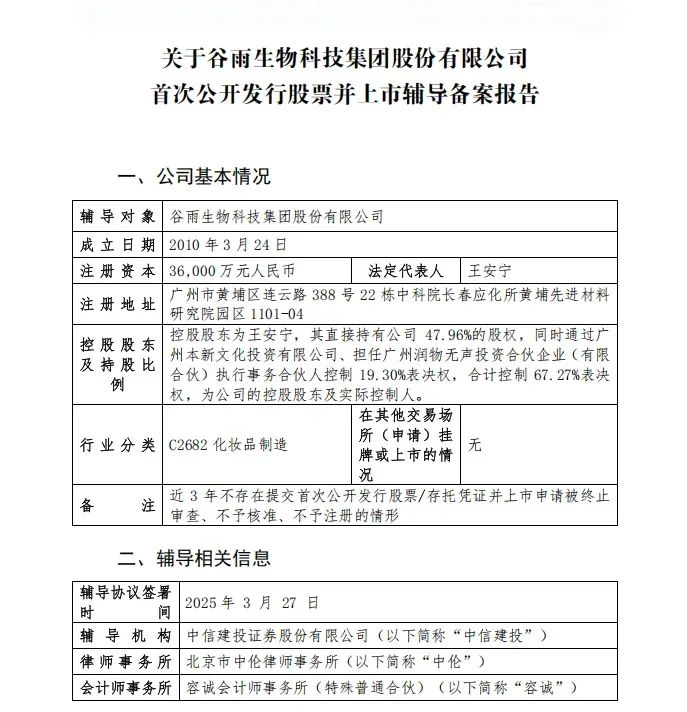
Core Viewpoint - The domestic skincare brand Gu Yu is set to launch its IPO process in A-shares, aiming to become the "first whitening stock" in the beauty market, despite facing challenges such as brand loyalty and high online sales ratio [1][3][25]. Company Overview - Gu Yu was established in March 2010 and has a registered capital of 36 million RMB. The company is headquartered in Guangzhou and is primarily engaged in cosmetics manufacturing [2]. - The company has shown rapid growth, with GMV reaching 10 billion RMB in 2010, and projected sales of 35 billion RMB in 2023 and over 50 billion RMB in 2024 [1][3]. Market Position - Gu Yu's sales growth positions it among leading domestic beauty brands, with competitors like Proya and Shiseido achieving significant revenue milestones [1][32]. - The brand's online sales ratio is projected to be 93% in 2024, indicating a heavy reliance on e-commerce channels [22]. Competitive Landscape - The domestic beauty market is experiencing intensified competition, with many brands accelerating their IPO processes as a survival strategy [25][26]. - Gu Yu has successfully leveraged various online platforms for marketing, including early adoption of live streaming on Taobao and collaborations with influencers on platforms like Xiaohongshu and Douyin [4][6]. Challenges and Risks - Despite its rapid growth, Gu Yu faces challenges such as insufficient brand loyalty, a lack of a diversified brand matrix, and the need to establish a stronger brand identity [3][14][20]. - The brand's reliance on a single product line and the potential for market saturation pose risks to its long-term sustainability [20][23]. Future Outlook - To succeed in the competitive landscape, Gu Yu must enhance its brand power and explore new product lines beyond its current offerings [20][30]. - The company aims to establish a more robust brand presence and diversify its product portfolio to mitigate risks associated with market fluctuations and consumer preferences [20][30].

2025年中国男士护肤品行业概览:细分市场崛起,解锁男性护肤新蓝海(精华版)
Tou Bao Yan Jiu Yuan· 2025-05-09 12:23
Investment Rating - The report does not explicitly provide an investment rating for the men's skincare industry in China. Core Insights - The men's skincare market in China is rapidly growing, with a market size of approximately 170 billion yuan in 2024, representing a year-on-year growth of 17%. It is projected to reach 292 billion yuan by 2029, indicating significant potential for expansion [4][35][36]. Summary by Sections Industry Overview - The skincare market in China is characterized by diversification, precision, and technological advancement. The market is expected to grow from approximately 3,635 billion yuan in 2024 to 4,337 billion yuan by 2028, driven by e-commerce innovations, technological advancements, and a growing demand for natural ingredients [3][29][31]. Men's Skincare Market Insights - The men's skincare market is expanding due to changing social perceptions and increasing awareness among men regarding skincare. The market is diversifying with a variety of products, and the demand for functional products is on the rise. The market is expected to see a significant increase in high-end products [4][35][36]. Market Size - The men's skincare market in China is projected to grow to approximately 170 billion yuan in 2024, with a year-on-year growth rate of 17%. The market is expected to reach 292 billion yuan by 2029, with significant growth in categories such as masks and sunscreens [4][35][36]. Product Efficacy - The primary focus of men's skincare products is on moisturizing, cleansing, and oil control. The market is evolving towards more specialized and personalized products, with innovations in technology and formulation [38][40]. Brand Performance - In the online sales channels for men's skincare, platforms like Taobao and Douyin lead in sales. While foreign brands dominate the market, domestic brands are experiencing rapid growth, indicating a potential shift in the competitive landscape [5][35]. Consumer Demographics - The consumer base for men's skincare products is diverse, with a significant portion of male consumers aged 18-35 developing systematic skincare habits. The market is also seeing a rise in demand from older male consumers for advanced skincare solutions [35][43][46]. Development Trends - The market is witnessing a trend towards younger consumers, with an increasing number of males starting to use skincare products at a younger age. The popularity of natural ingredients is also on the rise, driven by the values of the younger generation [52][56].
美容护理板块创两年新高,八大概念股盘点(名单)
Zheng Quan Zhi Xing· 2025-05-09 07:40
Group 1: Industry Overview - The beauty and personal care sector experienced a significant increase, with the index reaching a two-year high and the sector rising nearly 2% on May 9 [1] - Several companies within the sector reported notable growth in their financial performance, with leading company Proya (珀莱雅) achieving a revenue of 2.359 billion yuan, a year-on-year increase of 8.13%, and a net profit of 390 million yuan, up 28.87% [1] - Other companies in the sector, such as Nobon (诺邦股份), Qingsong (青松股份), and Jinbo (锦波股份), reported growth rates exceeding 50% in the first quarter [1] Group 2: Key Trends and Consumer Behavior - According to a report by Mintel, the trend of "Beauty in Body and Mind" is one of the three major trends influencing the global beauty and personal care industry in the coming years [2] - The rise of the "颜值经济" (beauty economy) and "悦己潮流" (self-pleasure trend) has led consumers to purchase functional skincare products, trendy makeup, and home fragrances for self-healing purposes [2] Group 3: Notable Companies in the Sector - Proya focuses on the research, production, and sales of cosmetic products, with brands including "Proya," "Caitang," "Off&Relax," and "Yuefuti" [2] - Shanghai Jahwa (上海家化) specializes in the research, production, and sales of daily chemical products, including personal care and beauty products [2] - Furuida (福瑞达) has transitioned into the health industry through acquisitions, creating a full industry chain from hyaluronic acid raw materials to products [2] - Huaxi Biological (华熙生物) is a leading high-tech enterprise in the production of hyaluronic acid through microbial fermentation technology [2] - Betaini (贝泰妮) operates a subsidiary focused on medical beauty services, including laser and micro-needle treatments [2] - Shuiyang (水羊股份) has launched a light medical beauty brand, primarily sold through online platforms [2] - Nobon produces water-jet non-woven materials used in beauty care, industrial materials, and medical supplies [2] - Marubi (丸美生物) specializes in the research, design, production, and sales of cosmetics, focusing on eye care, skincare, and cleansing products [2]

2025 美妆行业拐点已至?高盛:这两大龙头最值得关注
Zhi Tong Cai Jing· 2025-05-09 07:36
中国化妆品行业2024/2025总结:需求与竞争态势趋稳,年初至今的估值重估已反映中期趋势;买入巨子 生物、上海家化(600315) 与高盛2025年的展望相符,中国美妆行业在2024年呈现出触底迹象,随后在2025年有所改善。需求从同 比负增长转为持平,竞争也变得更加理性,这在妇女节期间表现得尤为明显。 特别是2025年第一季度,中国内地市场销售额同比增长3.2%,高于高盛预期的全年内地市场需求增长 率1.2%。不过,这一增长被DFS渠道的滞后表现所抵消,韩国/海南地区的DFS渠道销售额同比分别下 降23%/11%,而高盛预期的全年美妆门店需求增长率为2.9%。 这就解释了为什么尽管美妆行业业绩表现并不突出(价格指数上涨31%,而MSCI中国指数仅上涨12%), 但年初至今该行业表现优异,这得益于50%的估值重估(12个月预期市盈率从下行周期的20倍升至30 倍),以及盈利基数滚动至2025年。同时,根据高盛共识数据,2025年预期盈利平均下调了11%。 高盛覆盖的中国化妆品公司2024/2025年业绩喜忧参半,除巨子生物外,其他公司销售额均未达预期, 但部分公司(如珀莱雅(603605)、上海家化)通过强 ...
天津市北辰区市场监管局发布2024年儿童及婴幼儿服装、儿童洗手液、中小学生校服3种产品抽查结果
Zhong Guo Zhi Liang Xin Wen Wang· 2025-05-08 08:40
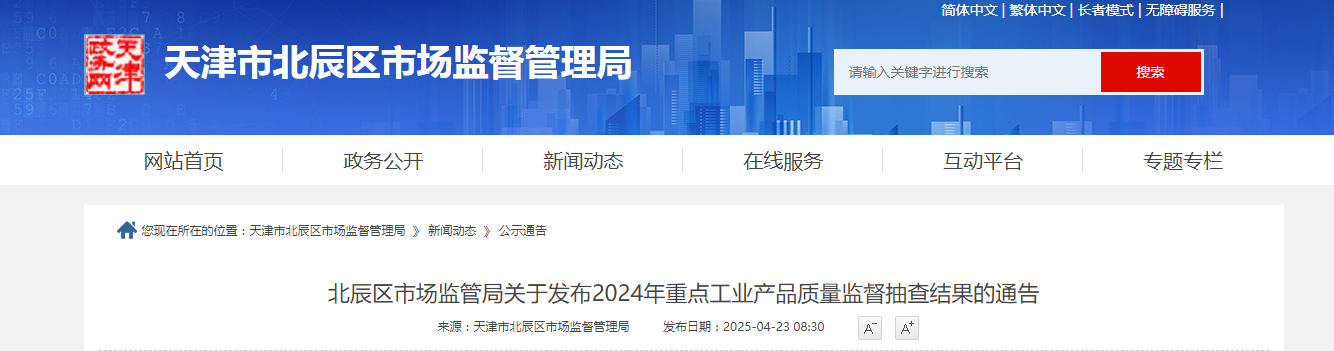
Core Viewpoint - The Tianjin Beichen District Market Supervision Administration has released the results of the 2024 quality supervision sampling inspection for key industrial products, indicating that all 47 batches of children's and infant clothing, children's hand sanitizers, and school uniforms passed inspection [3]. Group 1: Product Categories - Children's and infant clothing, children's hand sanitizers, and school uniforms are the three product categories inspected [3]. - A total of 47 batches of products were tested, and all were found to be compliant with quality standards [3]. Group 2: Inspection Results - The inspection results show that all tested products from various companies met the quality requirements, indicating a high level of compliance in the market [3]. - Specific brands and products listed in the inspection include items from companies such as Yilalal Group, Guirenniao Co., and Li Ning Sports, all of which received passing grades [4][5].
上海家化:主动调整24年业绩承压,25Q1企稳,静待改善-20250508
China Post Securities· 2025-05-08 08:23
Investment Rating - The report maintains a "Buy" rating for the company [8][14]. Core Views - The company faced significant challenges in 2024, with a revenue decline of 13.9% year-on-year, resulting in a net loss of 833 million yuan, primarily due to goodwill impairment in overseas operations and strategic adjustments in its core business [3][4]. - In Q1 2025, the company showed signs of stabilization with a revenue of 1.704 billion yuan, down 10.6% year-on-year, and a net profit of 217 million yuan, indicating a sequential improvement [3][4]. - The company is undergoing various adjustments in organizational structure, brand strategy, product innovation, and channel operations, with expectations for continued improvement in performance [6]. Company Overview - The latest closing price is 24.10 yuan, with a total market capitalization of 16.2 billion yuan [2]. - The company has a total share capital of 672 million shares, with an asset-liability ratio of 32.7% [2]. Financial Performance - In 2024, the personal care segment generated 2.38 billion yuan in revenue, a decrease of 3.42% year-on-year, while the beauty segment saw a significant decline of 29.81% to 1.05 billion yuan [4]. - The company’s online channel revenue was 2.54 billion yuan, down 9.7%, while offline channel revenue fell 17% to 3.14 billion yuan [5]. - The company has implemented a stock incentive plan for 2025, aiming to align the interests of key employees with the company's long-term growth [5]. Earnings Forecast - The company is projected to achieve net profits of 310 million yuan, 390 million yuan, and 480 million yuan for the years 2025, 2026, and 2027, respectively, with corresponding PE ratios of 52x, 42x, and 34x [6][10].
上海家化(600315):主动调整24年业绩承压,25Q1企稳,静待改善
China Post Securities· 2025-05-08 07:37
Investment Rating - The report maintains a "Buy" rating for the company, expecting a relative increase in stock price of over 20% compared to the benchmark index within six months [8][14]. Core Views - The company faced significant challenges in 2024, with a reported revenue of 5.679 billion yuan, a year-on-year decrease of 13.9%, and a net profit attributable to shareholders of -833 million yuan, a decline of 266.6% [3][6]. - In Q1 2025, the company showed signs of stabilization with a revenue of 1.704 billion yuan, down 10.6% year-on-year, and a net profit of 217 million yuan, down 15.3% year-on-year [3][4]. - The report highlights a strategic shift in the company's operations, focusing on improving product lines and enhancing online sales channels while reducing inventory in offline channels [5][6]. Company Overview - The latest closing price of the company's stock is 24.10 yuan, with a total market capitalization of 16.2 billion yuan [2]. - The company has a total share capital of 672 million shares, all of which are circulating [2]. Financial Performance - In 2024, the personal care segment generated 2.38 billion yuan in revenue, a decrease of 3.42% year-on-year, while the beauty segment saw a significant drop of 29.81% to 1.05 billion yuan [4]. - The company is undergoing adjustments in its organizational structure, brand strategy, product innovation, and channel operations, with expectations for continued improvement in 2025 [6][10]. Profit Forecast - The forecast for net profit attributable to shareholders for 2025 is 310 million yuan, with expected growth rates of 137.4% in 2026 and 23.6% in 2027 [10][11]. - The projected earnings per share (EPS) for 2025 is 0.46 yuan, improving to 0.57 yuan in 2026 and 0.71 yuan in 2027 [10][11].
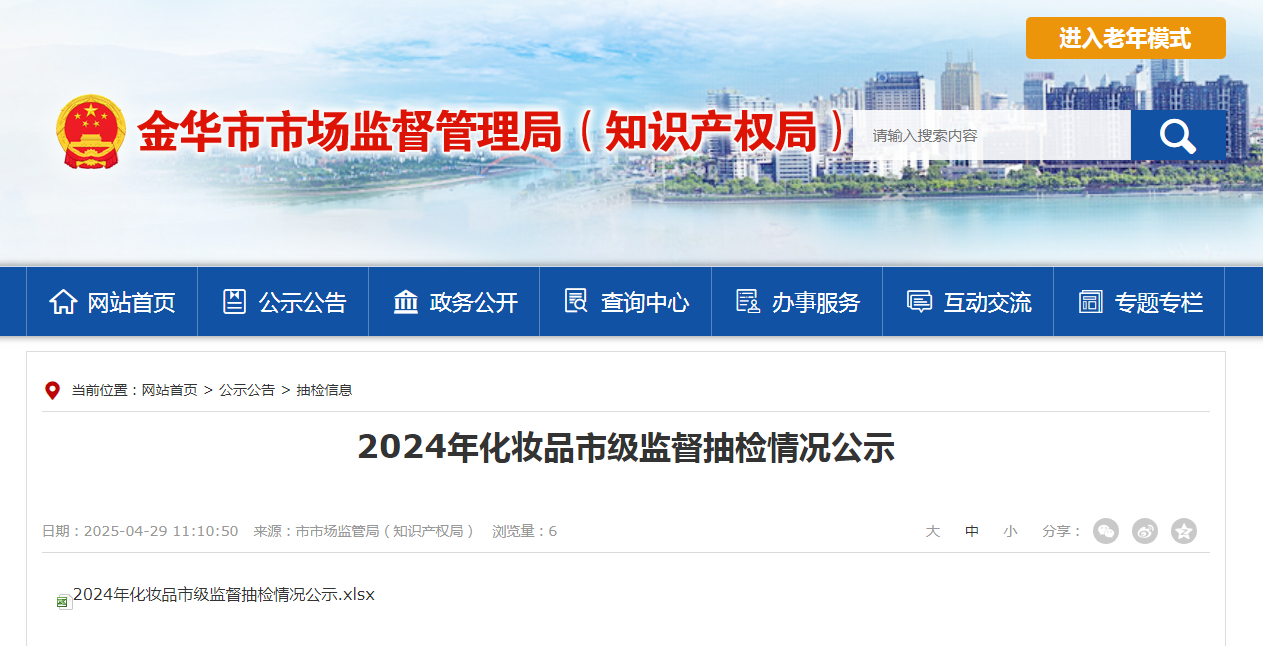
浙江省金华市市场监督管理局公示2024年化妆品市级监督抽检情况
Zhong Guo Zhi Liang Xin Wen Wang· 2025-05-07 02:53
Group 1 - The Zhejiang Jinhua Market Supervision Administration has announced the results of the 2024 cosmetic city-level supervision sampling inspection [3][4]. - The inspection covers various cosmetic products from multiple manufacturers, indicating a regulatory effort to ensure product safety and compliance [4][5]. Group 2 - The inspection results include a list of products, their manufacturers, and the sampling details, which reflect the ongoing monitoring of cosmetic quality in the region [4][6]. - Notable brands such as Mentholatum, Unilever, and Oushiman are included in the sampling, showcasing the involvement of major players in the cosmetic industry [4][5][6].